

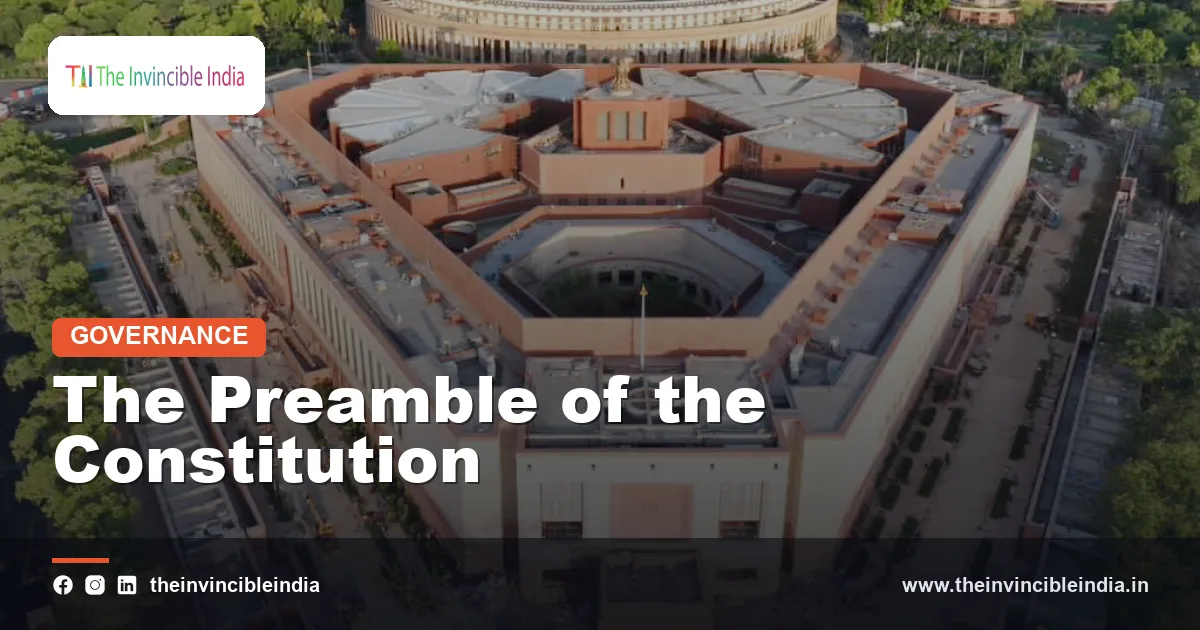
The Preamble is the short, solemn passage that opens the Constitution of India. In barely a hundred words it announces who is making the Constitution, what kind of country is being created, and which ideals the new republic promises to pursue. Jurists and commentators have called it the “identity card” and the “soul” of the Constitution, because every article that follows can be traced back to the vision it states.
Unlike the detailed Parts, Schedules and Articles, the Preamble does not create offices or hand out powers. Instead it explains why the Constitution exists. Understanding its text, its keywords, its history and the court cases that defined its legal status is one of the best ways to understand Indian democracy itself. This guide walks through all of it in plain language.
| Quick Facts | Details |
|---|---|
| What it is | The introductory statement of the Constitution of India |
| Opens with | “We, the people of India” |
| Source of inspiration | The Objectives Resolution moved by Jawaharlal Nehru on 13 December 1946 |
| Date mentioned in the text | 26 November 1949, the day the Constitution was adopted |
| Constitution came into force | 26 January 1950 |
| Words added later | “Socialist”, “Secular” and “integrity”, by the 42nd Amendment (1976) |
| Landmark ruling on its status | Kesavananda Bharati v. State of Kerala (1973): part of the Constitution |
| Enforceable in court? | No, but it guides interpretation |
What Is the Preamble and Why Does It Matter?
A preamble is an introduction placed before the operative part of a legal document. Many constitutions have one, but the Indian Preamble has acquired a special place in public life. It is read aloud in schools, printed at the start of every authorised copy of the Constitution and quoted in countless court judgments.
Its importance lies in the fact that it condenses the philosophy of the whole document into a single sentence. When a reader wants to know whether India is a monarchy or a republic, whether it favours one religion, or whether citizens are promised only legal rights or also a measure of social fairness, the Preamble answers in a few lines.
Why it is called the identity card
- It names the source of authority: the people of India.
- It describes the nature of the State: sovereign, socialist, secular, democratic and republic.
- It lists the aims of the State: justice, liberty, equality and fraternity.
- It records the date on which the Constituent Assembly adopted the Constitution.
Constitutional scholars have used phrases such as the “keynote” and “horoscope” of the Constitution for it. The images differ, but the idea is the same: the Preamble tells you what the rest of the Constitution is trying to achieve.
The Text of the Preamble
The Preamble in its present form, after the 1976 changes, reads as follows.
“WE, THE PEOPLE OF INDIA, having solemnly resolved to constitute India into a SOVEREIGN SOCIALIST SECULAR DEMOCRATIC REPUBLIC and to secure to all its citizens: JUSTICE, social, economic and political; LIBERTY of thought, expression, belief, faith and worship; EQUALITY of status and of opportunity; and to promote among them all FRATERNITY assuring the dignity of the individual and the unity and integrity of the Nation; IN OUR CONSTITUENT ASSEMBLY this twenty-sixth day of November, 1949, do HEREBY ADOPT, ENACT AND GIVE TO OURSELVES THIS CONSTITUTION.”
The original Preamble of 1949 was almost identical, with two differences. India was described as a “Sovereign Democratic Republic”, and fraternity assured “the unity of the Nation”. The words “Socialist”, “Secular” and “integrity” were inserted in 1976.
The structure of the Preamble
Grammatically the Preamble is one long sentence, but it is carefully organised. Although it is short, the Preamble is carefully organised. Reading it part by part makes its logic clear.
- The source of authority: “We, the people of India” establishes that the Constitution does not come from a king, a foreign power or a political party. Sovereignty rests with the people, who act through their representatives in the Constituent Assembly.
- The nature of the State: The phrase “sovereign socialist secular democratic republic” declares what kind of political system India is.
- The objectives: Justice, liberty, equality and fraternity are the goals the State is to secure or promote for all citizens.
- The date and act of adoption: The closing lines record the date, 26 November 1949, and the act by which the people “adopt, enact and give to ourselves” the Constitution.
The verbs are worth noticing. The people “secure” justice, liberty and equality, which are treated as rights to be guaranteed, while they “promote” fraternity, which is a value that grows through shared effort rather than being enforced by law.
Where the Preamble Came From: The Objectives Resolution
The roots of the Preamble lie in the Objectives Resolution, moved by Jawaharlal Nehru in the Constituent Assembly on 13 December 1946. The Assembly had held its first sitting only a few days earlier, on 9 December 1946, and Dr Rajendra Prasad later became its permanent president.
Nehru’s resolution declared the Assembly’s resolve to proclaim India an independent sovereign republic and to draw up a Constitution in which all power and authority would be derived from the people. It promised justice, equality of status and opportunity, and freedom of thought, expression, belief, faith, worship and association, along with safeguards for minorities, backward and tribal areas and depressed classes. The Assembly adopted the resolution on 22 January 1947.
Drafted last, placed first
The Assembly decided to take up the Preamble only after the rest of the Constitution had been settled, so that it would reflect the finished document faithfully. It was adopted in October 1949 and then placed at the front. The Drafting Committee, chaired by Dr B. R. Ambedkar, worked on the language, drawing on the Objectives Resolution.
Ideas from many traditions
- The opening words “We, the people” echo the American Constitution, though the Indian text builds on its own freedom struggle.
- Liberty, equality and fraternity recall the slogans of the French Revolution.
- The idea of justice in social, economic and political terms reflects the concern for social reform that ran through the national movement, including the Gandhian and Ambedkarite traditions.
The Keywords Explained: Sovereign, Socialist, Secular, Democratic, Republic
The five words that describe the State are the most quoted part of the Preamble. The table below summarises each one.
| Keyword | Meaning | Where it shows up in the Constitution |
|---|---|---|
| Sovereign | India is internally and externally supreme and independent, free from control by any foreign power. | Power to make laws, conduct foreign policy and decide on war and peace (Union List) |
| Socialist | The State works to reduce inequality and ensure fair distribution of wealth and opportunity. Added in 1976. | Directive Principles, such as Articles 38 and 39 |
| Secular | The State has no official religion and treats all faiths with equal respect. Added in 1976. | Articles 14, 15, 16 and 25 to 28 |
| Democratic | Authority comes from the people, who choose their governments through free and fair elections. | Universal adult suffrage under Article 326; Article 324 on the Election Commission |
| Republic | The head of State is elected, not hereditary. | Election of the President under Article 54 |
Sovereign and republic
“Sovereign” means that no outside authority can dictate India’s laws or policies. India chose to remain in the Commonwealth, but as a voluntary association of equals, not a constitutional subordination. “Republic” means the head of State, the President, is chosen through an election by an electoral college and holds office for a fixed term. No one holds the office by birth.
Democratic
India’s democracy is both political and, in aspiration, social. The framers extended the vote to every adult citizen at the very beginning, which was a bold step in a country with deep inequalities and low literacy at the time. Ambedkar warned that political democracy would be fragile unless it rested on social democracy.
Socialist and Secular: Words Added in 1976
Two of the five keywords were not in the original text. The 42nd Amendment Act, 1976, passed during the Emergency, inserted “Socialist” and “Secular” between “Sovereign” and “Democratic”, and changed “unity of the Nation” to “unity and integrity of the Nation”.
What “socialist” means in India
Indian socialism has not meant total state ownership. The Constitution’s economic vision, found mainly in the Directive Principles, calls for a welfare state that prevents concentration of wealth, secures adequate livelihood and protects workers. The Supreme Court has described it as democratic socialism, compatible with a mixed economy in which public and private sectors coexist.
What “secular” means in India
Indian secularism does not erect a wall between religion and State as in some Western models. Instead, the State keeps a principled distance from every religion, guarantees freedom of conscience and the right to profess, practise and propagate religion under Article 25, and forbids discrimination on grounds of religion. Even before 1976 these protections were already present in the Fundamental Rights. In S. R. Bommai v. Union of India (1994), the Supreme Court held secularism to be part of the Constitution’s basic structure.
The 1976 words therefore made explicit what was already implicit in the document. Challenges to their inclusion have been brought before the Supreme Court, which has declined to disturb them.
The Four Great Objectives: Justice, Liberty, Equality, Fraternity
After describing the State, the Preamble lists what it must deliver to its citizens.
Justice: social, economic and political
- Social justice means ending discrimination based on caste, religion, gender or birth. Article 17 abolishes untouchability, and Articles 15 and 16 allow special provisions for disadvantaged groups.
- Economic justice means fair access to resources and livelihood, reflected in the Directive Principles on equal pay, adequate means of livelihood and the avoidance of concentration of wealth.
- Political justice means equal political rights: one person, one vote, and equal access to public office.
Liberty
The Preamble promises liberty of thought, expression, belief, faith and worship. These freedoms are developed in Articles 19 to 22 and 25 to 28. Notably, the Preamble does not speak of unlimited liberty. The Constitution allows reasonable restrictions in the interest of public order, decency, security and sovereignty.
Equality
Equality of status and of opportunity is spelled out in Articles 14 to 18, which guarantee equality before the law, prohibit discrimination, ensure equal opportunity in public employment and abolish titles. The Preamble’s wording is careful: it does not promise identical outcomes, but equal chances to rise.
Fraternity
Fraternity, borrowed from the French ideal of brotherhood, is meant to bind a very diverse population together. It has two goals stated in the text: the dignity of the individual, and the unity and integrity of the Nation. Article 51A(e), one of the Fundamental Duties, asks citizens to promote harmony and the spirit of common brotherhood among all the people of India.
Dignity of the individual and unity and integrity of the Nation
These two phrases are attached to fraternity and show how the framers balanced the person and the nation. They recognised that India could not survive as a country unless its citizens felt respected, and that individual freedom could not flourish without a stable, united State.
Dignity of the individual. The Supreme Court has repeatedly read dignity into the right to life under Article 21, holding that life means more than bare survival. Dignity underlies the Court’s reasoning in cases on prisoners’ rights, bonded labour, privacy and equality.
Unity and integrity. The original Preamble spoke of the “unity of the Nation”. The 1976 Amendment added “integrity”, stressing that the territorial wholeness of India is as important as the sentiment of unity. This theme echoes in provisions about the Union of States, such as Article 1, which describes India as a Union that cannot be broken up by the withdrawal of a State.
The Date in the Preamble: 26 November 1949
The Preamble states that the Constituent Assembly adopted, enacted and gave the Constitution to the people “this twenty-sixth day of November, 1949”. That is the date on which the Assembly finished its work on the text. It is observed as Constitution Day, or Samvidhan Divas, in India.
The date is not the same as Republic Day. The Constitution came into full force on 26 January 1950, chosen because it recalled the Purna Swaraj declaration of 26 January 1930. A few provisions, such as those on citizenship and elections, took effect at once on 26 November 1949. Members of the Assembly signed the final document on 24 January 1950.
| Date | Milestone |
|---|---|
| 9 December 1946 | Constituent Assembly meets for the first time |
| 13 December 1946 | Nehru moves the Objectives Resolution |
| 22 January 1947 | Objectives Resolution adopted |
| 26 November 1949 | Constitution adopted; date recorded in the Preamble |
| 26 January 1950 | Constitution comes into force |
| 1976 | 42nd Amendment alters the Preamble |
Is the Preamble Part of the Constitution, and Can It Be Amended?
The Preamble has no operative force, so lawyers long debated whether it was truly part of the Constitution. The Supreme Court answered the question twice, with opposite results.
In re Berubari Union (1960)
The Berubari case arose from a presidential reference about transferring a territory to Pakistan under an agreement between the two countries. Here the Court said that the Preamble is a key to the minds of the framers and can help in understanding obscure provisions, but it is not a part of the Constitution. It also observed that the Preamble is not a source of power or a limitation on powers.
Kesavananda Bharati v. State of Kerala (1973)
A thirteen-judge Bench reconsidered the matter and reached the opposite view. The Court held that the Preamble is part of the Constitution. It reasoned that the Preamble was adopted by the Constituent Assembly after the main body, as a deliberate part of the final document, and that it contains the basic purposes the framers wanted the Constitution to serve. The Berubari view was therefore overruled on this point.
Later confirmation
The Court has repeated this position in later decisions, including S. R. Bommai (1994) and a case involving the Life Insurance Corporation of India (1995). Today it is settled that the Preamble is an integral part of the Constitution.
Can the Preamble be amended?
If the Preamble is part of the Constitution, can Parliament change it? Kesavananda Bharati provided the answer: yes, it can be amended under Article 368, but only so long as the basic structure of the Constitution is not altered.
The 1976 change in practice
This is exactly what happened in 1976. The 42nd Amendment added “Socialist”, “Secular” and “integrity”, and the Preamble has never been amended on any other occasion. Because those additions were consistent with ideals already present in the Constitution, they did not destroy its basic structure.
Limits on amendment
- Parliament cannot use Article 368 to remove a feature that forms the basic structure, such as democracy, the republican form of government, secularism, federalism or judicial review.
- The date “26 November 1949” cannot sensibly be altered, as it records a historical event.
- Any change must follow the procedure set out in Article 368, including the required special majority.
This balance lets the Constitution adapt to changing times while protecting its core identity from being rewritten by a passing majority.
The Preamble as a Tool of Interpretation and the Basic Structure
Although it cannot be enforced as a right, the Preamble plays a quiet but powerful role in court. Judges turn to it when the words of an Article are unclear or capable of more than one meaning, choosing the reading that best fits the goals of justice, liberty, equality and fraternity.
What it can and cannot do
- It can illuminate the meaning of an ambiguous provision.
- It can help identify features of the basic structure, such as democracy and secularism.
- It cannot override a clear provision of the Constitution.
- It cannot by itself give rise to a legal claim, as it is not enforceable in a court of law.
Link with the basic structure doctrine
The basic structure doctrine, formulated in Kesavananda Bharati, holds that certain essential features of the Constitution lie beyond Parliament’s amending power. Many of these features, including sovereignty, democracy, the republican form of government, secularism, equality and the unity of the nation, appear in the Preamble. In that sense the Preamble is a ready reference for identifying what the framers regarded as non-negotiable.
The Philosophy of the Preamble and Why It Still Matters
The Preamble reflects a distinctive blend of ideas. It combines liberal democracy, with its stress on individual liberty and equal rights, with a commitment to social justice and welfare shaped by the realities of a society marked by poverty and hierarchy. It also reflects the experience of the freedom struggle, in which Indians of every faith and region took part.
Three enduring lessons
- Power belongs to the people. Every government, legislature and court draws its authority from the Constitution the people gave themselves.
- Freedom and fairness go together. Liberty without equality, or equality without liberty, would each be incomplete.
- Unity in diversity. Fraternity treats the dignity of the person and the integrity of the nation as mutually supporting ideals.
Many citizens meet the Preamble for the first time in school, and it is often recited on Republic Day and Constitution Day. Its value is not only ceremonial. Whenever citizens, courts or lawmakers debate a new law, they implicitly measure it against the promises of justice, liberty, equality and fraternity made in 1949.
Conclusion
The Preamble is the shortest part of the Constitution and arguably the most revealing. It tells us that India’s Constitution is the work of its people, that the State is sovereign, socialist, secular, democratic and republic, and that its purpose is to secure justice, liberty and equality while promoting fraternity. Court rulings from Berubari to Kesavananda Bharati have fixed its legal status as part of the Constitution, amendable but never at the cost of the basic structure. Reading it closely is the first step in understanding how India governs itself.
Frequently Asked Questions
What is the Preamble of the Indian Constitution?
The Preamble is the introductory statement of the Constitution. It begins with “We, the people of India” and declares India a sovereign, socialist, secular, democratic republic committed to justice, liberty, equality and fraternity. It is often called the identity card of the Constitution.
Which words were added to the Preamble by the 42nd Amendment?
The 42nd Amendment Act, 1976, added the words “Socialist” and “Secular” to the description of India, and changed “unity of the Nation” to “unity and integrity of the Nation”. This is the only time the Preamble has been amended.
Where did the idea of the Preamble come from?
It is based on the Objectives Resolution moved by Jawaharlal Nehru in the Constituent Assembly on 13 December 1946 and adopted on 22 January 1947. The Assembly later adopted the Preamble itself after finishing the main text of the Constitution.
Is the Preamble a part of the Constitution?
Yes. In In re Berubari Union (1960), the Supreme Court said it was not, but in Kesavananda Bharati v. State of Kerala (1973) a larger Bench held that it is an integral part of the Constitution. This view has been followed since.
Can the Preamble be amended?
Yes, under Article 368, but Parliament cannot change the basic structure of the Constitution. The 1976 amendment is the only occasion on which it has been altered.
What does the date 26 November 1949 in the Preamble signify?
It marks the day the Constituent Assembly adopted, enacted and gave the Constitution to the people of India. The Constitution came into full force later, on 26 January 1950, which is celebrated as Republic Day.
{“@context”:”https://schema.org”,”@graph”:[{“@type”:”FAQPage”,”mainEntity”:[{“@type”:”Question”,”name”:”What is the Preamble of the Indian Constitution?”,”acceptedAnswer”:{“@type”:”Answer”,”text”:”The Preamble is the introductory statement of the Constitution. It begins with “We, the people of India” and declares India a sovereign, socialist, secular, democratic republic committed to justice, liberty, equality and fraternity. It is often called the identity card of the Constitution.”}},{“@type”:”Question”,”name”:”Which words were added to the Preamble by the 42nd Amendment?”,”acceptedAnswer”:{“@type”:”Answer”,”text”:”The 42nd Amendment Act, 1976, added the words “Socialist” and “Secular” to the description of India, and changed “unity of the Nation” to “unity and integrity of the Nation”. This is the only time the Preamble has been amended.”}},{“@type”:”Question”,”name”:”Where did the idea of the Preamble come from?”,”acceptedAnswer”:{“@type”:”Answer”,”text”:”It is based on the Objectives Resolution moved by Jawaharlal Nehru in the Constituent Assembly on 13 December 1946 and adopted on 22 January 1947. The Assembly later adopted the Preamble itself after finishing the main text of the Constitution.”}},{“@type”:”Question”,”name”:”Is the Preamble a part of the Constitution?”,”acceptedAnswer”:{“@type”:”Answer”,”text”:”Yes. In In re Berubari Union (1960), the Supreme Court said it was not, but in Kesavananda Bharati v. State of Kerala (1973) a larger Bench held that it is an integral part of the Constitution. This view has been followed since.”}},{“@type”:”Question”,”name”:”Can the Preamble be amended?”,”acceptedAnswer”:{“@type”:”Answer”,”text”:”Yes, under Article 368, but Parliament cannot change the basic structure of the Constitution. The 1976 amendment is the only occasion on which it has been altered.”}},{“@type”:”Question”,”name”:”What does the date 26 November 1949 in the Preamble signify?”,”acceptedAnswer”:{“@type”:”Answer”,”text”:”It marks the day the Constituent Assembly adopted, enacted and gave the Constitution to the people of India. The Constitution came into full force later, on 26 January 1950, which is celebrated as Republic Day.”}}]}]}


