

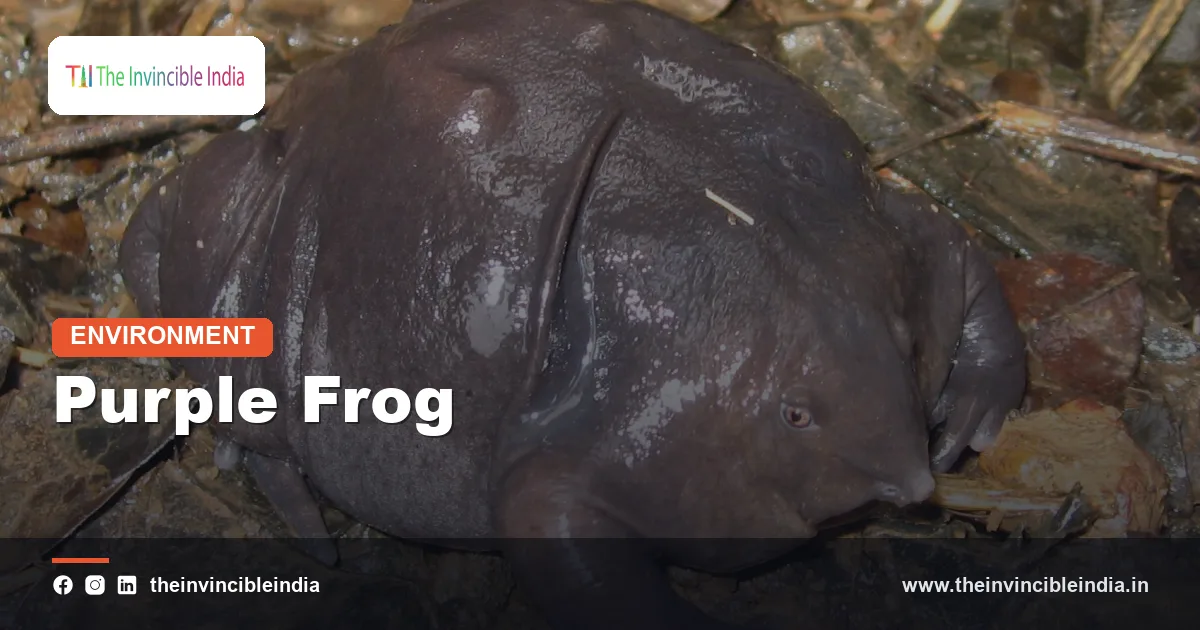
The purple frog (Nasikabatrachus sahyadrensis) is a stout, burrowing amphibian found only in the Western Ghats of southern India, and it is often called a living fossil because it belongs to a lineage that split from all other frogs many millions of years ago. The animal spends almost its entire life underground and comes to the surface for only about two weeks each year, when the heavy pre-monsoon and monsoon rains trigger its breeding burst.
Known in Kerala as the Maveli frog, the purple frog was formally described to science only in 2003, even though local farmers had long been aware of it. Its odd body, ancient ancestry, short breeding window and very small range have made purple frog conservation in India a flagship case for protecting the biodiversity of the Western Ghats.
| Attribute | Detail |
|---|---|
| Scientific name | Nasikabatrachus sahyadrensis |
| Common names | Purple frog, pignose frog, Maveli frog (Kerala) |
| Family | Nasikabatrachidae, a family containing only this genus |
| Formally described | 2003, by S. D. Biju and Franky Bossuyt |
| Range | Western Ghats of Kerala and Tamil Nadu, mostly on the southern and central Ghats |
| Typical size | Adults roughly 7 to 9 cm long, with females generally larger than males |
| IUCN Red List status | Endangered |
| Closest living relatives | The Sooglossidae frogs of the Seychelles islands |
| Surface activity | About two weeks a year, tied to monsoon breeding |
Key Takeaways
- The purple frog (Nasikabatrachus sahyadrensis) is a burrowing amphibian that lives only in the Western Ghats of Kerala and Tamil Nadu.
- The purple frog was scientifically described in 2003 and was placed in its own family, Nasikabatrachidae, because it differs so sharply from other frogs.
- The closest living relatives of the purple frog are the Sooglossidae frogs of the Seychelles, a link that reflects the ancient breakup of the Gondwana supercontinent.
- Adult purple frogs spend most of the year underground feeding on termites and come to the surface for only about two weeks during monsoon breeding.
- The International Union for Conservation of Nature (IUCN) lists the purple frog as Endangered because its habitat is small, fragmented and shrinking.
- Protecting purple frog habitat in India depends on safeguarding streams, forest soil and the edges of plantations in the Western Ghats.
What Is the Purple Frog?
The purple frog is a plump, dark-bodied burrowing frog with a tiny pointed head, short strong limbs and a snout that has a small, pig-like appearance, which is why it is also called the pignose frog. Its skin ranges from dark brown to a deep purplish shade, often with a paler bluish tint on the underside and around the eyes.
The body is bloated and round compared with most frogs, and the legs are short and sturdy rather than long and springy. Adults reach roughly 7 to 9 cm in length, although sizes vary and females are usually bigger than males. The shape is an adaptation for digging, not for leaping, and the frog moves through soil more than it hops over the forest floor.
The purple frog has a specialised mouth and tongue suited to picking up termites and ants from underground tunnels, rather than the long tongue flick used by many surface-dwelling frogs. A narrow, pointed head allows it to push through loose soil, and strong forelimbs help it dig. Biologists treat these features as evidence of a long period of evolution in a hidden, subterranean niche.
Why Is the Purple Frog Called a Living Fossil?
The purple frog is called a living fossil because it is the only surviving member of a very old frog lineage that has changed relatively little in form while related groups disappeared. The lineage is thought to have separated from other frog families many tens of millions of years ago, possibly in the Cretaceous period when dinosaurs still existed.
Researchers who studied the genetics of the species in the early 2000s placed it in a separate family and argued that its closest relatives were not in India at all but in the Seychelles. Estimates of the exact age of the split differ between studies, and newer dating methods have refined the figures, so it is safest to say the lineage is ancient, with a divergence reaching back well over 60 million years and perhaps much more.
The term living fossil is a popular label, not a strict scientific category. It does not mean the purple frog has stopped evolving. It means the species belongs to an old branch with few close relatives, which gives it unusual value for studies of how frogs, continents and climates are connected.
What Is the Seychelles Connection?
The Seychelles connection is the finding that the purple frog is most closely related to the tiny Sooglossidae frogs that live on the Seychelles islands in the western Indian Ocean, thousands of kilometres from the Western Ghats. This pairing supports the idea that the ancestors of both groups lived together on a single landmass long ago.
That landmass was part of the southern supercontinent Gondwana. Over a very long period India, Madagascar and the Seychelles drifted apart, and the ancestors of the purple frog and the Sooglossidae were separated by moving plates and widening oceans. India later travelled northwards and joined Asia, but the purple frog lineage stayed behind in the wet forests of the Western Ghats.
For this reason the species is often cited in textbooks and museum exhibits as a biological record of plate tectonics. It shows that animals with limited ability to travel can carry the signature of continental movement in their DNA.
Where Does the Purple Frog Live?
The purple frog lives in the evergreen and moist forests of the Western Ghats in Kerala and Tamil Nadu, typically on hill slopes at low to middle elevations, often below about 1,000 metres. It has been recorded in the Idukki, Wayanad, Pathanamthitta, Kollam and Thiruvananthapuram regions, among others, with scattered records along the southern and central Ghats.
The range is patchy, not continuous. The frog needs loose, moist soil for burrowing and clean, fast-flowing streams for its tadpoles, so it is found where these two features are close together. Many known populations sit near the edges of reserved forests, coffee and cardamom plantations, and village land, which makes their protection a shared responsibility between forest departments and local communities.
The Western Ghats are one of the world’s recognised biodiversity hotspots and a UNESCO World Heritage property, inscribed in 2012. The mountain chain runs along the western coast of India and catches monsoon rain, which is the climate engine behind the purple frog’s seasonal life.
How Does the Purple Frog Live Underground?
The purple frog lives underground by digging burrows in moist soil, usually a metre or more below the surface, and feeding almost entirely on termites. A long, specialised feeding method allows the frog to reach insects in narrow tunnels without leaving its burrow.
The frog may spend close to 50 weeks of the year beneath the ground, and some details of its underground behaviour are still poorly documented. Because the animal is so hidden, scientists once did not notice it, even in places where people walked every day. Its discovery in 2003 is sometimes described as one of the most important amphibian finds of the period, since it revealed a whole new family.
Key features of its underground life include:
- Diet: Termites form most of the diet, along with small ants and other soil insects.
- Burrowing: The animal uses its strong limbs and hardened feet to dig and moves backwards or forwards through its tunnels.
- Moisture needs: Cool, damp soil prevents the skin from drying out, which makes forest cover important.
- Low metabolism: The frog conserves energy for long periods between feeding and breeding.
When and How Does the Purple Frog Breed?
The purple frog breeds once a year, during a brief window of roughly two weeks when the first heavy monsoon rains arrive, usually in the months around May to August depending on the local rainfall. Males emerge from their burrows and call from the ground near stream banks, and the sound is a low, hollow, clucking call that carries across the forest.
Females also emerge for a short time, mating takes place in or beside flowing water, and eggs are laid in rock pools and slow edges of streams. After mating, the adults return underground. The speed of this process means that a person visiting the forest even a few days too early or too late can easily miss the animal completely.
What do purple frog tadpoles look like?
The tadpoles of the purple frog are unusual because they have a sucker-like mouth that lets them cling to rocks in fast-flowing streams while they graze on algae and organic film. Their bodies are flattened and streamlined, which helps them resist the current. The larval stage can last for a few months before the young frogs leave the water and disappear into the soil.
Why does the breeding window matter for conservation?
The short breeding window means that the whole year’s reproduction depends on a few rainy days, so disturbances in that period, such as digging, road work or stream pollution, can have an outsized effect on the next generation. Changing rainfall patterns linked to climate change may also shift or compress the window, which is an area of ongoing research.
Is the Purple Frog Endangered?
Yes, the purple frog is listed as Endangered on the IUCN Red List of Threatened Species. The listing reflects its small area of occurrence, its fragmented populations and the continuing loss of quality habitat in the Western Ghats.
Exact population numbers are not known, because the animal is hard to count, and the available estimates have wide margins of error. Surveys generally rely on listening for the males during the breeding season and searching stream banks, so numbers can only be inferred. Conservation scientists treat the frog as a sensitive indicator of forest soil and stream health rather than depending on headcounts alone.
The species is also valued internationally for its evolutionary distinctiveness. It has appeared in global lists that prioritise animals that are both threatened and without close relatives, because losing it would erase an entire branch of the frog tree of life.
What Are the Main Threats to the Purple Frog?
The main threats to the purple frog are habitat loss and degradation, particularly from farming, plantations, quarrying, road building and the expansion of settlements in the Western Ghats. Because the frog uses both soil and streams, damage to either one can break its life cycle.
The threats usually identified by researchers include the following:
- Land conversion: Forest clearing for crops, plantations and housing reduces the burrowing habitat.
- Stream disturbance: Dams, sand mining, quarries and silt from construction damage the clean streams that tadpoles need.
- Agrochemicals: Pesticides and fertilisers can poison termite prey and run into breeding streams.
- Roads and trampling: Breeding adults on the surface are vulnerable to vehicles and to people who dig or walk through breeding sites.
- Collection: Interest in the species has, at times, led to collection for curiosity, trade or research without proper permission.
- Climate change: Altered monsoon timing and rainfall intensity may disrupt the narrow breeding window.
Fragmentation is a further concern. When forest is cut into small patches, frogs in each patch cannot easily meet others, so populations become isolated and genetically poorer over time.
How Is the Purple Frog Protected in India?
The purple frog is protected in India through a combination of legal safeguards, forest reserves and community-based conservation. The Wildlife (Protection) Act, 1972 governs the hunting, trade and handling of listed species, and researchers need permission from state forest departments to collect or study protected amphibians.
Much of the frog’s range falls inside or near Western Ghats protected areas, reserved forests and tiger or wildlife reserves managed by the Kerala and Tamil Nadu forest departments. Some known sites are on private or plantation land, so conservation there depends on landowners and local people agreeing to protect streams and forest patches.
The cultural name Maveli frog has helped public interest in Kerala. The name links the frog’s appearance after the first rains to the legendary King Mahabali (Maveli), who is believed to return to Kerala every year, and this association has made the frog a popular symbol in school and community programmes.
What can citizens and visitors do?
Citizens and visitors can help by avoiding any disturbance of breeding sites, by not collecting or handling the frog, and by reporting sightings to forest officials or recognised research groups. Photographing the frog quietly from a distance and keeping noise and lights low during the breeding rains are considered responsible practices.
Are There Other Purple Frog Species?
Yes, a second related species, Nasikabatrachus bhupathi, was described in 2017 from the southern Western Ghats, which shows that the original species may be part of a small group and not a single isolated form. This species was reported to differ from the original in its genetics, its anatomy and the timing of its breeding.
The finding changed the way scientists think about the group. Instead of a single species, the family now appears to contain more than one lineage, each with a small range, and each needing its own conservation attention. Taxonomy in this area continues to develop, so readers should expect classification to be refined as new surveys and genetic studies appear.
Timeline of the Purple Frog Story
| Period | Event |
|---|---|
| Over 100 million years ago (approximate) | Ancestors of the lineage live on Gondwana before the continents separate |
| Early 2000s | Biju and Bossuyt study specimens and recognise a distinct lineage |
| 2003 | Nasikabatrachus sahyadrensis is formally described in a scientific journal and given its own family |
| 2012 | The Western Ghats are inscribed as a UNESCO World Heritage property |
| 2017 | A second species, Nasikabatrachus bhupathi, is described from the southern Ghats |
| Ongoing | Field surveys, genetic research and community programmes continue to track and protect populations |
Why Does Purple Frog Conservation Matter?
Purple frog conservation matters because the species carries unique evolutionary information, signals the health of Western Ghats soil and streams, and represents a wider crisis among amphibians worldwide. Amphibians are widely regarded as sensitive indicators of environmental change, since their permeable skin and dual life in water and on land make them respond quickly to pollution and climate shifts.
The Western Ghats supply water to millions of people through rivers that originate on their slopes. Keeping the forest and streams intact for the frog also keeps them functioning for farming, drinking water and flood control. In that sense, the frog works as an umbrella species whose protection benefits many less visible plants and animals.
The frog also has research value. Its biology offers clues about how animals adapt to burrowing life, how continents moved, and how species survive extreme seasonal conditions. Losing the species would erase this information before scientists have fully studied it.
Bottom Line
The purple frog is an ancient, secretive Western Ghats amphibian that surfaces for only about two weeks a year and is listed as Endangered. Protecting its forest soil, clean streams and breeding sites is the practical core of purple frog conservation in India, and it also secures the broader biodiversity and water systems of the Ghats.
Frequently Asked Questions
What is the purple frog?
The purple frog is a burrowing amphibian, scientifically named Nasikabatrachus sahyadrensis, that lives only in the Western Ghats of southern India. It has a round dark body, a small pointed snout and short limbs, and it spends most of its life underground feeding on termites.
Why is the purple frog called a living fossil?
The purple frog is called a living fossil because it is the survivor of a very old frog lineage with few close relatives. Its nearest cousins live on the Seychelles islands, which shows that both groups descend from ancestors that lived together on the ancient supercontinent Gondwana.
How long does the purple frog stay above ground?
The purple frog stays above ground for only about two weeks each year. This short period coincides with the heavy monsoon rains, when the males call and the animals mate before returning to their burrows.
Where can the purple frog be found in India?
The purple frog is found only in the Western Ghats of Kerala and Tamil Nadu, mainly on forested slopes close to clean streams. Records come from districts such as Idukki and Wayanad, but its range is patchy and it is rarely seen outside the breeding season.
Is the purple frog endangered?
Yes, the purple frog is classified as Endangered on the IUCN Red List. The main reasons are its small and fragmented range and the continuing loss of forest and stream habitat to farming, quarrying, roads and settlements.
What does Maveli frog mean?
Maveli frog is the Kerala name for the purple frog. It refers to the legendary King Mahabali, or Maveli, who is believed to visit Kerala every year, because the frog also reappears briefly each year with the rains.
{“@context”:”https://schema.org”,”@graph”:[{“@type”:”FAQPage”,”mainEntity”:[{“@type”:”Question”,”name”:”What is the purple frog?”,”acceptedAnswer”:{“@type”:”Answer”,”text”:”The purple frog is a burrowing amphibian, scientifically named Nasikabatrachus sahyadrensis, that lives only in the Western Ghats of southern India. It has a round dark body, a small pointed snout and short limbs, and it spends most of its life underground feeding on termites.”}},{“@type”:”Question”,”name”:”Why is the purple frog called a living fossil?”,”acceptedAnswer”:{“@type”:”Answer”,”text”:”The purple frog is called a living fossil because it is the survivor of a very old frog lineage with few close relatives. Its nearest cousins live on the Seychelles islands, which shows that both groups descend from ancestors that lived together on the ancient supercontinent Gondwana.”}},{“@type”:”Question”,”name”:”How long does the purple frog stay above ground?”,”acceptedAnswer”:{“@type”:”Answer”,”text”:”The purple frog stays above ground for only about two weeks each year. This short period coincides with the heavy monsoon rains, when the males call and the animals mate before returning to their burrows.”}},{“@type”:”Question”,”name”:”Where can the purple frog be found in India?”,”acceptedAnswer”:{“@type”:”Answer”,”text”:”The purple frog is found only in the Western Ghats of Kerala and Tamil Nadu, mainly on forested slopes close to clean streams. Records come from districts such as Idukki and Wayanad, but its range is patchy and it is rarely seen outside the breeding season.”}},{“@type”:”Question”,”name”:”Is the purple frog endangered?”,”acceptedAnswer”:{“@type”:”Answer”,”text”:”Yes, the purple frog is classified as Endangered on the IUCN Red List. The main reasons are its small and fragmented range and the continuing loss of forest and stream habitat to farming, quarrying, roads and settlements.”}},{“@type”:”Question”,”name”:”What does Maveli frog mean?”,”acceptedAnswer”:{“@type”:”Answer”,”text”:”Maveli frog is the Kerala name for the purple frog. It refers to the legendary King Mahabali, or Maveli, who is believed to visit Kerala every year, because the frog also reappears briefly each year with the rains.”}}]}]}


