

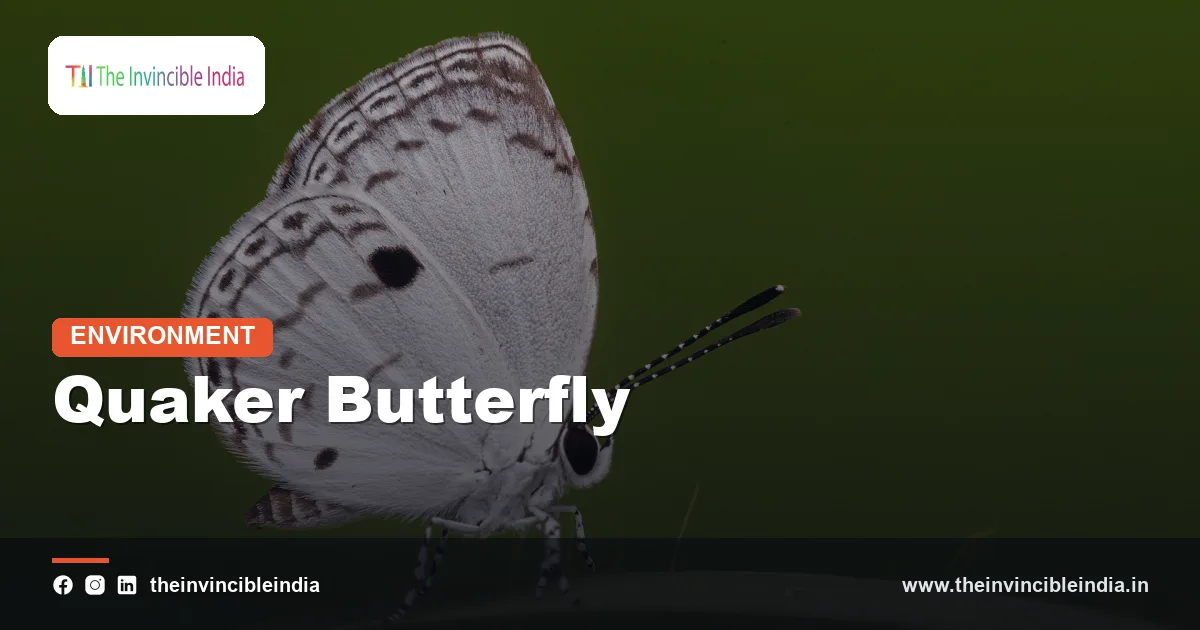
The quaker butterfly (Neopithecops zalmora) is a tiny gossamer-winged butterfly of the family Lycaenidae, with a wingspan of only about two to three centimetres, that is found in forest edges, scrub and gardens across much of India and South-East Asia. Seen from above it looks dusky and unremarkable, but with its wings folded it shows a pale, whitish underside dotted with small dark spots, and it flutters close to the ground in shady spots.
Because it is so small, weak-flying and plain, the quaker butterfly is easily overlooked, even though it is one of the commoner small butterflies in many Indian gardens and woodland margins. This explainer covers the species’ identification, range, habitat, behaviour, life cycle, host plants, similar-looking species and simple ways to support it.
Quick Facts
| Attribute | Detail |
|---|---|
| Scientific name | Neopithecops zalmora (described by Butler in 1870) |
| Common name | Quaker (also called common quaker) |
| Family and subfamily | Lycaenidae (gossamer-winged butterflies), subfamily Polyommatinae (the blues) |
| Wingspan | About 2 to 3 centimetres |
| Range | Indian subcontinent east through Myanmar and South-East Asia to southern China, Taiwan and Indonesia |
| Habitat | Shaded forest edges, scrub, plantations, parks and gardens, often near damp ground |
| Flight | Low, weak and fluttering, usually near the ground in shade |
| Active season | Throughout much of the year, with more adults after the rains |
| Conservation status | Common and widespread; not regarded as threatened |
Key Takeaways
- The quaker butterfly (Neopithecops zalmora) is a tiny lycaenid with a wingspan of about two to three centimetres and is one of the smallest butterflies commonly seen in Indian gardens.
- The quaker butterfly is identified by its dusky upperside and its pale, whitish underside marked with small black spots, a pattern visible when the butterfly rests with closed wings.
- Quaker butterflies fly low and weakly in shaded places and often settle on leaves or on damp ground, where males sip minerals from mud, a habit called mud-puddling.
- Like other butterflies, the quaker passes through four stages: egg, caterpillar, pupa and adult, and its caterpillars feed on the leaves or flowers of particular shrubs and small trees.
- The quaker butterfly is common and widespread across India and South-East Asia, but it depends on shaded vegetation and damp patches that are lost when gardens are over-cleaned or sprayed.
- Gardeners can help the quaker butterfly by keeping some native shrubs, leaving damp earth patches and avoiding insecticides.
What is the quaker butterfly?
The quaker butterfly is a small butterfly of the family Lycaenidae, scientifically named Neopithecops zalmora, found widely in India and South-East Asia. It belongs to the blues, the group within the family Lycaenidae that is known for small size and often bright blue upperwings, although the quaker itself is plain.
The species was described by the English entomologist Arthur Gardiner Butler in 1870. The genus Neopithecops was established later and contains only a small number of species. The name quaker is generally thought to reflect the butterfly’s sober, plain colouring, which recalls the simple dress of the Quaker religious movement. The family Lycaenidae is one of the largest groups of butterflies, accounting for roughly a third of all butterfly species worldwide, and its members are usually small and quick.
How do you identify a quaker butterfly?
A quaker butterfly is identified by its very small size, its pale whitish or greyish underside with small dark spots and fine lines, and its habit of keeping the wings closed at rest. The upperside is a dull dark brown, but it is rarely seen because the butterfly almost never opens its wings while perched.
- Size: wingspan of roughly 2 to 3 centimetres, smaller than a typical garden skipper or blue.
- Underside: pale, whitish to grey-white, with small black or dark spots and faint markings, giving a speckled look.
- Upperside: dusky brown, often with a paler or translucent look when light shines through the wings.
- Posture: wings usually held closed above the back while resting on a leaf.
- Flight: weak, low and fluttering, close to the ground and in shade.
Because the underside is the part that is normally visible, photographers often identify the species from a side-on picture of a perched butterfly.
Where is the quaker butterfly found?
The quaker butterfly is found across the Indian subcontinent and eastwards through Myanmar and South-East Asia to southern China, Taiwan and Indonesia. In India it has been recorded in peninsular India, the Western Ghats, the Himalayan foothills and the north-east, and it is also found in Sri Lanka.
Within India the species prefers humid, shaded locations and is more regularly seen in regions with good rainfall. It lives from the plains up into hill country, although its numbers drop in very dry areas and at high altitudes. Because it is so widespread and adaptable, the species is not regarded as threatened, but local populations can disappear when shady vegetation is cleared.
What habitat does the quaker butterfly prefer?
The quaker butterfly prefers shaded, humid places with shrubs and undergrowth, such as forest edges, scrub, plantations, parks and gardens. It is often found near damp ground, streams and drains, where moisture and minerals are available.
The butterfly generally avoids open, sunny, dry areas and spends its time flitting within a metre or so of the ground, among low shrubs and leaf litter. In towns it can persist in older gardens, in campuses with shrubs and in patches of semi-wild vegetation. It is regularly seen in the cooler parts of the day and on overcast afternoons in the monsoon.
How does the quaker butterfly behave?
The quaker butterfly behaves as a slow, low-flying forager that settles frequently on leaves and on damp soil, rather than as a strong, soaring flyer. It flutters in short hops between perches and rarely goes far from its patch.
Mud-puddling
Males, in particular, gather at wet sand, mud, animal dung and damp rock, where they sip fluids that contain salts and other minerals. This behaviour, known as mud-puddling, is common in many butterflies, and several quakers may appear together at a single wet patch.
Feeding
Adults take nectar from small flowers, and also feed on moisture from damp surfaces and, at times, on bird droppings and rotting matter. Their short mouthparts suit small, shallow flowers better than deep tubes.
What is the life cycle of the quaker butterfly?
The quaker butterfly goes through complete metamorphosis in four stages: egg, caterpillar, pupa and adult. A full cycle in warm, humid weather takes a matter of weeks, so several generations can occur in a year.
| Stage | What happens |
|---|---|
| Egg | The female lays tiny eggs singly on the buds, flowers or young leaves of a host plant. |
| Caterpillar | The larva is short and slug-shaped, a form typical of lycaenids, and feeds and grows through several moults. |
| Pupa | The caterpillar turns into a small, compact chrysalis attached to a leaf or twig, where the adult body forms. |
| Adult | The butterfly emerges, dries its wings, feeds, mates and lays eggs, starting the cycle again. |
Lycaenid caterpillars are often woodlouse-shaped and flattened, which helps them stay hidden and sit tight on a leaf surface. The exact timing of the quaker’s stages depends on temperature and food, and populations tend to be highest after the monsoon when fresh plant growth is abundant.
What do quaker butterfly caterpillars eat?
Quaker butterfly caterpillars feed on the young leaves, buds or flowers of certain shrubs and small trees, with recorded host plants including Glochidion and members of the madder family (Rubiaceae). Host plant records for this species are patchy, and local populations may use different plants in different regions.
As with many lycaenids, the caterpillars may be associated with ants in some species of the family, which tend the larvae in return for sugary secretions. Whether ants regularly attend the quaker’s caterpillars is not well documented, so observers should treat any such link as unconfirmed unless they see it for themselves. Naturalists keen to learn more can record the plant on which they see eggs or caterpillars, because such field notes add useful knowledge about the butterfly’s needs.
What other butterflies look similar to the quaker?
The butterflies most likely to be confused with the quaker are other small lycaenids, especially the related Pithecops species such as the forest quaker and the blue quaker, and small grass blues. These share the small size and pale undersides but differ in spot patterns, habitat and wing shape.
| Species | How it differs from the quaker |
|---|---|
| Forest quaker (Pithecops corvus) | A related small lycaenid of forest habitats, placed in the genus Pithecops rather than Neopithecops, with a distinct spot pattern. |
| Blue quaker (Pithecops fulgens) | Another Pithecops species, also small with a pale underside, but a different genus from the quaker and with its own spot pattern and range. |
| Tiny grass blue (Zizula hylax) | One of the smallest butterflies in India; found in open grassy places, with banded, brownish-grey underside rather than a mainly white one. |
| Common grass blues (Zizeeria and related genera) | Often seen in open lawns and meadows, with brownish undersides and rows of dark spots. |
Careful observation of the underside pattern, the habitat and the flight style usually separates these species, and photographs of a perched individual are a great help to experts.
How can gardeners help the quaker butterfly?
Gardeners can help the quaker butterfly by keeping shaded corners with native shrubs, leaving small damp patches, planting small-flowered nectar plants and avoiding insecticides. These steps cost little and benefit many other small insects as well.
- Keep a few native shrubs and small trees rather than clearing every corner, since the caterpillars need food plants.
- Leave a patch of bare, damp soil or a shallow saucer of wet sand, where males can sip minerals.
- Plant small-flowered nectar plants, such as small daisies and flowering herbs, to give adults a food source.
- Avoid broad-spectrum insecticides, which kill caterpillars and adults alike.
- Leave some leaf litter, because pupae and caterpillars often shelter in it.
- Record sightings on citizen science platforms, which helps scientists track butterfly populations.
Why do small butterflies like the quaker matter?
Small butterflies like the quaker matter because they pollinate small flowers, feed birds, lizards and spiders, and act as sensitive indicators of the health of shady habitats. A garden or woodland patch that supports many species of small butterflies is usually one where the plants, soil moisture and insect life are still in reasonable balance.
Butterflies respond quickly to changes in vegetation, temperature and rainfall, so long-term sightings help scientists detect shifts in local ecosystems. Because the quaker is common, it is a useful species for beginners and for citizen science projects. Many Indian naturalists record butterflies on shared platforms such as iNaturalist and the India Biodiversity Portal, and even a simple photograph with a date and place becomes valuable data. Watching the quaker also teaches patience, since the best views come to those who crouch quietly beside damp shrubs and wait for a tiny pale butterfly to settle.
Bottom Line
The quaker butterfly is a small, plain but fascinating insect that shows how much natural interest can be packed into a creature barely two centimetres wide. Anyone who slows down in a shady garden and watches low leaves may notice it, and a little habitat care keeps it fluttering.
Frequently Asked Questions
What is the scientific name of the quaker butterfly?
The scientific name of the quaker butterfly is Neopithecops zalmora. It is a small butterfly in the family Lycaenidae, described by Arthur Gardiner Butler in 1870.
How big is a quaker butterfly?
A quaker butterfly has a wingspan of about two to three centimetres, which makes it one of the smaller butterflies seen in Indian gardens. It is usually noticed as a tiny, pale flutter near the ground.
Where does the quaker butterfly live in India?
The quaker butterfly lives in shaded forest edges, scrub, plantations and gardens across much of India, including the Western Ghats, peninsular India and the north-east. It also occurs in Sri Lanka and South-East Asia.
Why do quaker butterflies gather on mud?
Quaker butterflies, mainly males, gather on damp mud to sip water that contains salts and minerals. This behaviour is called mud-puddling and is common in many butterflies.
Is the quaker butterfly rare or endangered?
No, the quaker butterfly is common and widespread, and it is not regarded as a threatened species. Local populations can still decline if shady vegetation is cleared or pesticides are used heavily.
How can I tell a quaker butterfly from a grass blue?
A quaker butterfly can be told apart from a grass blue mainly by its underside, which is pale whitish with small dark spots. Grass blues are usually found in open, sunny, grassy places and have a brownish-grey underside with rows of spots.
{“@context”:”https://schema.org”,”@graph”:[{“@type”:”FAQPage”,”mainEntity”:[{“@type”:”Question”,”name”:”What is the scientific name of the quaker butterfly?”,”acceptedAnswer”:{“@type”:”Answer”,”text”:”The scientific name of the quaker butterfly is Neopithecops zalmora. It is a small butterfly in the family Lycaenidae, described by Arthur Gardiner Butler in 1870.”}},{“@type”:”Question”,”name”:”How big is a quaker butterfly?”,”acceptedAnswer”:{“@type”:”Answer”,”text”:”A quaker butterfly has a wingspan of about two to three centimetres, which makes it one of the smaller butterflies seen in Indian gardens. It is usually noticed as a tiny, pale flutter near the ground.”}},{“@type”:”Question”,”name”:”Where does the quaker butterfly live in India?”,”acceptedAnswer”:{“@type”:”Answer”,”text”:”The quaker butterfly lives in shaded forest edges, scrub, plantations and gardens across much of India, including the Western Ghats, peninsular India and the north-east. It also occurs in Sri Lanka and South-East Asia.”}},{“@type”:”Question”,”name”:”Why do quaker butterflies gather on mud?”,”acceptedAnswer”:{“@type”:”Answer”,”text”:”Quaker butterflies, mainly males, gather on damp mud to sip water that contains salts and minerals. This behaviour is called mud-puddling and is common in many butterflies.”}},{“@type”:”Question”,”name”:”Is the quaker butterfly rare or endangered?”,”acceptedAnswer”:{“@type”:”Answer”,”text”:”No, the quaker butterfly is common and widespread, and it is not regarded as a threatened species. Local populations can still decline if shady vegetation is cleared or pesticides are used heavily.”}},{“@type”:”Question”,”name”:”How can I tell a quaker butterfly from a grass blue?”,”acceptedAnswer”:{“@type”:”Answer”,”text”:”A quaker butterfly can be told apart from a grass blue mainly by its underside, which is pale whitish with small dark spots. Grass blues are usually found in open, sunny, grassy places and have a brownish-grey underside with rows of spots.”}}]}]}


