

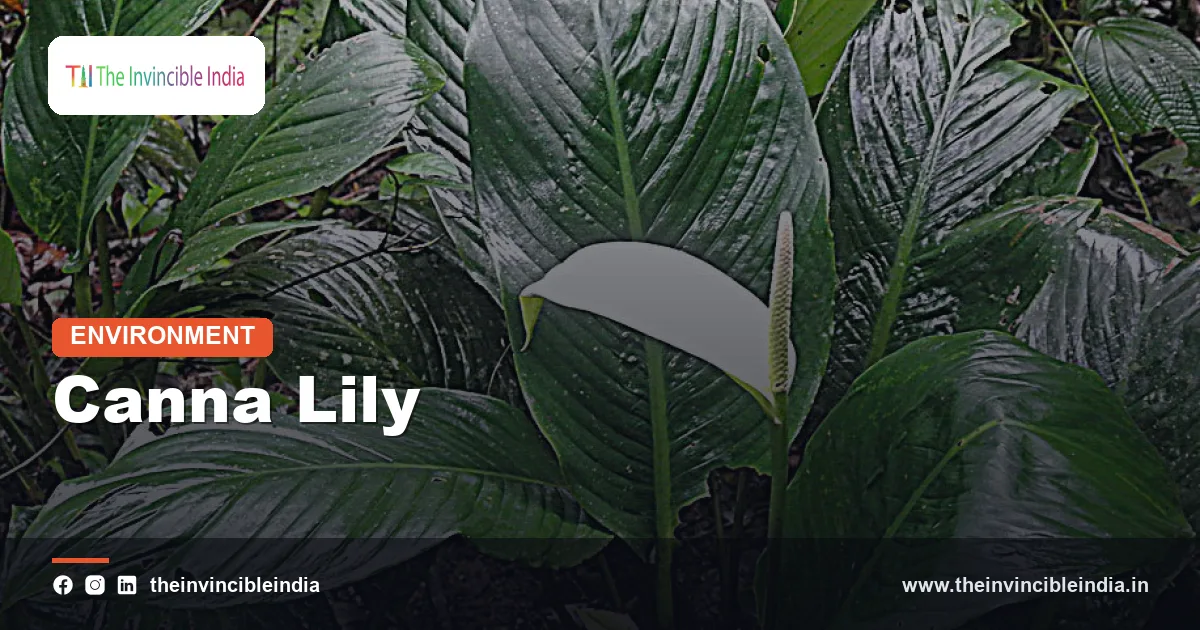
The canna lily (Canna indica and its many garden hybrids) is a tall, broad-leaved tropical ornamental plant with bright red, orange, yellow or pink flower spikes, widely grown in Indian parks, roadside medians, school grounds and home gardens. Despite its name, the canna lily is not a true lily: it belongs to its own family, Cannaceae, and is more closely related to bananas and gingers than to the lily family.
Native to the tropical and subtropical Americas, the canna lily was carried around the world by plant collectors and now grows in India almost as if it were a local species, thriving in the heat, monsoon rain and bright sun. This explainer covers its identity, appearance, cultivation, wildlife value, practical uses and the cases in which it turns into a weed.
Quick Facts
| Attribute | Detail |
|---|---|
| Scientific name | Canna indica (wild type); Canna x generalis (garden hybrids) |
| Family | Cannaceae, in the order Zingiberales with bananas, gingers and heliconias |
| Common names | Canna lily, canna, Indian shot, Indian shot plant |
| Native range | Tropical and subtropical Americas, including Central America, the Caribbean and northern South America |
| Plant type | Perennial herb growing from a fleshy underground rhizome |
| Typical height | About 1 to 2.5 metres, depending on type |
| Flower colours | Red, orange, yellow, pink, cream and bicoloured or speckled forms |
| Propagation | Division of rhizomes (main method); seeds for wild types |
| Main pollinators | Sunbirds in India; hummingbirds in the Americas; bees and butterflies |
Key Takeaways
- The canna lily (Canna indica) is a tall perennial ornamental from the Americas and is not a true lily, because it belongs to the family Cannaceae rather than the lily family.
- Canna lilies are grown in India for their large paddle-shaped leaves and bright flower spikes, and they flower for much of the year in warm climates.
- The showy parts of a canna flower are mostly modified stamens called staminodes, not true petals, which explains the unusual, ragged shape of the blooms.
- Canna lilies spread by thick underground rhizomes that can be divided every two to three years to make new plants.
- Canna indica is called Indian shot because its hard, round black seeds were once used as shot and are still used as beads and rattles.
- Canna lilies are used in constructed wetlands to help treat wastewater and can become weedy in damp ground where they spread freely.
What is the canna lily and why is it not a true lily?
The canna lily is a perennial flowering plant of the genus Canna, and it is not a true lily because true lilies belong to the genus Lilium in the family Liliaceae, while cannas belong to the family Cannaceae. The common name comes from the showy flowers, which gardeners compared to lilies, although the resemblance is superficial.
Botanists place the family Cannaceae in the order Zingiberales, which also includes bananas, gingers, heliconias and arrowroot. The resemblance to a banana plant is clear in the large leaves with a strong central vein. The genus contains roughly ten to twenty species depending on the classification, and the name Canna is generally said to derive from an ancient word for a reed or cane, a reference to the plant’s stiff stems.
Where does the canna lily come from?
The canna lily is native to the tropical and subtropical regions of the Americas, from the southern United States through Central America and the Caribbean to northern Argentina. European explorers took cannas back to Europe after the 1500s, and breeders there developed the large-flowered garden hybrids in the 1800s.
The plant reached the Indian subcontinent during the colonial period through botanical gardens and plant exchanges, and the species name indica reflects its early association with the East and West Indies rather than a true origin in India. Today the wild-type Canna indica has become naturalised across the tropics, while hybrid cannas are the type most often planted in parks and gardens.
What does the canna lily look like?
A canna lily is a clump-forming herb with large, oval to lance-shaped leaves held on upright, unbranched stems, topped by spikes of brightly coloured flowers. The leaves are typically 30 to 60 centimetres long, and they may be green, bronze, purple or striped, depending on the variety.
The flowers
The canna flower looks complex but is built in a simple way. Three small sepals and three narrow petals are present, but the large, colourful parts that attract attention are staminodes, which are modified stamens that look like petals. One of the staminodes folds back as a lip, and a single fertile stamen carries the pollen. This design leads to the irregular, asymmetric shape that sets cannas apart from true lilies.
Fruits and seeds
After pollination, the flower forms a rough, warty green capsule containing several round, very hard, black seeds. The seeds of Canna indica are about the size of a pea and are so hard that they can stay dormant for long periods unless the seed coat is scratched or soaked.
What are the main types of canna lily in India?
The main types of canna lily seen in India are the wild-type Canna indica, which has smaller flowers and tall growth, and the garden hybrids grouped under Canna x generalis, which have larger flowers and a wider colour range. The hybrids are further sorted by height, leaf colour and flower form.
| Type | Typical features | Common use |
|---|---|---|
| Wild Canna indica | Tall, smaller red or orange-red flowers, green leaves, hardy and self-seeding | Naturalised in damp places; hedges and wild corners |
| Tall hybrids | Up to about 2 metres, large flowers in many colours | Backgrounds in borders, along walls and fences |
| Dwarf hybrids | About 60 to 90 centimetres, compact clumps | Pots, front borders and roadside beds |
| Foliage types | Bronze, purple or striped leaves, with flowers a secondary feature | Landscaping and colour contrast |
| Water cannas | Narrow leaves, tolerant of standing water | Pond edges and shallow water |
How do you grow a canna lily in India?
Canna lilies are grown by planting rhizome pieces in sunny, fertile, moist soil, and they flower within a few months. The plant is easy to grow in most parts of India and needs only regular watering and occasional feeding.
Planting and sunlight
Gardeners plant rhizome pieces, each with at least one growing bud or eye, about 5 to 10 centimetres deep and spaced 45 to 60 centimetres apart. Cannas prefer full sun for at least five to six hours a day, and they flower best in strong light. The monsoon and pre-monsoon months are the usual planting seasons.
Water and feeding
Cannas are heavy drinkers and do best with regular watering during the growing season. They tolerate wet and even waterlogged soil better than many ornamentals. A balanced fertiliser or compost every month or so encourages larger leaves and more flowers.
Maintenance
Removing faded flower stalks encourages new blooms, and cutting old stems back to ground level once a year refreshes the clump. In crowded clumps, flowering declines, so gardeners dig up and divide the rhizomes every two to three years. In cold regions where frost occurs, the rhizomes are lifted and stored indoors, because frost kills the aboveground growth.
What wildlife does the canna lily attract?
The canna lily attracts nectar-feeding birds, bees, butterflies and moths, and in India its brightly coloured flowers are visited most often by sunbirds. The tubular flowers produce nectar, and the red and orange varieties in particular catch the eye of birds.
In the Americas, hummingbirds are the key visitors, and the canna’s flower shape is thought to have evolved partly in relation to such birds. Butterflies and skipper butterflies visit for nectar, and insect-eating birds may forage among the leaves. Some caterpillars also feed on the foliage. For urban gardeners, a clump of cannas is therefore a simple way to bring birds and pollinators into small spaces.
Is the canna lily edible or useful?
The canna lily has several practical uses, including edible starch from the rhizomes of some species, seeds used as beads, and a role in wastewater treatment. The most notable edible species is Canna edulis, known as achira, grown for its starchy rhizomes in the Andes and in parts of Asia.
- Starch: the rhizomes of some cannas yield starch used for food and for making noodles in parts of Southeast Asia; Canna edulis is the type grown for this purpose.
- Beads and rattles: the hard black seeds of Canna indica are strung as beads and have been placed in rattles; the “shot” in the name Indian shot refers to this use.
- Leaves for wrapping: the large leaves are used in some regions as wrapping or as plates for food, and as fodder for livestock.
- Traditional medicine: rhizome extracts feature in folk medicine for fever and as a diuretic, but scientific evidence is limited.
- Wastewater treatment: cannas are planted in constructed wetlands and reed beds to take up nutrients and some pollutants from sewage and greywater.
Gardeners should not eat the common ornamental hybrids without confirming the species, because the edible uses apply mainly to particular species grown for that purpose.
What pests and diseases affect the canna lily?
The canna lily is relatively hardy, but it is troubled by leaf-eating caterpillars, snails and slugs, aphids and some fungal and viral diseases. Most damage is cosmetic, and plants usually recover with simple care.
- Leaf-rolling caterpillars: chew and roll the leaves; hand-picking is the easiest remedy in a home garden.
- Snails and slugs: eat young shoots during the monsoon; clearing debris reduces their hiding places.
- Aphids and mealybugs: suck sap; a strong water spray or a neem-based spray helps.
- Rust and leaf spots: fungal infections that appear in humid weather; removing affected leaves limits spread.
- Canna viruses: cause streaking and stunted growth, and infected plants should be removed because viruses spread through rhizomes.
Can the canna lily become invasive?
Yes, Canna indica can become weedy in damp places, where it spreads through rhizomes and seeds and forms dense clumps that crowd out local plants. It has naturalised along streams, ditches and roadsides across many tropical countries, including India.
The hybrids are mostly sterile or set little seed, so they are generally better behaved than the wild type. Still, a discarded rhizome fragment dumped near a stream or wetland can start a new colony. Gardeners near sensitive wetlands or forests are advised to choose hybrid types, keep plants within a garden bed and dispose of cuttings with household waste rather than in natural areas.
Why is the canna lily so popular in Indian landscaping?
The canna lily is popular in Indian landscaping because it is cheap, fast-growing, tolerant of heat and flowers for many months, which suits municipal gardens, roundabouts and institutional campuses. A clump planted from a few rhizomes can fill a large bed within a single season.
Park managers value cannas for several reasons. The plants stay green through the monsoon, they need little attention beyond watering, and the tall types form a natural screen along walls or boundaries. In coastal and humid regions they cope well with moisture and salt-laden air better than many delicate flowers. Home gardeners also grow dwarf varieties in large pots on terraces and balconies, where the bright colours and broad leaves add a tropical look. Because the rhizomes multiply every year, gardeners often share divisions with neighbours, which is one reason cannas appear in so many gardens across the country.
Bottom Line
The canna lily is a showy, tough and generous garden plant that supplies colour through most of the year and also supports pollinators and birds. It is easy to grow from a rhizome, useful in wastewater wetlands and attractive in public landscapes, but it should be kept out of natural wetlands where it can spread.
Frequently Asked Questions
Is the canna lily a true lily?
No, the canna lily is not a true lily. It belongs to the family Cannaceae and is more closely related to bananas and gingers than to lilies.
Why is Canna indica called Indian shot?
Canna indica is called Indian shot because its seeds are hard, round and black, like small lead shot. The seeds have been used as beads and as the noisy filling of rattles.
Does the canna lily grow well in Indian weather?
Yes, the canna lily grows well across most of India because it likes heat, humidity and monsoon rain. It needs full sun and regular water, and it flowers for much of the year in warm regions.
How do you propagate a canna lily?
A canna lily is propagated mainly by dividing its underground rhizome into pieces that each have at least one bud. Each piece is planted about 5 to 10 centimetres deep and grows into a new clump.
Is the canna lily poisonous?
The canna lily is generally not considered highly toxic, and some species have edible rhizomes. Ornamental plants should still not be eaten unless the species is known to be edible, and children and pets should not chew them.
Which birds visit canna lily flowers?
Sunbirds are the most common birds to visit canna lily flowers in India, feeding on the nectar. In the Americas, where the plant is native, hummingbirds are the main visitors.
{“@context”:”https://schema.org”,”@graph”:[{“@type”:”FAQPage”,”mainEntity”:[{“@type”:”Question”,”name”:”Is the canna lily a true lily?”,”acceptedAnswer”:{“@type”:”Answer”,”text”:”No, the canna lily is not a true lily. It belongs to the family Cannaceae and is more closely related to bananas and gingers than to lilies.”}},{“@type”:”Question”,”name”:”Why is Canna indica called Indian shot?”,”acceptedAnswer”:{“@type”:”Answer”,”text”:”Canna indica is called Indian shot because its seeds are hard, round and black, like small lead shot. The seeds have been used as beads and as the noisy filling of rattles.”}},{“@type”:”Question”,”name”:”Does the canna lily grow well in Indian weather?”,”acceptedAnswer”:{“@type”:”Answer”,”text”:”Yes, the canna lily grows well across most of India because it likes heat, humidity and monsoon rain. It needs full sun and regular water, and it flowers for much of the year in warm regions.”}},{“@type”:”Question”,”name”:”How do you propagate a canna lily?”,”acceptedAnswer”:{“@type”:”Answer”,”text”:”A canna lily is propagated mainly by dividing its underground rhizome into pieces that each have at least one bud. Each piece is planted about 5 to 10 centimetres deep and grows into a new clump.”}},{“@type”:”Question”,”name”:”Is the canna lily poisonous?”,”acceptedAnswer”:{“@type”:”Answer”,”text”:”The canna lily is generally not considered highly toxic, and some species have edible rhizomes. Ornamental plants should still not be eaten unless the species is known to be edible, and children and pets should not chew them.”}},{“@type”:”Question”,”name”:”Which birds visit canna lily flowers?”,”acceptedAnswer”:{“@type”:”Answer”,”text”:”Sunbirds are the most common birds to visit canna lily flowers in India, feeding on the nectar. In the Americas, where the plant is native, hummingbirds are the main visitors.”}}]}]}


