

Along the eastern coast of India, in the region historically known as Kalinga, the Eastern Ganga dynasty presided over one of the most extraordinary chapters of Indian temple architecture. Ruling a coastal kingdom that maintained trade contacts stretching across the Bay of Bengal in a manner comparable to the maritime ambitions of the Vijayanagara empire further south in later centuries, the Eastern Gangas built monumental temples that remain among the most celebrated religious structures in the country. Their patronage produced both the great pilgrimage temple of Jagannath at Puri and the extraordinary chariot-shaped Sun Temple at Konark. This guide surveys the dynasty’s origins, governance, culture, and architectural legacy in Odisha.
Quick Facts
| Detail | Information |
|---|---|
| Region | Kalinga, present-day Odisha and adjoining coastal areas |
| Approximate Period | Roughly the 11th to the 15th century CE |
| Capital | Kalinganagara, with later administration centered near Cuttack |
| Signature Monuments | The Konark Sun Temple and the Jagannath Temple at Puri |
| Religions Patronized | Vaishnavism and Shaivism within a broader Hindu framework |
| Legacy | The distinctive Kalinga school of temple architecture |
Origins of the Eastern Ganga Dynasty
The Eastern Ganga dynasty rose to prominence along the eastern coast of India in the historical region of Kalinga, an area with a long-standing tradition of maritime trade and regional political power stretching back many centuries. Dynastic tradition connects the family to earlier Ganga lineages associated with the region, though the dynasty’s consolidation into a major imperial power took place gradually over successive generations. Emerging from a base of regional authority, the Eastern Gangas extended their control across the coastal plains and river deltas of Kalinga, benefiting from the area’s agricultural wealth and access to Bay of Bengal trade routes. Their rise coincided with a broader period of political realignment across eastern India, as older regional powers weakened and new dynasties sought to establish dominance. This foundation set the stage for the dynasty’s later transformation into one of the great temple-building powers of medieval India.
Rise to Imperial Power
The Eastern Gangas achieved their greatest consolidation of power under a ruler remembered for uniting Kalinga’s various regional territories into a single, more centralized kingdom capable of sustained monumental building projects. This consolidation involved military campaigns against rival regional powers as well as the careful integration of existing local structures of authority into a broader imperial framework. The dynasty’s growing strength allowed it to project influence along a substantial stretch of India’s eastern coastline, controlling both fertile agricultural deltas and important coastal trade centers. This combination of territorial consolidation and administrative integration transformed the Eastern Gangas from a regional power into one of the dominant dynasties of eastern India. Their strengthened position provided the resources and stability necessary for the ambitious temple-building projects that would define the dynasty’s legacy.
Extent of Eastern Ganga Territory
At its greatest extent, Eastern Ganga authority stretched along much of the eastern Indian coastline, encompassing present-day Odisha and extending at times into adjoining coastal areas of present-day Andhra Pradesh and West Bengal. This substantial coastal territory gave the dynasty control over important river deltas, agricultural plains, and ports engaged in trade across the Bay of Bengal. The kingdom’s geographic reach brought it into periodic contact and conflict with neighboring powers, including dynasties to the north, south, and west whose territories bordered Kalinga at various points. Control of this extensive and resource-rich coastal territory provided the economic foundation necessary to sustain the dynasty’s remarkable architectural ambitions. The Eastern Ganga realm’s scale and coastal orientation distinguish it as one of the most significant regional powers of medieval eastern India.
Notable Rulers
Eastern Ganga inscriptions preserve the names of numerous rulers across several centuries, with particular prominence given to those associated with the dynasty’s greatest phases of territorial consolidation and monumental construction. One ruler is especially remembered for founding the great Jagannath Temple complex at Puri, establishing a pilgrimage center that would become central to the religious and political identity of the kingdom. A later ruler is closely associated with the construction of the celebrated Sun Temple at Konark, an architectural achievement that represents the high point of Eastern Ganga artistic ambition. Other rulers in the dynastic sequence are remembered for military campaigns that defended Kalinga against determined incursions from powerful neighboring kingdoms. This succession of capable and ambitious rulers across multiple generations underpinned the dynasty’s sustained architectural and political achievements.
System of Governance
Eastern Ganga administration combined strong central royal authority with a network of provincial governors and local officials responsible for revenue collection and administration across the kingdom’s extensive coastal territory. Temple institutions themselves played an important administrative and economic role, with major shrines such as the Jagannath Temple functioning as centers of landholding, redistribution, and local governance alongside their religious functions. Inscriptions recording land grants and administrative arrangements provide much of the surviving evidence for how the dynasty organized its governance across a geographically extended kingdom. This integration of religious and administrative institutions reflects a distinctive feature of Eastern Ganga statecraft, in which temple patronage served practical governance purposes alongside its devotional significance. This system of governance proved capable of sustaining both political stability and extraordinary architectural achievement across several centuries.
Religious Patronage
The Eastern Gangas were devoted patrons of Vaishnavism, particularly the worship of Jagannath, a distinctive regional form of Vishnu whose cult became closely tied to the dynasty’s religious and political identity. Alongside this Vaishnava devotion, the dynasty also supported Shaiva traditions and other forms of Hindu worship present within Kalinga’s diverse religious landscape. Royal patronage extended well beyond temple construction to include the endowment of land, resources, and personnel necessary to sustain elaborate temple rituals and festivals on an ongoing basis. This close association between royal legitimacy and religious patronage is a defining feature of Eastern Ganga rule, with kingship itself closely tied to service and devotion toward the deity Jagannath. This sustained religious patronage across generations produced one of the richest traditions of temple worship and festival culture found anywhere in India.
The Jagannath Temple at Puri
The Jagannath Temple at Puri stands as one of the most significant religious foundations of the Eastern Ganga dynasty, established as the center of worship for a distinctive form of Vishnu whose cult had deep roots in regional Odishan tradition. The temple’s construction and subsequent expansion under successive Eastern Ganga rulers established Puri as one of the most important pilgrimage destinations in India, drawing devotees from across the subcontinent. The temple complex became closely associated with elaborate annual festivals, most notably a great chariot procession that remains a defining feature of Odishan religious and cultural life to this day. Royal identity under the Eastern Gangas became closely intertwined with service to Jagannath, with rulers often presenting themselves as servants or regents of the deity. This close relationship between temple and throne distinguishes the Eastern Ganga religious and political tradition.
The Konark Sun Temple
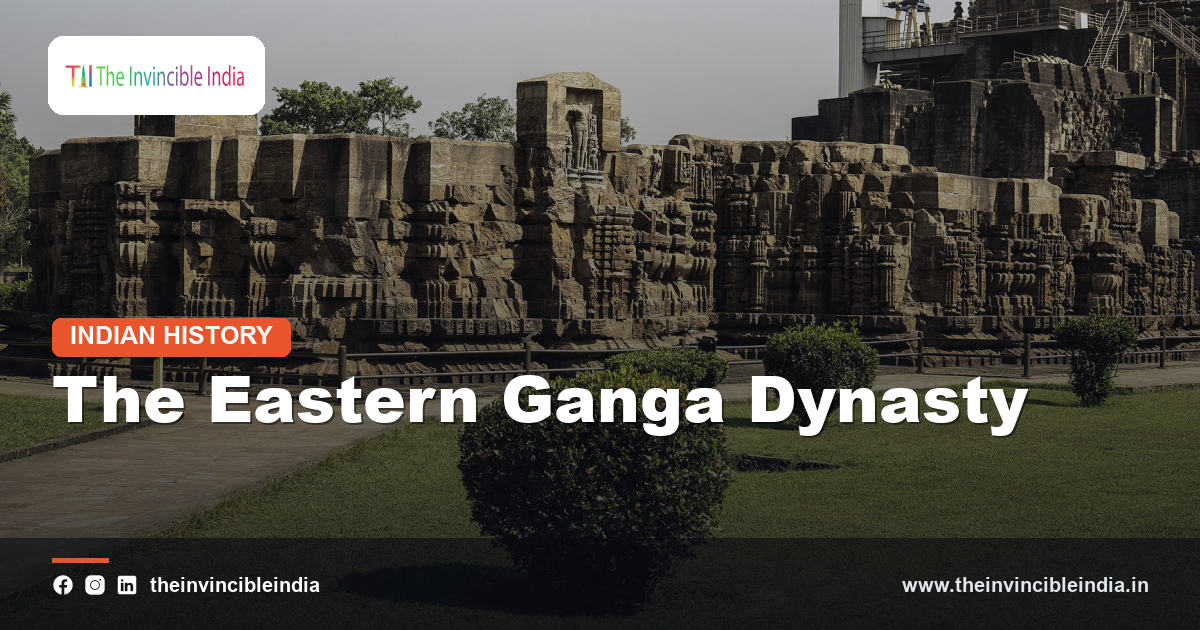
The Sun Temple at Konark represents the pinnacle of Eastern Ganga architectural achievement, an extraordinary structure conceived in the form of a colossal chariot dedicated to the sun deity Surya, complete with elaborately carved wheels and horses. Constructed on a monumental scale using dark stone, the temple’s design integrates astronomical symbolism with architectural form, reflecting sophisticated engineering and artistic planning. Intricate carvings covering the temple’s surfaces depict deities, celestial figures, and scenes from courtly and everyday life, executed with remarkable technical skill characteristic of the mature Kalinga architectural tradition. Though the temple’s main sanctuary tower no longer survives intact, the remaining structure continues to convey the extraordinary ambition and artistry of its original conception. Recognized today as a UNESCO World Heritage Site, the Konark Sun Temple remains one of the most celebrated monuments of medieval Indian architecture.
The Kalinga School of Temple Architecture
Eastern Ganga patronage brought the distinctive Kalinga school of temple architecture to its fullest maturity, characterized by towering curvilinear spires, richly carved surfaces, and a coherent structural vocabulary shared across major temples of the region. This regional style, while related to the broader Nagara architectural tradition of northern and central India, developed distinctive proportions and decorative conventions specific to Odisha’s temple-building tradition. Architects and craftsmen working under Eastern Ganga patronage developed increasingly sophisticated techniques for both structural engineering and sculptural decoration, visible in the scale and complexity of temples built during this period. This architectural tradition represents a significant regional contribution to the broader history of Indian temple design. The Kalinga style’s influence continued to shape temple construction in Odisha long after the Eastern Ganga dynasty’s political decline.
Trade and Maritime Contacts
The Eastern Ganga kingdom’s extensive coastline gave it an important role in maritime trade across the Bay of Bengal, connecting Kalinga to Southeast Asian ports and to other regions of India’s eastern seaboard. This maritime activity built on a much older tradition of trade and cultural contact between Kalinga and Southeast Asia, reflected in longstanding historical and cultural connections between the two regions. Coastal towns and river ports under Eastern Ganga control served as centers of exchange for textiles, agricultural produce, and other regional goods traded across the wider Bay of Bengal commercial network. This trade activity contributed significantly to the prosperity that funded the dynasty’s extraordinary temple-building projects. The Eastern Ganga period thus represents an important chapter in the long history of India’s maritime engagement with Southeast Asia.
Society and Temple Economy
Eastern Ganga society was closely organized around the temple economy, with major shrines such as those at Puri and Konark serving as centers of landholding, employment, and redistribution for a wide range of dependent workers, priests, and craftsmen. This temple-centered economic model integrated agricultural production, craft specialization, and religious ritual into a single interconnected system that sustained both the spiritual and material life of the kingdom. Artisans and builders engaged in temple construction represented a significant and specialized segment of society, their skills passed down and refined across generations of sustained architectural activity. Pilgrims traveling to major temple sites also contributed to the broader economic life of the kingdom, supporting a range of associated trades and services. This close integration of religion, economy, and society is a distinctive feature of the Eastern Ganga period.
Rivalries with Neighboring Powers
Throughout their history, the Eastern Gangas engaged in periodic conflicts with neighboring powers, including dynasties to the north in Bengal and various southern powers whose territories bordered Kalinga at different points. Control of contested frontier territories, along with valuable trade routes and agricultural land, fueled much of this competition across the dynasty’s long history. The Eastern Gangas generally proved capable of defending their core territory, drawing on the resources of a prosperous coastal kingdom and the loyalty commanded by their close association with the Jagannath cult. As the broader political landscape of eastern and northern India shifted with the emergence of new powers, the Eastern Gangas faced increasingly serious challenges to their independence in later centuries. This long history of contested frontiers illustrates the competitive political environment of medieval eastern India.
Decline of Eastern Ganga Power
By the later medieval period, internal succession difficulties combined with growing external pressure from expanding regional powers gradually weakened Eastern Ganga authority over Kalinga. Sustained conflict along multiple frontiers placed considerable strain on the kingdom’s resources, even as major temple institutions continued to function as centers of religious and social life. As central control loosened, the kingdom’s territory came under increasing pressure, eventually giving way to new ruling dynasties who inherited elements of the Eastern Ganga administrative and religious framework. This gradual political transition nonetheless preserved much of the religious and cultural infrastructure established under Eastern Ganga patronage, including the continued centrality of the Jagannath cult. The dynasty’s decline thus marked a political transition rather than a cultural rupture in the history of Odisha.
Legacy in Indian History
The Eastern Ganga dynasty is remembered today primarily for its extraordinary architectural legacy, with the Konark Sun Temple and the Jagannath Temple at Puri standing among the most celebrated religious monuments in India. The dynasty’s close association with the Jagannath cult continues to shape Odisha’s religious and cultural identity, with the temple at Puri remaining one of the most important pilgrimage sites in the country. The Kalinga school of temple architecture developed under Eastern Ganga patronage represents a significant and distinctive contribution to the broader history of Indian temple design. Historians studying medieval eastern India continue to draw on Eastern Ganga inscriptions and monuments to reconstruct the period’s political, religious, and economic life. This layered legacy secures the Eastern Gangas a lasting and significant place in Indian history.
The Eastern Ganga Dynasty Today
Today, the legacy of the Eastern Ganga dynasty draws millions of pilgrims and visitors to Puri and Konark each year, where the Jagannath Temple and the Sun Temple continue to serve as focal points of religious devotion and cultural heritage. Conservation authorities work to protect the delicate carvings of the Konark Sun Temple from coastal weathering, ensuring the monument’s preservation for future generations. The annual chariot festival associated with Jagannath continues to be celebrated with great devotion, carrying forward traditions that trace their institutional origins to the Eastern Ganga period. Ongoing scholarship continues to study Eastern Ganga inscriptions and architecture to deepen understanding of the dynasty’s political and religious history. Through its enduring temples and living traditions, the Eastern Ganga dynasty remains a vivid and active presence in the cultural life of Odisha.
Sources & Further Reading
- Ministry of Culture, Government of India (indiaculture.gov.in).
- Archaeological Survey of India (asi.nic.in).
Frequently Asked Questions
Who were the Eastern Gangas?
The Eastern Gangas were a medieval dynasty that ruled the Kalinga region, present-day Odisha, from roughly the 11th to the 15th century CE, remembered for their extraordinary temple architecture.
What is the Eastern Ganga dynasty famous for?
The dynasty is best known for building the Konark Sun Temple and the Jagannath Temple at Puri, two of the most celebrated religious monuments in India.
Where was the Eastern Ganga capital located?
The dynasty’s early capital was Kalinganagara, with administration later centered near present-day Cuttack, along Odisha’s fertile coastal river deltas.
What religions did the Eastern Gangas support?
Eastern Ganga rulers were devoted primarily to Vaishnavism, especially the worship of Jagannath, while also supporting Shaiva traditions within the broader Hindu fold.
Why is the Konark Sun Temple significant?
The Konark Sun Temple is celebrated for its chariot-shaped design, intricate stone carvings, and integration of astronomical symbolism, and is recognized as a UNESCO World Heritage Site.


