

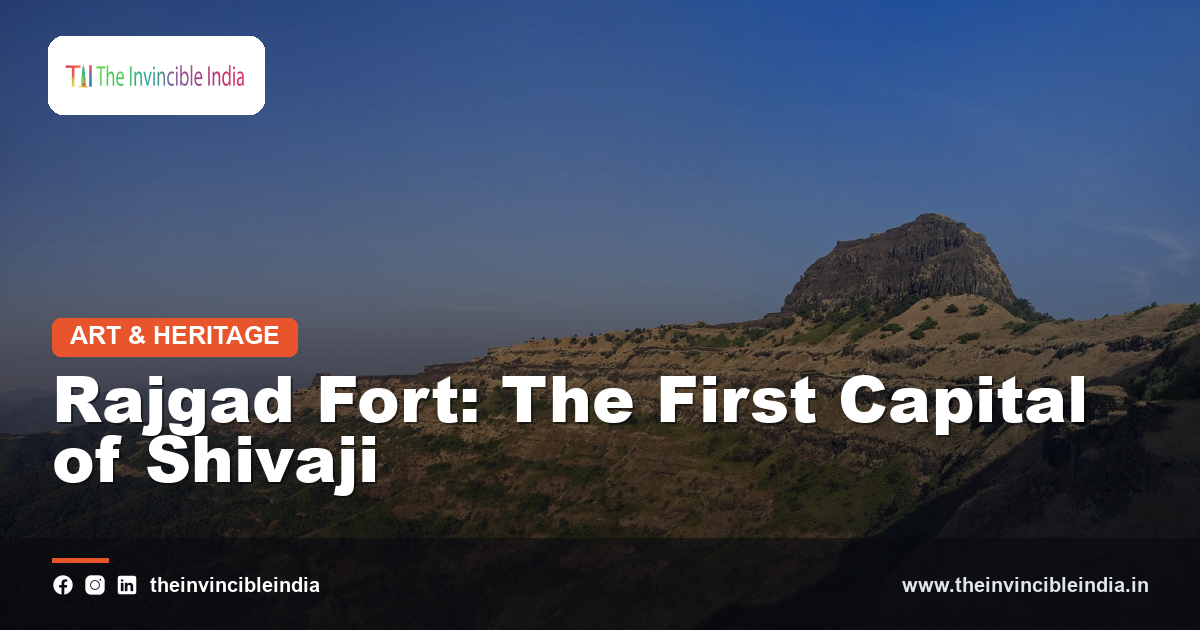
Perched on a spur of the Sahyadri range south-west of Pune, Rajgad is among the most celebrated hill fortresses in Maharashtra. Its name means the ruling fort, and for many years it served as the headquarters of Shivaji, the founder of the Maratha state, before the royal seat moved elsewhere. The fort is admired for its commanding position, its three terraced plateaus and its sweeping ridges, which together make it a masterpiece of military landscape design. Like the great forts of India, it unites defence, administration and symbolism in stone. This guide examines its history, layout and enduring place in the cultural memory of the region.
Quick Facts
| Detail | Information |
|---|---|
| Location | Sahyadri range, Pune district, Maharashtra |
| Type | Hill fort |
| Associated with | Shivaji and the early Maratha state |
| Earlier name | Murumbdev |
| Main divisions | Balekilla and three machis |
| Significance | Early capital and a celebrated trekking destination |
A Fortress Born of the Sahyadris
Rajgad rises from the rugged Sahyadri hills, a landscape of steep scarps, deep valleys and narrow ridges that proved ideal for fortification. The fort sits on a long, branching hill whose natural features were used to create layered lines of defence. From its heights the surrounding country can be watched in every direction, and approaches from the plains are visible from far away.
This command of the landscape explains why the fort was chosen as a base. The builders did not conquer the hill so much as work with it, using cliffs as walls and ridges as ramparts. Rajgad shows how the geography of the Sahyadris shaped the military and political imagination of the Marathas, and the fort remains inseparable from the mountains that carry it.
From Murumbdev to Rajgad
The hill was originally known as Murumbdev, and tradition holds that it was strengthened and renamed when it came into the hands of Shivaji. The new name, Rajgad, signalled its role as a ruling seat rather than a simple outpost. Fortifications were extended, gateways were improved and the hilltop was prepared to house an administration.
This change of name reflects a larger story of ambition and state building. Shivaji’s early forts were bases from which a new kingdom took shape in the hills, and Rajgad became the most prominent of them in the early phase. The fort’s name therefore carries meaning about leadership and identity, and it connects the hill to one of the most admired figures in Indian history.
Shivaji and the Early Maratha State
Shivaji is remembered as the founder of the Maratha state, a leader who combined military skill with careful administration and a strong sense of local identity. In his early career he gathered a chain of hill forts in the Sahyadris, and these strongholds formed the backbone of his growing power. Rajgad was among the most important, and for a considerable period it was the centre from which affairs of the young state were directed.
Life in the fort mingled military readiness with government. Officials, soldiers, craftsmen and families lived on the hill, and decisions that shaped the region were made there. The association with Shivaji gives Rajgad a special aura, and it is often described with affection as the first capital of the Maratha kingdom.
Why a Hill Fort Made Sense
Hill forts suited the conditions of the western Deccan. The terrain made large armies slow and vulnerable, while small, mobile forces could use the passes and ridges to advantage. A fort on a high spur offered safety to rulers, storage for grain and weapons, and a secure place to assemble troops.
For Shivaji’s strategy, this arrangement had great value. A network of forts allowed control of the countryside without the need for a single vast garrison, and it gave the Marathas a flexible structure of defence. Rajgad was one of the strongest links in this network, a stronghold that expressed a philosophy of warfare built on knowledge of the land and swift movement.
The Three Machis
The fort is organised around three terraced plateaus known as machis, which extend outward from the central high point like arms. Each plateau has its own character and its own set of defences, and together they give Rajgad a distinctive, sprawling shape. The names of the machis are Padmavati, Sanjivani and Suvela, and each is associated with a particular part of the fort’s life and defence.
This division spread the fort’s functions across the hill and gave defenders several positions from which to cover one another. It also made the fort feel like a small town on a mountain, with residential areas, water sources and gateways. The three machis are the most recognisable feature of Rajgad and the key to understanding its plan.
Padmavati Machi: The Heart of Habitation
Padmavati Machi is the plateau most closely tied with daily life in the fort. Here stand a temple dedicated to the goddess Padmavati, along with water tanks and the ruins of buildings that once held residences and offices. The plateau is broad and gentle compared with the rest of the fort, and it is a natural place to pause and take in the surroundings.
The temple continues to be visited by trekkers and local devotees, giving the area a living quality. Traces of walls and foundations suggest the scale of the community that once inhabited the hill. Padmavati Machi is therefore both a historical site and a place of ongoing devotion, a reminder that forts were homes as well as strongholds.
Sanjivani Machi and Its Double Wall
Sanjivani Machi is celebrated for its long, curving line of fortification, often described as a double wall because it consists of two parallel layers of defence running along the ridge. A path runs between them, allowing defenders to move quickly and take positions along the rampart. The wall follows the contour of the hill and is a splendid piece of military engineering.
Its bastions and loopholes show how carefully the builders considered angles of attack and fields of fire. Walking along the ridge today gives a strong sense of how the fort was meant to function in battle. Sanjivani Machi is regarded as one of the finest stretches of fortification in the Sahyadris, and it is a highlight for visitors interested in military architecture.
Suvela Machi and the Eastern Spur
Suvela Machi extends along another arm of the hill and offers dramatic views over the valleys below. Its position made it important for watching the lower approaches and for guarding that side of the fort. A notable feature of this plateau is a rock formation with a natural opening, which attracts the curiosity of trekkers.
The terrain here is steep and exposed, and the defences take full advantage of it. The ramparts and bastions blend into the cliff edges so that human work and natural rock seem to form a single wall. Suvela Machi completes the trio of plateaus and shows how the builders of Rajgad turned each ridge into a purposeful part of the fortress.
Balekilla: The Citadel at the Summit
At the very top of the hill, above the three machis, stands the Balekilla, the inner citadel and the most strongly defended part of the fort. Reaching it involves a steep climb up a narrow approach, and the last stretch passes through fortified gateways that controlled access. The citadel was meant to be the final refuge if outer defences were breached.
From the summit the view is magnificent, taking in the surrounding peaks and, on clear days, other forts of the region. The sense of height and command at Balekilla explains why the Marathas valued it so highly. The citadel reveals the logic of layered defence, where each level offered a further obstacle and a last, secure place of command.
Gateways and Entrances
Rajgad is entered through a series of fortified gateways, each designed to slow and confine anyone who approached. Among the names remembered are the Pali Darwaza and the Gunjavane Darwaza, which lead onto different approaches, and the smaller Chor Darwaza, a narrow hidden passage. The doors are set within thick walls and bastions that overlook the path.
The gateways were built with a clear understanding of defence, forcing visitors to turn and climb in ways that exposed them to fire from above. They also served as ceremonial thresholds, marking the transition from the outside world to the seat of power. These entrances are among the most photographed parts of Rajgad and a showcase of Maratha fort design.
Water Tanks and Daily Supplies
A fort that might be besieged for long periods needed dependable water and storage, and Rajgad’s builders attended to both. Rock-cut tanks and cisterns collect rain water on the plateaus, and some are fed by natural springs. Granaries, storehouses and lanes also formed part of the settlement.
These facilities show that the fort was organised as a self-sufficient community. The same practical intelligence that placed the walls also placed the tanks, ensuring that defenders and residents could survive on the hill. The water works of Rajgad are valuable evidence of the planning that sustained Maratha forts, and they remain visible and impressive to visitors today.
Architecture of Defence
The architecture of Rajgad is built of the local stone and is designed for strength rather than ornament. Walls follow the ridges, bastions project at key points and gateways are protected by overlapping defences. Features such as loopholes, watch posts and narrow stairways reflect a deep understanding of the problems of defending a mountain stronghold.
The beauty of the fort lies in this functional clarity and in the harmony between built form and landscape. It belongs to the wider tradition of Indian fort building, seen also in places like Amber Fort, yet it is distinct in its rugged, mountain character. Rajgad shows that military architecture can be a true art form when it responds sensitively to place.
Rajgad and the Shift to Raigad
In time the centre of Shivaji’s government moved to another hill fort, Raigad, which became the royal capital and the site of the coronation. This did not erase the importance of Rajgad, but it changed its role within the kingdom. Rajgad remained a major fort and a symbol of the early years of the Maratha state.
The relationship between the two forts illustrates how a growing kingdom adapted its centres to new needs. Rajgad was the foundation, the base from which the state expanded, while Raigad became the stage for sovereignty. Remembering both helps to understand the full arc of Maratha history, in which Rajgad holds the honour of being the first great capital.
Rajgad in Memory and Popular Culture
Rajgad occupies a cherished place in the cultural memory of Maharashtra. It features in ballads, stories, school lessons and the speeches that honour Shivaji, and it is often invoked as a symbol of courage and self-rule. The fort is a point of pride for local communities and a destination for those who wish to feel close to history.
Festivals and commemorations draw visitors to the hill, and the fort appears often in literature and visual art. This strong emotional connection means that Rajgad is valued not only as a ruin but as a living symbol. The fort stands in the popular imagination as a monument to a bold and enterprising beginning.
Trekking to Rajgad
Rajgad is one of the most popular trekking destinations in the Sahyadris, with several routes leading up the hill from the surrounding villages. The climbs vary in difficulty, and the fort is large enough that exploring it fully takes a day or more. Many trekkers choose to stay overnight on the plateau, enjoying the sunrise and the open sky.
Sensible preparation matters, since the terrain is steep and the weather can change rapidly, especially during the monsoon. Carrying water, wearing proper footwear and respecting the site and its temple are basic courtesies. The trek turns history into direct experience, and many visitors count it among the most memorable journeys in the region.
Rajgad Fort Today
Today Rajgad is a protected heritage monument and a beloved destination for pilgrims of history, nature lovers and adventurers. Its walls, gateways and plateaus remain impressive despite the weathering of centuries, and the views from the summit are among the finest in the region. The fort continues to teach lessons about strategy, planning and identity.
Its significance has endured because it joins physical grandeur with a powerful story. Together with the other great hill forts of Maharashtra and the wider tradition of royal palaces of India and fortresses, Rajgad forms part of a shared national heritage. It stands as a proud reminder of the beginnings of the Maratha state.
Sources & Further Reading
- Archaeological Survey of India (asi.nic.in).
- Ministry of Culture, Government of India (indiaculture.gov.in).
Frequently Asked Questions
Where is Rajgad Fort located?
Rajgad stands on a spur of the Sahyadri range in the Pune district of Maharashtra. It lies south-west of Pune city and is reached by roads and trails from nearby villages.
Why is Rajgad called Shivaji's first capital?
The fort served as the main seat of Shivaji’s government for a considerable period during the early Maratha state. It was later succeeded as capital by the fort of Raigad.
What are the three machis of Rajgad?
They are the terraced plateaus named Padmavati, Sanjivani and Suvela. Each extends from the central summit and has its own defences and character.
What is special about Sanjivani Machi?
It is known for its long double wall that follows the ridge and allowed defenders to move along the rampart. It is regarded as one of the finest stretches of fortification in the Sahyadris.
Can visitors trek to Rajgad today?
Yes, Rajgad is a popular trekking destination with several routes from the surrounding villages. Visitors should prepare for steep terrain and changing weather, particularly in the monsoon.


