

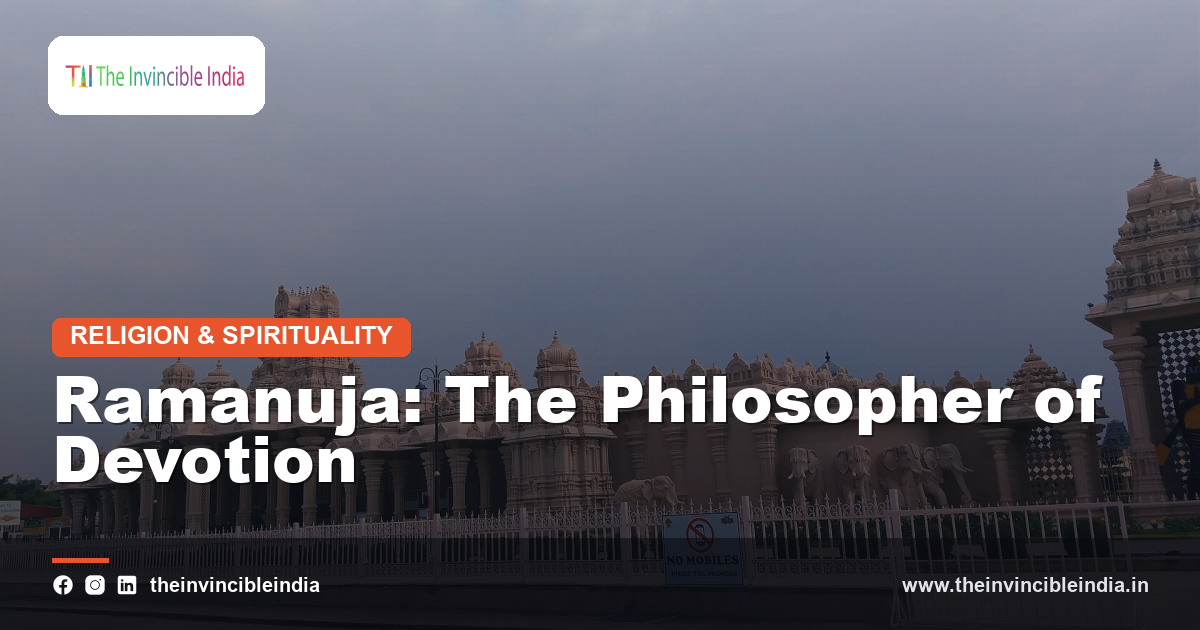
Ramanuja is remembered as one of the most influential philosopher-saints in the history of Indian thought, a teacher whose synthesis of devotion and philosophy reshaped the course of Hindu spirituality. Born in south India, he rose to become the foremost exponent of Vishishtadvaita, or qualified non-dualism, a school of Vedanta that affirmed both the reality of the individual soul and its intimate, loving relationship with a personal supreme being. Associated closely with the great temple town of Srirangam, Ramanuja travelled widely across the subcontinent, engaging in philosophical debate, composing influential commentaries, and building institutions that carried his teaching forward. His legacy endures today in the Sri Vaishnava tradition and in the wider heritage of devotional Hindu philosophy. This guide explores his life, teachings, writings and lasting influence.
Quick Facts
| Detail | Information |
|---|---|
| Known as | A philosopher-saint of the Sri Vaishnava tradition |
| Philosophy | Vishishtadvaita, or qualified non-dualism |
| Era | Traditionally placed in medieval south India |
| Associated centre | Srirangam temple, Tamil Nadu |
| Legacy | Foremost systematiser of Sri Vaishnavism |
| Key writings | Commentaries on the Brahma Sutras and Bhagavad Gita |
Early Life in South India
Ramanuja is traditionally held to have been born into a learned south Indian family, in a milieu where the study of Vedic texts and philosophy was highly valued. From an early age he is remembered as showing a keen intellect and a deep interest in questions of scripture and spiritual meaning, qualities that would define his later life as a teacher. He pursued his early education under respected teachers of the Vedanta tradition, immersing himself in the philosophical debates of his time. This grounding in rigorous scriptural study gave him the tools he would later use to develop his own distinctive philosophical school. His early years set the foundation for a life devoted entirely to the pursuit and teaching of spiritual truth.
Formative Philosophical Training
As a young scholar, Ramanuja studied under teachers associated with established schools of Vedanta, engaging closely with the interpretive traditions built around the Upanishads, the Brahma Sutras and the Bhagavad Gita. Even as he absorbed this inherited learning, he began to develop his own perspective, one that sought to reconcile the impersonal absolute described in some philosophical texts with the deeply personal, loving God described in popular devotion. This tension between abstract philosophy and heartfelt devotion became the central question that Ramanuja would spend his life addressing. His willingness to engage seriously with differing viewpoints, while ultimately charting his own path, marked him as an independent and original thinker even in his formative years.
The Turn Towards Vishishtadvaita
Ramanuja is remembered as having moved decisively toward a philosophical position that came to be known as Vishishtadvaita, or qualified non-dualism, distinguishing his thought from other prevailing schools of Vedanta of his era. This position held that ultimate reality was indeed one, but that this oneness contained real distinctions, with individual souls and the material world understood as intimately related to, yet not identical with, the supreme being. By affirming both unity and meaningful difference, Ramanuja offered a framework that could accommodate the philosophical concern for a single ultimate reality alongside the devotional experience of a personal, approachable God. This synthesis became the defining contribution of his life’s work.
Vishishtadvaita Explained
At the core of Vishishtadvaita is the idea that the individual soul, the material world and the supreme being together form a single reality, related to one another as the body is related to a soul that pervades and sustains it. Individual souls, in this view, retain their distinct identity even while existing in eternal dependence upon and relationship with the divine. This philosophy allowed Ramanuja to affirm the reality and value of the created world and the individual self, rather than viewing them merely as illusion, while still upholding the ultimate supremacy of the divine. Vishishtadvaita thus offered a middle path that honoured both philosophical rigor and the lived reality of devotion, shaping Hindu thought for centuries afterward.
Devotion as a Path to the Divine
Central to Ramanuja’s teaching was the conviction that loving devotion, or bhakti, offered the most accessible and complete path to the divine, open to people regardless of their scholarly training. He taught that a personal, loving relationship with a supreme, gracious God was not opposed to philosophical truth but was, in fact, its fullest expression in human life. This emphasis gave his philosophy an unusually warm and accessible character compared to more austere or abstract schools of thought, and it resonated deeply with the broader devotional movements flourishing in south India during his lifetime. His teaching helped give intellectual grounding to popular bhakti traditions, elevating heartfelt devotion to a position of philosophical respectability.
Association with Srirangam
Ramanuja is closely associated with the great temple town of Srirangam in present-day Tamil Nadu, one of the most important centres of Vaishnava worship in India. He is remembered as having spent significant periods of his life connected to the temple there, shaping its religious and administrative practices and using it as a base from which his teachings spread. The temple at Srirangam remains, to this day, one of the principal seats of the Sri Vaishnava tradition that traces its philosophical lineage to Ramanuja. This enduring association between the saint and the temple reflects the deep and lasting bond between his teaching and the institutional life of Vaishnava worship in south India.
Travels Across the Subcontinent
According to long-standing tradition, Ramanuja undertook extensive travels across the Indian subcontinent during his lifetime, visiting centres of learning and pilgrimage far beyond his south Indian homeland. These journeys are remembered as opportunities for him to engage in philosophical dialogue, establish temples and communities aligned with his teaching, and extend the reach of Sri Vaishnavism to new regions. Such travels, undertaken largely on foot across considerable distances, reflect the depth of his commitment to spreading his philosophy and the practice of devotion he espoused. The geographic reach of his influence, extending well beyond any single region, helped establish Vishishtadvaita as a pan-Indian philosophical tradition rather than a purely regional one.
Literary and Philosophical Works
Ramanuja is credited with a body of philosophical writing that remains foundational to the Sri Vaishnava tradition, most notably his commentary on the Brahma Sutras, known as the Sri Bhashya, along with commentaries on the Bhagavad Gita and other devotional and philosophical works. These writings systematically laid out the principles of Vishishtadvaita, engaging carefully with earlier philosophical schools while building his own distinct interpretive framework. His prose is remembered for its careful, reasoned argumentation, reflecting both deep scriptural learning and independent philosophical insight. These texts continue to be studied closely within the Sri Vaishnava tradition and in the broader field of Indian philosophy, securing his reputation as one of the great systematic thinkers of Vedanta.
Teaching on Surrender and Grace
A distinctive feature of Ramanuja’s teaching was its emphasis on surrender to the divine, a disposition of trust and humility through which a devotee could rely on divine grace rather than on personal effort alone. This teaching offered comfort and accessibility to devotees from all walks of life, suggesting that sincere devotion and reliance on a compassionate, personal God could open the path to spiritual fulfilment. This idea would go on to shape later developments within Sri Vaishnavism, including subsequent debates within the tradition about the relative importance of effort and grace. Ramanuja’s articulation of surrender as a spiritual disposition remains one of the most cherished aspects of his teaching within the devotional traditions that followed him.
Establishing the Sri Vaishnava Community
Ramanuja is remembered as a key figure in organising and strengthening the institutional life of the Sri Vaishnava community, establishing structures of temple worship, disciplic succession and communal practice that would carry his teachings forward across generations. He is credited with reforming certain aspects of temple administration and ritual practice to align them more closely with his philosophical and devotional vision. Through these efforts, Sri Vaishnavism developed into a well-organised tradition with clearly defined philosophical positions, ritual practices and community structures. This institutional legacy proved crucial in ensuring the survival and continued growth of the tradition long after Ramanuja’s own lifetime, giving his philosophy a lasting institutional home.
Disciples and Succession
Ramanuja is remembered as having gathered a significant following of disciples during his lifetime, individuals who carried forward and further elaborated his philosophical and devotional teachings. This body of disciples helped establish an enduring lineage of teachers within the Sri Vaishnava tradition, a succession that continued to interpret, defend and extend Vishishtadvaita philosophy across the centuries that followed. Later developments within the tradition, including subsequent schools of interpretation, trace their philosophical roots directly back to the foundational work laid down by Ramanuja and his immediate followers. This continuous chain of teaching and transmission reflects the depth of Ramanuja’s influence and the durability of the intellectual and devotional framework he established.
Influence on Bhakti Movements
Ramanuja’s synthesis of rigorous philosophy with heartfelt devotion had a considerable influence on the wider bhakti movements that flourished across India in the centuries following his life. By giving philosophical legitimacy to the path of loving devotion toward a personal God, he helped shape the intellectual climate in which later devotional traditions, across many regions and languages, could flourish with confidence. His ideas about the accessibility of devotion, regardless of social or scholarly standing, resonated with the broader spirit of the bhakti movement. This far-reaching influence illustrates how Ramanuja’s philosophical work extended well beyond the specific tradition of Sri Vaishnavism to touch the wider landscape of Hindu devotional thought.
Temples and Sacred Sites
A number of temples across India, particularly in south India, are closely associated with the memory and legacy of Ramanuja, serving as living centres of the Sri Vaishnava tradition he helped shape. The temple at Srirangam remains especially significant, but shrines and traditions linking back to his life and teaching are found in various parts of the subcontinent, reflecting the extent of his travels and influence. These sacred sites continue to draw pilgrims and devotees who honour his memory as a great teacher and saint. The continued vitality of these places of worship testifies to the lasting devotional and institutional legacy that Ramanuja left behind.
Philosophical Legacy in Indian Thought
Within the broader history of Indian philosophy, Ramanuja holds a position of central importance as one of the principal architects of Vedanta thought, alongside other major philosophical figures of the tradition. His qualified non-dualism offered an influential alternative within the spectrum of Vedantic philosophy, one that continues to be studied, debated and taught in centres of Indian philosophy to this day. Scholars and students of Indian philosophy regard his systematic writings as essential to understanding the full range of Vedantic thought. This enduring philosophical stature reflects the intellectual depth and rigor of his work, securing his place among the foremost thinkers in the history of Indian religious philosophy.
Ramanuja and Social Inclusion
Tradition remembers Ramanuja as holding an inclusive vision of devotion, one that regarded sincere faith and surrender to the divine as more significant than social distinctions of birth or scholarly attainment. This inclusive spirit, reflected in various accounts of his teaching and conduct, is remembered as a notable aspect of his approach to spiritual life. Such an emphasis on the universal accessibility of devotion aligned closely with the wider spirit of the bhakti movements gaining strength during his era. This aspect of his legacy continues to be recalled with admiration within the Sri Vaishnava tradition as an expression of the inclusive potential of devotional philosophy.
Commemoration and Continuing Reverence
Ramanuja continues to be remembered with deep reverence within the Sri Vaishnava tradition and across the wider landscape of Hindu devotional life, his memory honoured through festivals, temple observances and continued study of his writings. Institutions tracing their lineage to his teaching continue to function actively, preserving and transmitting his philosophical and devotional legacy to new generations. Statues and images of Ramanuja are found in temples associated with the Sri Vaishnava tradition, serving as reminders of his enduring stature as a teacher and saint. This continued veneration reflects the depth of the impression Ramanuja made on Indian religious life, an impression that has endured across many centuries.
Ramanuja Today
Today Ramanuja is remembered as one of the towering figures in the history of Hindu philosophy, a thinker whose synthesis of rigorous Vedantic reasoning and heartfelt devotion continues to shape the Sri Vaishnava tradition and to inform broader currents of Hindu thought. His philosophical writings remain subjects of serious study, while the temples and institutions associated with his life continue to serve as living centres of worship and learning. His teaching that devotion and philosophy need not be opposed, but can instead enrich one another, continues to resonate with those exploring the relationship between reason and faith. Ramanuja’s legacy endures as a testament to the depth and vitality of India’s philosophical and devotional heritage.
Sources & Further Reading
- Ministry of Culture, Government of India, on the philosophical and religious heritage of India (indiaculture.gov.in).
- Archaeological Survey of India, on the historic Srirangam temple and Vaishnava heritage sites (asi.nic.in).
Frequently Asked Questions
Who was Ramanuja?
Ramanuja was a philosopher-saint of medieval south India, remembered as the foremost systematiser of Vishishtadvaita, or qualified non-dualism, and a central figure in the Sri Vaishnava tradition of Hindu devotion.
What is Vishishtadvaita philosophy?
Vishishtadvaita, meaning qualified non-dualism, is the philosophy associated with Ramanuja that holds individual souls and the material world to be really distinct yet eternally related to a single supreme divine reality.
What is Ramanuja's connection to Srirangam?
Ramanuja is closely associated with the temple town of Srirangam in Tamil Nadu, where he is remembered as having shaped temple practice and used the site as a base for spreading his teachings.
What did Ramanuja teach about devotion?
Ramanuja taught that loving devotion, or bhakti, combined with humble surrender to a gracious, personal God, offered an accessible and complete path to spiritual fulfilment, open to people of all backgrounds.
What writings did Ramanuja leave behind?
Ramanuja is credited with influential commentaries on the Brahma Sutras, known as the Sri Bhashya, as well as commentaries on the Bhagavad Gita, texts that remain foundational to Sri Vaishnava philosophy.


