

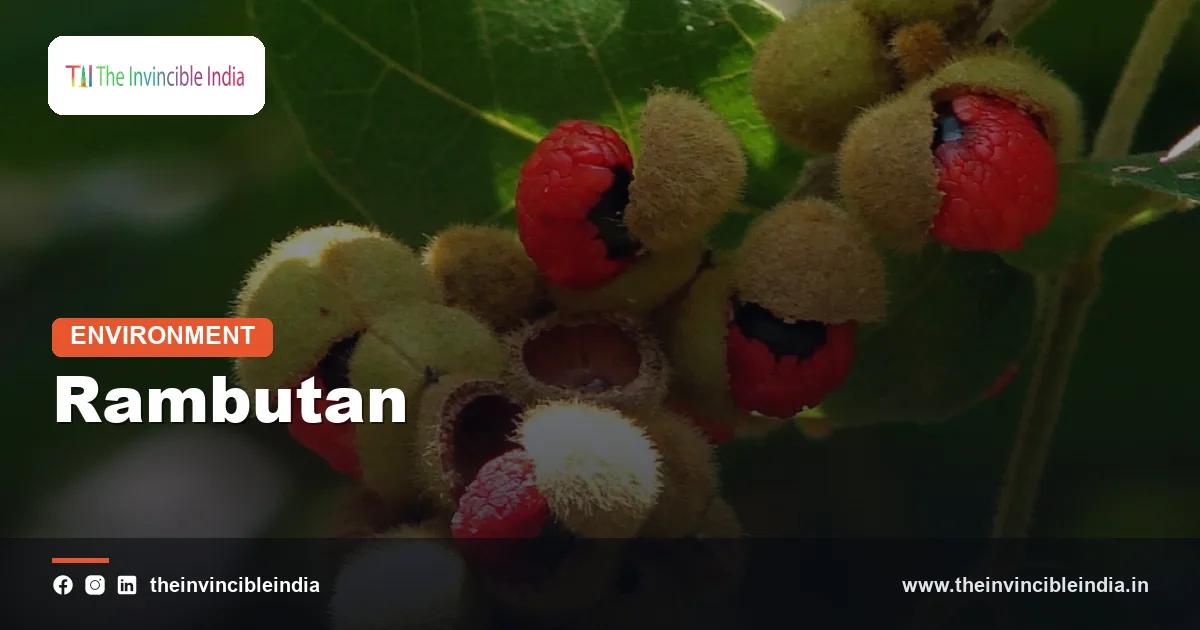
Rambutan (Nephelium lappaceum) is a small, oval, red tropical fruit covered in soft, hair-like spines that hides a sweet, juicy, translucent white flesh around a single seed, and it grows in India mainly in the humid south, especially Kerala. The rambutan tree is a close relative of the lychee and longan, belonging to the soapberry family Sapindaceae, and it originated in the Malay Archipelago of Southeast Asia.
Rambutan arrived in India in recent decades as a plantation and homestead fruit, and it has become a seasonal favourite in Kerala, where the fruit ripens around the monsoon. This explainer covers what rambutan is, how the tree grows, where it is cultivated in India, how it is eaten, what its nutrition is and how it compares with lychee and longan.
Quick Facts
| Common name | Rambutan |
|---|---|
| Scientific name | Nephelium lappaceum |
| Family | Sapindaceae (soapberry family), which also includes lychee and longan |
| Origin | Malay Archipelago in Southeast Asia (Malaysia and Indonesia) |
| Name meaning | From the Malay word rambut, meaning hair |
| Tree | Evergreen tree, commonly 10 to 20 m tall when mature |
| Fruit | Oval, 3 to 6 cm long, red or yellow with soft spines, white translucent flesh, one seed |
| Climate | Hot, humid tropics with high, well-spread rainfall and no frost |
| Main area in India | Kerala, with smaller plantings in southern Tamil Nadu, coastal Karnataka and the Andaman Islands |
Key Takeaways
- Rambutan (Nephelium lappaceum) is a red, hairy-skinned tropical fruit of the soapberry family, closely related to lychee and longan, and its name comes from the Malay word for hair.
- In India, rambutan is grown chiefly in Kerala, where the fruit usually ripens during the monsoon months, roughly from June to August.
- The edible part of a rambutan is the juicy, translucent white aril, which is sweet with a mild acidity; the skin is discarded and the seed should not be eaten raw.
- Rambutan trees need a hot, humid, frost-free climate and well-drained soil, and most are propagated by air-layering, budding or grafting to keep the quality of the fruit.
- Rambutan does not ripen further once picked, so fruit growers harvest whole clusters only when the fruit has fully coloured on the tree.
- Rambutan provides carbohydrates, some fibre and small amounts of vitamin C and minerals, and it is eaten fresh or used in juices, desserts and canned fruit.
What is rambutan?
Rambutan is the edible fruit of Nephelium lappaceum, an evergreen tropical tree, and it is recognised by its bright red, leathery skin that bears soft, curved, flexible spines resembling hair. The English name was adopted directly from Malay, where rambut means hair.
Botanically, the rambutan belongs to the family Sapindaceae, which also contains the lychee (Litchi chinensis), longan (Dimocarpus longan) and the soapberry or ritha tree (Sapindus) whose seeds are used as a natural soap in India. The fruit is classed as a drupe-like fruit with a single large seed, and the juicy part is a fleshy outgrowth of the seed coat called an aril.
The fruit is native to the lowland rainforests of the Malay Archipelago and has been cultivated for centuries in Malaysia, Indonesia, Thailand and Vietnam. Thailand, Indonesia and Malaysia remain among the largest producers, and the fruit is now also grown in parts of Central America, Africa, Australia and India.
How did rambutan come to India?
Rambutan was introduced to India in relatively recent times as a horticultural import from Southeast Asia, with Kerala emerging as the main growing area because its climate resembles that of the fruit’s homeland. Unlike mango or jackfruit, rambutan has no ancient history in the country.
The fruit spread in Kerala through nurseries, planters and farmers, particularly in the central and southern districts. Growers in the rubber and spice belt saw it as a profitable fruit tree that could grow alongside other crops in humid plantations. Public agricultural institutions and private nurseries have since promoted improved clones and grafted plants. Exact dates and the earliest planting sites are not firmly documented, so it is safest to say that the crop has expanded notably since the late twentieth century.
Today Kerala’s rambutan is sold in local markets and by roadside sellers in season, and it has become a recognisable part of the state’s monsoon fruit calendar alongside mangosteen, jackfruit and passion fruit.
Where is rambutan grown in India?
Rambutan is grown in India mainly in Kerala, with smaller plantings in southern Tamil Nadu, coastal Karnataka and the Andaman and Nicobar Islands, where the climate is hot and wet. Central Kerala districts, including Pathanamthitta, Kottayam and Kollam, are widely associated with rambutan farming.
The tree needs an average temperature of around 25 to 35 degrees Celsius, high humidity and regular rainfall, preferably well spread through the year. It is not suited to the cold winters and dry air of north India. A short dry spell helps trigger flowering, but long dry periods reduce fruit set and fruit quality.
- Soil: deep, well-drained, fertile loam rich in organic matter; waterlogging damages roots.
- Rainfall: generally above about 2,000 mm a year is favourable.
- Altitude: best in the lowlands and low hills; growth declines with cold.
- Shade: young trees prefer light shade, while mature trees need open sun for flowering.
What does the rambutan tree look like?
The rambutan tree is a medium to large evergreen with a dense, rounded crown, a short trunk and compound leaves made of two to four pairs of glossy oval leaflets. Mature trees often reach 10 to 20 metres, though orchard trees are pruned lower to ease harvesting.
Flowers and sex types
Rambutan flowers are small, greenish-white and borne in branched clusters at the shoot tips, and they attract bees. Trees differ in their flower types: some are male, producing pollen but no fruit; others are hermaphrodite but functionally female, producing fruit. Most commercial cultivars are of the fruiting type, which is one reason that grafted plants of known clones are preferred over seedlings, whose sex and quality are unpredictable.
Fruit development
Fruit clusters usually ripen some four months after flowering. The fruit turns from green to yellow to red or, in some varieties, stays yellow or orange. Each tree can bear hundreds of fruits in a good year, and the harvest is picked as whole clusters.
Common cultivars
Well-known cultivars include Rongrien and other Thai selections, as well as Malaysian types such as Binjai and Rapiah. Cultivar names used by farmers in Kerala vary, and nursery stock is often sold under local or trade names.
How is rambutan harvested and stored?
Rambutan is harvested when the fruit has fully developed its colour on the tree, because it is a non-climacteric fruit that does not ripen further or gain sweetness after picking. Growers cut entire clusters with a short piece of the stalk, rather than pulling single fruits.
Rambutan has a short shelf life. At room temperature the skin darkens and the spines blacken within two to three days, although the flesh may remain good a little longer. In a refrigerator in a perforated bag, the fruit can last for about a week, but the appearance deteriorates. For this reason, most Kerala fruit is sold within days of picking in nearby markets.
- Choose fruit with bright red or yellow skin and fresh green-tipped spines.
- Avoid fruit that smells fermented, has split skin or has dried, black spines.
- Peeled fruit can be frozen or canned in syrup.
How is rambutan eaten?
Rambutan is eaten fresh by splitting the skin with a fingernail or knife, squeezing out the translucent white flesh and discarding the skin and the seed. The flavour is sweet, slightly tangy and floral, similar to lychee but often milder and less perfumed.
The flesh may cling to the seed in some varieties and part freely in others, and fruit with a freestone seed is more valued. Outside fresh eating, rambutan is added to fruit salads, sherbets, jellies, ice cream and mixed drinks, and the fruit is canned in syrup for export in producing countries.
The seed is not normally eaten raw because it contains bitter compounds and is considered mildly toxic in raw form. In some Southeast Asian traditions, roasted seeds are consumed in small amounts, but this is not a recommended practice in India and is not necessary for enjoying the fruit.
What is the nutritional value of rambutan?
Rambutan flesh is a source of carbohydrates and water, with roughly 70 to 80 kilocalories per 100 grams, together with some fibre and small amounts of vitamin C and minerals. Most of the energy comes from natural sugars.
| Nutrient (approximate, per 100 g flesh) | Typical amount |
|---|---|
| Energy | About 70 to 82 kcal |
| Water | About 78 to 82 g |
| Carbohydrate | About 18 to 21 g |
| Dietary fibre | About 1 to 2 g |
| Protein | About 0.7 g |
| Fat | About 0.2 g |
Published values for vitamin C and minerals differ between varieties and studies, so rambutan is best described as a modest source rather than a rich one. The fruit is a pleasant addition to a varied diet but is not a medicine, and people watching their blood sugar should treat it like other sweet fruits and eat moderate portions.
How is rambutan different from lychee and longan?
Rambutan differs from lychee and longan mainly in its hairy red skin, its wetter tropical growing conditions and its usually milder, less perfumed taste, even though all three fruits belong to the Sapindaceae family and have a similar white aril. The three are often confused by buyers because the flesh looks alike.
| Feature | Rambutan | Lychee | Longan |
|---|---|---|---|
| Scientific name | Nephelium lappaceum | Litchi chinensis | Dimocarpus longan |
| Skin | Red or yellow with soft spines | Rough, bumpy, pinkish red | Smooth, tan to light brown |
| Flavour | Sweet, mildly tangy | Sweet, floral, aromatic | Sweet, musky |
| Climate | Hot, humid, equatorial | Subtropical with cool winters | Subtropical to tropical |
| Main Indian area | Kerala and the south | Bihar, West Bengal, Uttarakhand, Punjab | Only limited, scattered plantings |
Lychee, India’s well-known summer fruit, needs a cool, dry winter to flower, which is why it is grown in the north and east. Rambutan, by contrast, thrives in the hot, rainy south, so the two fruits do not compete for the same regions.
Is rambutan farming good for the environment?
Rambutan farming can be environmentally compatible when the trees are grown as part of mixed home gardens or agroforestry systems, because the tall evergreen canopy shades the soil, supports birds and insects and provides nectar for bees. However, the ecological outcome depends on how the orchard is managed.
Rambutan flowers are a source of nectar and pollen, and honey bees and stingless bees visit them in large numbers. Farmers who keep bee colonies in rambutan orchards often report better fruit set. Fruit bats and birds feed on the ripe fruit, which can cause crop losses but also forms part of the local food web.
Risks include heavy fertiliser and pesticide use in monoculture orchards, clearing of existing vegetation for new plantations and water stress in dry years. Mixed planting with spices, coconut and other fruit trees, mulching and integrated pest management are the usual recommendations from agricultural extension services.
How can a gardener grow a rambutan tree in India?
A gardener in a hot, humid part of India can grow a rambutan tree by planting a grafted or air-layered sapling in deep, well-drained, organic-rich soil, giving it light shade at first, regular watering and mulch, and protecting it from strong wind. Grafted plants of a known fruiting cultivar are strongly preferred to seedlings.
Seedlings are slow, variable and may turn out to be male trees that never fruit, so they are rarely recommended. A grafted tree usually begins to bear within about three to five years, while a seedling may take longer, if it bears at all. Planting pits are usually prepared in advance with compost, and young trees are spaced widely, often around 8 to 10 metres apart, because the canopy spreads with age.
- Water young trees regularly, but avoid standing water around the roots.
- Apply organic manure and balanced fertiliser in split doses through the year.
- Prune after harvest to open the canopy and keep the tree at a manageable height.
- Protect fruit from birds and bats with nets or bags during ripening.
- Watch for common problems such as powdery mildew, fruit-feeding insects and fruit drop in dry spells.
Home growers in cooler or drier regions, including most of north India, should not expect good results, because the tree is sensitive to cold and low humidity.
Bottom Line
Rambutan is a hairy, red tropical fruit of the lychee family that has found a good home in Kerala’s hot, humid climate. It is enjoyed fresh during the monsoon, needs careful handling because it spoils quickly, and fits well into mixed, bee-friendly home gardens and plantations.
Frequently Asked Questions
What is rambutan?
Rambutan is a tropical fruit with red, hairy-looking skin and sweet, juicy, translucent white flesh around a single seed. It belongs to the same family as lychee and longan and comes from Southeast Asia.
Where is rambutan grown in India?
Rambutan is grown mainly in Kerala, especially in the central and southern districts, with smaller plantings in southern Tamil Nadu, coastal Karnataka and the Andaman Islands. It needs a hot, humid, frost-free climate.
When is rambutan season in Kerala?
Rambutan season in Kerala generally runs from about June to August, around the monsoon. The exact timing varies with the cultivar, the location and the weather in the preceding months.
Is rambutan the same as lychee?
No, rambutan is not the same as lychee, although the two are close relatives in the family Sapindaceae. Rambutan has a hairy, soft-spined skin and a milder flavour, while lychee has a rough, bumpy skin and a more floral taste.
Can you eat the rambutan seed?
No, the rambutan seed should not be eaten raw because it contains bitter compounds and is considered mildly toxic. The seed and the skin are discarded, and only the white flesh is eaten.
How long does rambutan stay fresh?
Rambutan stays fresh for only two to three days at room temperature and about a week in a refrigerator. The spines darken quickly, and the fruit does not ripen further once it is picked.
{“@context”:”https://schema.org”,”@graph”:[{“@type”:”FAQPage”,”mainEntity”:[{“@type”:”Question”,”name”:”What is rambutan?”,”acceptedAnswer”:{“@type”:”Answer”,”text”:”Rambutan is a tropical fruit with red, hairy-looking skin and sweet, juicy, translucent white flesh around a single seed. It belongs to the same family as lychee and longan and comes from Southeast Asia.”}},{“@type”:”Question”,”name”:”Where is rambutan grown in India?”,”acceptedAnswer”:{“@type”:”Answer”,”text”:”Rambutan is grown mainly in Kerala, especially in the central and southern districts, with smaller plantings in southern Tamil Nadu, coastal Karnataka and the Andaman Islands. It needs a hot, humid, frost-free climate.”}},{“@type”:”Question”,”name”:”When is rambutan season in Kerala?”,”acceptedAnswer”:{“@type”:”Answer”,”text”:”Rambutan season in Kerala generally runs from about June to August, around the monsoon. The exact timing varies with the cultivar, the location and the weather in the preceding months.”}},{“@type”:”Question”,”name”:”Is rambutan the same as lychee?”,”acceptedAnswer”:{“@type”:”Answer”,”text”:”No, rambutan is not the same as lychee, although the two are close relatives in the family Sapindaceae. Rambutan has a hairy, soft-spined skin and a milder flavour, while lychee has a rough, bumpy skin and a more floral taste.”}},{“@type”:”Question”,”name”:”Can you eat the rambutan seed?”,”acceptedAnswer”:{“@type”:”Answer”,”text”:”No, the rambutan seed should not be eaten raw because it contains bitter compounds and is considered mildly toxic. The seed and the skin are discarded, and only the white flesh is eaten.”}},{“@type”:”Question”,”name”:”How long does rambutan stay fresh?”,”acceptedAnswer”:{“@type”:”Answer”,”text”:”Rambutan stays fresh for only two to three days at room temperature and about a week in a refrigerator. The spines darken quickly, and the fruit does not ripen further once it is picked.”}}]}]}


