

Soursop, known in Hindi as lakshman phal and in scientific terms as Annona muricata, is a large, spiny, green, heart-shaped tropical fruit with soft white pulp that tastes of a blend of strawberry, pineapple and citrus, grown on a small evergreen tree in the warm, humid parts of India. The soursop tree is native to the tropical Americas and the Caribbean, and it reached Asia through the colonial-era exchange of plants.
In India, soursop is a backyard and homestead fruit rather than a major commercial crop, with most trees found in Kerala, coastal Karnataka, Tamil Nadu, Maharashtra’s Konkan belt and the Andaman and Nicobar Islands. This explainer covers what soursop is, how the tree grows, how the fruit is eaten, what its nutritional value is, what the evidence says about health claims and where cautions apply.
Quick Facts
| Common names | Soursop, lakshman phal (Hindi), graviola (Portuguese and Spanish), guanabana |
|---|---|
| Scientific name | Annona muricata |
| Family | Annonaceae (custard-apple family) |
| Origin | Tropical Americas and the Caribbean |
| Tree | Small evergreen tree, usually 4 to 8 m tall, with glossy dark-green leaves |
| Fruit | Heart-shaped or oval, soft-spined green skin, white fibrous pulp, many black seeds |
| Climate | Warm, humid, frost-free tropical lowlands |
| Regions in India | Kerala, Karnataka coast, Tamil Nadu, Konkan, Andaman and Nicobar, parts of north-east India |
| Relatives in India | Custard apple or sitaphal (Annona squamosa), bullock’s heart or ramphal (Annona reticulata) |
Key Takeaways
- Soursop (Annona muricata), called lakshman phal in Hindi, is a tropical fruit of the custard-apple family (Annonaceae) that originated in the Americas and is now grown in warm coastal parts of India.
- The ripe soursop has a creamy, slightly fibrous white pulp with a sweet-sour flavour that is used for juices, sherbets, ice cream and smoothies.
- The soursop tree is a small, frost-sensitive evergreen that flourishes in humid tropical lowlands and usually begins fruiting three to five years after planting from seed.
- The seeds of the soursop fruit are hard, black and toxic to eat, and they should be removed and never chewed or crushed into food.
- Laboratory studies have tested extracts of soursop for biological activity, but no reliable clinical trials show that soursop treats or cures cancer or any other disease in people.
- Researchers have linked heavy, long-term consumption of annonaceous fruits and teas, including soursop, to a risk of a nerve disorder resembling atypical Parkinson’s disease, so moderation is advised.
What is soursop?
Soursop is the edible fruit of Annona muricata, an evergreen tree in the family Annonaceae, and it is among the largest fruits of the custard-apple group, often weighing from several hundred grams to a few kilograms. The English name “soursop” comes from the Dutch zuurzak, meaning “sour sack”, a reference to the sub-acid taste of the pulp.
In India the fruit is known by several local names. In Hindi and in many northern traditions, it is called lakshman phal, one of a set of names for custard-apple relatives (sitaphal, ramphal and lakshman phal) that draw on characters from the epic Ramayana. In Malayalam it is commonly called mullatha, and in Tamil, mullu seetha, names that refer to its spiny skin and its relationship with the custard apple.
The name graviola, used in international trade and in supplement marketing, is the Portuguese and Brazilian name of the same fruit. The related fruits sold in Indian markets include the custard apple or sitaphal and the bullock’s heart or ramphal, which are smaller and sweeter.
How did soursop reach India?
Soursop reached India as part of the movement of American crop plants across tropical Asia after the sixteenth century, carried by Portuguese and Spanish traders and plant collectors. No exact date or route for the first planting in India is firmly documented, so historians speak generally of introduction in the early colonial period.
Along with the custard apple, the guava, papaya, cashew, pineapple and chilli, soursop belongs to the group of New World plants that Indian farmers and gardeners adopted, often through coastal settlements and botanical gardens. The warm, humid west coast, with its established plantation culture, was a natural place for the tree to take hold. Over time, the tree became a familiar presence in Kerala home gardens, where it grew alongside coconut, banana and jackfruit.
Because the fruit is delicate and does not travel well, soursop never became a large-scale commodity in India. It remains a locally consumed fruit, sold in small quantities in farmers’ markets and by roadside vendors in the south.
What does the soursop tree look like?
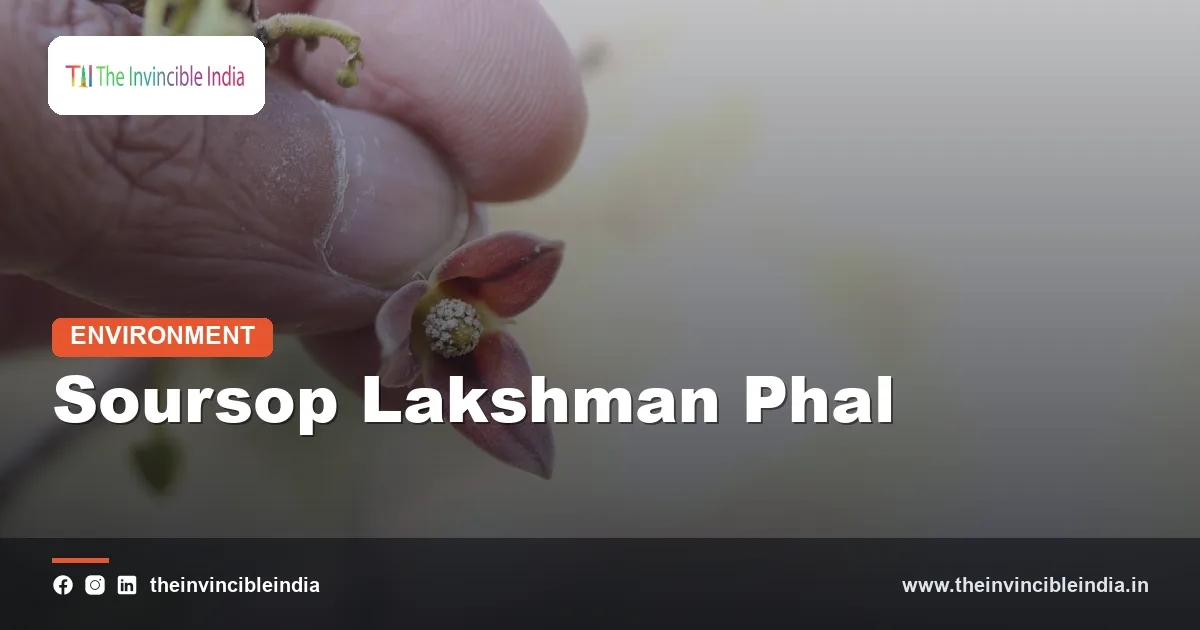
The soursop tree is a small, slender, evergreen tree, usually four to eight metres tall, with a rounded crown, glossy oblong leaves and large, fleshy, yellowish-green flowers that grow directly on branches and sometimes on the trunk. The leaves release a distinctive, slightly sharp scent when crushed.
Flowers and pollination
The flowers of the soursop are hermaphrodite, but the female parts mature before the male parts, a pattern called protogyny, which discourages self-pollination. Beetles are natural pollinators in the tree’s home range, and many fruits in home gardens are misshapen because pollination is poor. Gardeners often improve fruit shape by hand-pollinating flowers in the early morning.
The fruit
The fruit has a thin, dark-green skin covered with short, soft, curved spines that are not sharp. As the fruit ripens, the colour dulls to a lighter yellowish-green and the spines soften and spread apart. Inside, white pulp surrounds numerous glossy black seeds. Mature fruits are often 15 to 30 cm long, and some in favourable conditions grow even larger.
Where and how is soursop grown in India?
Soursop is grown in India mainly in the humid coastal and low-elevation tropics, including Kerala, coastal Karnataka, Tamil Nadu, parts of Andhra Pradesh, the Konkan coast of Maharashtra and the Andaman and Nicobar Islands, usually as scattered trees in home gardens. Cultivation is almost entirely small-scale.
The tree needs a warm, frost-free climate with high humidity and does best with annual temperatures roughly between 25 and 30 degrees Celsius. It is damaged by cold below about 5 degrees Celsius and struggles in dry, windy and arid conditions. It prefers deep, well-drained, slightly acidic soil rich in organic matter and does poorly in waterlogged ground.
- Propagation: most trees are grown from seed, which germinates in a few weeks; grafted or budded plants are used for more uniform fruit and earlier bearing.
- Fruiting: seedling trees typically bear from about three to five years of age, and grafted trees may bear earlier.
- Season: flowering and fruiting can continue through much of the year in warm regions, with peaks that depend on rainfall and local conditions.
- Common problems: fruit borers, mealybugs, scale insects, fruit rot and poor fruit set.
Harvesting requires care. Fruits are picked when still firm but showing signs of maturity, such as a dull skin and widely spaced spines, and then ripened off the tree for a few days at room temperature. A fruit left to ripen on the tree often drops and splits.
How is soursop eaten and used?
Soursop is eaten by scooping out the soft white pulp and discarding the seeds, and the pulp is most often blended into juice, sherbet, smoothies, ice cream and desserts. The flavour is a mix of strawberry, pineapple and citrus with a creamy, slightly sour finish.
Because the pulp is fibrous, cooks usually press it through a sieve before use. The pulp-based drink is commonly sweetened and chilled, and it is sold in some southern Indian towns as a seasonal juice. Soursop pulp also freezes well and is used in sorbets, custards and milkshakes.
Soursop leaves are used in some folk traditions to make a herbal infusion. This use is cultural rather than established medicine, and the safety of regular leaf tea is not well studied. Unripe soursop fruit is occasionally cooked as a vegetable in some tropical countries, but the practice is uncommon in India.
What is the nutritional value of soursop?
Soursop is a low-fat fruit that supplies carbohydrates, dietary fibre, vitamin C and potassium, and the edible pulp provides roughly 60 to 70 kilocalories per 100 grams according to common food composition tables. Exact values vary with ripeness and variety.
| Nutrient (approximate, per 100 g pulp) | Typical amount |
|---|---|
| Energy | About 60 to 66 kcal |
| Carbohydrate | About 14 to 17 g |
| Dietary fibre | About 3 g |
| Protein | About 1 g |
| Fat | Under 1 g |
| Vitamin C | Roughly 20 mg |
| Potassium | Roughly 280 mg |
The values above are indicative and come from international food composition databases, not from Indian field samples. Most of the energy comes from natural sugars, so people monitoring blood glucose should consume soursop in moderate portions. As with other fruits, whole pulp provides more fibre than strained juice.
Does soursop cure cancer or have proven health benefits?
No, soursop does not cure cancer, and there is no reliable clinical evidence in humans that soursop fruit, leaf tea or supplements treat or prevent cancer or any other serious disease. Cancer research organisations have stated that claims circulating online are not supported by human trials.
Part of the confusion arises from laboratory research. Soursop contains a group of plant compounds called annonaceous acetogenins, and some of these have shown toxic effects on cancer cells in test-tube and animal experiments. Results in cell cultures do not predict outcomes in people, because doses, absorption, safety and effectiveness are entirely different in a living patient. No large, well-designed human trials have established a benefit.
What the fruit does offer is ordinary nutrition. Like other fruits, soursop supplies vitamin C, fibre and potassium as part of a varied diet. Anyone with cancer or another serious illness should follow the treatment plan advised by their oncologist or physician and should not replace it with herbal products.
Is soursop safe to eat, and who should be careful?
Soursop pulp is generally safe in normal food amounts for most healthy adults, but the seeds are toxic and the fruit, leaves and supplements should be used with care because some compounds in this plant family affect the nervous system. The seeds should be spat out or removed rather than chewed or crushed.
Researchers studying people in Guadeloupe and other places noted an association between heavy, long-term consumption of soursop and related fruits and an atypical form of Parkinsonism. The compound annonacin is suspected to play a role. The evidence is epidemiological and experimental rather than conclusive, but it is the main reason that health agencies advise against high-dose, long-term use of soursop products, particularly concentrated extracts and teas.
- Pregnant and breastfeeding women are advised to avoid soursop leaf products and supplements, because safety data are lacking.
- People taking medication for high blood pressure or diabetes should consult a doctor, because soursop extracts may lower blood pressure and blood sugar in animal studies.
- People with kidney or liver disease, or those awaiting surgery, should seek medical advice before using supplements.
- Seeds and unripe fruit should not be eaten.
How do you choose and store soursop?
To choose a good soursop, pick a fruit with unblemished skin that is slightly soft when gently pressed and has spines that have spread apart, and ripen firm fruit at room temperature for two to four days. A ripe fruit yields to light pressure like a ripe avocado.
Once ripe, soursop spoils quickly, so it should be refrigerated and eaten within a couple of days. The pulp can be separated, de-seeded and frozen in portions for several months. Dark patches on the skin are normal in a ripe fruit, but a strong fermented smell or leaking juice indicates that the fruit has gone off.
How does soursop compare with custard apple and bullock’s heart?
Soursop differs from the custard apple (sitaphal) and the bullock’s heart (ramphal) in being larger, spinier, creamier and more tart, although all three belong to the genus Annona in the family Annonaceae. The three fruits are often sold in the same markets in southern India, and buyers sometimes confuse them.
| Feature | Soursop | Custard apple | Bullock’s heart |
|---|---|---|---|
| Scientific name | Annona muricata | Annona squamosa | Annona reticulata |
| Hindi name | Lakshman phal | Sitaphal | Ramphal |
| Skin | Dark green with soft spines | Pale green with knobby segments | Reddish brown, smooth with faint pattern |
| Pulp | Creamy, fibrous, sweet-sour | Granular, very sweet | Custardy, mildly sweet |
| Typical size | Large, often over 500 g | Small to medium | Medium |
| Climate | Humid tropical lowlands | Dry to semi-arid tropics | Humid tropics |
The custard apple tolerates drier conditions and is grown commercially in states such as Maharashtra, Gujarat and Andhra Pradesh, whereas soursop prefers humid coasts. All three fruits have toxic seeds and should be eaten pulp only, with the seeds discarded.
Bottom Line
Soursop, or lakshman phal, is a creamy, tart-sweet tropical fruit that has found a quiet place in warm Indian home gardens, especially in the south. It is a pleasant, nutritious fruit when eaten in moderation, but claims that it cures cancer are unsupported, and its seeds and concentrated products call for caution.
Frequently Asked Questions
What is soursop called in India?
Soursop is called lakshman phal in Hindi, mullatha in Malayalam and mullu seetha in Tamil. The scientific name is Annona muricata.
What does soursop taste like?
Soursop tastes like a creamy blend of strawberry, pineapple and citrus with a mildly sour finish. The pulp is soft, white and slightly fibrous.
Does soursop cure cancer?
No, soursop does not cure cancer. Laboratory studies have examined its compounds, but there are no reliable human clinical trials showing it treats or prevents cancer, so patients should follow medical advice.
Are soursop seeds poisonous?
Yes, soursop seeds are toxic and should not be eaten, chewed or crushed. They contain compounds, such as annonacin, that affect nerve cells, so the seeds should always be removed from the pulp.
Where is soursop grown in India?
Soursop is grown mainly in warm, humid coastal parts of India such as Kerala, coastal Karnataka, Tamil Nadu, the Konkan and the Andaman and Nicobar Islands. It is mostly a home-garden fruit, not a large commercial crop.
How long does a soursop tree take to fruit?
A soursop tree grown from seed usually begins to fruit in about three to five years, and grafted trees may fruit earlier. The tree needs a warm, frost-free and humid climate.
{“@context”:”https://schema.org”,”@graph”:[{“@type”:”FAQPage”,”mainEntity”:[{“@type”:”Question”,”name”:”What is soursop called in India?”,”acceptedAnswer”:{“@type”:”Answer”,”text”:”Soursop is called lakshman phal in Hindi, mullatha in Malayalam and mullu seetha in Tamil. The scientific name is Annona muricata.”}},{“@type”:”Question”,”name”:”What does soursop taste like?”,”acceptedAnswer”:{“@type”:”Answer”,”text”:”Soursop tastes like a creamy blend of strawberry, pineapple and citrus with a mildly sour finish. The pulp is soft, white and slightly fibrous.”}},{“@type”:”Question”,”name”:”Does soursop cure cancer?”,”acceptedAnswer”:{“@type”:”Answer”,”text”:”No, soursop does not cure cancer. Laboratory studies have examined its compounds, but there are no reliable human clinical trials showing it treats or prevents cancer, so patients should follow medical advice.”}},{“@type”:”Question”,”name”:”Are soursop seeds poisonous?”,”acceptedAnswer”:{“@type”:”Answer”,”text”:”Yes, soursop seeds are toxic and should not be eaten, chewed or crushed. They contain compounds, such as annonacin, that affect nerve cells, so the seeds should always be removed from the pulp.”}},{“@type”:”Question”,”name”:”Where is soursop grown in India?”,”acceptedAnswer”:{“@type”:”Answer”,”text”:”Soursop is grown mainly in warm, humid coastal parts of India such as Kerala, coastal Karnataka, Tamil Nadu, the Konkan and the Andaman and Nicobar Islands. It is mostly a home-garden fruit, not a large commercial crop.”}},{“@type”:”Question”,”name”:”How long does a soursop tree take to fruit?”,”acceptedAnswer”:{“@type”:”Answer”,”text”:”A soursop tree grown from seed usually begins to fruit in about three to five years, and grafted trees may fruit earlier. The tree needs a warm, frost-free and humid climate.”}}]}]}


