

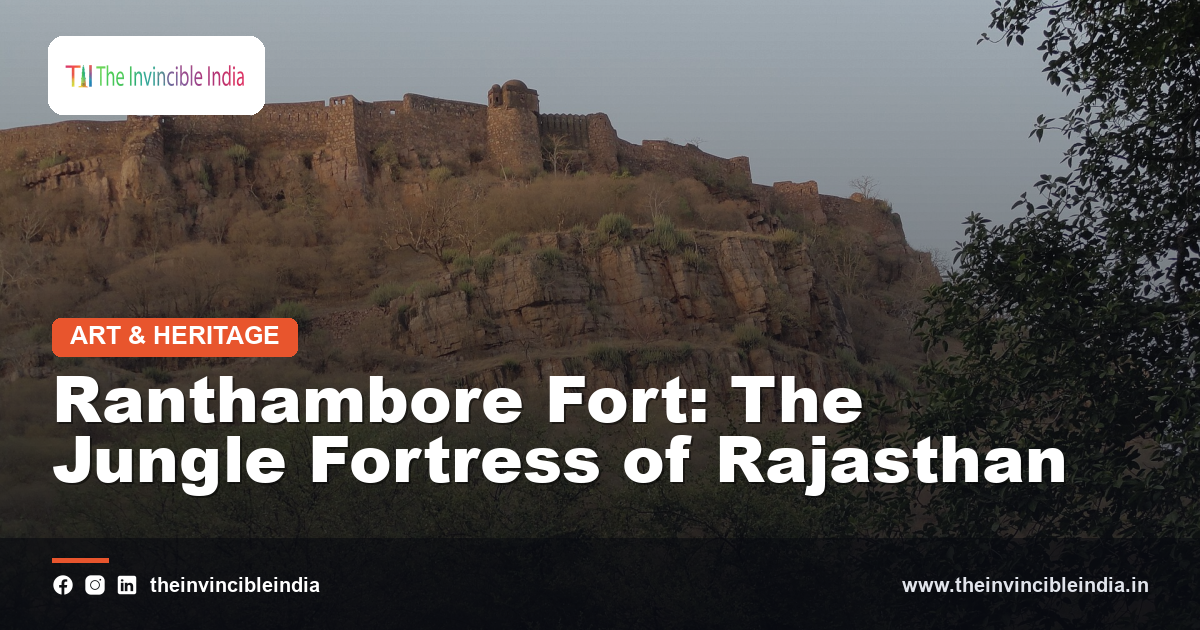
Ranthambore Fort rises from a rugged plateau in eastern Rajasthan, its weathered ramparts and bastions emerging from a landscape of dry deciduous forest and rocky hills. Once among the most coveted strongholds of northern India, it witnessed centuries of Rajput valour, sieges, and changing dynasties. Today the fort forms part of a celebrated group of hill citadels recognised as a World Heritage property, and it shares its setting with a famous national park. Its massive gates, ruined palaces, temples, and ancient reservoirs reward every visitor who climbs its steep approach. Like the great forts of India, Ranthambore is not merely a military structure but a record of history, faith, and the relationship between people and the land.
Quick Facts
| Detail | Information |
|---|---|
| Location | Sawai Madhopur district, Rajasthan |
| Type | Hill fort on a rocky plateau |
| Associated rulers | Chauhan Rajputs and later powers |
| Heritage status | Part of the Hill Forts of Rajasthan, UNESCO World Heritage |
| Setting | Within Ranthambore National Park |
| Famous shrine | Trinetra Ganesh Temple |
A Fortress in the Forest
Ranthambore Fort occupies a commanding position on a rocky hill in eastern Rajasthan, where the Aravalli and Vindhya ranges approach one another. The fort stands within a landscape of forested ridges, open glades, and seasonal streams, and from its walls the visitor looks out over a wide sweep of countryside. This setting is central to its identity, for the dense woodland that surrounds the hill once added a further layer of natural defence to the stone walls themselves. Few other Indian forts blend so closely with the wilderness around them. Today the hill is enclosed within a renowned protected area, and the ruins of the fort share the forest with wildlife that has made the region famous worldwide. The union of history and nature is what gives Ranthambore its distinctive character, setting it apart from the desert citadels of western Rajasthan and affirming its place as a fortress born of both strategy and landscape.
Origins and Early Tradition
The origins of Ranthambore Fort are lost in the mists of early medieval history, and tradition attributes its foundation to rulers of the region in the centuries before the great sieges of the Delhi Sultanate. Like many ancient strongholds in India, the fort grew gradually, with successive generations strengthening its walls, adding gates, and building shrines and cisterns. Local memory preserves stories about its earliest builders, but the surviving structures reflect a long process of expansion and repair rather than a single act of construction. What can be said with confidence is that the site was recognised as strategically valuable from an early period, because its plateau was easily defended and controlled routes between the plains and the hills. The fort therefore emerged as an important centre of authority long before it became famous in chronicles. Its origins, though uncertain in detail, point clearly to a place chosen and cherished for its natural strength.
The Chauhan Era and Rajput Resistance
Ranthambore is most closely associated with the Chauhan Rajputs, whose rulers made the fort a bastion of their power in the medieval period. Under the Chauhans the stronghold became a symbol of Rajput independence and pride, drawing warriors, administrators, and artisans to its walls. The most celebrated figure linked with the fort is Hammir Dev, remembered in the folk tradition and literature of Rajasthan as a ruler who upheld honour and refused to surrender. His story, retold in poetry and local legend, has made Ranthambore a name that evokes courage and sacrifice across generations. While the details of such narratives are shaped by memory and storytelling, their cultural importance is undeniable. The Chauhan era gave the fort its place in the Rajput imagination, ensuring that its stones are remembered not only for their strength but for the ideals of loyalty and resistance that later generations attached to them.
Sieges and Changing Hands
Because of its strength and strategic location, Ranthambore attracted the attention of every ambitious power in northern India. The fort was besieged on more than one occasion during the medieval period, and its long defence against powerful armies became legendary. Chroniclers of the Delhi Sultanate recorded its capture as an event of great significance, and the fort passed through the hands of several authorities over the following centuries. Later it came under the Mughal emperors, who valued it as a fortress controlling the approaches between important regions. In time it passed to the rulers of Jaipur, under whom it served as a hunting preserve as well as a historic stronghold. This succession of owners shows how central the fort was to the politics of the subcontinent. Each power left its imprint, and together they turned Ranthambore into a layered monument whose walls record the rise and fall of dynasties.
Walls, Bastions, and Defensive Design
The defensive design of Ranthambore Fort follows the logic of the terrain. Long ramparts trace the edge of the plateau, following the contours of the cliffs so that natural slopes and man-made walls reinforce one another. Bastions project at intervals along the circuit, giving defenders a wide field of fire, while narrow, steeply rising approaches force any attacker to climb under pressure. The walls were built of local stone and are pierced by loopholes and crowned by battlements from which guards could watch the surrounding plain. Within the circuit there is ample room for buildings, storehouses, and reservoirs, which allowed a garrison to endure prolonged sieges. The overall impression is one of unadorned practicality, where every feature serves a purpose in survival and control. This blend of natural and constructed defence shows the skill of the builders, who understood that a fort is strongest when it works with the hill rather than against it.
The Great Gates of the Fort
Entry to Ranthambore Fort is achieved through a sequence of massive gateways, each placed so that visitors and attackers alike must pass through a series of narrow, guarded thresholds. Among the best known are the Navlakha Pol, the Hathi Pol, the Andheri Pol, and the Delhi Gate, each with its own character and setting. The gates are built of heavy stone, with strong arches, thick walls, and bends in the approach that slow movement and expose anyone passing through to defenders above. Some passages are dark and enclosed, which explains the names that people have given them over time. Beyond their military role, the gates also act as ceremonial entrances that prepare the visitor for the interior of the fort. Moving through them is an experience of gradual ascent and transition, from the open forest below to the quiet ruins above, and it remains one of the most memorable parts of any visit.
The Trinetra Ganesh Temple
Within the fort stands a temple to Ganesh that is among the most beloved shrines of the region. Known as the Trinetra Ganesh Temple, it is dedicated to the elephant-headed deity in a form shown with three eyes, a feature that gives the shrine its name. Devotees travel from near and far to offer prayers here, and it is especially associated with the custom of sending invitations to Ganesh for weddings and other important family occasions. Letters and cards addressed to the deity reach the temple from many parts of the country, a tradition that reflects the warmth and intimacy of popular devotion. The shrine sits within the walls of the fort, and a climb through the gates leads pilgrims to its quiet courtyard. Its presence reminds the visitor that Ranthambore is not only a place of battle and strategy but also a living centre of faith, where ancient traditions continue to shape daily life.
Other Temples and Sacred Spaces
Beyond the famous Ganesh shrine, the plateau of Ranthambore contains a number of other temples and sacred spaces that reveal the devotional life of the fort across centuries. Shrines to Shiva and to other deities, along with older structures in varying states of preservation, are scattered among the ruins. Some of these buildings display carved pillars, ornamented doorways, and sculptural fragments that reflect the artistic tastes of the dynasties who patronised them. Jain traditions are also represented at the site, which shows the diversity of religious practice within the fort. The religious structures stand alongside palaces and gateways, illustrating how worship was woven into the life of a medieval garrison. For pilgrims, they offer places of quiet reflection, while for students of architecture they provide evidence of changing styles. Together they ensure that the fort is understood as a complete community, where defence, governance, and devotion existed side by side.
Palaces, Pavilions, and Courtly Life
Although much of the fort now lies in ruins, the remains of its palaces and pavilions give a sense of the courtly life once lived on the plateau. Structures such as the Badal Mahal and the Hammir Court are remembered as places where rulers held audience and conducted the business of the state. Their stone walls, arched openings, and terraces suggest buildings designed for both comfort and display, set against sweeping views of the surrounding forest. Chhatris, or domed pavilions, rise at vantage points and provide shaded places to rest and observe the countryside. Many of these structures have been softened by age, with plants growing from their cracks and stones weathered by the seasons, yet their outlines remain clear. They evoke a world of ceremony, hunting, and politics that existed within the fortress walls. In their present state they speak with quiet force of the rise and fading of royal power in the region.
Lakes, Reservoirs, and Water Management
Water was the lifeblood of any fortress, and Ranthambore Fort contains a series of ponds, tanks, and reservoirs that allowed its inhabitants to survive long periods of siege. Among the best known is the Padam Talao, a large pond on the plateau whose waters reflect the ruins and surrounding trees. Other reservoirs, carved into the rock or built with stone embankments, collected rainwater during the monsoon and stored it for use through the dry months. This careful management of water reflects the practical intelligence of the fort’s builders and administrators. The tanks also created pockets of greenery and attracted birds and animals, adding to the beauty of the plateau. Today these waterbodies remain important parts of the landscape, valued both for their historical significance and for the life they support. They demonstrate that the strength of a fortress rested not only on walls and gates but also on the secure provision of its most essential resource.
Jogi Mahal and the Surrounding Landscape
At the foot of the fort, beside a lake in the forest, stands a former hunting lodge known as the Jogi Mahal. It was once used by visitors to the area as a rest house, and it is associated with a large and ancient banyan tree that has become a local landmark. The building and its setting form a quiet corner of the wider fort landscape, where water, trees, and old stone come together in a scene of great calm. From the lodge one can look up toward the walls of the fort on the hill, appreciating how the fortress dominates the valley below. The area is also frequented by wildlife that comes to drink at the lake, adding a living dimension to the historic scene. The Jogi Mahal shows that the heritage of Ranthambore extends beyond the fort itself, embracing the lakes, woods, and lodges that together make up a unified cultural landscape.
The Fort and the National Park
One of the most unusual aspects of Ranthambore is that the fort stands inside a protected national park, famous for its wildlife and its tigers. This partnership between monument and reserve is the result of the region’s history as a royal hunting ground, which preserved large areas of forest long after the fort’s military role had ended. Visitors to the park often see the ruins of the fort rising from the trees, and they may encounter peacocks, deer, langurs, and many other creatures among the old walls and ponds. The combination of ancient architecture and living wilderness is rare and gives the place a special atmosphere. It also brings responsibilities, for the conservation of the forest and the preservation of the fort must be balanced with the needs of visitors. When managed with care, the two goals reinforce each other, protecting a landscape in which natural and cultural heritage are inseparable parts of one story.
World Heritage Recognition
Ranthambore Fort is inscribed as part of a serial World Heritage property known as the Hill Forts of Rajasthan, alongside other great citadels of the state. The inscription recognises the group as an outstanding example of the military architecture and defensive traditions of the Rajput rulers, with fortifications adapted to hills, forests, and deserts. For Ranthambore, the recognition affirms its role as a fort shaped by a forested environment and by centuries of political history. World Heritage status also brings attention, research, and support for conservation, helping to protect the site for future generations. It encourages visitors to see the fort as part of a wider network of related monuments, each telling a different part of the story of Rajasthan. The designation is a reminder that heritage belongs to all humanity, and that places like Ranthambore, though rooted in a single region, carry meanings that extend far beyond their own walls and valleys.
Folklore, Memory, and Literature
The fort has a rich life in folklore, ballad, and written tradition, and its story has been retold for generations by bards and storytellers. Tales of heroism, loyalty, and tragic sacrifice cluster around the name of Ranthambore, shaping how it is remembered in Rajasthan and beyond. Such stories are not simply entertainment; they carry values that communities have chosen to preserve, including courage, honour, and devotion to a cause. The fort appears in poems and folk songs, and its name is invoked as a symbol of steadfastness. While historians distinguish between legend and documented fact, they recognise that memory itself is part of heritage, giving a place meaning that stone alone cannot provide. In this sense, Ranthambore lives in the imagination as much as in its ruins. The tradition of storytelling around the fort ensures that new visitors arrive already connected to a long chain of voices that has kept its memory alive.
Conservation and Visiting Today
Preserving a large hill fort in a forest setting is a demanding task, requiring regular repair of walls, clearing of vegetation, and protection against the effects of weather. Conservation work at Ranthambore is carried out by the responsible authorities, who must also manage visitor access so that the monument and the surrounding wildlife are not harmed. Pathways, signage, and carefully regulated entry help visitors understand the site without damaging it. For those who come, the best approach is to move slowly, follow the rules of the park, and allow time to appreciate both the architecture and the natural surroundings. Respect for the shrines within the fort is especially important, since they remain places of living worship. Responsible tourism supports the local community and helps fund the continued care of the monument. Through such shared effort, the fort can remain accessible while retaining the quiet dignity that makes it so impressive.
Ranthambore Fort Today
Today Ranthambore Fort stands as one of the most evocative monuments of Rajasthan, a place where centuries of history are written into stone and surrounded by living forest. Its gates, ramparts, temples, and reservoirs preserve the memory of the Chauhan rulers, the great sieges, and the later dynasties that held the plateau. At the same time, the fort remains a place of devotion, drawing pilgrims to its Ganesh shrine and visitors to its quiet ruins. Its recognition as a World Heritage property has placed it among the treasures of human civilisation, while its setting within a national park gives it a unique natural dimension. For students of history, lovers of architecture, and seekers of beauty, the fort offers lasting rewards. It remains a powerful reminder that heritage and nature can share a single landscape, and that India’s great fortresses continue to speak to the present with calm and enduring authority.
Sources & Further Reading
- Archaeological Survey of India (asi.nic.in).
- UNESCO World Heritage Centre, Hill Forts of Rajasthan (whc.unesco.org).
Frequently Asked Questions
Where is Ranthambore Fort located?
Ranthambore Fort is located in the Sawai Madhopur district of eastern Rajasthan. It stands on a rocky plateau inside Ranthambore National Park, surrounded by forested hills.
Which dynasty is most closely linked with Ranthambore Fort?
The fort is most closely associated with the Chauhan Rajputs, and especially with the legendary ruler Hammir Dev. It later passed through the hands of the Delhi Sultanate, the Mughals, and the rulers of Jaipur.
Is Ranthambore Fort a World Heritage Site?
Yes, Ranthambore Fort is part of the serial World Heritage property called the Hill Forts of Rajasthan. The group recognises the distinctive military architecture of the Rajput rulers.
What is the Trinetra Ganesh Temple?
It is a famous shrine to Ganesh located inside the fort, where the deity is worshipped in a three-eyed form. Devotees traditionally send wedding invitations and letters to the temple.
Can visitors see wildlife near the fort?
Yes, because the fort stands within a national park, visitors may see deer, langurs, peacocks, and other animals around the ruins and lakes. Visits should follow the rules of the park to protect both wildlife and the monument.


