

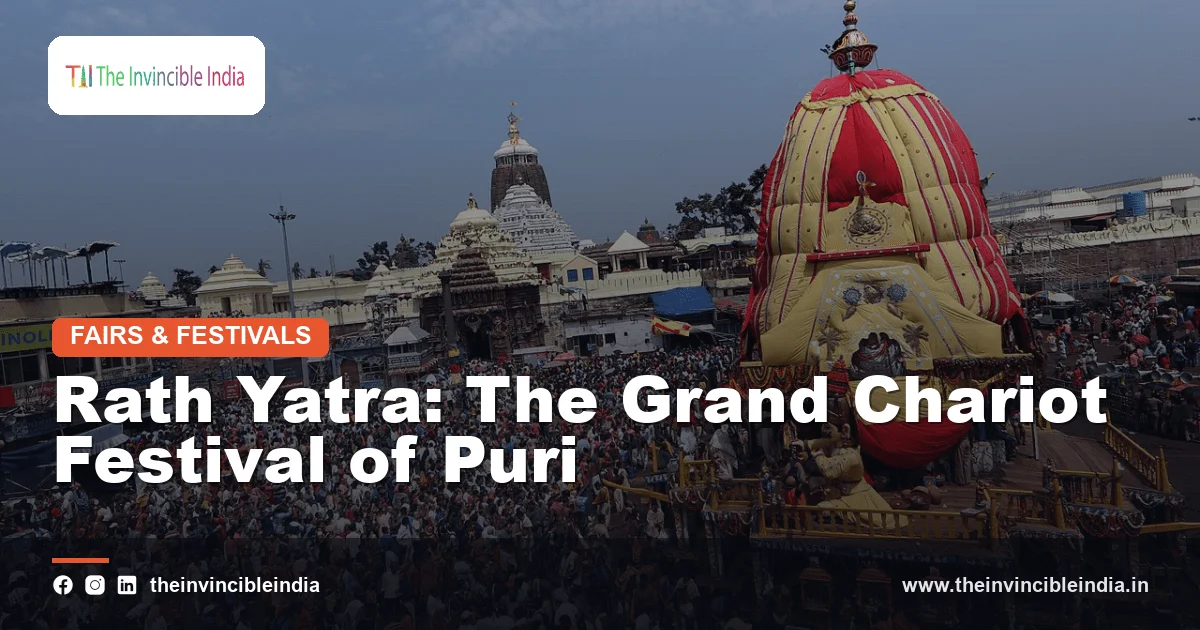
The Rath Yatra of Puri, the majestic Chariot Festival of Lord Jagannath, is one of the oldest, largest and most spectacular religious processions on earth. Held every year in the coastal town of Puri in Odisha, it draws well over a million devotees from across India and around the world, who gather to witness the deities of Lord Jagannath, his brother Balabhadra and sister Subhadra journey from their temple through the streets on gigantic, elaborately decorated wooden chariots. This guide explores the history, meaning, rituals and grandeur of this extraordinary festival, and offers practical guidance for those who wish to experience it.
Quick Facts: Rath Yatra of Puri
| Detail | Information |
|---|---|
| Location | Puri, Odisha |
| Deities | Lord Jagannath, Balabhadra, Subhadra |
| When | June or July (Ashadha month, bright fortnight) |
| Main route | Jagannath Temple to Gundicha Temple (about 3 km) |
| Number of chariots | Three, rebuilt new every year |
| Attendance | Over a million devotees |
The Deities and the Jagannath Temple
At the heart of the festival is Lord Jagannath, a form of Lord Vishnu or Krishna, whose name literally means “Lord of the Universe” and from which the English word “juggernaut” is derived. He is worshipped alongside his elder brother Balabhadra and his sister Subhadra. Uniquely, the images of these deities are carved from wood in a distinctive, abstract style with large round eyes and unfinished arms, and they are ceremonially replaced with new idols every few years in a secret ritual known as Nabakalebara.
Their home is the great Jagannath Temple in Puri, one of the four sacred Char Dham pilgrimage sites for Hindus and a towering example of Kalinga temple architecture, built in the 12th century. For most of the year the deities reside within the temple, but during Rath Yatra they emerge to travel among the people, an event of immense spiritual significance.
The Meaning of the Chariot Festival
The Rath Yatra commemorates the journey of Lord Jagannath from his temple to the Gundicha Temple, believed to be the home of his aunt, where the deities stay for a week before returning. Symbolically, the festival represents the Lord coming out to bless all his devotees, including those who may never be permitted to enter the temple itself, making it one of the most inclusive and democratic of Hindu festivals. The act of pulling the chariot ropes is considered a great blessing, believed to cleanse the devotee of sins and grant spiritual merit.
The Magnificent Chariots
The three chariots are marvels of traditional craftsmanship, built afresh every single year from specific types of wood by hereditary carpenters, using no nails or metal. Lord Jagannath’s chariot, called Nandighosha, is the largest, rising to a great height on sixteen wheels. Balabhadra’s chariot is Taladhwaja, and Subhadra’s is Darpadalana, each of a distinct colour and design. Adorned with bright canopies and decorations, these towering structures are pulled by thousands of devotees using long, thick ropes, moving slowly through the sea of humanity along the grand avenue known as the Bada Danda.
The Rituals of the Festival
The festival is rich in ancient rituals. One of the most striking is the Chhera Pahara, in which the Gajapati King of Puri, considered the first servant of the Lord, sweeps the chariot platforms with a golden broom and sprinkles sandalwood water, symbolising that before God all are equal, regardless of status. After a week at the Gundicha Temple, the deities make the return journey in a ceremony called Bahuda Yatra, during which they receive an offering of a special sweet pancake known as Poda Pitha.
The Legend and Spiritual Symbolism
Behind the grandeur of the Rath Yatra lies deep spiritual symbolism that has drawn seekers and philosophers for centuries. The chariot is often interpreted as a metaphor for the human body, with the deity within representing the soul, and the journey symbolising the progress of life towards the divine. The pulling of the chariot by countless hands, rich and poor together, expresses the idea that devotion transcends all barriers of caste, creed and status. Various legends surround the festival, including the belief that Lord Jagannath expresses his wish to visit his birthplace and the home of his devotees, coming out of the sanctum once a year so that all may behold him and receive his blessings, an event known as the Ratha Yatra darshan, considered supremely auspicious.
The Nabakalebara Ceremony
One of the most extraordinary and mysterious traditions connected with Lord Jagannath is the Nabakalebara, meaning “new body”, a secret ceremony held every few years when the wooden idols of the deities are ceremonially replaced with new ones. This rare event, which can occur only in years with a particular astronomical configuration, involves an elaborate ritual in which specially selected neem trees, identified by sacred marks, are located and used to carve the new images. The transfer of the mysterious “life substance” from the old idols to the new is performed by blindfolded priests in complete secrecy at the dead of night. Nabakalebara draws even larger crowds than usual and is regarded as one of the most sacred moments in the Jagannath tradition.
The Grand Scale and Atmosphere
To witness the Rath Yatra in person is to be swept up in an ocean of humanity and devotion unlike almost anything else on earth. The wide avenue of the Bada Danda fills with more than a million pilgrims, their voices rising in chants and prayers, as the towering chariots inch forward, pulled by thousands straining at the enormous ropes. The air is filled with the sound of conch shells, drums, cymbals and kirtans, while the scent of incense and flowers mingles with the sea breeze. Priests, dancers and elephants add to the spectacle, and the sheer emotional intensity of the crowd, many moved to tears at the sight of their beloved Lord, creates an atmosphere of overwhelming spiritual power.
Experiencing the Festival: Practical Tips
For those wishing to attend the Rath Yatra, careful planning is essential given the enormous crowds. Accommodation in Puri must be booked far in advance, as hotels fill months ahead. Visitors should be prepared for dense crowds, heat and humidity, and should carry water, wear comfortable clothing and stay alert to their belongings. It is wise to arrive early to secure a good vantage point along the route, and to follow the instructions of the authorities and volunteers who manage the massive gathering. Combining the visit with the other attractions of Odisha, such as the Sun Temple at Konark and the temples of Bhubaneswar, makes for a deeply rewarding journey through the spiritual heartland of eastern India.
The Deities’ Journey and Stay at Gundicha
The heart of the Rath Yatra is the sacred journey of the three deities from the Jagannath Temple to the Gundicha Temple, about three kilometres away, where they remain for a week. This period is known as the Gundicha Yatra, and the days the deities spend there are marked by special rituals and worship. On the return journey, called the Bahuda Yatra, the chariots pause at the Mausi Maa Temple, dedicated to the Lord’s aunt, where the deities are offered the famous Poda Pitha, a baked rice cake said to be Lord Jagannath’s favourite. Upon returning to the main temple, one of the most beautiful rituals takes place: the Suna Besha, when the deities are adorned in magnificent golden ornaments and displayed to the multitude of devotees, a sight of dazzling splendour.
The Jagannath Culture of Odisha
The worship of Lord Jagannath is not merely a religious practice but the very soul of Odishan culture and identity. The traditions, art, dance, cuisine and daily life of the region are deeply intertwined with the deity and his temple. The famous Mahaprasad, the sacred food offered to Lord Jagannath and prepared in one of the largest temple kitchens in the world, is considered supremely holy and is shared without distinction of caste or status, embodying the inclusive spirit of the tradition. The Pattachitra paintings, appliqué work, and classical Odissi dance all draw inspiration from the Jagannath cult, making the festival a celebration of an entire living heritage.
A Festival for All Humanity
What makes the Rath Yatra truly special is its profoundly inclusive nature. Unlike many temple rituals restricted to certain devotees, the Rath Yatra brings the Lord out into the open, onto the public road, where anyone, regardless of faith, background or standing, may behold him, touch the chariot and pull its ropes. This egalitarian spirit has made the festival a symbol of universal devotion and has inspired similar Rath Yatra celebrations in cities across India and around the world, from London to New York, wherever the followers of the tradition have carried their faith. In this way, the humble town of Puri sends out each year a message of unity, devotion and joy that resonates across the globe.
Best Time and How to Reach Puri
The Rath Yatra falls in June or July, during the warm and humid early monsoon season, so visitors should be prepared for heat and occasional rain. Puri is well connected by rail to major Indian cities and lies a short distance from the Odisha capital, Bhubaneswar, which has the nearest airport, about 60 kilometres away. During the festival, transport and accommodation are in extremely high demand, so booking well in advance is essential. Beyond the festival, Puri itself is a popular seaside destination with a fine beach, and it forms part of the celebrated “Golden Triangle” of Odisha tourism along with Bhubaneswar and the Sun Temple at Konark, making it easy to combine spiritual and cultural sightseeing in a single rewarding trip.
The Universal Message of the Rath Yatra
The Rath Yatra of Puri is far more than a spectacular religious procession; it is a living expression of faith, unity and joy that has endured for many centuries and continues to touch the lives of millions. In the sight of the great chariots rolling forward, drawn by the hands of the humble and the mighty alike, lies a timeless message: that the divine belongs to all, that devotion knows no barriers, and that in coming together to serve and celebrate, humanity finds its truest expression. Whether experienced amid the vast crowds of Puri or in the smaller processions held around the world, the festival leaves an indelible impression of the power of shared faith and the enduring grandeur of one of India’s greatest living traditions.
Frequently Asked Questions
What is the Rath Yatra of Puri?
It is the annual Chariot Festival of Lord Jagannath, held in Puri, Odisha, in which the deities of Jagannath, Balabhadra and Subhadra are taken in a grand procession on three enormous chariots from the Jagannath Temple to the Gundicha Temple.
When is the Rath Yatra celebrated?
It is celebrated in June or July, on the second day of the bright fortnight of the Hindu month of Ashadha, and attracts well over a million devotees each year.
Why are the chariots rebuilt every year?
By tradition, the three chariots are constructed anew each year from specific woods by hereditary craftsmen, without nails or metal, as part of the sacred ritual of the festival.
Can anyone pull the chariots?
Yes, devotees of all backgrounds are welcome to help pull the chariot ropes, an act believed to bring great spiritual blessing and merit.


