

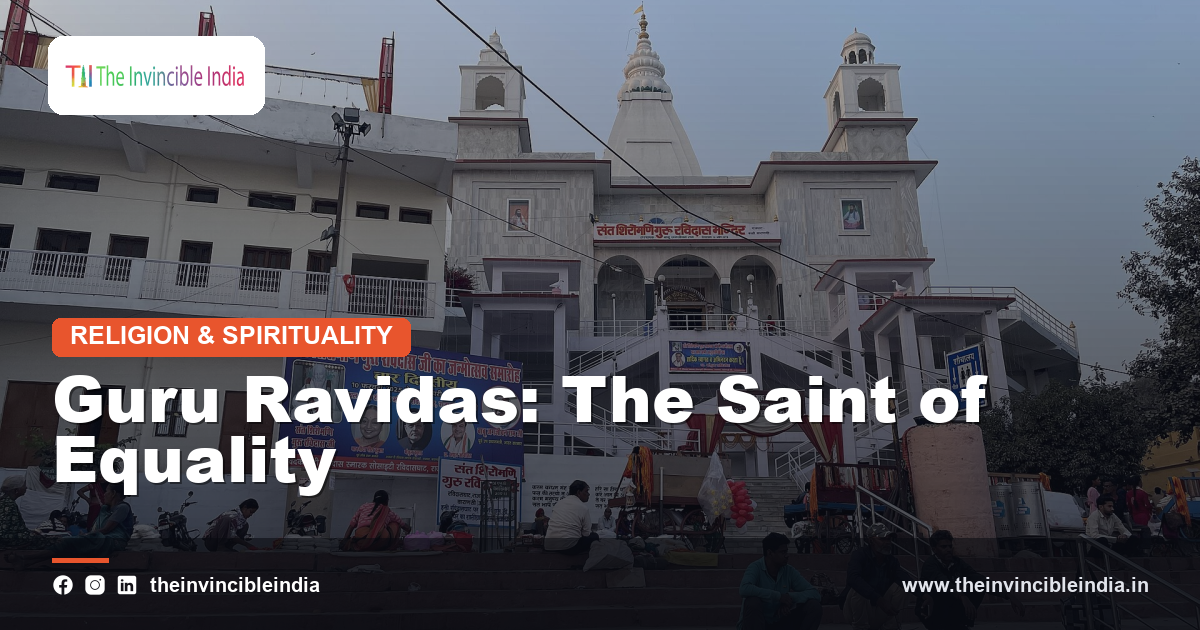
Sant Ravidas, also called Raidas and honoured as Guru Ravidas, was a North Indian poet-saint of the Nirguna bhakti, or sant, tradition, generally placed in the fifteenth and sixteenth centuries and associated by tradition with Varanasi. He is remembered as a mystic who sang of devotion to the one formless God and who taught that all people are equal before the divine, regardless of birth or caste. Tradition records that he was born into a leather-working community, and his teaching of a casteless, devotion-based society, expressed in his vision of an ideal city called Begumpura, a place without sorrow or distinction, is cherished to this day. Some of his hymns are included in the Guru Granth Sahib, the sacred scripture of the Sikhs, and he is revered especially in the Ravidassia tradition. His life and message belong to the wider world of the Bhakti movement, and he is honoured across northern India as a saint who proclaimed the dignity of every soul.
Quick answer: Sant Ravidas, also called Raidas, is a North Indian poet-saint of the Nirguna bhakti (sant) tradition, generally placed in the fifteenth and sixteenth centuries and associated by tradition with Varanasi. Born into a leather-working community, he taught devotion to the one formless God and the equality of all people, envisioning an ideal casteless city called Begumpura. Some of his hymns are included in the Guru Granth Sahib, and he is revered especially in the Ravidassia tradition.
Key Takeaways
- Sant Ravidas, also called Raidas, is a North Indian poet-saint of the Nirguna bhakti (sant) tradition.
- He is generally placed in the fifteenth and sixteenth centuries and associated by tradition with Varanasi.
- Tradition records that he was born into a leather-working (Chamar) community.
- He taught devotion to the one formless God and the equality of all people before the divine.
- His vision of an ideal casteless city, Begumpura, a place without sorrow, is cherished to this day.
- Some of his hymns are included in the Guru Granth Sahib, and he is revered especially in the Ravidassia tradition.
The sections below explain his life as told by tradition, his names, his social background and its significance, the Nirguna bhakti tradition, his teaching of a casteless society, his vision of Begumpura, his hymns, his place in the Guru Granth Sahib, the Ravidassia tradition and his continuing legacy.
Quick Facts
| Detail | Information |
|---|---|
| Also called | Raidas; Guru Ravidas |
| Tradition | Nirguna bhakti; the sant tradition of northern India |
| Era | Fifteenth to sixteenth century, generally placed |
| Region | North India; associated by tradition with Varanasi |
| Language of works | Vernacular (Braj and related speech of northern India) |
| Principal works | Devotional hymns; some included in the Guru Granth Sahib |
| Deity | The one formless God (Nirguna) |
| Known for | Teaching a casteless, devotion-based society and the vision of Begumpura |
| Principal shrine | Sri Guru Ravidas Janmasthan and temples at Varanasi |
Who Was Sant Ravidas?
Sant Ravidas, also called Raidas and honoured as Guru Ravidas, was a North Indian poet-saint of the Nirguna bhakti tradition, generally placed in the fifteenth and sixteenth centuries and associated by tradition with Varanasi. He is revered as a mystic who sang of devotion to the one formless God and who taught the equality of all people before the divine.
Tradition records that he was born into a leather-working community and that he lived a life of labour and devotion, pouring out his love for God in hymns that are cherished across northern India. His teaching that all souls are equal, whatever their birth, and his vision of a society without caste distinction, lie at the heart of his memory. Because parts of his life come down through tradition, careful accounts describe his era in general terms. His standing as a saint who proclaimed the dignity of every soul is firmly and lovingly held.
What Do His Names Signify?
The saint is known as Ravidas and also as Raidas, and he is honoured with the title Guru, so that he is called Guru Ravidas, and recognising these forms helps a reader place him among the sants of northern India. The variants Ravidas and Raidas are used in different regions and traditions for the same revered figure.
The name is borne with deep reverence by those who honour him, above all in the Ravidassia tradition, where he is addressed as Guru Ravidas, the venerable teacher. The title Guru marks him as a spiritual master whose word guides his followers. Recognising that Ravidas and Raidas refer to the same saint helps a reader follow him across the accounts and the many communities that cherish his memory. The names thus mark him as a revered poet-saint and spiritual teacher, honoured across northern India and beyond.
What Was His Social Background and Why Does It Matter?
Tradition records that Sant Ravidas was born into a leather-working community, known as Chamar, a group placed low in the social order of his time, and this background is central to the meaning of his life and message. His rise to honour as a revered saint from such a background is cherished as a sign of the truth he proclaimed.
In the society of his day, those who worked with leather were held in low regard, yet Ravidas, through his devotion and his teaching, came to be revered as a saint across lines of caste and community. His life stands as a living witness to his message that all souls are equal before God and that devotion, not birth, is the measure of a person. His social background is honoured with respect as the very ground of his teaching. Understanding it helps a reader appreciate the dignity and the courage of his proclamation of a casteless society.
What Is the Nirguna Bhakti Tradition?
The Nirguna bhakti tradition is the devotion to the one God conceived as formless and without attributes, nirguna, that flourished among the sants of northern India, and Sant Ravidas was one of its great voices. His hymns sang of the formless God at the heart of this devotion.
The sants of the Nirguna tradition taught devotion to a single formless God beyond name and image, emphasising the inward path of the heart, the chanting of the divine name and the guidance of the true guru rather than outward ritual or the distinctions of caste. This stream of devotion is cherished across northern India and is associated with a company of revered sants. Sant Ravidas belongs to this tradition, teaching the one formless God and the equality of all before the divine. Understanding the Nirguna bhakti tradition helps a reader see the devotional world in which his teaching and his hymns found their meaning.
What Did He Teach About a Casteless Society?
Sant Ravidas taught that all people are equal before the one God and that distinctions of caste and birth have no bearing on the worth of a soul, proclaiming a vision of a society founded on devotion rather than social rank. This teaching of a casteless, devotion-based society is among the heart of his message.
In a time marked by rigid divisions, Ravidas sang that devotion to God is open to all and that the divine does not regard the accidents of birth, holding that the humblest devotee is honoured in the sight of the Lord. His own life, rising from a community held low to the honour of a revered saint, bore witness to this teaching. His message is cherished as a proclamation of human dignity and equality. Understanding his teaching of a casteless society helps a reader appreciate the vision of justice and devotion that lies at the centre of his legacy.
What Is the Vision of Begumpura?
Begumpura, meaning a city without sorrow, is the vision of an ideal society that tradition associates with the hymns of Sant Ravidas, a place where there is no grief, no fear and no distinction of high and low, and where all live in dignity and peace. This vision is cherished as a poetic image of the casteless, just society he proclaimed.
In the imagery attributed to Ravidas, Begumpura is a land free of sorrow and oppression, where none are counted lesser and all share equally in well-being, a city shaped by devotion and justice. The vision gives poetic form to his teaching that all souls are equal before God and that a society without caste distinction is the true dwelling of the devout. Begumpura is honoured as one of the most cherished images in the sant tradition. Understanding it helps a reader appreciate the hope of a just and equal society that fills the message of Sant Ravidas.
What Are His Hymns and Their Themes?
The hymns of Sant Ravidas are devotional verses sung in the vernacular of northern India, filled with the themes of devotion to the one formless God, the equality of all souls and the longing of the heart for the divine. Through them his teaching was given voice and handed down to later generations.
His compositions express a heartfelt and ardent devotion, dwelling on the greatness and the grace of God, the lowliness and need of the devotee and the dignity of every soul before the Lord. They share in the spirit of the wider sant tradition, yet they carry the particular voice of a saint who rose from a community held low to proclaim the equality of all. Because the hymns belong to the living tradition and are sung within it, careful accounts describe their themes in general terms. The hymns of Ravidas remain cherished as the voice of his devotion and his message of dignity.
Why Are His Hymns in the Guru Granth Sahib?
Some of the hymns of Sant Ravidas are included in the Guru Granth Sahib, the sacred scripture of the Sikhs, where his compositions are preserved alongside those of other revered sants and the Sikh Gurus. This place in the scripture reflects the honour in which his devotion was held across traditions.
The Guru Granth Sahib gathers the sacred verses of the Sikh Gurus together with hymns of a number of saints of the bhakti and sant traditions whose devotion was held in reverence. Among these are hymns attributed to Ravidas, which are read and sung with honour in the Sikh tradition. Their inclusion reflects the shared devotion to the one formless God that unites the sants and the Sikh Gurus. Understanding why his hymns are in the Guru Granth Sahib helps a reader appreciate the wide reverence in which Sant Ravidas is held and the place of his devotion within the broader religious life of northern India.
What Is the Ravidassia Tradition?
The Ravidassia tradition is the community of followers who revere Sant Ravidas as their guru and centre their faith and devotion upon his teaching and his hymns. It keeps his memory, his message of equality and his verses alive in the devotional life of its people to this day.
The followers of the Ravidassia tradition honour Guru Ravidas as the fountainhead of their faith, gathering to sing his hymns, to remember his teaching of the one formless God and to cherish his vision of a society without caste distinction. The tradition maintains temples and observances in his honour and keeps his message of human dignity at the heart of its devotion. It is cherished by communities in India and among those settled abroad. Understanding the Ravidassia tradition helps a reader see how the teaching of Sant Ravidas continues as a living faith and a source of dignity and identity for his followers.
How Is He Associated With Varanasi?
Sant Ravidas is associated by tradition with Varanasi, the ancient and holy city on the Ganga, where tradition holds that he lived and taught and where his memory is cherished, above all at the place honoured as his birthplace. The city is the chief home of his memory.
Varanasi, revered as one of the holiest cities of India, is honoured in the tradition of Ravidas as the place associated with his life and his devotion. A shrine known as the Sri Guru Ravidas Janmasthan marks the place honoured as his birthplace, drawing the faithful who come to pay their respects to the saint, especially on the observance of his birth anniversary. The association of Ravidas with Varanasi binds his memory to the sacred geography of northern India. Understanding this link helps a reader place the life and the continuing devotion of Sant Ravidas within the holy city that cherishes his memory.
How Is He Linked to Other Saints of the Bhakti Movement?
Sant Ravidas is linked by tradition to the wider company of saints of the Bhakti movement, and he is associated in devotional memory with the saint-poet Mirabai and with the circle of the teacher Ramananda. These links set his life within the broad and cherished stream of bhakti devotion.
The Bhakti movement gathered a great company of saints across the regions of India who sang of loving devotion to God and often challenged the distinctions of caste and ritual. Tradition associates Ravidas with Mirabai, the princess-saint devoted to Krishna, who is remembered in devotional lore as drawn to his teaching, and with the circle around Ramananda, a revered teacher of the age. Because such associations come down through tradition, they are received as devotional memory rather than documented record. Understanding these links helps a reader see Sant Ravidas within the shared devotion of the saints of the Bhakti movement.
When and Where Did He Live?
Sant Ravidas is generally placed in the fifteenth and sixteenth centuries, and tradition associates him with Varanasi in northern India, though because parts of his life come down through tradition it is wise to describe his era in general terms rather than fix exact dates. His memory is bound to the holy city and to the sant tradition.
His life unfolded in northern India during a period cherished as a great age of the sants and the Bhakti movement, when devotion to the one formless God flourished and the saints challenged the divisions of society. Because the accounts of his life come through tradition, careful writers describe his region and general period while leaving precise dates open, in keeping with the respectful caution the sources invite. His era is remembered as a time of the flowering of devotion, and his home at Varanasi as the heart of the tradition that cherishes him.
Why Is His Message of Dignity Cherished?
The message of Sant Ravidas is cherished because it proclaims the dignity and equality of every soul before God, a teaching that lifts up the humble and honours the devotion of all, regardless of birth. This message of human dignity is the enduring heart of his legacy.
In a world marked by division, Ravidas sang that the divine does not regard the accidents of caste or station and that the humblest devotee is honoured in the sight of the Lord. His own life, rising from a community held low to the honour of a revered saint, gave living witness to this truth. His message continues to inspire those who seek a society of justice and equality and those who cherish the dignity of the human person. Understanding why his message of dignity is cherished helps a reader appreciate the enduring power of the teaching of Sant Ravidas across the generations.
How Is He Remembered and Venerated Today?
Sant Ravidas is remembered and venerated today across northern India and among communities abroad, above all in the Ravidassia tradition, through temples, hymn-singing and the observance of his birth anniversary. His memory is kept alive as a saint of devotion and a teacher of human dignity.
His followers gather to sing his hymns, to honour his teaching of the one formless God and to cherish his vision of a society without caste distinction, keeping his message at the heart of their devotion. The shrine honoured as his birthplace at Varanasi and temples dedicated to him in many places draw the faithful, and his birth anniversary is observed with devotion. His memory is thus a living presence in the religious and social life of his communities. Understanding how he is venerated today helps a reader appreciate the continuing devotion that gathers around the memory of Sant Ravidas.
Sant Ravidas Today
Sant Ravidas today is remembered as a North Indian poet-saint of the Nirguna bhakti tradition, a mystic who sang of the one formless God and who taught the equality of all souls, and whose vision of Begumpura, a city without sorrow, still inspires the hope of a just society. His memory endures as a living presence in the devotion of his followers.
Through his hymns, some of which are preserved in the Guru Granth Sahib, his teaching of a casteless society and the Ravidassia tradition that reveres him as guru, he became an enduring figure of the spiritual and social heritage of northern India. Because parts of his life come down through tradition, his story is received with respectful care, honoured for its meaning and its message. His legacy endures as a proclamation of the dignity of every soul and of a devotion that knows no distinction of birth, cherished by all who honour Sant Ravidas.
Sources & Further Reading
- Ministry of Culture, Government of India (indiaculture.gov.in).
- Sahitya Akademi general references on the sant and devotional literature of northern India.
Frequently Asked Questions
Who was Sant Ravidas?
Sant Ravidas, also called Raidas, was a North Indian poet-saint of the Nirguna bhakti tradition, generally placed in the fifteenth and sixteenth centuries and associated by tradition with Varanasi. Born into a leather-working community, he taught devotion to the one formless God and the equality of all souls, and some of his hymns are included in the Guru Granth Sahib.
What did Sant Ravidas teach?
Sant Ravidas taught that all people are equal before the one God and that distinctions of caste and birth have no bearing on the worth of a soul. He proclaimed a casteless, devotion-based society and expressed his vision in the image of Begumpura, an ideal city without sorrow or distinction.
What is Begumpura in the teaching of Ravidas?
Begumpura, meaning a city without sorrow, is the vision of an ideal society associated with the hymns of Sant Ravidas, a place without grief, fear or distinction of high and low. It is cherished as a poetic image of the just, casteless society he proclaimed.
Why are hymns of Ravidas in the Guru Granth Sahib?
Some hymns of Sant Ravidas are included in the Guru Granth Sahib, the sacred scripture of the Sikhs, where his compositions are preserved alongside those of other revered sants and the Sikh Gurus. Their inclusion reflects the shared devotion to the one formless God and the wide reverence in which his devotion was held.
What is the Ravidassia tradition?
The Ravidassia tradition is the community of followers who revere Sant Ravidas as their guru and centre their faith on his teaching and his hymns. It keeps his memory, his message of equality and his verses alive through temples, hymn-singing and observances in his honour.
When and where did Sant Ravidas live?
Sant Ravidas is generally placed in the fifteenth and sixteenth centuries and is associated by tradition with Varanasi in northern India. Because parts of his life come down through tradition, his era is best described in general terms rather than by exact dates.


