

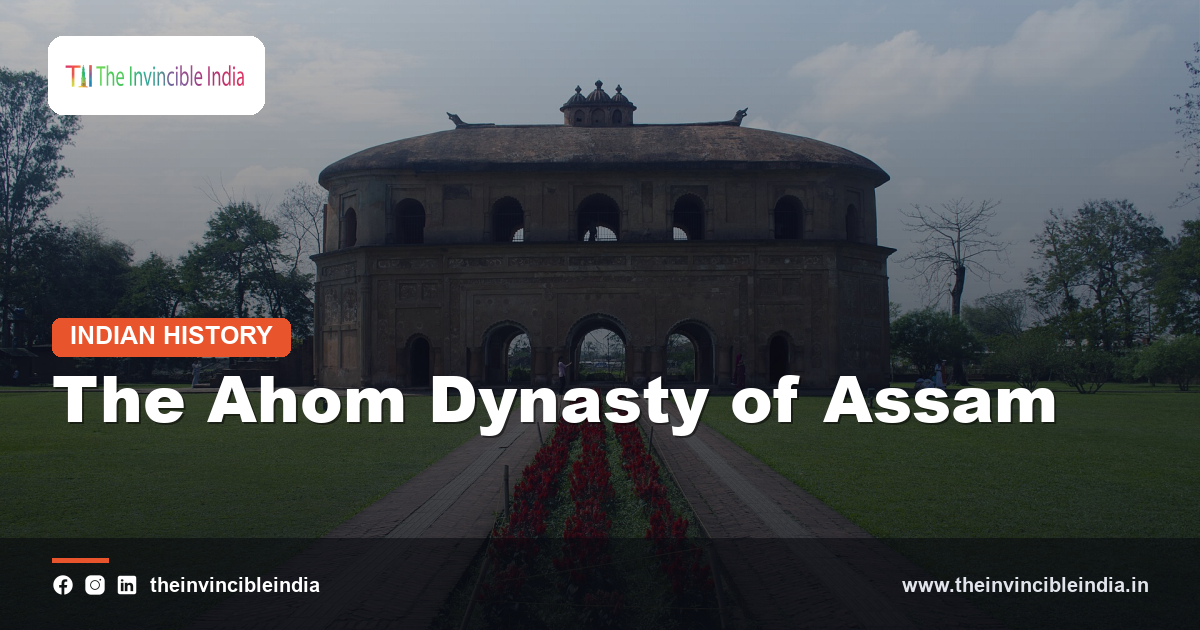
The Ahom dynasty was the ruling house of a kingdom that governed the Brahmaputra valley of present-day Assam for about six centuries, from the early thirteenth century until the early nineteenth century. Founded by a branch of the Tai peoples who entered the valley from the east, the dynasty is remembered for forging a durable state in north-eastern India and, above all, for its long resistance to the expanding power of the Mughal Empire. Its rulers, who bore the title Swargadeo, built their early seat at Charaideo and later ruled from Garhgaon and Rangpur, near present-day Sivasagar. The kingdom is also known for its chronicles, the Buranjis, and for monuments such as the Rang Ghar and the Talatal Ghar. Because several early dates and details rest on tradition, this account keeps to general terms where the record is uncertain.
Quick answer: The Ahom dynasty was the ruling house of a Tai kingdom that governed the Brahmaputra valley of present-day Assam for about six centuries, from the early thirteenth century until the early nineteenth century. Founded by Tai migrants, it is remembered for resisting the Mughals, notably under the general Lachit Borphukan at the Battle of Saraighat in 1671, and for monuments such as the Rang Ghar and Talatal Ghar. Its rulers bore the title Swargadeo, and its rule ended around the time of the Burmese invasions and the Treaty of Yandabo of 1826.
Key Takeaways
- The Ahom dynasty ruled a kingdom in the Brahmaputra valley of present-day Assam for about six centuries, from the early thirteenth to the early nineteenth century.
- The Ahoms were a Tai people who, by tradition, entered Assam under a leader remembered as Sukaphaa in the early thirteenth century.
- Ahom rulers bore the title Swargadeo and ruled from capitals at Charaideo, later Garhgaon and Rangpur, near present-day Sivasagar.
- The kingdom is famous for resisting the Mughals, notably under the general Lachit Borphukan at the Battle of Saraighat in 1671.
- Ahom monuments include the Rang Ghar, the Talatal Ghar, and the royal burial mounds known as maidams.
- Ahom rule ended in the early nineteenth century, around the time of the Burmese invasions and the Treaty of Yandabo of 1826.
Read on for the history, culture, and legacy in detail.
Quick Facts
| Detail | Information |
|---|---|
| Kingdom | The Ahom kingdom of Assam |
| People | A Tai people of the Brahmaputra valley |
| Period | Early 13th to early 19th century (about six centuries) |
| Region | Brahmaputra valley, present-day Assam |
| Capitals | Charaideo, later Garhgaon and Rangpur (Sivasagar) |
| Traditional Founder | Sukaphaa (by tradition, early 13th century) |
| Famous General | Lachit Borphukan (Battle of Saraighat, 1671) |
| Notable Monuments | Rang Ghar, Talatal Ghar, Ahom maidams |
| Legacy | Long resistance to the Mughals; distinctive Assamese heritage |
What Was the Ahom Dynasty?
The Ahom dynasty was the ruling house of a kingdom that governed the Brahmaputra valley of present-day Assam for about six centuries, from the early thirteenth century until the early nineteenth century. Founded by a branch of the Tai peoples, the dynasty established one of the most enduring states of north-eastern India, holding its territory through a long succession of rulers who bore the title Swargadeo, meaning lord of the heavens. The kingdom is remembered for forging a durable political order in the valley, for its long resistance to outside powers, and for a rich tradition of chronicle-writing. Its rulers governed from a series of capitals in the upper valley, and its history is unusually well recorded by the standards of the region. As one of the great regional states of the subcontinent, the Ahom dynasty holds an important place in the history of Assam and of India. Its story spans the medieval and early modern periods.
Where Did the Ahoms Rule?
The Ahoms ruled in the Brahmaputra valley of present-day Assam, the broad river valley of north-eastern India through which the great Brahmaputra flows between the Himalayas to the north and the hills to the south. This fertile valley, a land of rivers, wetlands and rice fields, formed the heartland of the Ahom kingdom, whose centre lay in the upper, eastern part of the valley around present-day Sivasagar. From this core the kingdom extended its authority over much of the valley through its long history, contending with neighbouring peoples and kingdoms of the region. The geography of the valley, with its rivers and its ring of surrounding hills, shaped the character and defence of the kingdom. Its position in the far north-east placed it at a distance from the powers of the Indian plains, a distance that helped preserve its independence. The Brahmaputra valley thus formed the enduring homeland of the Ahom dynasty.
Who Were the Ahoms?
The Ahoms were a Tai people, part of the wider family of Tai peoples of South-East Asia, who established the ruling house and kingdom that bear their name in the Brahmaputra valley. Entering Assam from the east, across the hills that separate the valley from the lands beyond, the Ahoms brought with them their own language, traditions and systems of rule, which they planted in their new home. Over the centuries, the Ahoms and the peoples of the valley drew closer together, and the ruling house in time adopted much of the language, religion and culture of the region, while retaining a distinct identity and memory of its origins. The name Ahom itself became associated with the ruling community and is connected in tradition with the name Assam. As a Tai people who built an enduring kingdom in India, the Ahoms represent a distinctive strand in the history of the subcontinent and its north-eastern frontier.
How Did the Ahoms Enter Assam?
The entry of the Ahoms into Assam is attributed in tradition to a leader remembered as Sukaphaa, held to have led a band of followers into the Brahmaputra valley in the early thirteenth century, generally dated by tradition to around 1228. According to the Ahom chronicles, Sukaphaa crossed the hills from the east and, after a period of movement through the upper valley, established his seat and laid the foundation of the kingdom. This account of the founding, cherished in the memory of the dynasty, rests largely on tradition and the chronicles rather than on independent record, and its details are treated with scholarly care. The arrival of the Ahoms marked the beginning of a new political order in the valley, which would endure for centuries. From these traditional beginnings the kingdom grew through the gradual extension of its authority. The founding of the Ahom state by Sukaphaa thus stands as the opening chapter of the dynasty.
What Were the Capitals of the Ahom Kingdom?
The Ahom kingdom was governed from a series of capitals in the upper Brahmaputra valley, beginning with the early seat at Charaideo and moving in later times to Garhgaon and Rangpur, near present-day Sivasagar. Charaideo, held in tradition to be the first capital established by Sukaphaa, remained a place of special importance to the dynasty, associated with the royal burial mounds. As the kingdom grew, the court moved to other centres, with Garhgaon serving as a capital and Rangpur becoming a principal seat in the later period. These capitals, set in the upper valley, formed the political and ceremonial heart of the kingdom, surrounded by the monuments, tanks and structures built by its rulers. The region around Sivasagar preserves many of these remains today. The succession of capitals reflects the long history and development of the Ahom state. These seats anchored the dynasty in the upper Brahmaputra valley.
How Was the Ahom Kingdom Governed?
The Ahom kingdom was governed by the Swargadeo, the sovereign, supported by a distinctive system of great officers and a form of service obligation known in the region as the paik system. The paik system organised the population into groups liable to render service to the state, whether in labour, military duty or other obligations, forming the basis of the kingdom’s manpower for war and public works. Great officers, including figures such as the Borphukan and the Borbarua, held high responsibilities in the administration and the command of the army and the frontiers. This system of organised service and high office enabled the kingdom to mobilise resources and defend its territory over a long history. The arrangement was adapted and developed over the centuries as the state grew. The details of the administration are drawn from the chronicles and records of the kingdom. This distinctive system of governance was central to the strength and endurance of the Ahom state.
What Were the Buranjis?
The Buranjis were the chronicles of the Ahom kingdom, a rich tradition of historical writing that recorded the deeds of the rulers, the affairs of the state and the events of its history. Maintained by the court and composed first in the Ahom language and later in Assamese, the Buranjis form one of the most remarkable bodies of indigenous historical writing in the subcontinent, unusual for the detail and continuity with which they record the past. They preserve accounts of the kings, their wars, their administration and their dealings with neighbours, and they are a principal source for the history of the kingdom. As with all such records, scholars read the Buranjis with care, weighing their accounts against other evidence. Their very existence reflects the strong sense of history and record that marked the Ahom court. The Buranjis thus stand among the great achievements of the Ahom kingdom and a key to its history.
How Did the Ahoms Resist the Mughals?
The Ahoms resisted the Mughals through a long series of conflicts in which the kingdom defended the Brahmaputra valley against the repeated efforts of the empire to extend its authority into the north-east. As the Mughal Empire pressed toward the valley from the plains of Bengal, the Ahom kingdom met its armies and fleets in a prolonged contest over the lower valley and its approaches. The Ahoms, fighting in their own country of rivers, wetlands and hills, made effective use of the terrain, their river craft and their knowledge of the land to counter the imperial forces. Over the course of these struggles, which extended across generations, the kingdom succeeded in preserving its independence against one of the greatest powers of the age. This long resistance is among the most celebrated chapters of Ahom history. It secured the valley against absorption into the empire and became a lasting source of regional pride.
Who Was Lachit Borphukan?
Lachit Borphukan was the celebrated Ahom general who led the kingdom’s forces in its most famous victory over the Mughals, and who is remembered as one of the great heroes of Assamese history. Holding the high office of Borphukan, the commander responsible for the western frontier of the kingdom, Lachit led the Ahom armies in the defence of the lower Brahmaputra valley during a major confrontation with the imperial forces. He is remembered above all for his leadership, resolve and devotion to the defence of his country, qualities celebrated in tradition and in the historical memory of the region. His name is especially associated with the Battle of Saraighat, fought on the Brahmaputra. The figure of Lachit Borphukan has become a powerful symbol of regional valour and patriotism, honoured in Assam and beyond. His leadership in the defence of the valley secured him an enduring place in the history and memory of the Ahom kingdom.
What Happened at the Battle of Saraighat?
The Battle of Saraighat, fought in 1671 on the Brahmaputra near present-day Guwahati, was a decisive naval engagement in which the Ahom forces under Lachit Borphukan repelled a major Mughal advance into the valley. The battle, fought largely on the river, saw the Ahoms make skilful use of their boats, the terrain and their knowledge of the waters to overcome a powerful imperial force. According to the celebrated tradition, the resolve and leadership of Lachit Borphukan, even in sickness, were central to rallying the Ahom defenders and securing the victory. The outcome checked the Mughal effort to extend their authority over the valley and confirmed the independence of the Ahom kingdom in the region. The Battle of Saraighat became one of the most famous events in the history of Assam, celebrated as a triumph of regional defence. It remains a cherished symbol of Ahom valour and of the kingdom’s successful resistance to the empire.
What Is the Rang Ghar?
The Rang Ghar is one of the most famous monuments of the Ahom kingdom, a two-storeyed royal pavilion near present-day Sivasagar, built to serve as a structure from which the rulers and court could view sports, games and public entertainments. Standing amid the historic sites of the old Ahom heartland, the Rang Ghar is admired for its distinctive form and its graceful design, and it is often described as one of the notable examples of royal architecture in the region. The building reflects the prosperity and cultural life of the kingdom in its later period, when such structures were raised around the capital. Together with other Ahom monuments, it bears witness to the building traditions of the dynasty. The Rang Ghar survives today as one of the best-known landmarks of Ahom heritage, drawing visitors to the Sivasagar region. It stands as an enduring symbol of the splendour of the Ahom court.
What Is the Talatal Ghar?
The Talatal Ghar is a large Ahom-era palace and structure near Sivasagar, remembered as one of the grandest buildings of the kingdom and associated with the royal seat of the later period. A substantial complex, the Talatal Ghar is noted for its scale and its combination of upper storeys and lower levels, and it is connected in tradition with the military and residential functions of the Ahom court. The building reflects the power and resources of the kingdom at the height of its later development, when its rulers raised impressive structures around the capital. As with other Ahom monuments, its history and features are drawn from the record and tradition of the region and are described in general terms. The Talatal Ghar survives among the notable heritage sites of the Sivasagar area. Together with the Rang Ghar and other remains, it bears witness to the architectural achievement of the Ahom kingdom.
What Are the Ahom Maidams?
The Ahom maidams are the royal burial mounds of the dynasty, found especially at Charaideo, where the kings and members of the royal house were laid to rest beneath great earthen mounds. These maidams, raised over the burials of the Ahom rulers, form a distinctive feature of the kingdom’s heritage, reflecting the funerary traditions that the Ahoms brought with them and maintained over their long history. The mounds at Charaideo, set in the old heartland of the kingdom, constitute an important and evocative group of monuments, often compared in their significance to the royal necropolises of other cultures. They are studied for the light they shed on the beliefs, traditions and history of the Ahom house. The maidams are recognised among the notable heritage of Assam and the subcontinent. As the resting places of the Ahom kings, the maidams of Charaideo stand among the most significant monuments of the dynasty and its memory.
What Was the Religion and Culture of the Ahoms?
The religion and culture of the Ahoms blended the traditions the dynasty brought from its Tai origins with the religion and culture of the Brahmaputra valley, which the ruling house increasingly adopted over the centuries. In their early history, the Ahoms maintained their own priestly traditions, rituals and beliefs, together with their language and customs. As the kingdom grew and drew closer to the peoples of the valley, the ruling house and the court increasingly embraced Hindu traditions and the devotional life of the region, while elements of the older heritage endured. The kingdom patronised temples, religious institutions and the cultural life of Assam, contributing to the development of Assamese language, literature and the arts. This blending of traditions gave the Ahom period a distinctive cultural character. The details of this religious and cultural life are drawn from the chronicles and heritage of the region. Through this synthesis the Ahoms shaped the culture of Assam.
How Did the Ahom Kingdom Decline?
The Ahom kingdom declined in the later eighteenth and early nineteenth centuries, weakened by internal troubles and then overwhelmed by invasions from Burma, before the region passed under British authority. In its final period the kingdom was shaken by internal conflicts and disturbances that sapped its strength, including the upheavals associated with religious and social unrest in the valley. Amid this weakness, forces from Burma invaded the Brahmaputra valley, bringing great hardship and effectively ending the independent power of the Ahom state. The conflict drew in the British, whose intervention led to the Treaty of Yandabo of 1826, by which Burma gave up its claims and the region came under British control. This brought to a close the long rule of the Ahom dynasty. The details of this decline are drawn from the chronicles and records of the period and are described in general terms. The fall of the kingdom marked the end of about six centuries of Ahom rule.
Why Is the Ahom Dynasty Significant?
The Ahom dynasty is significant as the builder of one of the most enduring kingdoms of the subcontinent and as the house that preserved the independence of the Brahmaputra valley against the great empires of the age. Its rule of about six centuries, its long and successful resistance to the Mughals, and its rich tradition of chronicle-writing in the Buranjis set it apart among the regional states of India. The figures of Sukaphaa and Lachit Borphukan, and events such as the Battle of Saraighat, have become powerful symbols of regional identity, valour and pride. The dynasty shaped the language, religion, culture and heritage of Assam, leaving a deep and lasting mark on the region. Its monuments, from the Rang Ghar to the maidams of Charaideo, stand among the notable heritage of the subcontinent. For students of Indian history, the Ahom dynasty offers a vivid example of an enduring and distinctive regional state.
The Ahom Dynasty Today
The Ahom dynasty is remembered today through the heritage of the Sivasagar region and the wider Brahmaputra valley, and through the enduring memory of its heroes and achievements in the culture of Assam. The monuments of the kingdom, including the Rang Ghar, the Talatal Ghar and the royal maidams of Charaideo, draw visitors and students of history, standing as reminders of the long rule of the dynasty. The figure of Lachit Borphukan and the memory of the Battle of Saraighat remain powerful symbols of regional valour, honoured in commemorations and public memory. The Buranjis continue to be studied as a remarkable record of the kingdom and its history. Scholars and communities continue to celebrate and research the heritage of the Ahom period. For readers of Indian history, the Ahom dynasty offers a striking example of an enduring north-eastern kingdom. Its legacy endures in the monuments, chronicles and living memory of Assam.
Sources & Further Reading
- Archaeological Survey of India (asi.nic.in).
- Ministry of Culture, Government of India (indiaculture.gov.in).
- Directorate of Archaeology, Government of Assam.
Frequently Asked Questions
What was the Ahom dynasty?
The Ahom dynasty was the ruling house of a Tai kingdom that governed the Brahmaputra valley of present-day Assam for about six centuries, from the early thirteenth century until the early nineteenth century. It is remembered for its long resistance to the Mughals and for its distinctive culture and monuments.
Who founded the Ahom kingdom?
By tradition, the Ahom kingdom was founded by a Tai leader remembered as Sukaphaa, who is held to have entered the Brahmaputra valley in the early thirteenth century, generally dated to around 1228. This account rests largely on the Ahom chronicles and tradition.
Who was Lachit Borphukan?
Lachit Borphukan was a celebrated Ahom general who led the kingdom’s forces against the Mughals, remembered above all for his leadership at the Battle of Saraighat in 1671. He is honoured as one of the great heroes of Assamese history and a symbol of regional valour.
What was the Battle of Saraighat?
The Battle of Saraighat, fought in 1671 on the Brahmaputra near present-day Guwahati, was a decisive naval engagement in which the Ahom forces under Lachit Borphukan repelled a major Mughal advance. The victory confirmed the independence of the Ahom kingdom in the valley.
What are the Ahom maidams?
The Ahom maidams are the royal burial mounds of the dynasty, found especially at Charaideo, where the kings and members of the royal house were buried beneath great earthen mounds. They form a distinctive and significant group of monuments of Ahom heritage.
How did the Ahom kingdom end?
The Ahom kingdom declined in the later eighteenth and early nineteenth centuries amid internal troubles and invasions from Burma, and the region passed under British control following the Treaty of Yandabo of 1826. This brought to a close about six centuries of Ahom rule.


