

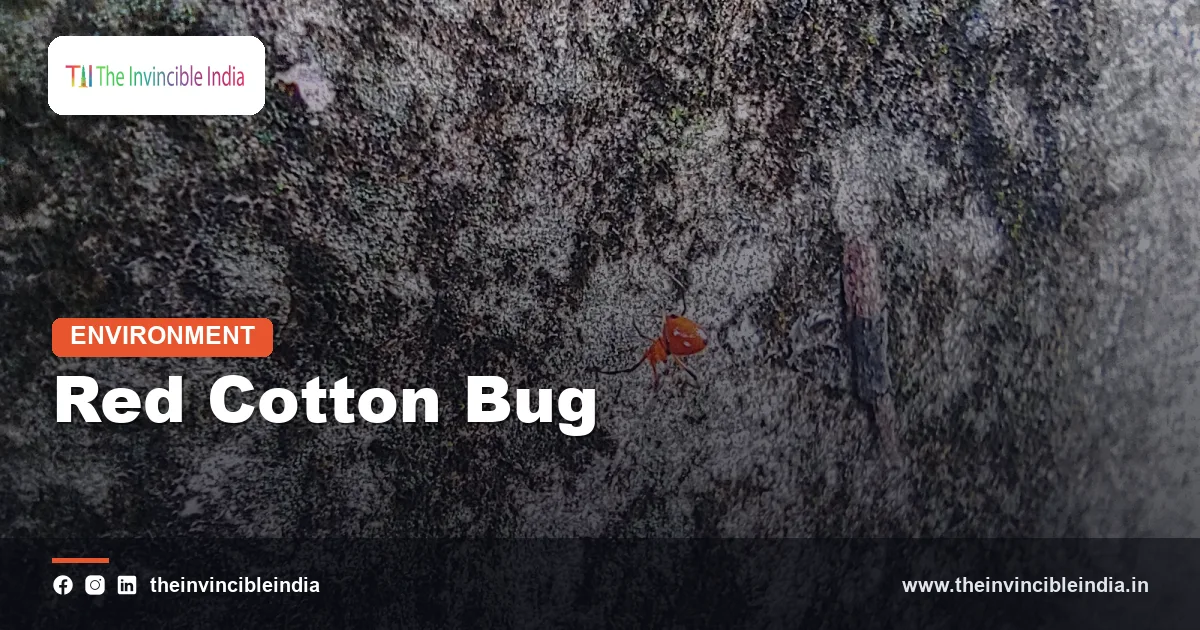
The red cotton bug is a bright red-and-black sap- and seed-feeding true bug of the genus Dysdercus, family Pyrrhocoridae, that gathers in clusters on cotton, okra, hibiscus and silk-cotton trees across India and is best known as a pest that stains cotton lint. The commonest Indian species, Dysdercus cingulatus, is often called the red cotton bug or cotton stainer, and its vivid colouring makes it one of the easiest garden insects to recognise.
Because the red cotton bug appears in dense groups and is often seen mating end to end, many people notice it long before they understand what it does to a crop. This article explains what the red cotton bug is, how to identify it, what it feeds on, how it damages cotton, how its life cycle works, and which methods are used to manage it without relying only on chemicals.
Quick Facts
| Common name | Red cotton bug (also cotton stainer or red bug) |
|---|---|
| Scientific classification | Order Hemiptera, suborder Heteroptera; family Pyrrhocoridae; genus Dysdercus (commonly Dysdercus cingulatus and Dysdercus koenigii in India) |
| Size | Adults are roughly 1.5 to 2 cm long, with a narrow, elongated body |
| Habitat in India | Cotton fields, kitchen gardens, roadside plants, hedges and the trees and shrubs of the mallow family, found across most of the country |
| Diet | Seeds and sap of cotton and other mallow-family plants, including okra, hibiscus and silk-cotton; also fallen seeds and sometimes dead insects |
| Life cycle | Incomplete metamorphosis: egg, five nymph stages, adult; one generation takes roughly six to eight weeks in warm weather |
| Ecological role | Seed feeder and secondary crop pest; food for spiders, assassin bugs, birds and lizards |
| Notable features | Bright red body marked with white bands and black spots, a piercing beak, a strong smell when disturbed, and a habit of living in groups |
Key Takeaways
- The red cotton bug belongs to the family Pyrrhocoridae of the true bugs and is placed in the genus Dysdercus, which is named for its habit of staining cotton.
- A red cotton bug feeds mainly on the developing seeds of cotton bolls by piercing the boll wall with its beak and sucking the contents.
- The red cotton bug stains cotton lint through its excreta, crushed bodies and the yeast-like fungi it introduces, which lowers the quality and price of the fibre.
- The red cotton bug passes through five nymph stages without a pupa, and a female can lay several batches of eggs in the soil during her life.
- The bright red colour of the red cotton bug is a warning signal, and the insect also gives off a pungent smell when handled.
- Control of the red cotton bug relies on field hygiene, trap methods, removal of alternative host plants, natural enemies and, only when needed, targeted sprays.
What is the red cotton bug?
The red cotton bug is a medium-sized plant-feeding bug of the genus Dysdercus that belongs to the family of firebugs and cotton stainers, the Pyrrhocoridae. The family contains several hundred species worldwide, most of them brightly marked in red, black and white.
The genus Dysdercus is widespread in the tropics and warmer regions, and it includes the cotton stainers of Africa, the Americas and Asia. In India, two species are particularly familiar: Dysdercus cingulatus, which is the one usually called the red cotton bug, and Dysdercus koenigii, which is similar in appearance and habits. Both are found on cotton and on many wild and cultivated plants of the mallow family, Malvaceae.
The common name "cotton stainer" comes from the most visible effect of the insect on the cotton industry: when the bugs feed on open bolls, they can leave the lint spotted in yellow and brown, which is difficult to remove and reduces the value of the crop.
How can you identify a red cotton bug?
A red cotton bug can be identified by its elongated, flattened body, which is bright red or orange-red, crossed by white bands and marked with black spots and a black membrane on the wings. The head is small, the legs are black, and the antennae are slender and also dark.
The adult usually has a white band across the thorax or abdomen, and the wings are held flat over the back so that the black wing tips overlap into a dark patch. The nymphs are smaller, wingless and mostly red with dark markings, and they sit in tight groups near fallen seeds or the base of the host plant.
Look-alikes
The red cotton bug is sometimes confused with other red-and-black insects. The dusky cotton bug (Oxycarenus) is much smaller and brownish-grey, and it also feeds on cotton seeds. Ladybird beetles have domed, rounded bodies with hard wing cases, while the red cotton bug is flat and has a visible triangle on its back. Some assassin bugs are red, but they hold a stout, curved beak under the head and have a thin neck.
A simple way to separate the red cotton bug from similar insects is to look for the clustering habit. Groups of red bugs, often joined tail to tail in mating pairs, on a cotton plant, okra pod or hibiscus bush are very likely to be this species.
What does the red cotton bug eat?
The red cotton bug eats the seeds of plants, especially the immature seeds inside cotton bolls, and it also sucks sap from stems, leaves and fruits. It is a seed specialist that prefers the oily, nutritious seeds of mallow-family plants.
The insect pushes its needle-like beak through the boll wall and into the seed, injects saliva that begins digestion, and then sucks up the liquefied contents. The seeds shrivel or fail to develop, and the damaged tissue provides a way in for micro-organisms.
- Cotton, in both the green boll and the open boll stage.
- Okra, or lady’s finger, and other garden vegetables of the mallow family.
- Hibiscus and other ornamental mallows.
- Silk-cotton trees, which provide seeds in the dry season.
- Fallen seeds on the ground and, at times, dead or injured insects.
Silk-cotton trees and wild mallows are especially important, because the bugs shelter and breed on them when cotton is not in season and then move onto the cotton crop when it begins to form bolls.
How does the red cotton bug damage cotton?
The red cotton bug damages cotton by feeding on the seeds in the bolls and by staining the lint, which lowers both the quality of the cotton and the viability of the seed. The effect is serious when large numbers gather on a field, but a few bugs usually cause little harm.
The damage happens in several ways. The bugs puncture the bolls and suck the seeds, so the seeds become light, shrivelled and low in oil. The excreta of the insects, which are rich in pigments, spoil the lint. The bugs are also carriers of yeast-like fungi, such as Nematospora, which grow in the feeding punctures and cause what is called internal boll rot and yellowish staining of the fibre.
Why staining matters
Cotton is graded on colour and cleanliness, and a stained lot fetches a lower price. Crushed bugs in ginning machinery add to the problem by smearing the fibre with body fluids. Seed from damaged bolls also germinates poorly, so farmers who save seed may find their next crop affected.
India is one of the world’s leading cotton producers, so even a modest percentage of loss matters at the national level. The red cotton bug is generally described as a minor or secondary pest compared with the bollworms, but it can become important in some seasons and regions, especially late in the crop when the bolls open.
How does the life cycle of the red cotton bug work?
The life cycle of the red cotton bug has three stages, egg, nymph and adult, and the insect develops by incomplete metamorphosis, so there is no pupal stage. A full generation takes roughly six to eight weeks in warm weather, and several generations can occur in a year.
The female lays small, yellowish, oval eggs in clusters in moist soil, under leaf litter or in cracks in the ground near the host plants. A cluster may contain a few dozen eggs, and a female may lay several clusters, adding up to a few hundred eggs in her lifetime. The eggs hatch in about a week.
The nymphs pass through five stages, or instars, shedding their skin each time. They are wingless and stay close to the ground at first, feeding on fallen seeds. As they grow, they climb onto the plants. The adult stage is reached after a few weeks, and the winged adults can fly from field to field.
| Stage | Appearance | Approximate duration in warm weather |
|---|---|---|
| Egg | Small, oval, yellowish, laid in clusters in soil or leaf litter | About one week |
| Nymph (five instars) | Wingless, red with dark markings, often in groups | About three to five weeks |
| Adult | Winged, red with white bands and black marks | Several weeks to a few months |
In cooler or dry months the adults may become less active and shelter in crevices, on trees or in plant debris. They resume feeding and breeding when the weather warms or when new host plants begin to form seeds.
Why do red cotton bugs gather in groups and mate tail to tail?
Red cotton bugs gather in groups because they release chemical signals that attract others of their kind, and they mate tail to tail because the male and female stay joined for a long time after pairing. The pairs are often seen walking in opposite directions, still locked together.
The grouping has benefits. A large cluster makes the warning colours more striking to predators, and the insects find good feeding sites more easily by following others. The pairing posture lets the male guard the female and reduces the chance of a rival mating with her, and the pairs may remain joined for hours.
The habit also makes the red cotton bug easy to spot and to count, which helps farmers who monitor fields. A cluster of red bugs on the ground at the base of the crop is often the first sign of an infestation.
Is the red cotton bug harmful to humans?
The red cotton bug is not harmful to humans, does not bite people and does not carry human diseases. It uses its beak only for plant seeds, and it is not considered a danger to households, even when it enters gardens in large numbers.
The bug does give off a strong, unpleasant smell when it is crushed or handled, which comes from defensive glands. The smell can linger on hands and on cloth, and the bodies may leave red stains. It is best to brush the insects away or remove them with a stick or a cloth.
The bright red body acts as a warning to birds and other predators, telling them that the bug tastes bad. This is called aposematic colouring, and it is one of the reasons the insect can feed in the open without hiding.
How is the red cotton bug controlled?
The red cotton bug is controlled mainly through field hygiene, physical removal, trap methods and the protection of natural enemies, with chemical sprays kept as a last resort. This approach is part of integrated pest management, which combines several methods in order to keep damage below an economic level.
- Remove alternative host plants such as wild mallows near the field, and clean up crop residue after harvest so that the bugs have fewer places to breed.
- Destroy the egg clusters and the groups of nymphs when they are seen at the base of plants; hand-picking into soapy water is effective on small plots.
- Use trap heaps of cotton seed or oil-cake placed on the ground, which attract the bugs and make them easy to collect and destroy.
- Pick open bolls on time, since leaving bolls open for a long time gives the bugs more access to the seed.
- Encourage natural enemies, including spiders, assassin bugs, ants, birds and lizards.
- Where a spray is justified, choose recommended products and doses, and follow the advice of the local agricultural university or extension office.
It is worth remembering that the Bt trait in genetically modified cotton is directed at bollworm caterpillars and does not control sucking bugs. Farmers therefore still need to watch for the red cotton bug and other sucking pests even in Bt cotton fields.
Which natural enemies keep the red cotton bug in check?
The natural enemies of the red cotton bug include predatory bugs, spiders, ants, birds, lizards and some parasitic flies, which together keep populations from rising too high in many fields. Assassin bugs and the large garden spiders are among the main hunters of the nymphs and adults.
Ants take eggs and young nymphs from the soil, and birds such as mynas and bulbuls may eat the adults despite their warning colours, though many birds avoid them. Some parasitic flies lay their eggs on or in the bugs, and their larvae kill the host. Soil fungi and other disease-causing micro-organisms also infect the insects in humid weather.
The wise use of pesticides is therefore important, because broad-spectrum sprays kill these helpful predators as well as the pest, and the red cotton bug may recover faster than its enemies.
Why does the red cotton bug matter in the wider ecosystem?
The red cotton bug matters in the wider ecosystem because it is a seed eater and a food source in many food webs, and because its relationship with cotton is a well-known example of how an apparently minor pest can affect a major crop. It also shows how insects use warning colours to survive in the open.
In natural habitats, the red cotton bug feeds on the seeds of wild mallows and silk-cotton trees, and it may help to thin the seeds that are produced. At the same time, its nymphs and adults are eaten by many small predators. The bug therefore transfers energy from plant seeds to insect-eating animals.
For students and gardeners, it is an easy insect to observe. A cluster of red bugs on a hibiscus bush or an okra patch lets them see clustering, mating, moulting and the bug’s colour pattern at close quarters, and nymphs of different ages may be found together.
Bottom Line
The red cotton bug is a striking red, white and black seed-feeding bug that stains cotton, spoils seeds and gathers in groups on mallow-family plants across India. It is harmless to people and usually a minor pest, but it can cause losses in some cotton seasons, and its control depends on field hygiene, traps and the protection of natural enemies rather than on sprays alone.
Frequently Asked Questions
What is the red cotton bug?
The red cotton bug is a bright red-and-black true bug of the genus Dysdercus that feeds on the seeds of cotton and other mallow-family plants. It belongs to the family Pyrrhocoridae. It is also called the cotton stainer because it stains cotton lint.
Why is the red cotton bug called a cotton stainer?
The red cotton bug is called a cotton stainer because its excreta, crushed bodies and the fungi it introduces leave yellow-brown stains on cotton lint. The stains lower the grade and price of the fibre. The bug also damages the seeds in the bolls.
Is the red cotton bug harmful to humans?
The red cotton bug is not harmful to humans and does not bite people. It feeds only on plant seeds and sap. It gives off an unpleasant smell when crushed, and its body fluids can stain hands and cloth.
What does the red cotton bug eat?
The red cotton bug eats mainly the seeds of cotton and other mallow-family plants such as okra, hibiscus and silk-cotton. It pierces the seed with its beak and sucks out the contents. It may also feed on fallen seeds and on dead insects.
How can the red cotton bug be controlled?
The red cotton bug can be controlled by removing alternative host plants, destroying egg clusters and groups of nymphs, using seed-heap traps and picking bolls on time. Natural enemies such as spiders and assassin bugs also help. Sprays should be used only when needed and as recommended by local agricultural experts.
What is the life cycle of the red cotton bug?
The red cotton bug has an incomplete life cycle with three stages: egg, nymph and adult. The female lays eggs in clusters in the soil, and the nymphs pass through five stages before becoming winged adults. One generation takes about six to eight weeks in warm weather.
{“@context”:”https://schema.org”,”@graph”:[{“@type”:”FAQPage”,”mainEntity”:[{“@type”:”Question”,”name”:”What is the red cotton bug?”,”acceptedAnswer”:{“@type”:”Answer”,”text”:”The red cotton bug is a bright red-and-black true bug of the genus Dysdercus that feeds on the seeds of cotton and other mallow-family plants. It belongs to the family Pyrrhocoridae. It is also called the cotton stainer because it stains cotton lint.”}},{“@type”:”Question”,”name”:”Why is the red cotton bug called a cotton stainer?”,”acceptedAnswer”:{“@type”:”Answer”,”text”:”The red cotton bug is called a cotton stainer because its excreta, crushed bodies and the fungi it introduces leave yellow-brown stains on cotton lint. The stains lower the grade and price of the fibre. The bug also damages the seeds in the bolls.”}},{“@type”:”Question”,”name”:”Is the red cotton bug harmful to humans?”,”acceptedAnswer”:{“@type”:”Answer”,”text”:”The red cotton bug is not harmful to humans and does not bite people. It feeds only on plant seeds and sap. It gives off an unpleasant smell when crushed, and its body fluids can stain hands and cloth.”}},{“@type”:”Question”,”name”:”What does the red cotton bug eat?”,”acceptedAnswer”:{“@type”:”Answer”,”text”:”The red cotton bug eats mainly the seeds of cotton and other mallow-family plants such as okra, hibiscus and silk-cotton. It pierces the seed with its beak and sucks out the contents. It may also feed on fallen seeds and on dead insects.”}},{“@type”:”Question”,”name”:”How can the red cotton bug be controlled?”,”acceptedAnswer”:{“@type”:”Answer”,”text”:”The red cotton bug can be controlled by removing alternative host plants, destroying egg clusters and groups of nymphs, using seed-heap traps and picking bolls on time. Natural enemies such as spiders and assassin bugs also help. Sprays should be used only when needed and as recommended by local agricultural experts.”}},{“@type”:”Question”,”name”:”What is the life cycle of the red cotton bug?”,”acceptedAnswer”:{“@type”:”Answer”,”text”:”The red cotton bug has an incomplete life cycle with three stages: egg, nymph and adult. The female lays eggs in clusters in the soil, and the nymphs pass through five stages before becoming winged adults. One generation takes about six to eight weeks in warm weather.”}}]}]}


