

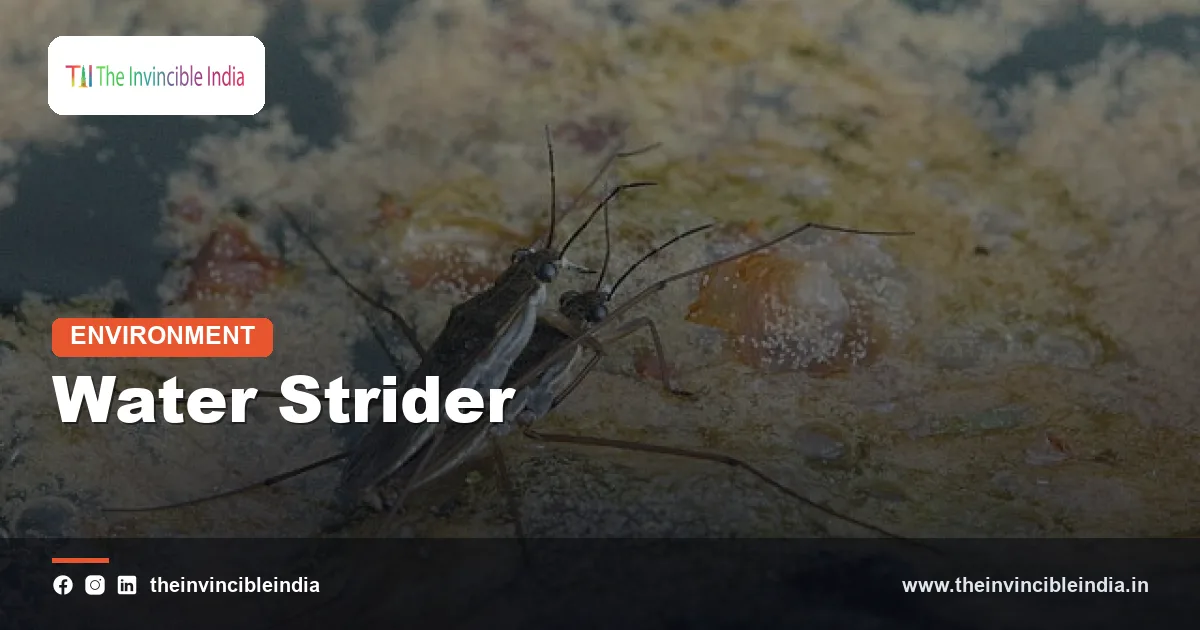
A water strider is a slender, long-legged true bug of the family Gerridae that lives on the surface of still and slow-moving fresh water, where it glides on water-repellent legs without breaking through the surface film. Also called a pond skater or, in some places, a Jesus bug, the water strider is a familiar sight on village ponds, paddy fields, lake margins, canals and quiet stretches of hill streams across India.
Because it appears to walk on water, the water strider is often a child’s first lesson in the physics of surface tension. This article explains what a water strider is, how it stays afloat, how it hunts and senses its surroundings, which kinds occur in India, how its life cycle works, and why a healthy population is a good sign for a pond.
Quick Facts
| Common name | Water strider (also pond skater, water skater, water bug or Jesus bug) |
|---|---|
| Scientific classification | Order Hemiptera, suborder Heteroptera; family Gerridae (infraorder Gerromorpha, the semi-aquatic bugs) |
| Size | Roughly 1 to 2 cm in most Indian species, with some stream-dwelling species noticeably larger and very long-legged |
| Habitat in India | Ponds, tanks, lakes, paddy fields, ditches, slow rivers and rocky hill streams; a few groups live on sheltered coastal water |
| Diet | Small insects and other arthropods that fall onto or hatch at the water surface, including mosquito larvae and pupae at the film |
| Life cycle | Incomplete metamorphosis: egg, five nymph stages, adult; eggs are laid on floating plants or objects at the water edge |
| Ecological role | Surface predator and scavenger; prey for fish, frogs, birds and other aquatic predators |
| Notable features | Hair-covered, water-repellent legs; rowing middle legs; steering hind legs; ripple-sensing; winged and wingless forms within one species |
Key Takeaways
- The water strider belongs to the family Gerridae of the true bugs (order Hemiptera) and is a predator that lives on the surface film of fresh water.
- A water strider stays on the surface because its legs are covered with thousands of tiny water-repellent hairs that trap air and let surface tension support its weight.
- The middle legs of a water strider act as oars, the hind legs steer, and the short front legs grab prey and detect vibrations.
- A water strider feeds by piercing small insects that fall on the water and sucking out their body fluids through a needle-like beak.
- Water striders develop through incomplete metamorphosis, passing through five nymph stages without a pupa before they become adults.
- Oil, soap and detergent on the water break the surface tension that a water strider needs, so the insect is a useful everyday indicator of an undisturbed pond surface.
What is a water strider?
A water strider is a semi-aquatic insect of the family Gerridae that spends almost its whole life on top of the water rather than in it. Like all true bugs, it has a piercing and sucking mouth, forewings that are partly hardened, and a body built around feeding on fluids.
The body of a water strider is narrow and elongated, usually dark brown, grey or blackish above and silvery below because of the dense hair that traps air. The legs are exceptionally long compared with the body, and the middle and hind pairs are spread wide so that the insect’s weight is distributed over a large area of the surface film.
The family Gerridae contains several hundred species worldwide, and its members are found on every continent except Antarctica. India has a rich fauna of water striders, with different species living on ponds, slow lowland water, shaded forest pools and fast hill streams. The group sits within the semi-aquatic bugs, which also include the water measurers and the broad-shouldered water striders.
How does a water strider walk on water?
A water strider walks on water because its legs are water-repellent and the surface of water behaves like a thin elastic skin created by surface tension. The insect does not break through the film; its feet press small dimples into the surface, and the upward pull of the stretched film balances the insect’s weight.
The key to the effect is the leg surface. Each leg is covered with a dense mat of fine hairs, called microsetae, and these hairs carry microscopic grooves. Together they trap a thin layer of air and keep water away from the cuticle. A drop of water placed on such a leg stays rounded rather than spreading, which is why the leg does not get wet and does not sink.
The physics in plain terms
Water molecules cling to one another more strongly than they cling to air, which produces surface tension. A water strider is light enough, and its contact area with the surface is wide enough, for the force of surface tension to carry its weight. Only the tips of the legs touch the water, and the dimples they form are visible as small circular shadows on the bottom of a clear pond in bright sunlight.
The same principle explains why the insect fails if the film is damaged. Soap, detergent, oil or a layer of scum lowers the surface tension and wets the leg hairs, so a water strider placed on such water can lose its support and become trapped.
How does a water strider move and steer on the surface?
A water strider moves by rowing with its middle legs, using them as a pair of oars that push backwards against the water while the hind legs trail behind and act as rudders. The sweeping stroke creates small swirls, or vortices, in the water, and the insect moves forward by pushing against them rather than by simply pressing on the film.
The front legs are short, held forward and used mainly for catching prey and sensing the surroundings. Because of this division of labour, the water strider can accelerate quickly, skate in a straight line, turn sharply and even leap across the surface. Some species can cover a distance of many body lengths in a single stroke and reach speeds of roughly a metre per second in short bursts.
The large middle legs are held out so wide that the insect can cover a considerable area of surface with a body only a couple of centimetres long. This is why a water strider seems to float effortlessly even in a light breeze, and why it is hard to catch by hand: the slightest movement of the water or the observer sends it skating away.
What does a water strider eat?
A water strider eats small insects and other arthropods that fall onto the water or come up to the surface, and it feeds on them by piercing the body and sucking out the fluids. It is a predator and a scavenger, and it will also feed on insects that have drowned or are struggling on the film.
Typical food items include flies, ants, moths, beetles blown onto the water and the larvae and pupae of mosquitoes when they come to the surface to breathe. The water strider grabs the prey with its front legs, holds it against its body and pushes its beak into it. Its saliva contains enzymes that begin to digest the tissues, and the insect then sucks the liquefied contents.
- Terrestrial insects that land or fall on the water, such as flies, ants and small moths.
- Aquatic insect larvae and pupae that hang from the surface film, including mosquito stages.
- Dead or dying insects floating on the water.
- Occasionally other water striders or their eggs and nymphs when food is scarce.
Because it removes insects from the surface, the water strider plays a modest part in controlling mosquito breeding in still water. It should not be treated as a substitute for good water management, but its presence is one reason a clean village pond is less troublesome than a stagnant, polluted one.
How does a water strider sense its prey and its mates?
A water strider senses prey and other insects mainly through ripples on the surface, which its legs detect as vibrations. A struggling insect sends out characteristic waves, and the water strider turns towards them and approaches with remarkable accuracy, even in the dark.
The legs carry sensory organs that respond to the very small movements of the film. In addition to detecting prey, the insect uses surface waves to communicate. Males of many species send ripple signals to attract females or to warn off rival males, and females may respond with their own signals. Because the surface of the water is a two-dimensional space, ripples travel outwards in circles and give the receiver both direction and distance.
The water strider also has well-developed eyes, which help it spot movement above the surface, and it escapes danger by skating or jumping away. These senses allow it to hunt without ever diving or swimming.
What are the different kinds of water strider in India?
India has several genera of water striders, which differ in size, habitat and body shape. Some, such as members of the genera Gerris and Limnogonus, are typical pond and slow-water skaters. Others, such as Metrocoris and Ptilomera, are adapted to flowing hill streams, where they hold position on riffles and rocky pools.
| Group or genus | Typical habitat | Notable feature |
|---|---|---|
| Gerris and relatives | Ponds, ditches and slow-moving water | Slender body, long legs, common and widely distributed |
| Limnogonus | Ponds, tanks, paddy fields and lake edges | Medium-sized and strongly built, often seen in groups |
| Metrocoris | Rocky hill streams and riffles | Short, broad body suited to flowing water |
| Ptilomera | Fast forest streams | Large with very long middle legs; fan-like hairs at the leg tips |
| Small surface skaters (such as Rhagadotarsus) | Ponds with floating vegetation | Small and short-legged; may be mistaken for tiny beetles |
Identification of species in this group usually needs a hand lens or a microscope, because the differences lie in the shape of the thorax, the length of the leg segments and the structure of the male’s genitalia. For a general reader it is enough to distinguish pond forms from stream forms and to note that all of them share the same surface-living way of life.
How does the life cycle of a water strider work?
The life cycle of a water strider has three stages, egg, nymph and adult, and the insect develops by incomplete metamorphosis, which means there is no pupal stage. After mating, the female lays her eggs in a row or cluster on floating leaves, twigs, stones or other objects close to the water, often fastened with a clear gelatinous substance.
The eggs hatch into nymphs that look like miniature, wingless adults. The nymph grows through five stages, called instars, and sheds its skin at the end of each one. Under warm conditions, the whole cycle from egg to adult may take only a few weeks to a couple of months, and several generations can occur in a year in the Indian tropics.
Winged and wingless forms
Many water striders show wing polymorphism, which means that adults of the same species may be fully winged, partly winged or entirely wingless. Wingless adults are common in stable ponds, where there is no need to leave. Winged adults are produced when a pond dries up, becomes crowded or loses its food supply, and they fly at night to find new water, sometimes arriving in puddles formed by the first monsoon rains.
During dry periods, adults of some species shelter in leaf litter and under stones near the water, and they return to the surface when the rains refill the ponds. This flexibility helps explain why water striders are found in so many kinds of temporary and permanent water.
Where do water striders live in India, and what eats them?
Water striders live wherever there is fairly clean, still or slowly moving fresh water with some shelter from strong wind, and they can be found from the plains to the foothills and forest streams of India. Village ponds, temple tanks, irrigation channels, flooded paddy fields, reservoirs and slow river backwaters all support them, and monsoon rains often bring a sudden increase in numbers.
The water strider has enemies both below and above the surface. Fish may strike upwards from underneath, frogs and toads snap at them from the bank, and birds such as kingfishers, herons and wagtails take them from the edge. Aquatic bugs such as backswimmers and water scorpions, together with larger spiders, also take their share.
- Fish and tadpoles that feed at the surface.
- Frogs, toads and lizards at the water’s edge.
- Birds that forage in shallow water and along the banks.
- Predatory water bugs and spiders.
- Parasitic water mites, which are sometimes seen as small red dots on the legs and body of a water strider.
The insect defends itself mostly by speed and by its quick reaction to ripples. Some species release a scent from glands on the thorax, and many group together, so that the movement of the whole cluster confuses a predator.
Is a water strider the same as a backswimmer or a whirligig beetle?
A water strider is not the same as a backswimmer or a whirligig beetle, although all three are common insects of pond surfaces. A water strider lives on top of the water and stands on its legs, a backswimmer hangs upside down just beneath the surface and swims with its hind legs, and a whirligig beetle swims in rapid circles on the surface with its body partly in the water.
| Insect | Position on the water | How it moves | Group |
|---|---|---|---|
| Water strider | Stands on the surface film, body dry | Rows with the middle legs | True bug (Hemiptera) |
| Backswimmer | Hangs upside down just below the film | Swims with oar-like hind legs | True bug (Hemiptera) |
| Whirligig beetle | Floats partly submerged on the surface | Swirls in rapid circles | Beetle (Coleoptera) |
| Water measurer | Walks slowly on the surface and floating plants | Slow, stick-like steps | True bug (Hemiptera) |
The water measurer, a close relative, is thinner and slower than a water strider and has a distinctly stick-like body with a long head. Its leisurely walk, in contrast to the quick skating of the water strider, is the easiest way to tell the two apart.
Does a water strider bite humans, and is it harmful?
A water strider does not normally bite humans and is harmless to people, livestock and crops. It has a beak that is meant for small insects, and it will not attack a person who touches the water; if handled roughly it may jab with the beak in self-defence, but the effect is slight.
The insect is not a pest in any ordinary sense. It does not damage fish, rice or other crops, and it does not carry diseases to humans. In fish hatcheries and nurseries a heavy population of water striders may take a few fish fry or eggs at the surface, but this is a minor local problem rather than a general concern.
For most people the water strider is simply a harmless and charming neighbour of the pond. Children can watch it from the bank without risk, and a small container of pond water makes a good, temporary observation tank, provided the insect is returned to its pond afterwards.
Why does the water strider matter, and what does it tell us about a pond?
The water strider matters because it links the water surface with the land and the air around it, and because its presence suggests that the pond surface is intact and free from heavy pollution. By feeding on insects that fall into the water, it recycles energy that would otherwise be lost, and it provides food for fish, frogs and birds.
Scientists also study the water strider because its leg design has inspired the development of water-repellent materials and tiny robots that can stand on water. The combination of hair-covered legs and a rowing action offers lessons in lightweight surface locomotion.
Ordinary pond care helps the water strider. The surface should be kept free from oil, soap and detergent, and the margins should have some floating and edge vegetation for egg-laying and shelter. Overuse of insecticides near ponds and fields reduces the supply of insect prey and may kill the water strider directly.
Bottom Line
The water strider is a small predatory bug that uses water-repellent legs, surface tension and a rowing action to hunt on the surface film of Indian ponds, paddy fields and streams. It is harmless to people, helpful in a modest way for controlling insects such as mosquito larvae, and a good everyday indicator of a clean pond surface.
Frequently Asked Questions
What is a water strider?
A water strider is a slender, long-legged true bug of the family Gerridae that lives on the surface of fresh water. It is also called a pond skater. It feeds on small insects that fall on the water and is common in ponds, paddy fields and streams across India.
How does a water strider walk on water?
A water strider walks on water because its legs are covered with tiny water-repellent hairs that trap air, so surface tension holds the insect up. Only the tips of the legs touch the film and press small dimples into it. The insect moves by rowing with its middle legs and steering with its hind legs.
What does a water strider eat?
A water strider eats small insects and other arthropods that fall on or rise to the water surface. This includes flies, ants, small moths and mosquito larvae and pupae at the film. It pierces the prey with a needle-like beak and sucks out the fluids.
Can a water strider bite humans?
A water strider does not normally bite humans and is harmless to people. Its beak is designed for small insects, so it uses it only on prey. If handled roughly, it may jab in self-defence, but this causes little or no harm.
Why do water striders sometimes sink or fail to skate?
A water strider fails to skate when oil, soap, detergent or scum lowers the surface tension or wets its leg hairs. Without the water-repellent air layer on its legs, the insect can no longer stay on the surface. This is why a clean, undisturbed pond surface matters to the species.
How is a water strider different from a backswimmer?
A water strider stands on top of the water and rows with its middle legs, while a backswimmer hangs upside down just below the surface and swims with its oar-like hind legs. Both are true bugs, but they use the water in opposite ways. A backswimmer also lives partly underwater, which a water strider does not.
{“@context”:”https://schema.org”,”@graph”:[{“@type”:”FAQPage”,”mainEntity”:[{“@type”:”Question”,”name”:”What is a water strider?”,”acceptedAnswer”:{“@type”:”Answer”,”text”:”A water strider is a slender, long-legged true bug of the family Gerridae that lives on the surface of fresh water. It is also called a pond skater. It feeds on small insects that fall on the water and is common in ponds, paddy fields and streams across India.”}},{“@type”:”Question”,”name”:”How does a water strider walk on water?”,”acceptedAnswer”:{“@type”:”Answer”,”text”:”A water strider walks on water because its legs are covered with tiny water-repellent hairs that trap air, so surface tension holds the insect up. Only the tips of the legs touch the film and press small dimples into it. The insect moves by rowing with its middle legs and steering with its hind legs.”}},{“@type”:”Question”,”name”:”What does a water strider eat?”,”acceptedAnswer”:{“@type”:”Answer”,”text”:”A water strider eats small insects and other arthropods that fall on or rise to the water surface. This includes flies, ants, small moths and mosquito larvae and pupae at the film. It pierces the prey with a needle-like beak and sucks out the fluids.”}},{“@type”:”Question”,”name”:”Can a water strider bite humans?”,”acceptedAnswer”:{“@type”:”Answer”,”text”:”A water strider does not normally bite humans and is harmless to people. Its beak is designed for small insects, so it uses it only on prey. If handled roughly, it may jab in self-defence, but this causes little or no harm.”}},{“@type”:”Question”,”name”:”Why do water striders sometimes sink or fail to skate?”,”acceptedAnswer”:{“@type”:”Answer”,”text”:”A water strider fails to skate when oil, soap, detergent or scum lowers the surface tension or wets its leg hairs. Without the water-repellent air layer on its legs, the insect can no longer stay on the surface. This is why a clean, undisturbed pond surface matters to the species.”}},{“@type”:”Question”,”name”:”How is a water strider different from a backswimmer?”,”acceptedAnswer”:{“@type”:”Answer”,”text”:”A water strider stands on top of the water and rows with its middle legs, while a backswimmer hangs upside down just below the surface and swims with its oar-like hind legs. Both are true bugs, but they use the water in opposite ways. A backswimmer also lives partly underwater, which a water strider does not.”}}]}]}


