

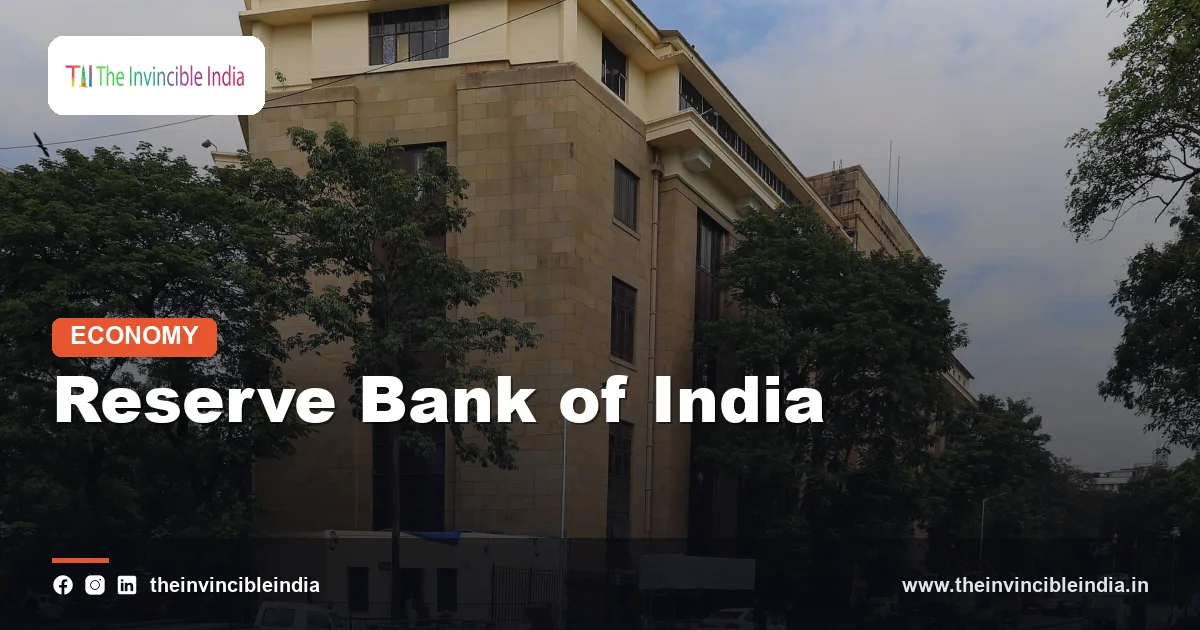
The Reserve Bank of India (RBI) is the country’s central bank and the apex institution of its monetary and financial system. From the rupee note in your wallet to the interest rate on your home loan, from the safety of your savings account to the UPI payment you make at a tea stall, the central bank’s decisions and rules sit quietly behind almost every financial transaction in the economy.
This guide explains how the RBI came into being, how it is organised, and what it actually does every day. It covers its seven core functions, the monetary policy tools it uses to manage inflation and growth, its role in currency management and digital payments, and even the story behind its palm-tree-and-tiger emblem. It is written for students, exam aspirants and curious readers who want a clear, factual picture of the institution.
Quick Facts About the RBI
| Particular | Detail |
|---|---|
| Full name | Reserve Bank of India |
| Established | 1 April 1935 |
| Governing law | Reserve Bank of India Act, 1934 |
| Intellectual basis | Recommendations of the Hilton Young Commission (1926) |
| Nationalised | 1 January 1949 |
| Headquarters | Mumbai, Maharashtra |
| Headed by | The Governor, assisted by Deputy Governors |
| Inflation-targeting framework | Flexible inflation targeting, around 4% with a tolerance band of 2% on either side |
| Emblem | A tiger and a palm tree |
History and Origins of the Reserve Bank of India
Before the RBI existed, India had no single central bank. The Imperial Bank of India, formed in 1921 by merging three Presidency banks, handled government accounts and some banking functions, while currency and credit policy were largely managed by the colonial Finance Department. Many economists felt this arrangement was untidy and inefficient.
The turning point came with the Royal Commission on Indian Currency and Finance, better known as the Hilton Young Commission, which reported in 1926. It recommended a central bank that would control currency and credit, act as banker to the government, and be independent of day-to-day political pressure. After years of debate and several drafts, the Reserve Bank of India Act was passed in 1934, and the bank began operations on 1 April 1935. It was initially set up as a shareholders’ institution, that is, privately owned, with its central office in Calcutta. The office moved to Mumbai in 1937.
Key Milestones
| Year | Milestone |
|---|---|
| 1926 | Hilton Young Commission recommends a central bank |
| 1934 | Reserve Bank of India Act enacted |
| 1935 | RBI begins functioning on 1 April, with Sir Osborne Smith as its first Governor |
| 1937 | Central office shifts from Calcutta to Mumbai |
| 1943 | C. D. Deshmukh becomes the first Indian Governor |
| 1949 | RBI nationalised on 1 January; Banking Regulation Act follows the same year |
| 2016 | Monetary Policy Committee created by amending the RBI Act |
After Independence, the RBI was nationalised, meaning the Government of India took over ownership of its entire capital. Since then it has functioned as a fully state-owned institution, though with considerable operational autonomy in monetary matters.
Structure and Governance
The RBI is run by a Central Board of Directors. The Governor chairs it, and there can be several Deputy Governors, along with directors nominated by the Government of India and directors representing different regions and sectors. The Governor and Deputy Governors are appointed by the central government, and the Governor is the public face of the institution.
Central Board and Deputy Governors
The Central Board oversees the general affairs of the bank, while Deputy Governors typically look after specific portfolios such as regulation, supervision, monetary policy, and payment systems. Various committees of the Board and specialised departments support their work.
Local Boards and Offices
The Act also provides for local boards for four regions, with offices spread across the country. The central office in Mumbai coordinates policy, while regional offices, currency chests and training and research institutions carry out the bank’s activities on the ground.
The Palm Tree and the Tiger: The RBI Logo
The RBI emblem shows a tiger standing beneath a palm tree. It is derived from the design of the East India Company’s double mohur coin, which carried a lion and a palm tree. When the RBI adopted the emblem, the lion was replaced by the tiger, a native symbol of India’s strength and vigour, while the palm tree stands for prosperity and stability.
Monetary Authority: Managing Money Supply and Inflation
The first and most visible role of the Reserve Bank of India is as the country’s monetary authority. It is responsible for deciding how much money and credit flow through the economy, so that prices stay reasonably stable while growth is supported. Too much money chasing too few goods pushes up inflation; too little squeezes businesses and households.
Since 2016, this task has rested on a legal framework known as flexible inflation targeting. The government, in consultation with the RBI, sets an inflation target based on the Consumer Price Index. The current arrangement aims for an inflation rate of about 4%, with a tolerance band of 2% on either side. The word “flexible” matters: the RBI tries to keep inflation within this band while also keeping an eye on economic growth.
The Monetary Policy Committee
Interest rate decisions are taken by the Monetary Policy Committee (MPC), a six-member body created under an amendment to the RBI Act. Three members come from the RBI, including the Governor, who chairs it, and three external members are appointed by the government. Decisions are taken by majority vote, with the Governor holding a casting vote in case of a tie. The committee meets at least four times a year and publishes the minutes of its meetings, which makes the process more transparent than it was in the past.
If inflation stays outside the tolerance band for a prolonged period, the RBI must explain the reasons and the corrective steps to the government in writing.
Monetary Policy Tools of the RBI
To influence money supply and interest rates, the RBI uses a set of instruments. Some work on the price of money (interest rates), while others work on the quantity of money (liquidity) in the banking system. The exact rates change from time to time, so the table below describes what each tool is and how it works rather than quoting current numbers.
| Tool | What it is | How it works |
|---|---|---|
| Repo rate | The rate at which the RBI lends short-term money to commercial banks against government securities | A higher repo rate makes borrowing costlier for banks, which tends to raise loan rates and cool demand; a lower rate does the opposite |
| Reverse repo rate | The rate at which the RBI borrows money from banks | Encourages banks to park surplus funds with the central bank, thereby absorbing excess liquidity |
| Cash Reserve Ratio (CRR) | The share of a bank’s deposits that must be kept as cash with the RBI | Raising CRR reduces the money banks can lend; lowering it releases funds into the system |
| Statutory Liquidity Ratio (SLR) | The share of deposits banks must hold in liquid assets such as cash, gold and government securities | Higher SLR limits the funds available for lending; it also ensures banks stay safe and liquid |
| Open Market Operations (OMO) | Buying and selling of government securities by the RBI in the market | Buying securities injects money into the system; selling them draws money out |
| Bank Rate and Marginal Standing Facility | Longer-term and emergency lending windows for banks | Act as a ceiling for short-term rates and help banks handle sudden shortfalls |
In practice, the repo rate acts as the main policy rate. Changes in it ripple through the economy, influencing what banks charge for home loans, car loans and business credit, and what they pay on deposits.
Issuer of Currency and the Clean Note Policy
Under the RBI Act, the bank holds the sole right to issue banknotes in India. The only exception is the one-rupee note and all coins, which are issued by the Government of India through the Ministry of Finance. The RBI, however, acts as the government’s agent for putting coins into circulation. Notes are printed at government-owned and RBI-owned presses, and then distributed through a network of currency chests maintained by banks under RBI supervision.
Managing Notes in Circulation
The RBI decides the denominations to be printed, watches demand from different regions, and works to keep the supply adequate. It also looks after security features that make counterfeiting difficult. The demonetisation of Rs 500 and Rs 1,000 notes on 8 November 2016 showed how central the RBI and the Government are to currency management.
The Clean Note Policy
The clean note policy aims to give the public good-quality notes and coins. Under it, the RBI withdraws soiled, mutilated and worn-out notes from circulation and replaces them with fresh ones, while soiled notes are processed and destroyed at its offices. Banks are expected to sort notes, keep only fit ones in circulation, and provide exchange facilities to customers. The policy also supports the fight against fake currency, because handling and sorting notes regularly makes counterfeits easier to catch.
In recent years, the RBI has also explored a central bank digital currency, the digital rupee, through pilot programmes.
Banker to the Government and Banker to Banks
The RBI performs two banking roles at once, and both are central to how the system functions.
Banker and Debt Manager to Government
The central government and state governments keep their money accounts with the RBI, which handles their receipts and payments. It also manages public debt: it conducts auctions of government securities and treasury bills, helping governments raise funds from the market, and advises on the timing and structure of borrowing. Short-term cash mismatches are handled through arrangements such as Ways and Means Advances.
Banker to Banks and Lender of Last Resort
Commercial banks maintain accounts with the RBI, using them to hold required reserves and to settle payments between themselves. When a bank faces a temporary liquidity crisis, the RBI can lend to it, and this is why it is called the lender of last resort. The assurance that emergency funding is available helps prevent panic, and stops a problem at one bank from spreading through the entire system.
This role also gives the RBI the right to manage the country’s clearing and settlement arrangements, keeping the movement of money between banks smooth and dependable.
Regulator and Supervisor of the Financial System
The RBI licenses and regulates banks in India under laws such as the Banking Regulation Act, 1949. It decides who can open a bank, where branches may be opened, and how much capital a bank must hold against its risks. It also lays down norms on classifying bad loans, which helps make sure banks’ books reflect the real quality of their lending.
Whom the RBI Regulates
- Scheduled commercial banks, including public sector, private sector, small finance and payments banks
- Cooperative banks, in their banking functions
- Non-banking financial companies (NBFCs) and similar lenders
- Payment system operators and prepaid wallet issuers
- Credit information companies
Supervision and Consumer Protection
Beyond writing rules, the bank inspects and supervises the institutions it regulates, and it can impose penalties, restrict activities or, in serious cases, take action against the management of a troubled lender. It also runs an ombudsman scheme that lets customers of regulated entities lodge complaints about deficiency in services. A subsidiary, the Deposit Insurance and Credit Guarantee Corporation, insures bank deposits up to a specified limit, giving small savers an added layer of protection.
The RBI also publishes a Financial Stability Report twice a year, assessing risks to the financial system.
Manager of Foreign Exchange
India’s external transactions, such as imports, exports, remittances and overseas investments, involve foreign currencies, and the RBI sits at the centre of this system. It administers the Foreign Exchange Management Act, 1999 (FEMA), which replaced the older and stricter Foreign Exchange Regulation Act of 1973. FEMA’s focus is on facilitating external trade and payments and promoting orderly development of the foreign exchange market, rather than on control for its own sake.
Reserves and the Rupee
The RBI holds and manages the country’s foreign exchange reserves, which include foreign currency assets, gold and other holdings. These reserves act as a cushion against external shocks and help maintain confidence in the economy. India follows a market-determined exchange rate system, but the RBI may step into the currency market to reduce excessive volatility. It does not target a particular level for the rupee.
Authorised dealer banks, licensed by the RBI, carry out most foreign exchange business on its behalf, and the bank issues detailed rules on what kinds of foreign transactions are permitted.
Payment Systems and Digital Payments
A modern economy needs safe and efficient ways to move money, and the RBI is the regulator and overseer of the country’s payment systems under the Payment and Settlement Systems Act, 2007. It also runs the core large-value and retail settlement infrastructure.
- RTGS (Real Time Gross Settlement): used for high-value transfers, settled individually in real time.
- NEFT (National Electronic Funds Transfer): a widely used system for everyday electronic transfers between bank accounts.
- UPI (Unified Payments Interface): the instant mobile payments platform, launched in 2016 and operated by the National Payments Corporation of India (NPCI), an umbrella organisation promoted by the RBI and banks and regulated by the central bank.
- Cards, wallets and other instruments: regulated through licensing and security norms.
UPI in particular has become a global talking point, with small merchants across India accepting payments through a simple QR code. The RBI’s oversight makes sure such innovations remain safe, interoperable and trusted, while its regulatory approach has also opened space for fintech firms.
Financial Inclusion and Developmental Role
Alongside its regulatory duties, the RBI has a broader developmental mission: to spread banking and credit to people and regions that formal finance has traditionally left out. Financial inclusion means that every individual, whether a farmer, a daily-wage worker or a small entrepreneur, has access to affordable financial services.
How the RBI Promotes Inclusion
- Encouraging banks to open branches and appoint banking correspondents in underserved areas
- Setting priority sector lending norms, which direct a share of bank credit to agriculture, small businesses and weaker sections
- Supporting the development of specialised institutions, including NABARD for agriculture and rural development and SIDBI for small industries, which grew out of the need for development finance
- Promoting financial literacy campaigns and simpler customer protection rules
Government initiatives such as the Pradhan Mantri Jan Dhan Yojana, launched in 2014, worked alongside RBI guidance to bring millions of households into the banking system, and digital payments have extended that reach further.
Conclusion
From its founding on 1 April 1935 to its present role as regulator, currency issuer, government banker and guardian of price stability, the Reserve Bank of India has grown with the country it serves. Its work is often invisible when things go well, which is precisely the mark of a stable central bank. Understanding its functions helps citizens make sense of news about interest rates, inflation, bank rules and digital payments, and shows why the RBI is regarded as one of the most important institutions in the Indian economy.
Frequently Asked Questions
When was the Reserve Bank of India established and where is it headquartered?
The Reserve Bank of India began functioning on 1 April 1935 under the Reserve Bank of India Act, 1934. It was originally set up with its central office in Calcutta, which was moved to Mumbai in 1937, and Mumbai remains its headquarters today.
Was the RBI always owned by the government?
No. It started as a privately held shareholders’ bank. The Government of India nationalised it on 1 January 1949, after which the entire capital has been owned by the government.
What are the main functions of the RBI?
The RBI acts as the monetary authority, the issuer of currency, the banker to the government, the banker to banks and lender of last resort, the regulator and supervisor of the financial system, the manager of foreign exchange under FEMA, and a promoter of development, financial inclusion and payment systems.
Does the RBI print all Indian currency?
The RBI has the sole right to issue banknotes, but the one-rupee note and all coins are issued by the Government of India. The RBI distributes coins on the government’s behalf.
What is the Monetary Policy Committee and what is the inflation target?
The Monetary Policy Committee is a six-member body, chaired by the RBI Governor, that decides the policy interest rate. It works under a flexible inflation-targeting framework, which aims for inflation of around 4% with a tolerance band of 2% on either side.
What do the tiger and palm tree in the RBI logo represent?
The emblem is adapted from the East India Company’s double mohur coin, which showed a lion and a palm tree. The RBI replaced the lion with a tiger, which represents strength, while the palm tree symbolises prosperity and stability.


