

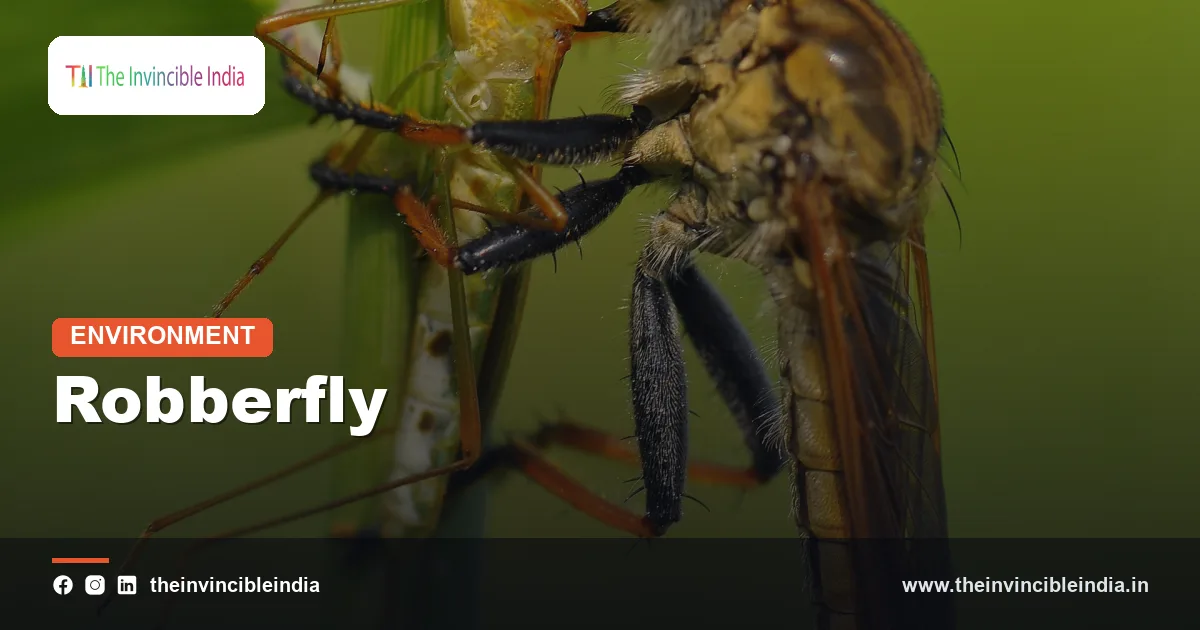
The robberfly is a predatory fly of the family Asilidae that ambushes other insects in mid-air, pierces them with a strong proboscis and sucks out their body fluids. Robberflies are also called assassin flies, and they are conspicuous in open, sunny places across India, perched on twigs, rocks and bare ground as they watch for passing prey.
The robberfly is one of the fiercest small hunters in the insect world, with a bristly face, powerful legs and sharp eyesight. It poses little danger to people and plays a useful role in keeping other insect populations in check. This explainer describes how to recognise a robberfly, how it hunts, how its life cycle works and where it fits in the ecology of Indian habitats.
Quick Facts: Robberfly
| Scientific group | Family Asilidae (robber flies or assassin flies) |
|---|---|
| Order | Diptera (true flies) |
| Size | Roughly 3 mm to about 5 cm, with most species between 10 and 30 mm; the largest tropical species are bulky and heavy |
| Habitat in India | Open, sunny places such as grassland, scrub, farmland, forest clearings, dry slopes and sandy ground |
| Diet | Adults are predators of flying and resting insects; larvae are predators of other soil and wood insects |
| Life cycle | Egg, several larval stages, pupa and adult; may take from a few months to more than a year |
| Hunting method | Ambush from a perch, capture in flight with the legs, paralysis by injected saliva |
| Ecological role | Natural predator that regulates numbers of many insects |
| Notable features | Beard-like facial bristles, sunken head between big eyes, strong spiny legs and a stiff piercing proboscis |
Key Takeaways
- The robberfly is a predatory true fly of the family Asilidae, with more than seven thousand species described worldwide.
- Robberflies hunt by ambush, watching from a perch, intercepting prey in flight and injecting saliva that paralyses and digests the victim.
- A robberfly has a distinctive tuft of bristles on its face, called the mystax, which protects the head from the struggles of captured prey.
- Robberflies eat a wide range of insects, including flies, bees, wasps, beetles, grasshoppers and even dragonflies.
- Robberfly larvae live in soil, leaf litter or rotting wood, where they feed on the eggs and larvae of other insects.
- Robberflies are not aggressive towards people, and they bite only if they are handled or squeezed.
What is a robberfly?
A robberfly is a medium-sized to large fly in the family Asilidae that catches and eats other insects, and it is recognised by its stiff bristles, elongated body and spiny legs. More than seven thousand species have been described across the world, and the family occurs on every continent except Antarctica.
Robberflies belong to the order Diptera, so they have only one pair of wings. The common name comes from their habit of seizing prey in flight, which was thought to resemble highway robbery. The alternative name assassin fly refers to their quick, lethal strike. Several robberfly genera, such as Philodicus and Ommatius, are known from tropical Asia and from India.
The family should not be confused with assassin bugs, which belong to the order Hemiptera and are unrelated. Assassin bugs have a different mouthpart structure and four wings (or none), while robberflies have two wings and a typical fly body.
How can you recognise a robberfly?
A robberfly can be recognised by its sunken space between the large eyes, the beard of bristles on its face, its stout spiny legs and its habit of perching upright and watching. The body is usually slender and tapering in the abdomen, though some species are stocky and hairy.
- Head: The top of the head has a hollow between the big compound eyes, where three simple eyes (ocelli) sit.
- Mystax: A moustache-like tuft of stiff bristles on the face guards the eyes and head from struggling victims.
- Proboscis: A strong, rigid, needle-like mouthpart projects forward and downward.
- Legs: Long, strong legs with bristles and claws are used to catch and hold prey.
- Perching style: Many robberflies sit on a favoured twig, stone or tip of grass, flying out to catch prey and returning to the same spot.
- Flight: The flight is fast and direct, with a distinctive buzz in larger species.
Some robberflies imitate bees, wasps or bumblebees in shape and colour, which may help them approach their prey. Others are grey, brown or black and blend with soil and bark. The wide range of body forms is one reason that different species can seem unlike one another.
How does a robberfly hunt?
A robberfly hunts by watching from a perch, launching at a passing insect, grabbing it with its legs in mid-air and then stabbing it with its proboscis to inject paralysing saliva. The whole attack is usually over in a fraction of a second.
Spotting the prey
The large compound eyes give excellent vision, and the forward-facing position of the eyes helps judge distance. A robberfly will typically react to anything of suitable size that moves, and some species ignore objects that are too big or too small.
Capturing the prey
The fly rushes out, intercepts the target, and holds it with its front legs against its body. The bristles on the face protect the robberfly from kicks and bites. It then carries the victim back to a perch or eats it as it hangs on.
Killing and feeding
The proboscis, which is a hardened structure, is inserted into a soft spot such as the neck joint or the base of a leg or wing. Saliva containing a fast-acting neurotoxin paralyses the victim quickly. The saliva also contains enzymes that break down the internal tissues, and the robberfly sucks up the resulting liquid. What remains is a dry empty shell of the prey.
The ability of such a small predator to subdue prey as large or larger than itself, including wasps and bees, is one of the striking features of the group.
What does a robberfly eat?
A robberfly eats other insects, and the adult takes almost any flying or resting insect that it can overpower, including flies, bees, wasps, beetles, grasshoppers, butterflies, moths and even dragonflies. Large robberflies can tackle bigger prey than small ones, so prey size increases with the size of the predator.
| Life stage | Typical food | Where it feeds |
|---|---|---|
| Adult | Flying and resting insects: flies, wasps, bees, beetles, grasshoppers, moths and bugs | Perches in open, sunny places |
| Larva | Eggs, larvae and pupae of beetles and other insects | Soil, leaf litter, rotting wood and dung |
Because many of their prey insects are pests, robberflies are sometimes considered helpful to farmers. However, they eat harmless and useful insects as well, such as bees and hoverflies. They are generalist predators, so their effect on any one pest is limited.
How does the life cycle of the robberfly work?
The life cycle of the robberfly has four stages, egg, larva, pupa and adult, and the larval stage is long and hidden. Duration varies with the species and the climate, and in some robberflies the cycle takes a year or longer, while tropical species may develop faster.
Courtship and eggs
In many species, males court females with a brief display, and in some species they offer a prey item, which helps the female accept the male rather than treat him as food. After mating, the female lays eggs in the soil, in cracks in wood, on grass stems or under bark. Some species lay the eggs in clusters and cover them with a protective coating. Others scatter them or push them into the ground with a specialised egg-laying organ.
Larva
The larvae are slender, whitish or yellowish and live in soil, decaying wood, dung or leaf litter. They are carnivores that attack other insect larvae, using strong mouthparts to seize prey. The larval stage is the longest part of the life cycle, and many species pass through several larval stages before they pupate.
Pupa and adult
The larva forms a pupa in the soil or wood. When the adult is ready to emerge, the pupa wriggles to the surface and splits open. The adult then dries its wings, flies off and begins to hunt. Adults of many species live for only a few weeks.
Where do robberflies live in India?
Robberflies live in open, warm, sunlit habitats across India, including grasslands, scrub jungles, farm margins, dry deciduous forest clearings, riverbanks and sandy or rocky ground. They are found from the plains to hill slopes, and more species occur in dry and semi-arid areas than in dense, dark forest.
Typical perching sites include bare twigs, dry grass heads, fence posts, rocks and the ground. Because the flies return again and again to the same perch, a quiet observer can watch their hunting trips over a few minutes. They are most active on warm, sunny days.
The numbers and kinds of robberflies in an area often reflect the diversity of insect prey and the condition of the soil. Because the larvae live in soil and decaying wood, habitats with undisturbed ground and dead wood tend to support more robberflies. Heavy tillage, pesticide use and the clearing of grassy margins can reduce them.
Are robberflies dangerous to humans?
No, robberflies are not dangerous to humans: they do not seek out people, and they have no sting, though a large robberfly can give a sharp bite if it is picked up or squeezed. The bite comes from the stiff proboscis and can be painful, but it is rarely serious and usually heals without treatment.
The best approach is simply to observe them from a distance. Anyone who is bitten should wash the area with soap and water. Those with known allergies to insect bites, or who develop swelling or other unusual symptoms, should seek medical advice.
Robberflies do not carry diseases that affect people, and they do not damage crops, houses or stored food. They are best seen as part of the natural pest-control system of grasslands and fields.
Why are robberflies important to the ecosystem?
Robberflies are important because they are top insect predators in many open habitats and help to keep populations of other insects balanced. As adults they remove large numbers of flies, beetles, grasshoppers and other insects, and as larvae they feed on insects living in soil and wood.
Their presence is also a useful sign. A healthy population of robberflies suggests that a field, grassland or scrub has plenty of insect life and relatively undisturbed ground. Birds, spiders, lizards and larger predatory insects in turn eat the robberflies, so they form one link in the food web.
Several features make robberflies interesting to scientists. The fast visual tracking of the prey has been studied as an example of how a small brain can control precise pursuit. The saliva, which combines a neurotoxin with digestive enzymes, is also studied by biochemists.
- Regulation of insects: They take a share of flying insects, including some crop and garden pests.
- Soil and wood life: Larvae take part in the food web within the soil and in dead wood.
- Food for others: Robberflies themselves are eaten by birds and other predators.
- Indicators: Their numbers reflect the condition of open habitats.
Bottom Line
The robberfly is a sharp-eyed, bristly ambush predator that captures insects in mid-air and feeds on their liquefied insides. It is harmless to people if left alone, and it is a natural part of the balance of insect life in India’s fields, scrub and grasslands.
Frequently Asked Questions
What is a robberfly?
A robberfly is a predatory fly of the family Asilidae that catches other insects in flight. It uses a stiff proboscis to inject paralysing saliva and then sucks out the victim’s body fluids. It is also called an assassin fly.
Do robberflies bite or sting humans?
Robberflies do not sting, and they bite humans only if handled or squeezed. The bite can be sharp but is rarely serious. They do not attack people unprovoked.
What do robberflies eat?
Adult robberflies eat other insects such as flies, bees, wasps, beetles, grasshoppers and moths. The larvae eat the eggs and larvae of other insects in soil, dung or rotting wood. They are predators at every stage of life.
How is a robberfly different from an assassin bug?
A robberfly is a true fly with two wings, while an assassin bug belongs to the order Hemiptera and is unrelated. Robberflies catch prey in the air and have bristly faces. Assassin bugs have a curved beak and usually stalk their prey on plants.
Where can robberflies be seen in India?
Robberflies can be seen in sunny, open places such as grasslands, scrub, farm edges, forest clearings and sandy ground. They often sit on twigs, stones or grass tips and fly out to catch passing insects. They are most active on warm, bright days.
Are robberflies useful to farmers?
Robberflies are partly useful because they eat many insects, including some pests. However, they also catch beneficial insects such as bees, so they are general predators and not a targeted pest control. Protecting grassy margins and avoiding heavy pesticide use helps them survive.
{“@context”:”https://schema.org”,”@graph”:[{“@type”:”FAQPage”,”mainEntity”:[{“@type”:”Question”,”name”:”What is a robberfly?”,”acceptedAnswer”:{“@type”:”Answer”,”text”:”A robberfly is a predatory fly of the family Asilidae that catches other insects in flight. It uses a stiff proboscis to inject paralysing saliva and then sucks out the victim’s body fluids. It is also called an assassin fly.”}},{“@type”:”Question”,”name”:”Do robberflies bite or sting humans?”,”acceptedAnswer”:{“@type”:”Answer”,”text”:”Robberflies do not sting, and they bite humans only if handled or squeezed. The bite can be sharp but is rarely serious. They do not attack people unprovoked.”}},{“@type”:”Question”,”name”:”What do robberflies eat?”,”acceptedAnswer”:{“@type”:”Answer”,”text”:”Adult robberflies eat other insects such as flies, bees, wasps, beetles, grasshoppers and moths. The larvae eat the eggs and larvae of other insects in soil, dung or rotting wood. They are predators at every stage of life.”}},{“@type”:”Question”,”name”:”How is a robberfly different from an assassin bug?”,”acceptedAnswer”:{“@type”:”Answer”,”text”:”A robberfly is a true fly with two wings, while an assassin bug belongs to the order Hemiptera and is unrelated. Robberflies catch prey in the air and have bristly faces. Assassin bugs have a curved beak and usually stalk their prey on plants.”}},{“@type”:”Question”,”name”:”Where can robberflies be seen in India?”,”acceptedAnswer”:{“@type”:”Answer”,”text”:”Robberflies can be seen in sunny, open places such as grasslands, scrub, farm edges, forest clearings and sandy ground. They often sit on twigs, stones or grass tips and fly out to catch passing insects. They are most active on warm, bright days.”}},{“@type”:”Question”,”name”:”Are robberflies useful to farmers?”,”acceptedAnswer”:{“@type”:”Answer”,”text”:”Robberflies are partly useful because they eat many insects, including some pests. However, they also catch beneficial insects such as bees, so they are general predators and not a targeted pest control. Protecting grassy margins and avoiding heavy pesticide use helps them survive.”}}]}]}


