

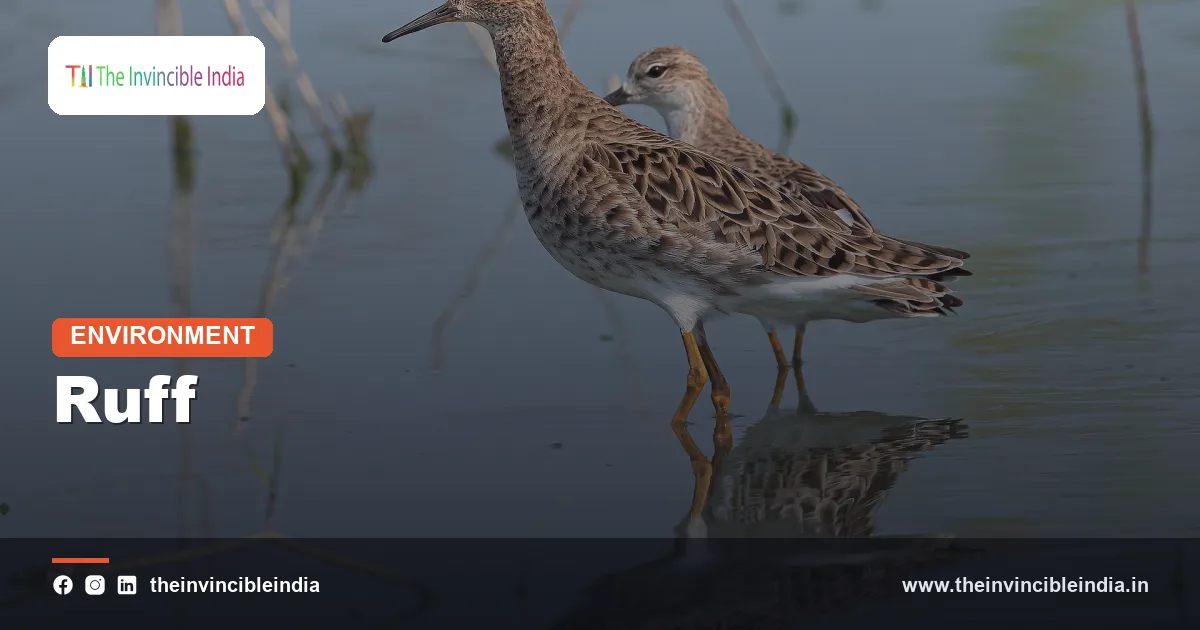
The ruff (Calidris pugnax) is a medium-sized wader in which breeding males grow spectacular, variously coloured neck ruffs and ear tufts, while in India the bird is seen mainly as a plain, scaly-backed non-breeding visitor in large winter flocks on wetlands and flooded fields. The ruff is among the most remarkable birds in the world for its breeding behaviour, yet visitors to Indian wetlands usually see it in its subdued winter dress.
The ruff breeds on wet meadows and tundra across northern Europe and Siberia and travels to Africa, South Asia and sometimes Australasia for the winter. This explainer describes how to recognise the ruff in India, where it lives, what it eats, and why its breeding system has made it a subject of scientific study.
| Attribute | Details |
|---|---|
| Common name | Ruff (the female is called a reeve) |
| Scientific name | Calidris pugnax (formerly Philomachus pugnax) |
| Family | Scolopacidae (sandpipers, curlews, snipes and relatives) |
| Size | Males about 26 to 32 cm, females about 20 to 25 cm; males are clearly larger |
| Range and habitat in India | Winter visitor and passage migrant; freshwater marshes, jheels, flooded fields, lake margins and some coastal lagoons |
| Diet | Insects and larvae, small crustaceans, molluscs, worms, plus seeds and grain |
| Breeding and migration | Breeds on wet meadows and tundra of northern Eurasia using lek displays; migrates along the Central Asian Flyway |
| Conservation status | Least Concern globally, though populations have declined in parts of Europe |
Key Takeaways
- The ruff is a Eurasian wader of the family Scolopacidae in which breeding males grow showy neck ruffs and head tufts that vary widely in colour.
- Male ruffs perform in communal display grounds called leks, and the males take no part in nest-building or caring for the young.
- Male ruffs exist in three genetically determined forms: independents, satellites and rare female-mimicking males known as faeders.
- In India the ruff is a winter visitor and passage migrant that appears mostly in plain non-breeding plumage, with scaly brown upperparts and variable leg colour.
- Ruffs feed in flocks on shallow wetlands and flooded fields, taking insects, small aquatic animals and seeds.
- The ruff is listed as Least Concern by the IUCN, but loss of wet meadows and wetlands has caused declines in parts of its range.
What is a ruff?
A ruff is a medium-sized, long-legged wader that belongs to the sandpiper family and is best known for the extraordinary breeding plumage of the male. The name refers to the ruff, the frilled collar worn in sixteenth-century Europe, because the males develop an elaborate ruff of feathers around the neck in spring.
Males are much larger than females, which is unusual among waders and a result of the competitive mating system. The female is called a reeve,. The scientific name pugnax means pugnacious, referring to the energetic sparring of males at their display grounds.
Though now classified in the genus Calidris along with the sanderling and the red knot, the ruff was for a long time placed in its own genus, Philomachus, and older books may still use that name. The ruff is the only species of its type, with no close look-alike in India.
How do you identify a ruff in India?
A ruff in India is identified by its scaly brown upperparts, a small head, a short slightly drooping bill, a plump body and legs that range from dull green to orange or reddish. Because the ruff is so variable, observers use the overall impression rather than a single feature.
The key identification points are:
- Back pattern: feathers with pale edges give a distinct scaly look.
- Legs: yellowish, orange, reddish or greenish, depending on age and individual.
- Bill: short to medium, straight or slightly decurved at the tip, often with an orange base on some birds.
- Size difference: males can look as big as a redshank, while females are noticeably smaller.
- Flight pattern: a narrow white wing bar and oval white patches on each side of the dark rump.
Most ruffs seen in India are in non-breeding or transitional plumage. Some males arrive or depart partly moulted, with a few dark or white feathers on the neck, giving a hint of the spring finery they will show on the breeding grounds.
Where does the ruff live in India?
The ruff lives across much of India as a winter visitor and passage migrant, favouring freshwater marshes, shallow lakes, wet grassland, flooded fields and the muddy edges of reservoirs. The bird is more of an inland wader than many sandpipers, though it also appears on coastal lagoons.
It is recorded widely in northern and western India, and it reaches the peninsula in smaller numbers. Wetlands that regularly attract the species include Keoladeo National Park in Rajasthan, the lakes and marshes of Gujarat such as Nal Sarovar, and the shallow wetlands of the Indo-Gangetic plain. Large flocks can appear in agricultural land when fields flood after rain or irrigation.
Ruffs seem to prefer soft muddy ground with short vegetation, where they can walk and probe without obstruction. They often roost together at night on islands, bunds or mudbanks, and they commonly mix with black-tailed godwits, redshanks, lapwings and other waders.
How does the ruff’s breeding display work?
The ruff’s breeding display works through a lek, a communal arena where males gather each spring to show off for visiting females. At the lek, each male defends a small patch of ground, raises his ruff, tufts and wings, and leaps, crouches and sparrings with rivals, while females walk through and choose a mate.
After mating, the female leaves to nest alone. She makes a simple ground nest hidden in tall grass or sedge, lays about four eggs, incubates them herself and rears the chicks without help from the male. The chicks are precocial, which means they can walk and feed shortly after hatching.
The ruff’s lek system has been studied intensively because the males differ so strongly in appearance and behaviour. It is a classic example in textbooks of how sexual selection can shape both ornaments and strategies. None of this display occurs in India, but the transitional feathering seen on some Indian birds in spring is a faint preview.
What are the three types of male ruff?
There are three types of male ruff: independents, satellites and faeders, and each follows a different mating strategy. The types differ in colour, behaviour and size, and scientists have shown that the differences are inherited.
| Male type | Appearance | Behaviour |
|---|---|---|
| Independent | Dark ruff, usually black or chestnut; the majority of males | Defends a court on the lek and fights rivals |
| Satellite | White or pale ruff; a minority of males | Does not hold a court, visits and shares the display ground peacefully |
| Faeder | Looks like a female but is larger; very rare | Mimics a reeve to slip in and mate while other males are distracted |
Researchers have shown that these forms are controlled by a block of genes on one chromosome that behaves as a supergene, and that the faeder form arose long ago through a rare chromosomal rearrangement. Outside the breeding season, the types are difficult to tell apart, and none of them can be reliably identified in India.
What does the ruff eat?
The ruff eats a mixed diet of insects and their larvae, small crustaceans, snails, worms and plant material such as seeds and waste grain. The bird feeds by walking steadily over wet ground and pecking at the surface or probing softly in shallow mud.
On the breeding grounds, insects are the staple, including beetles, flies and midges, which are rich in protein for growing chicks and laying females. In winter, especially in India and Africa, the diet is broader. Ruffs readily feed in flooded rice fields and on harvested paddy, where they pick up grain and the invertebrates that gather in the stubble and water.
The ability to switch between aquatic animals and plant foods helps the ruff exploit both natural wetlands and farmland. It also explains why large flocks are often found on agricultural land in addition to protected lakes.
Why does the ruff migrate to India?
The ruff migrates to India because its northern breeding grounds are frozen or unproductive in winter, and the warmer wetlands of South Asia supply food during the cold months. The bird travels along the Central Asian Flyway, which links Arctic and subarctic breeding areas with wintering areas across South Asia and Africa.
Many ruffs are long-distance fliers, and a large proportion of the world population winters in Africa, with other groups using South Asia and parts of the Middle East. Birds that reach India are mostly from the Siberian breeding populations. Arrival begins in autumn, from around August or September, and birds typically leave by April or May, sometimes in lively display-like spring plumage.
Stopover wetlands are vital because the journey requires repeated rest and feeding. A ruff may double its normal body mass in fat before a long crossing, so any loss of stopover habitat makes migration riskier.
Is the ruff threatened, and what is its legal protection?
The ruff is not globally threatened; the IUCN lists the ruff as Least Concern because it has a very large range and a big population. Even so, numbers have fallen in several European breeding areas due to drainage of wet meadows and intensive farming, and conservationists monitor the species closely.
In India the ruff benefits from the protection of wetlands and sanctuaries and from national commitments to migratory species. India has been a party to the Convention on Migratory Species since 1983 and to the Ramsar Convention since 1982. National and regional action plans for the Central Asian Flyway encourage wetland monitoring and cooperation between range countries.
Threats facing wetlands used by the ruff include drainage, encroachment, pollution, overgrazing and the build-up of invasive plants. Retaining shallow, seasonally flooded habitats, including traditional village tanks and paddy fields managed with care, is one of the simplest ways to help.
How can you spot a ruff among other waders?
You can spot a ruff among other waders by looking for a plump bird with a small head, scaly back and unusually variable leg colour that stands out in a mixed flock. A flock of ruffs often shows a surprising range of sizes, because males and females differ so much.
Helpful tips for watching ruffs in India include:
- Scan shallow muddy edges and flooded fields in the morning and evening, when birds feed actively.
- Look for a white oval patch on either side of the tail when the flock takes off.
- Compare with redshanks and godwits, which have longer bills and different leg colours.
- Keep a safe distance and avoid flushing the flock, since feeding time is precious.
The best months are usually from October to March, when large wetlands in northern and western India hold flocks. With patience, careful observers may also see a male in partial breeding feathers before spring departure.
Bottom Line
The ruff is a wader whose winter appearance in India is modest but whose breeding biology is among the most extraordinary of any bird. Protecting shallow wetlands and wet fields in India helps sustain a species that links the Siberian tundra with the Indian subcontinent each year.
Frequently Asked Questions
What is a ruff bird?
A ruff is a medium-sized wader of the sandpiper family whose breeding males grow elaborate neck ruffs and head tufts. It breeds in northern Europe and Siberia and winters in Africa, South Asia and sometimes Australasia, including in India.
Why is the ruff called a ruff?
The ruff is named after the frilled collar of the same name worn in sixteenth-century Europe. Breeding males develop a similar collar of showy feathers around the neck, which they display at their breeding arenas.
What is a female ruff called?
A female ruff is called a reeve. She is smaller and plainer than the male and handles all nesting duties alone, including incubation and rearing of the chicks.
When can ruffs be seen in India?
Ruffs can be seen in India mainly from autumn to spring, with the best numbers between October and March. They are widespread winter visitors and passage migrants, especially on wetlands and flooded fields in northern and western India.
What do ruffs eat?
Ruffs eat insects and their larvae, small crustaceans, snails and worms, as well as seeds and waste grain. In India they often feed in flooded fields and on the muddy edges of lakes and marshes.
Is the ruff an endangered bird?
No, the ruff is not endangered and is listed as Least Concern by the IUCN because it has a large range and population. Some European populations have declined due to wetland loss, so the species is still watched closely by conservationists.
{“@context”:”https://schema.org”,”@graph”:[{“@type”:”FAQPage”,”mainEntity”:[{“@type”:”Question”,”name”:”What is a ruff bird?”,”acceptedAnswer”:{“@type”:”Answer”,”text”:”A ruff is a medium-sized wader of the sandpiper family whose breeding males grow elaborate neck ruffs and head tufts. It breeds in northern Europe and Siberia and winters in Africa, South Asia and sometimes Australasia, including in India.”}},{“@type”:”Question”,”name”:”Why is the ruff called a ruff?”,”acceptedAnswer”:{“@type”:”Answer”,”text”:”The ruff is named after the frilled collar of the same name worn in sixteenth-century Europe. Breeding males develop a similar collar of showy feathers around the neck, which they display at their breeding arenas.”}},{“@type”:”Question”,”name”:”What is a female ruff called?”,”acceptedAnswer”:{“@type”:”Answer”,”text”:”A female ruff is called a reeve. She is smaller and plainer than the male and handles all nesting duties alone, including incubation and rearing of the chicks.”}},{“@type”:”Question”,”name”:”When can ruffs be seen in India?”,”acceptedAnswer”:{“@type”:”Answer”,”text”:”Ruffs can be seen in India mainly from autumn to spring, with the best numbers between October and March. They are widespread winter visitors and passage migrants, especially on wetlands and flooded fields in northern and western India.”}},{“@type”:”Question”,”name”:”What do ruffs eat?”,”acceptedAnswer”:{“@type”:”Answer”,”text”:”Ruffs eat insects and their larvae, small crustaceans, snails and worms, as well as seeds and waste grain. In India they often feed in flooded fields and on the muddy edges of lakes and marshes.”}},{“@type”:”Question”,”name”:”Is the ruff an endangered bird?”,”acceptedAnswer”:{“@type”:”Answer”,”text”:”No, the ruff is not endangered and is listed as Least Concern by the IUCN because it has a large range and population. Some European populations have declined due to wetland loss, so the species is still watched closely by conservationists.”}}]}]}


