

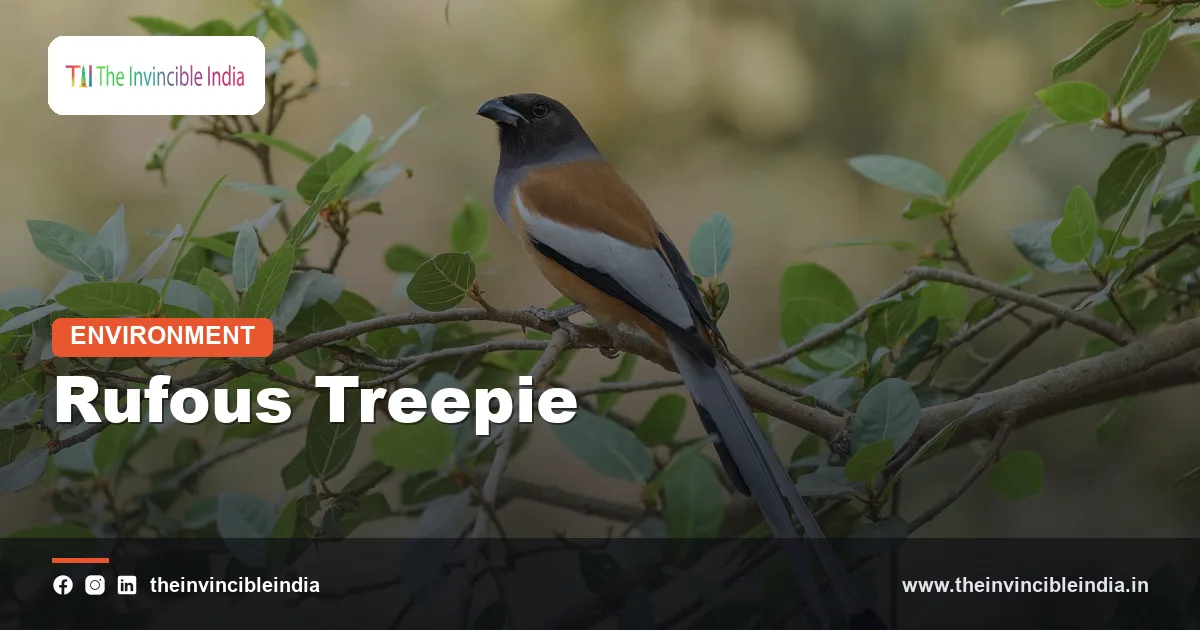
The rufous treepie (Dendrocitta vagabunda) is a long-tailed, rufous-bodied member of the crow family that lives in the open woodlands, farmland and gardens of the Indian subcontinent and is easily recognised by its loud, bell-like calls. Where most corvids look dark and sombre, the rufous treepie stands out with a warm cinnamon body, a sooty black hood, a grey-and-white wing patch and a tail nearly as long as the rest of its body.
The rufous treepie is also known for its bold, opportunistic habits, which range from raiding other birds’ nests to perching on deer and picking off ticks. This explainer describes how the rufous treepie looks, where it lives, what it eats, how it breeds and how it differs from other treepies of India, with each section written to be understood on its own.
| Attribute | Details |
|---|---|
| Common name | Rufous treepie (also written rufous tree pie) |
| Scientific name | Dendrocitta vagabunda |
| Family | Corvidae (crows, jays, magpies and treepies) |
| Body length | Roughly 46 to 50 cm including the long tail, which makes up about half the length |
| Range | Indian subcontinent and parts of mainland Southeast Asia, including India, Pakistan, Nepal, Bangladesh and Myanmar |
| Habitat | Open deciduous forest, scrub, farmland, orchards, roadside avenues and gardens |
| Diet | Omnivorous, taking fruit, nectar, insects, eggs, nestlings, small reptiles and scraps |
| Conservation status | Least Concern on the IUCN Red List, a widespread and common species |
Key Takeaways
- The rufous treepie is a corvid, scientifically named Dendrocitta vagabunda, that is related to crows, jays and magpies despite its colourful plumage.
- The rufous treepie has a rufous-brown body, a black hood and a very long grey tail tipped with black, and the tail alone is about half of its total length.
- The call of the rufous treepie is a loud, fluty, metallic, bell-like series of notes that carries well through open woodland.
- The rufous treepie is a bold omnivore that eats fruit, nectar, insects and, at times, the eggs and chicks of smaller birds.
- In several Indian tiger reserves, the rufous treepie has been recorded perching on deer and picking off ticks and other parasites.
- The rufous treepie is classed as Least Concern and remains common across much of India’s plains and lower hills.
What is a rufous treepie?
A rufous treepie is a medium-sized, long-tailed passerine bird of the crow family that is common across the Indian subcontinent. The word “treepie” is a variant of “magpie”, and the bird is named for its life in trees and its pied-looking pattern of black, rufous, grey and white.
The scientific name Dendrocitta vagabunda is built from Greek and Latin roots, with Dendrocitta meaning roughly “tree jay” and vagabunda meaning wandering. The name suits a bird that moves restlessly from tree to tree and rarely stays in one spot for long.
The rufous treepie belongs to the family Corvidae, which also includes the house crow, the large-billed crow, the Eurasian jay and the magpies. Like other corvids, the rufous treepie is quick, curious, adaptable and noisy, and it is generally seen as an intelligent bird.
What does a rufous treepie look like?
The rufous treepie looks like a slender, long-tailed bird with a black or sooty-brown head and breast, a rufous-orange back and belly, and a grey tail. The contrast between the dark hood and the warm brown body gives the bird a distinctive look that is hard to confuse with any other common Indian species.
Field marks include:
- Head and breast: a dark hood covering the head, throat and upper breast.
- Body: cinnamon to rufous on the back and belly, with the exact tone varying by region.
- Wings: dark flight feathers with a conspicuous whitish patch that shows well in flight.
- Tail: very long and graduated, grey with a black tip and a whitish underside, often held cocked or swung when the bird calls.
- Bill: stout, black and slightly hooked, adapted to a wide variety of foods.
Males and females are similar in appearance. Several subspecies are recognised across the range, and they differ mainly in how pale or deep the body colour appears, with birds of drier north-western regions generally looking paler than those of the wetter south.
Where does the rufous treepie live?
The rufous treepie lives across most of India, from the plains at the foot of the Himalaya through the central and peninsular regions, and also in Pakistan, Nepal, Bangladesh and Myanmar. It is a bird of open country with scattered trees rather than of dense, closed-canopy forest.
Typical habitats of the rufous treepie include:
- Open dry and moist deciduous forest.
- Scrub woodland and thorn forest.
- Farmland with hedgerows, orchards and groves of mango, neem and tamarind.
- Roadside avenues, parks and large gardens in towns and cities.
The species is often seen in pairs or small family parties, moving from tree to tree in a series of flapping glides. It tends to be less common in the driest deserts and in very wet evergreen forest, where other corvids and treepie species take its place.
What does the rufous treepie eat?
The rufous treepie eats a very wide range of foods, including fruits, nectar, insects, small reptiles, the eggs and chicks of other birds, and human scraps. This broad diet is one of the reasons the species has remained common while many specialist birds have declined.
Plant foods
The rufous treepie feeds on wild and cultivated fruits such as figs, berries and the fruits of garden trees. It also visits flowering trees such as silk cotton and coral tree for nectar. While moving between flowers, the bird may carry pollen on its face and bill, and it can also spread seeds by dropping or passing them away from the parent tree.
Animal foods
Insects form an important part of the diet, including beetles, caterpillars, grasshoppers and termites, which the bird takes from foliage, bark and the ground. The rufous treepie also takes lizards, small frogs and, opportunistically, carrion or leftovers.
Nest raiding
Like many corvids, the rufous treepie raids the nests of smaller birds for eggs and nestlings. This behaviour makes it unwelcome to nesting songbirds, and small birds will often mob a treepie that comes close to their nests.
Why does the rufous treepie sit on deer?
The rufous treepie sits on deer because it picks ticks, flies and other parasites from the animal’s skin, a feeding habit that benefits both partners. The behaviour has been reported from wildlife reserves in India, including tiger reserves where chital and sambar are common.
The bird perches on the back or head of a calm deer and searches the coat with its bill, taking ectoparasites and sometimes dead skin. The deer tolerates the visitor, and the treepie gets an easy meal without needing to search through foliage. Ecologists describe such a relationship as cleaning or facilitation, and it is one of several examples of birds associating with large mammals in India.
The same habit has led visitors to safaris to see treepies riding on the backs of animals as the herd feeds. The behaviour should not be seen as a rule for every individual, since only some birds in certain areas are seen doing it.
What does the call of the rufous treepie sound like?
The call of the rufous treepie is a loud, metallic, flute-like series of notes that has been compared to a bell, and bird watchers often write it as “ko-tree” or “bob-o-link”. The bird also produces harsh, rattling and chattering sounds, especially when alarmed.
The loud call is delivered from the top of a tree and often sounds different from one individual to another. The treepie also makes softer, croaking notes when feeding or moving about with a mate. Many people first notice the bird by its voice, since the clear, ringing notes stand out among the calls of other woodland species.
Treepies are known to give alarm calls when predators such as hawks or snakes appear, and other birds and animals nearby may respond. This makes the rufous treepie a useful sentinel in woodland and garden settings.
How does the rufous treepie breed?
The rufous treepie breeds in the warmer months, building an untidy, shallow cup or platform of twigs in the fork of a tree. The nest is usually lined with finer material such as rootlets and thin twigs, and it is often placed at a moderate height in a leafy tree.
The female lays about three to five eggs that are pale and marked with blotches or spots in shades of brown and grey. Both parents typically take part in raising the young, and the pair is often aggressive in defending the nest from crows, squirrels and other intruders. The breeding season in much of India runs from spring into the monsoon, although the exact timing varies from region to region.
After fledging, young treepies stay close to their parents for some time and may join family parties that move together through the trees. The young resemble the adults but are duller in colour with a shorter tail.
How is the rufous treepie different from other treepies in India?
The rufous treepie differs from other Indian treepies mainly in its warm rufous body and wide distribution, while its relatives are greyer or occupy narrower ranges. India is home to several treepie species, and the table below summarises how they compare.
| Species | Scientific name | Key features and range |
|---|---|---|
| Rufous treepie | Dendrocitta vagabunda | Rufous body, black hood, long grey tail, widespread across plains and open woodland |
| Grey treepie | Dendrocitta formosae | Greyer body with a dark face, found in the Himalayan foothills and eastern forests |
| White-bellied treepie | Dendrocitta leucogastra | Dark and white plumage, endemic to the forests of the Western Ghats |
| Collared treepie | Dendrocitta frontalis | Dark body with a pale collar, found in the forests of north-eastern India |
| Andaman treepie | Dendrocitta bayleyi | Rich brown plumage, endemic to the Andaman Islands |
Among these, the rufous treepie is the one most people see, because it adapts best to farmland, gardens and towns. The other species generally prefer forest and, in some cases, are restricted to small regions.
What role does the rufous treepie play in the ecosystem?
The rufous treepie plays several roles in the ecosystem, acting as an insect predator, a seed disperser, a flower visitor and a nest predator. This varied job profile reflects the bird’s omnivorous diet and its habit of foraging at every level of the woodland.
- Pest control: by eating large numbers of insects, the bird can help limit crop and tree pests.
- Seed dispersal: fruit-eating treepies move seeds away from parent trees, helping plants to spread.
- Pollen transfer: visits to nectar-rich flowers may carry pollen from tree to tree.
- Predation: raids on nests influence the breeding success of smaller birds.
- Alarm calling: loud warning notes alert other animals to predators.
Is the rufous treepie threatened, and where can you see it?
The rufous treepie is not threatened and is classed as Least Concern, because it is common across a very large range and copes well with human-modified landscapes. Local numbers may change as trees are cleared, but the species is not considered at risk at the national level.
The bird is easy to find in:
- Wildlife reserves with open deciduous forest, such as the dry forests of central and western India.
- City parks and large gardens with mature trees, including in Delhi, Jaipur and Bhopal.
- Farmland edges, orchards and old tree avenues along rural roads.
The best time to look is early morning, when the birds call from the tops of trees, or in fruiting season, when they gather at fig and berry trees. Native wild birds in India are generally protected under the Wildlife (Protection) Act, 1972, so the species should be watched but not disturbed or kept.
Bottom Line
The rufous treepie is a handsome, vocal and resourceful corvid that brings colour and character to India’s woodlands and gardens. Its rufous body, long tail and ringing call make it easy to identify, while its varied diet and odd partnership with deer show how adaptable it is. For beginners, it is one of the most rewarding common birds to learn.
Frequently Asked Questions
What is the scientific name of the rufous treepie?
The scientific name of the rufous treepie is Dendrocitta vagabunda. The species belongs to the crow family Corvidae and is found across the Indian subcontinent and parts of mainland Southeast Asia.
Is the rufous treepie related to crows?
Yes, the rufous treepie is a member of the crow family Corvidae, which also includes jays, magpies and ravens. Like its relatives, it is intelligent, vocal and adaptable, with an omnivorous diet.
What does the rufous treepie eat?
The rufous treepie eats fruits, nectar, insects, small reptiles, the eggs and chicks of smaller birds and human scraps. This varied diet allows the species to live in forests, farms and cities alike.
Why do treepies sit on deer?
Treepies sit on deer to pick off ticks and other parasites, which gives the bird an easy meal and may relieve the animal. This behaviour has been reported in Indian wildlife reserves, including those with chital and sambar.
How long is the rufous treepie?
The rufous treepie is roughly 46 to 50 cm long including its tail. The tail alone makes up about half of that length, which gives the bird its slim, trailing look in flight.
Is the rufous treepie a protected bird in India?
Native wild birds in India are generally protected under the Wildlife (Protection) Act, 1972, so the rufous treepie should not be hunted or kept as a pet. The species is common and listed as Least Concern on the IUCN Red List.
{“@context”:”https://schema.org”,”@graph”:[{“@type”:”FAQPage”,”mainEntity”:[{“@type”:”Question”,”name”:”What is the scientific name of the rufous treepie?”,”acceptedAnswer”:{“@type”:”Answer”,”text”:”The scientific name of the rufous treepie is Dendrocitta vagabunda. The species belongs to the crow family Corvidae and is found across the Indian subcontinent and parts of mainland Southeast Asia.”}},{“@type”:”Question”,”name”:”Is the rufous treepie related to crows?”,”acceptedAnswer”:{“@type”:”Answer”,”text”:”Yes, the rufous treepie is a member of the crow family Corvidae, which also includes jays, magpies and ravens. Like its relatives, it is intelligent, vocal and adaptable, with an omnivorous diet.”}},{“@type”:”Question”,”name”:”What does the rufous treepie eat?”,”acceptedAnswer”:{“@type”:”Answer”,”text”:”The rufous treepie eats fruits, nectar, insects, small reptiles, the eggs and chicks of smaller birds and human scraps. This varied diet allows the species to live in forests, farms and cities alike.”}},{“@type”:”Question”,”name”:”Why do treepies sit on deer?”,”acceptedAnswer”:{“@type”:”Answer”,”text”:”Treepies sit on deer to pick off ticks and other parasites, which gives the bird an easy meal and may relieve the animal. This behaviour has been reported in Indian wildlife reserves, including those with chital and sambar.”}},{“@type”:”Question”,”name”:”How long is the rufous treepie?”,”acceptedAnswer”:{“@type”:”Answer”,”text”:”The rufous treepie is roughly 46 to 50 cm long including its tail. The tail alone makes up about half of that length, which gives the bird its slim, trailing look in flight.”}},{“@type”:”Question”,”name”:”Is the rufous treepie a protected bird in India?”,”acceptedAnswer”:{“@type”:”Answer”,”text”:”Native wild birds in India are generally protected under the Wildlife (Protection) Act, 1972, so the rufous treepie should not be hunted or kept as a pet. The species is common and listed as Least Concern on the IUCN Red List.”}}]}]}


