

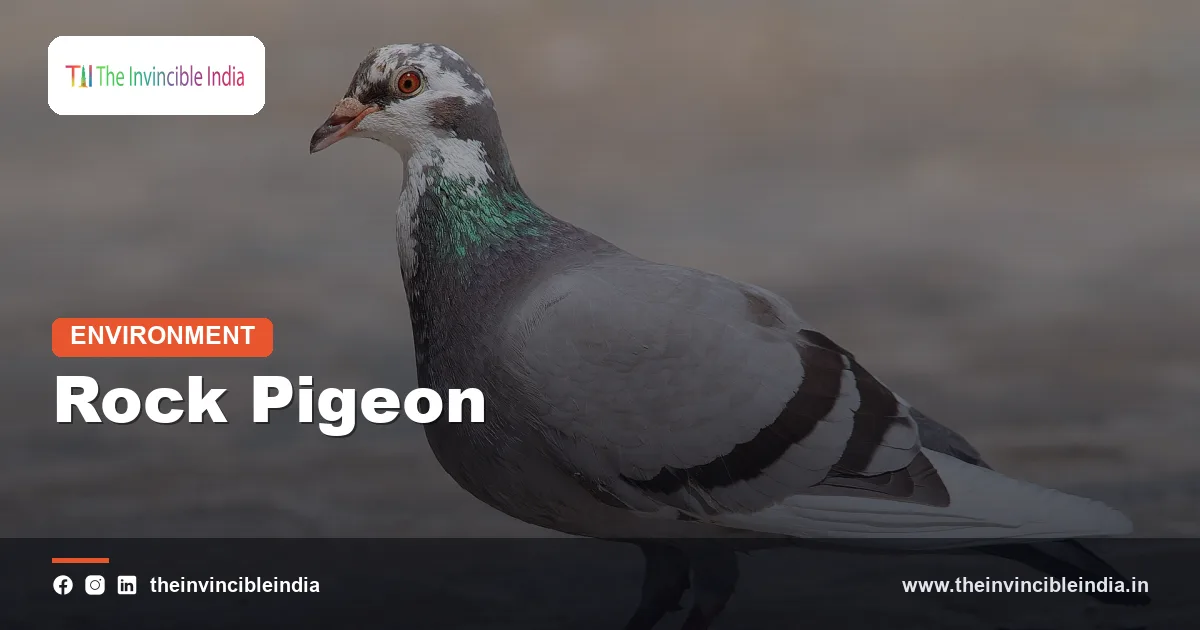
The rock pigeon (Columba livia), also called the blue rock dove, is the grey, ledge-nesting pigeon that fills Indian cities, temples, railway stations and old forts, and it is the wild ancestor of nearly every domestic and feral pigeon in the world. The familiar pigeon on a Mumbai balcony or a Delhi monument is, in biological terms, a feral descendant of birds that humans began to keep thousands of years ago.
The rock pigeon is probably the most easily seen wild-living bird in urban India, yet its history, biology and health implications are less well known than its appearance. This explainer covers how the rock pigeon looks, where it nests, what it eats, how it breeds, how it finds its way home, how it has been kept and raced in India, and how to deal sensibly with the health caution around its droppings.
| Attribute | Details |
|---|---|
| Common names | Rock pigeon, blue rock dove, rock dove, city pigeon, feral pigeon (kabutar in Hindi) |
| Scientific name | Columba livia |
| Family | Columbidae (pigeons and doves) |
| Body length | Roughly 30 to 35 cm |
| Native range | Cliffs and rocky areas across Europe, North Africa and Asia, including the Indian subcontinent |
| Habitat in India | Cliffs, ruins, forts, temples, bridges, buildings, towns and farmland |
| Breeding | Usually two white eggs per clutch, with chicks fed on crop milk, and breeding possible through much of the year |
| Conservation status | Least Concern on the IUCN Red List, extremely widespread |
Key Takeaways
- The rock pigeon, scientifically named Columba livia, is the wild ancestor of all domestic pigeon breeds and of the feral city pigeons seen across India.
- The rock pigeon naturally nests on cliff ledges, so buildings, bridges and old monuments serve as ideal artificial cliffs in Indian towns and cities.
- Rock pigeons feed their chicks on a nutritious secretion called crop milk, produced by both the male and the female.
- Rock pigeons have strong homing ability, which led to centuries of use as messenger and racing birds, including in the Mughal courts and in the Odisha Police pigeon service.
- Dry pigeon droppings and feathers can carry fungi and bacteria linked to respiratory illness, so cleaning should be done with wet methods and protective masks.
- The rock pigeon is classed as Least Concern, and its numbers in Indian cities are generally believed to be large and stable.
What is a rock pigeon?
A rock pigeon is a medium-sized, plump, short-legged bird of the family Columbidae that originally lived on sea cliffs, rocky gorges and mountain ledges. The wild type is bluish-grey and nests in crevices of rock, and it is the single species from which humans developed domestic pigeons.
The name “rock pigeon” is used in modern checklists, while the older name “rock dove” and the descriptive name “blue rock dove” are still common. In everyday speech in India, the bird is simply called kabutar or kabootar. Scientists use Columba livia for all forms, whether wild, domestic or feral.
The terms pigeon and dove have no strict biological boundary, since both refer to members of the same family Columbidae. In general usage, “pigeon” tends to be applied to larger, stouter species and “dove” to smaller, slimmer ones, and the rock pigeon is large enough to be called a pigeon in nearly every language.
Is the rock pigeon the same as the city pigeon?
Yes, the city pigeon is a feral form of the rock pigeon, meaning it descends from domesticated birds that escaped or were released and now live independently. Feral pigeons belong to the same species, Columba livia, and can interbreed freely with wild-type rock pigeons.
Genuine wild-type rock pigeons still occur in India, especially in cliffs, rocky hills, old forts and ruins away from the largest cities. These birds look more uniform in colour and nest naturally in rock crevices. The pigeons of urban streets are a more varied mix because generations of domestic breeds have mingled with them.
The result is that city flocks contain many colour forms, including blue-grey birds with two black wing bars, chequered grey birds, dark almost black birds, reddish-brown birds and pale or white ones. All these variations are different expressions of the same species.
What does the rock pigeon look like?
The rock pigeon is a stout grey bird with a pale blue-grey body, a darker head and neck, two black bars across each wing and a dark band at the end of the tail. The neck and upper breast show an iridescent green and purple sheen in sunlight, which is most noticeable on displaying males.
- Eyes: orange to reddish.
- Bill: dark, with a pale, fleshy swelling called the cere at the base.
- Legs and feet: reddish-pink.
- Rump: pale, which is a useful clue for telling wild-type birds from some similar species in flight.
- Size: roughly 30 to 35 cm long.
Males and females look very similar, though males usually have a slightly larger, more glossy neck and tend to puff up and strut during courtship. Feral birds may deviate from these markings, but nearly all still show the rounded body, small head and quick, clattering wingbeats typical of the species.
Where do rock pigeons live and nest in India?
Rock pigeons live and nest across India wherever there are sheltered ledges, such as cliffs, rocky hills, old forts, temples, bridges and buildings. Cities offer the species ledges, window sills, ventilators and air-conditioner housings that function like cliff faces.
The wild-type pigeon of India is generally regarded as a subspecies often called the Indian rock pigeon, which is typically paler and has a greyish-white rather than clean white rump. It lives in rocky outcrops, ruins and the walls of old monuments in many regions.
Feral rock pigeons are very successful in Indian towns because they find food, water and nest sites in the same neighbourhood. They are present from large metropolitan areas to small towns, railway platforms, grain markets and village temples. They usually roost in groups at night and feed in flocks by day.
What do rock pigeons eat?
Rock pigeons eat mainly grains and seeds, supplemented by green shoots, small fruits, food scraps and occasionally insects. In agricultural areas they feed on harvested fields and spilled grain, while in cities they rely on grain scattered by people and on food waste.
Pigeons drink by sucking water continuously, rather than lifting the head to swallow, which is a feature of the family. They need regular access to water, particularly in the summer, and they often gather at taps, puddles, fountains and shallow tanks.
In Indian cities, feeding pigeons grain is a widespread practice and has religious and cultural roots in several communities, including the Jain tradition of offering grain to birds. In parts of Gujarat and Rajasthan, special bird-feeding towers called chabutro have long been built for this purpose. Public feeding also supports larger flocks than the surrounding area would otherwise sustain.
How do rock pigeons breed and raise their young?
Rock pigeons form monogamous pairs, typically lay two white eggs at a time and feed their chicks on crop milk. The pair builds a thin, untidy platform of twigs, straw and debris on a ledge, in a niche or in any sheltered corner.
The details of the breeding cycle include:
- Eggs: usually two, white and smooth.
- Incubation: roughly 17 to 19 days, shared by both parents.
- Crop milk: a protein- and fat-rich secretion from the lining of the crop, produced by both sexes, which is the only food of newly hatched chicks.
- Chicks: called squabs, which leave the nest after roughly four to six weeks.
- Frequency: a pair can raise several broods in a year, and breeding may continue year round where food is plentiful.
The ability to breed throughout the year, combined with reliable food in cities, explains the high numbers of feral pigeons. Wild individuals typically live only a few years, although captive birds can live far longer.
How do pigeons find their way home?
Pigeons find their way home using a combination of cues, including the Earth’s magnetic field, the position of the sun, smell and visual landmarks. Scientists continue to study how these cues fit together, and there is no single agreed explanation for homing.
The homing instinct is strong because rock pigeons are tied to a nest site and a mate. A bird released far from its loft will usually circle, orient and then fly towards home, sometimes covering hundreds of kilometres. Racing pigeons are selectively bred and trained to improve this skill, and they can fly at well over 60 km/h over long distances in good conditions.
The same ability made the pigeon a natural messenger bird. Notes were tied to the leg or tail, and the bird was released to fly back to its home loft. The method was used by many ancient and medieval societies before faster communication replaced it.
Why have pigeons been kept and raced in India?
Pigeons have been kept in India for food, messages, sport and companionship, and the practice has a long history, including at the Mughal court. Emperor Akbar is widely recorded as a keen pigeon fancier, and the pastime of flying and training pigeons, known as kabutarbaazi, became popular in cities such as Lucknow and Delhi.
| Use | Description |
|---|---|
| Courtly sport | Mughal and later princely and nawabi households kept flocks of fancy and flying pigeons for display and competition |
| Messenger service | Homing pigeons carried written messages; the Odisha Police maintained a pigeon service from 1946, which was wound down in 2008 |
| Racing | Clubs in Indian cities hold races in which trained pigeons are released far from home and timed on their return |
| Religious feeding | Communities offer grain to pigeons as an act of charity, including at temples and designated feeding places |
| Science | Charles Darwin studied fancy pigeon breeds when developing his argument for selection in On the Origin of Species in 1859 |
This long relationship explains why the rock pigeon appears in Indian poetry, film songs and folklore as a carrier of love letters and good wishes.
Are rock pigeon droppings harmful to health?
Rock pigeon droppings can be harmful to health when they dry out and are disturbed, because they may carry fungi and bacteria that can cause respiratory illness in some people. The risk is generally low for casual contact, but it is higher for people who breathe in dust from large, old accumulations of droppings.
Health authorities commonly list the following conditions as linked to pigeon droppings or associated dust:
- Histoplasmosis: a lung infection caused by a fungus that can grow in soil enriched by bird droppings.
- Cryptococcosis: a fungal infection that can affect the lungs and, in people with weak immunity, the nervous system.
- Psittacosis: a bacterial infection, also called chlamydiosis, that can pass from birds to people.
- Hypersensitivity pneumonitis: an allergic lung condition, sometimes called pigeon breeder’s lung, seen after long exposure to feathers and dust.
People with asthma, chronic lung disease or weak immunity are advised to be extra careful. Sensible precautions include wearing a mask and gloves, dampening droppings before removing them rather than sweeping dry, keeping rooms ventilated and covering balcony gaps with netting. Anyone with persistent cough, fever or breathlessness should consult a doctor. The risks are best treated as a reason for caution, not for cruelty to the birds.
How is the rock pigeon different from other pigeons and doves in India?
The rock pigeon differs from other Indian pigeons and doves in its grey body, double wing bars and strong dependence on buildings and ledges. India has many native columbids, and the table below compares a few that are often mistaken for one another.
| Species | Scientific name | Key features |
|---|---|---|
| Rock pigeon | Columba livia | Grey with two black wing bars, nests on ledges and buildings |
| Hill pigeon | Columba rupestris | Similar but with a broad white band across the tail, found in higher hills and mountains |
| Spotted dove | Spilopelia chinensis | Smaller, pinkish-brown, with a spotted black-and-white neck patch |
| Eurasian collared dove | Streptopelia decaocto | Pale buff-grey with a narrow black half-collar |
| Yellow-footed green pigeon | Treron phoenicopterus | Green plumage with yellow legs, a fruit eater of trees |
The hill pigeon is the closest lookalike, and it is separated by the white tail band. The doves are smaller and slimmer, while the green pigeons live in the canopy of fruiting trees rather than on buildings.
Is the rock pigeon a protected bird in India?
Native wild birds in India are generally covered by the Wildlife (Protection) Act, 1972, but the specific schedule and the status of feral and domestic pigeons can differ and should be checked against current rules. The rock pigeon is neither threatened nor rare, and it is classed as Least Concern on the IUCN Red List.
In practice, urban pigeons are managed through local rules on feeding, waste and building maintenance, not through conservation law. Some municipal bodies have limited feeding at certain public spots because of concerns about cleanliness and health, and these decisions have sometimes sparked debate between bird lovers and residents.
Humane measures such as netting, smooth sloping ledges and removing spilled grain are widely recommended over poisoning or trapping. Pigeons are also hunted by raptors such as the shikra and the peregrine falcon, which helps keep numbers in check in many cities.
Bottom Line
The rock pigeon is a common bird with an uncommon history, as the wild ancestor of every domestic pigeon and a companion of human cities for thousands of years. In India it has been a messenger, a racing bird, an object of charity and a part of daily urban life. Respecting the bird while keeping droppings and feeding sites clean is the sensible way to live alongside it.
Frequently Asked Questions
What is the scientific name of the rock pigeon?
The scientific name of the rock pigeon is Columba livia. The same species includes the wild blue rock dove, domestic racing and fancy pigeons, and the feral pigeons that live in cities.
Is the rock pigeon the same as the blue rock dove?
Yes, the rock pigeon and the blue rock dove are the same species, Columba livia. The name “blue rock dove” is an older and descriptive name for the wild blue-grey form.
How long do rock pigeons live?
Wild and feral rock pigeons often live only a few years because of predators, disease and hardship, while well-kept captive birds can live considerably longer. Longevity depends heavily on food, shelter and safety.
Are pigeon droppings dangerous?
Pigeon droppings can be dangerous when dry and disturbed, because they may carry fungi and bacteria linked to illnesses such as histoplasmosis, cryptococcosis and psittacosis. Wearing a mask, wetting the area before cleaning and keeping rooms ventilated lowers the risk, and people with lung problems should take extra care.
How do homing pigeons find their way back?
Homing pigeons find their way back using several cues, including the Earth’s magnetic field, the sun, smell and landmarks. Researchers are still working out exactly how these cues combine, and there is no single settled explanation.
Why are there so many pigeons in Indian cities?
There are many pigeons in Indian cities because buildings supply ledge nest sites, people supply grain and food waste, and the birds can breed through much of the year. These conditions allow feral rock pigeon flocks to grow far larger than natural cliff populations.
{“@context”:”https://schema.org”,”@graph”:[{“@type”:”FAQPage”,”mainEntity”:[{“@type”:”Question”,”name”:”What is the scientific name of the rock pigeon?”,”acceptedAnswer”:{“@type”:”Answer”,”text”:”The scientific name of the rock pigeon is Columba livia. The same species includes the wild blue rock dove, domestic racing and fancy pigeons, and the feral pigeons that live in cities.”}},{“@type”:”Question”,”name”:”Is the rock pigeon the same as the blue rock dove?”,”acceptedAnswer”:{“@type”:”Answer”,”text”:”Yes, the rock pigeon and the blue rock dove are the same species, Columba livia. The name “blue rock dove” is an older and descriptive name for the wild blue-grey form.”}},{“@type”:”Question”,”name”:”How long do rock pigeons live?”,”acceptedAnswer”:{“@type”:”Answer”,”text”:”Wild and feral rock pigeons often live only a few years because of predators, disease and hardship, while well-kept captive birds can live considerably longer. Longevity depends heavily on food, shelter and safety.”}},{“@type”:”Question”,”name”:”Are pigeon droppings dangerous?”,”acceptedAnswer”:{“@type”:”Answer”,”text”:”Pigeon droppings can be dangerous when dry and disturbed, because they may carry fungi and bacteria linked to illnesses such as histoplasmosis, cryptococcosis and psittacosis. Wearing a mask, wetting the area before cleaning and keeping rooms ventilated lowers the risk, and people with lung problems should take extra care.”}},{“@type”:”Question”,”name”:”How do homing pigeons find their way back?”,”acceptedAnswer”:{“@type”:”Answer”,”text”:”Homing pigeons find their way back using several cues, including the Earth’s magnetic field, the sun, smell and landmarks. Researchers are still working out exactly how these cues combine, and there is no single settled explanation.”}},{“@type”:”Question”,”name”:”Why are there so many pigeons in Indian cities?”,”acceptedAnswer”:{“@type”:”Answer”,”text”:”There are many pigeons in Indian cities because buildings supply ledge nest sites, people supply grain and food waste, and the birds can breed through much of the year. These conditions allow feral rock pigeon flocks to grow far larger than natural cliff populations.”}}]}]}


