

Samarth Ramdas is remembered as one of the great saints of Maharashtra, a devotee of Rama whose teachings shaped the religious and moral outlook of the region. He is best known for the Dasbodh, a long work of spiritual and practical instruction in the Marathi language, and for the Manache Shlok, a set of verses that many households still recite. His message joined inner devotion with outward discipline and service. The saint belongs to the same larger stream of devotion as the poet-saints who came before him, a current traced in the Bhakti movement that transformed religious life across India.
Quick Facts
| Detail | Information |
|---|---|
| Known as | Samarth Ramdas, Ramdas Swami |
| Region | Maharashtra |
| Chief deity | Rama, with devotion to Hanuman |
| Major works | Dasbodh, Manache Shlok |
| Language | Marathi |
| Associated site | Sajjangad |
Who Was Samarth Ramdas
Samarth Ramdas was a saint and spiritual teacher from Maharashtra who lived in the seventeenth century and became widely revered for his devotion to Rama. The honorific Samarth, meaning capable or powerful, reflects the respect with which later generations regarded him. He is remembered as a renunciant who chose a life of wandering, worship, and teaching rather than settled household life.
His significance lies in the breadth of his influence. He wrote about devotion, but also about conduct, organisation, and the responsibilities of individuals toward society. Devotees and scholars alike see him as a figure who brought spiritual ideals into daily life. Samarth Ramdas is therefore honoured as both a saint of the heart and a teacher of practical wisdom, a dual reputation that continues to define his legacy.
Early Life and Renunciation
Traditional accounts describe Ramdas as a thoughtful young man who was drawn early toward spiritual concerns and eventually left ordinary life to pursue devotion. Such narratives are common in the biographies of Indian saints, and they emphasise the theme of renunciation as a turning point that opens the way to a larger purpose. Details differ among the sources, and it is best to treat many of them as devotional tradition.
What is widely agreed is that he embraced an ascetic path centred on Rama and undertook a long period of spiritual discipline. This foundation shaped everything that followed, including his writing and his work in founding centres of devotion. The story of his renunciation thus serves as an entry point into his teaching, which consistently values inner commitment as the source of all outward action.
Wanderings Across the Land
Tradition holds that Ramdas travelled extensively across the subcontinent, visiting places of pilgrimage and observing the conditions of the people. Such journeys were a familiar part of the life of a renunciant, and they gave him a broad view of the religious and social landscape of his time. The wanderings are often described as a period of learning as well as worship.
The experience of travel is reflected in the range of his writing, which addresses audiences from many walks of life. It helped him understand how ordinary people lived and what spiritual guidance they needed. The wanderings of Samarth Ramdas therefore enriched his vision, allowing him to speak with authority about both the devotional life and the everyday challenges faced by the communities he encountered.
Devotion to Rama
At the centre of the saint’s spiritual life stood Rama, the hero of the Ramayana, whom he worshipped as the supreme ideal of righteousness and compassion. His verses call on the listener to remember the name of Rama, to meditate on the qualities of the deity, and to live in accordance with dharma. The devotion expressed is warm, personal, and steady.
This focus on Rama gave his followers a clear object of worship and a model for conduct. The well-known salutation associated with the tradition invokes Raghuveer, a name for Rama, together with the title Samarth. Devotion to Rama thus forms the spiritual core of his entire teaching, and every other theme in his writing can be understood as flowing from that central and constant love.
The Dasbodh
The Dasbodh is the best-known work of Samarth Ramdas and is regarded as a major text of Marathi religious literature. Composed in the form of instruction, it takes the shape of conversations between a teacher and a disciple. The work is organised into sections called dashaks, which are further divided into smaller units, and it moves through many topics in a clear and orderly way.
The text explores the nature of devotion, knowledge, and right conduct, and it does so in plain, direct language meant to be understood by ordinary readers. Its purpose is both spiritual and practical. The Dasbodh therefore remains a cornerstone of the saint’s legacy, studied by devotees who seek guidance and by readers interested in the moral and intellectual traditions of Maharashtra.
Themes and Teachings of the Dasbodh
The Dasbodh addresses a wide range of themes, from the qualities of a true teacher and the signs of a sincere disciple to the dangers of pride and the value of humility. It discusses the distinction between lasting truth and passing appearances, and it offers advice on how to live wisely in the world without becoming bound by it. The tone is earnest and often practical.
A notable feature is its attention to everyday conduct, including diligence, foresight, and skill in dealing with others. The text does not ask the reader to withdraw from life but to act with awareness and integrity. The teachings of the Dasbodh therefore balance the pursuit of spiritual knowledge with the demands of daily responsibility, presenting a vision in which both belong together.
Manache Shlok
The Manache Shlok is a celebrated collection of verses addressed to the mind, urging it to turn toward good conduct and devotion. The title means roughly verses for the mind, and the work speaks to the restless human tendency toward distraction and desire. Each verse offers a short, memorable piece of guidance.
The verses are widely recited in Maharashtra and have been taught to generations of children and adults. Their rhythm and clarity make them easy to remember, which has helped them endure in oral tradition as well as in print. The Manache Shlok thus functions as a daily companion for many families, and it stands among the most recognised and loved expressions of the saint’s gentle but firm moral counsel.
Other Writings and Devotional Verses
Alongside the Dasbodh and the Manache Shlok, Samarth Ramdas is credited with a number of other compositions, including devotional songs, hymns of praise, and verses of spiritual reflection. These works are in Marathi and are sung or recited in temples, homes, and gatherings of devotees. Some are associated with particular deities and occasions.
Together the writings show a mind equally at ease with abstract philosophy and with simple expressions of love. They reveal the range of a poet who wrote for learned and unlearned audiences alike. The wider body of work attributed to Ramdas therefore enriches the tradition, offering devotees many ways to approach the same central themes of devotion, discipline, and inner steadiness.
Worship of Hanuman
Samarth Ramdas is closely associated with the promotion of Hanuman worship in Maharashtra. Hanuman, the devoted servant of Rama, embodies strength, courage, and selfless service, and the saint held him up as a model for his followers. Shrines dedicated to Hanuman are traditionally linked with his efforts, and many such temples in the region are remembered in connection with him.
The emphasis on Hanuman complemented the devotion to Rama by adding the ideal of physical and moral vigour. A healthy body, a disciplined mind, and readiness to serve were all valued. The worship of Hanuman in the tradition of Ramdas thus joins spiritual commitment with personal strength, and it remains a visible and popular feature of religious life in Maharashtra to this day.
Mathas and Organised Devotion
Samarth Ramdas is remembered for establishing mathas, or monastic centres, where disciples could gather for worship, study, and service. These centres helped give structure to the spiritual community that grew around him, and they served as bases for teaching and outreach. The tradition that followed is often called the Ramdasi sampradaya.
The idea behind the mathas was that devotion should be supported by organisation and continuity. By training disciples and assigning them responsibilities, the saint ensured that his message would outlast his own lifetime. The mathas therefore illustrate his practical genius, showing how a spiritual movement can be sustained by thoughtful institutions that keep teaching, worship, and community service alive across generations.
Sajjangad and Sacred Memory
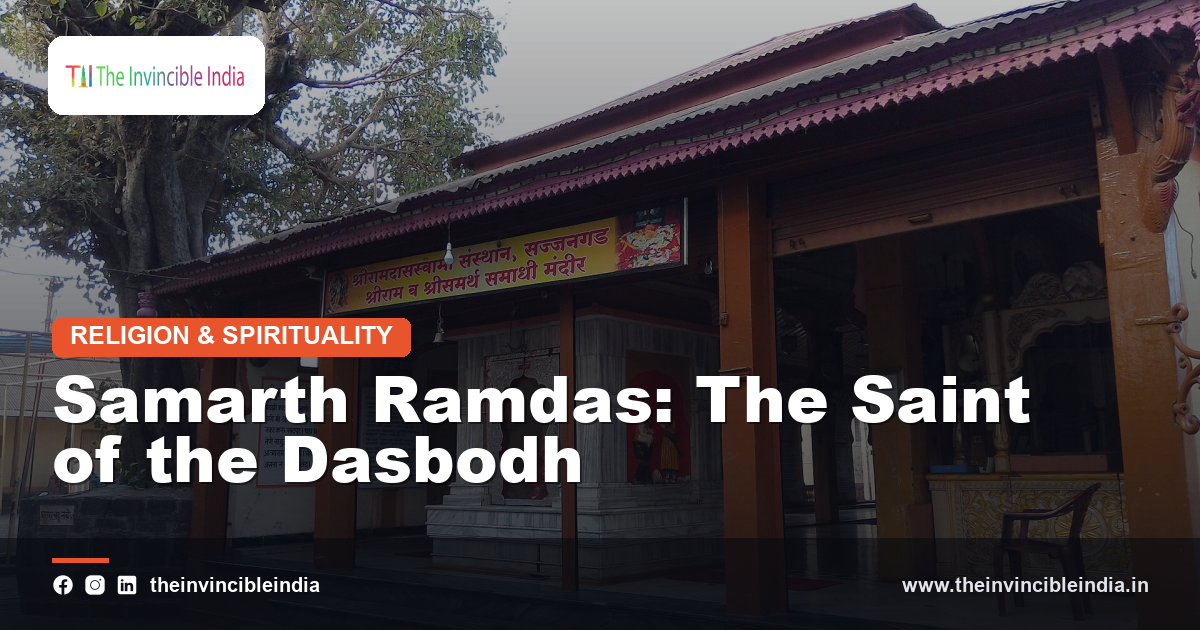
Sajjangad, a hill fort in the Sahyadri region of Maharashtra, is the place most closely associated with the last phase of the saint’s life, and it is honoured as his resting place. Devotees visit the site to pay their respects, to see the places linked with his memory, and to enjoy the quiet and scenic surroundings. The hill has long been a centre of pilgrimage.
For followers of the tradition, Sajjangad is more than a historical location, since it embodies the presence of the saint and the continuity of his teaching. Regular worship and observances are held there. The site of Sajjangad thus serves as a living memorial, gathering pilgrims from across Maharashtra and beyond who wish to connect with the legacy of Samarth Ramdas.
Relationship with Shivaji Maharaj
Samarth Ramdas is traditionally linked with Chhatrapati Shivaji Maharaj, the founder of the Maratha state, and popular memory often describes the saint as a spiritual guide who was respected by the ruler. Historians discuss the exact nature and extent of this relationship with care, and accounts vary in emphasis. It is therefore best to describe the connection in general terms as a meaningful one in tradition.
What remains clear is that both figures belonged to a period in which religious confidence and public responsibility were closely tied in Maharashtra. The association has inspired writers, artists, and storytellers, and it continues to appear in cultural narratives. The link between the saint and the ruler thus stands as a symbol of the union between spiritual inspiration and worldly duty.
Place Among the Maharashtra Saints
Maharashtra has a rich tradition of saints, including poets of the Varkari stream such as Tukaram, Eknath, and Namdev, whose songs of devotion to Vitthal are cherished across the region. Samarth Ramdas stands alongside them as a distinct voice, with a stronger emphasis on Rama, Hanuman, discipline, and organised effort. His path complements rather than competes with theirs.
The related tradition of the poet-saints of the region offers a fuller picture of this variety. Together they show the variety of spiritual expression in a single land. The place of Ramdas among the saints of Maharashtra is therefore secure and unique, since he contributed a voice that joined devotion with discipline and public spirit.
Guidance on Discipline and Character
A recurring concern in the writing of Samarth Ramdas is the formation of character. He stresses punctuality, honesty, careful speech, and the avoidance of idleness, and he criticises arrogance and carelessness. These instructions appear throughout his works and are expressed in a manner that ordinary readers can apply to their own lives.
The ethical vision is rooted in devotion but extends into conduct at work, at home, and in public life. The saint suggests that real spirituality shows itself in reliability and kindness toward others. The guidance of Ramdas on discipline and character thus gives his teaching lasting relevance, since it speaks to anyone who wishes to live with purpose, steadiness, and integrity.
Legacy in Literature and Culture
The influence of Samarth Ramdas is visible in Marathi literature, in popular devotion, and in the cultural memory of Maharashtra. His verses are quoted in speeches, taught in schools, and recited in festivals. The salutation associated with his name remains widely known, and the image of the saint appears in books, paintings, and theatre.
Beyond the region, he is studied as part of the broader story of Indian devotional and philosophical writing. Scholars examine his language, his ideas about society, and his place within the history of religious thought. The legacy of Ramdas in literature and culture therefore extends well beyond the circle of his followers, and it continues to shape how Maharashtra understands its own spiritual heritage.
Samarth Ramdas Today
Today Samarth Ramdas continues to be honoured through recitation of the Dasbodh and Manache Shlok, through visits to Sajjangad, and through festivals that commemorate his life and teachings. Mathas and devotional groups keep the tradition active, and many families include his verses in their daily practice. His name carries warmth and respect across the state.
The enduring appeal of his message lies in its combination of spiritual depth and practical good sense. In a world of constant change, the call to steady devotion, disciplined living, and service remains as relevant as ever. Samarth Ramdas therefore endures as a guiding voice from the past, offering readers of every background a source of reflection on how to live faithfully, thoughtfully, and with a sense of responsibility.
Sources & Further Reading
- Ministry of Culture, Government of India (indiaculture.gov.in).
- Sahitya Akademi (sahitya-akademi.gov.in).
Frequently Asked Questions
Who was Samarth Ramdas?
Samarth Ramdas was a seventeenth-century saint of Maharashtra, devoted to Rama and known for his writings in Marathi. He is honoured for combining spiritual devotion with practical guidance on conduct and community life.
What is the Dasbodh?
The Dasbodh is the saint’s major work, presented as instruction from a teacher to a disciple. It is organised into sections called dashaks and covers devotion, knowledge, and right living in clear Marathi.
What is the Manache Shlok?
The Manache Shlok is a set of verses addressed to the mind, encouraging good conduct and devotion. It is widely recited in Maharashtra and remembered for its clarity and rhythm.
Why is Hanuman important in the tradition of Ramdas?
Hanuman is regarded as the ideal servant of Rama and a symbol of strength and selfless service. The saint is traditionally associated with promoting Hanuman worship and shrines in Maharashtra.
What is Sajjangad?
Sajjangad is a hill fort in Maharashtra closely associated with the final phase of the saint’s life and honoured as his resting place. It remains an active centre of pilgrimage and remembrance.


