

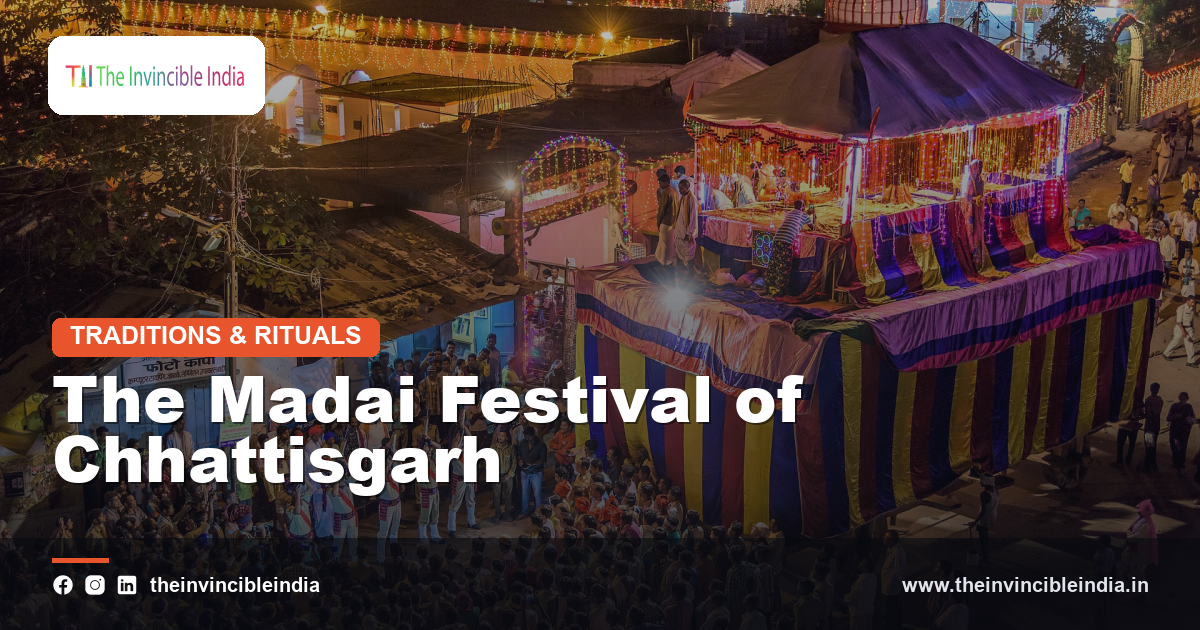
The Madai festival is among the most distinctive tribal fairs of central India, held in the Bastar region of Chhattisgarh during the cooler months after the harvest. Its defining sight is the arrival of deities from surrounding villages, carried in procession with drums, flags and umbrellas to a shared gathering ground. Part religious assembly, part marketplace and part community reunion, Madai reflects the living belief systems of the region’s tribal communities. Much as Bonalu expresses village devotion in Telangana, Madai shows how local deities shape social life in Bastar. This guide explains its meaning, rituals, music, crafts and continuing cultural importance.
Quick Facts
| Detail | Information |
|---|---|
| Festival type | Tribal fair and village-deity gathering |
| Main region | Bastar region of Chhattisgarh |
| Season | Cooler months after the harvest |
| Central custom | Procession of village deities to a common fair |
| Key communities | Gond, Muria, Halba and other tribal groups |
| Cultural expressions | Folk dance, music and traditional crafts |
What Is the Madai Festival
Madai is a traditional fair of the Bastar region in southern Chhattisgarh, organised in the season that follows the harvest. It brings people from surrounding villages to a common site where the deities of the locality are honoured together. The festival is at once a religious observance, a social gathering and an occasion for trade, and all these strands are woven into a single celebration.
Unlike a festival centred on one temple, Madai spreads its devotion across many village deities, each carried by its own community. The fair therefore functions as a meeting of the spiritual and social world of the region. It gives the tribal communities of Bastar a moment to affirm their beliefs, renew their relationships and enjoy the rewards of a completed agricultural year.
The Bastar Region and Its Landscape
Bastar is a region of dense forest, rivers, hills and scattered villages in the south of Chhattisgarh, long known for its rich tribal heritage. The landscape has shaped the way of life of its people, who have traditionally depended on farming, forest produce and craft. Their beliefs are closely tied to the natural world, with groves, rivers, hills and trees often regarded as sacred.
This setting helps explain the character of Madai. The festival grew within a world where villages are separated by forest and where gatherings require long journeys on foot or in carts. Bringing many villages together in one place is therefore a significant event. The forested landscape of Bastar forms the living backdrop of the festival and gives it much of its distinctive atmosphere.
The Tribal Communities Behind the Festival
Madai is maintained by the tribal communities of Bastar, among them the Gond, Muria, Halba and Bhatra groups, along with other residents of the region. Each community has its own customs, dialect and traditions, and the fair provides a rare common stage on which these differences are displayed and respected.
The festival is not the property of a single group but a shared cultural institution, and its organisation depends on cooperation among villages. Elders, village priests and local leaders play an important part in arranging the gathering. The presence of many communities in one space shows how the fair strengthens regional identity while honouring each group’s own heritage. Madai is thus an expression of collective belonging as much as of devotion.
The Meaning of Madai
The word Madai is commonly associated with a fair or gathering in the regional language, and it is in this sense that the festival is understood by the people who attend it. The emphasis falls on assembly, on the coming together of people and deities rather than on a single mythological event or a single celebrated figure.
Explanations of the origin of the tradition vary from one local account to another, and it is wise to treat them as community memory rather than settled history. What is widely agreed is that the fair has long been part of the annual life of Bastar. Its continuity through generations reflects the importance of shared gatherings in tribal society, where religion, governance and social exchange are closely connected.
A Fair That Travels from Village to Village
One of the notable features of Madai is that it is not held at a single fixed place at a single time. Instead the fair is organised at different centres across the region through the season, so that each locality hosts its own gathering in turn. Among the best known are the fairs held in towns such as Narayanpur and Kondagaon.
This rotating pattern allows many communities to take part without travelling impossible distances, and it lets each host village take pride in receiving its neighbours. The schedule of the fairs is generally worked out by local tradition and community agreement. The moving character of Madai turns the winter season into a chain of celebrations across Bastar, binding distant villages into one network of shared custom.
Village Deities and the Procession
The central spectacle of Madai is the arrival of village deities. Each community brings the symbols of its deity, often carried on palanquins or in decorated frames, accompanied by priests, attendants and devotees. Processions move toward the fair ground with drums, horns, banners and ceremonial umbrellas, creating a striking scene of colour and sound.
The deities are regarded as living presences who guard their villages, protect crops and watch over the well-being of the community. Their journey to the fair is therefore a serious undertaking, carried out with reverence. When the deities from different villages meet, the gathering is understood as a meeting of the protective powers of the region. The procession is the visible heart of Madai and the clearest expression of its devotional purpose.
Priests, Rituals and Offerings
Worship at Madai is led by village priests and traditional ritual specialists, who follow customs handed down within their communities. Rites generally include the presentation of offerings, the recitation of traditional invocations and the ceremonial honouring of each deity on arrival at the fair ground. The details differ from village to village and are guided by local tradition.
The rituals are intended to secure blessing for the people, their livestock and their fields, and to express thanks for the harvest that has been gathered. Devotees take part with quiet respect, and visitors are expected to observe the gathering with consideration. The ritual side of Madai shows the depth of tribal religious life, in which every village keeps a direct and continuing relationship with its own protective deity.
The Fair as a Place of Exchange
Alongside its religious dimension, Madai is a lively market. Traders, artisans and farmers set out their goods, and people from distant villages come to buy, sell and barter. Forest produce, grain, tools, ornaments, household goods and food are all part of the exchange, and the fair ground becomes a bustling centre of activity.
In a region where villages may be far apart, such a gathering serves an essential economic function. It allows households to obtain things they cannot easily produce themselves and gives artisans direct access to customers. The combination of trade and worship has long been a feature of traditional Indian fairs, and Madai follows this pattern. The market thus complements the ritual, making the festival useful as well as sacred.
Dance, Music and Song
Music and dance give Madai much of its energy. Tribal communities of Bastar have rich performing traditions, in which groups of dancers move in patterns to the beat of drums and the sound of traditional instruments. Dances associated with the region, such as those of the Muria and Maria communities, are admired for their rhythm, costume and communal spirit.
Songs often draw on themes of nature, work, love and devotion, and they are passed down by oral tradition. Performances at the fair are usually participatory, with spectators joining in or forming rings around the dancers. Through these shared performances the festival sustains the intangible heritage of the region. Dance and music at Madai express joy in the harvest and pride in a living cultural identity.
Costumes, Ornaments and Adornment
The fair is a showcase of traditional dress and ornament. Participants wear garments and accessories that reflect the identity of their community, often including beads, metal jewellery, feathers and decorated headgear. Some dance costumes are especially elaborate, using materials drawn from the local environment and crafted with considerable skill.
Adornment at Madai is more than decoration, for it communicates belonging and heritage. Clothing and ornaments pass from one generation to another, and preparing for the fair is an occasion to bring out cherished items. The visual richness of the gathering, with its varied colours and forms, offers visitors a direct impression of tribal aesthetics. Costume thus becomes another way in which the festival celebrates and preserves cultural identity.
Bastar Crafts on Display
Bastar is renowned for its handicrafts, and the Madai fair provides a natural setting in which they are seen and sold. The region is known for metal casting, wrought iron work, wood carving, bamboo and cane articles, and terracotta, all produced by artisan communities using methods passed down through families.
Visiting the fair allows people to see how these crafts are connected to daily life and belief, since many objects are made for ritual use as well as for sale. Support from buyers helps artisans continue their work and pass skills to younger members. The presence of crafts at Madai shows how festivals sustain traditional livelihoods, and how the skill of the hand is as much a part of heritage as song or ritual.
Food and Hospitality
Food and hospitality are an integral part of the fair. Families travelling long distances carry provisions, and stalls offer local snacks and drinks prepared from the region’s produce. Meals are often shared, and guests are welcomed in accordance with the tribal tradition of generosity toward visitors.
The foods of Bastar draw on grains, forest produce and seasonal vegetables, and they reflect a close relationship with the local environment. Sharing a meal at the fair strengthens relationships between communities that may see each other only once a year. Hospitality in this setting is not a formality but a social duty, and it gives the gathering its friendly and open character. The shared table at Madai expresses the same values of community that the festival as a whole upholds.
Social Life and Community Bonds
For many people, Madai is above all a chance to meet. Relatives who live in different villages renew ties, friends exchange news, and elders share stories with the young. The fair has traditionally been an occasion when social and family matters are discussed, and when the bonds that hold scattered settlements together are refreshed.
The festival also helps pass cultural knowledge to younger generations, who learn the customs of their community by taking part. Being present at the gathering, carrying a village emblem or joining a dance are ways of inheriting identity. In this sense Madai is a school of tradition without walls. It keeps the social fabric of Bastar intact, linking people across distance and across generations through shared experience.
Madai and the Wider Bastar Calendar
Madai is one of several important observances that mark the cultural year in Bastar. The region is also famous for its long Dussehra tradition, which differs in character from the festival celebrated elsewhere in India and centres on local worship and community participation. Together with Madai, these observances define the ritual life of the region.
Where Dussehra in Bastar is associated with a particular sequence of public rites, Madai is distinguished by the movement of many village deities to a common fair. Understanding them as separate traditions helps avoid confusion. Both show how tribal communities of Bastar have maintained distinctive forms of worship and gathering, and both illustrate the depth of the region’s living heritage within the wider cultural diversity of India.
Respectful Visiting and Safeguarding Tradition
Madai is a living religious and social event, not a staged performance, and visitors are encouraged to attend with respect. Basic courtesy includes observing ritual spaces quietly, seeking permission before photographing people or sacred objects, and following the guidance of local organisers and elders.
Responsible visiting supports the community by buying directly from artisans and avoiding any behaviour that disturbs worship. Safeguarding such traditions also involves documentation, education and recognition by cultural institutions, so that younger members see value in maintaining their heritage. Approaching Madai with humility allows outsiders to learn from the tradition without altering it, and helps ensure that the fair remains a community-owned celebration rather than a spectacle.
The Madai Festival Today
Today Madai continues to be held across Bastar as a cherished gathering of deities, families and traders. Roads, schools and modern communication have changed daily life in the region, yet the fair retains its essential character of procession, worship, market and performance. Many young people take part with pride, and interest from visitors, researchers and cultural organisations has brought wider attention to the tradition.
The festival endures because it meets real needs, offering spiritual reassurance, economic exchange and social connection in a single occasion. It demonstrates how tribal heritage remains a living force in contemporary India. Madai stands as a reminder that cultural richness often survives in community gatherings, where belief and belonging are renewed each season.
Sources & Further Reading
- Ministry of Culture, Government of India (indiaculture.gov.in).
- Chhattisgarh Tourism Board, Government of Chhattisgarh (cgtourism.in).
Frequently Asked Questions
What is the Madai festival?
Madai is a traditional fair of the Bastar region in Chhattisgarh. Village deities are carried in procession to a common gathering that combines worship, trade and celebration.
When is Madai held?
It is held in the cooler months after the harvest, at different centres across the region in turn. Local tradition and community agreement guide the schedule, so visitors should check with local authorities.
Which communities take part in Madai?
Tribal communities of Bastar such as the Gond, Muria, Halba and Bhatra, along with other local residents, take part. Each group brings its own customs, dress and performance traditions.
Is Madai the same as Bastar Dussehra?
No, they are separate traditions. Bastar Dussehra is a long regional observance with its own rites, while Madai is a fair where village deities gather, though both are important to the cultural life of the region.
How should visitors behave at the fair?
Visitors should observe rituals quietly, ask permission before photographing people or sacred objects, and follow local guidance. Buying crafts directly from artisans is a good way to support the community.


