

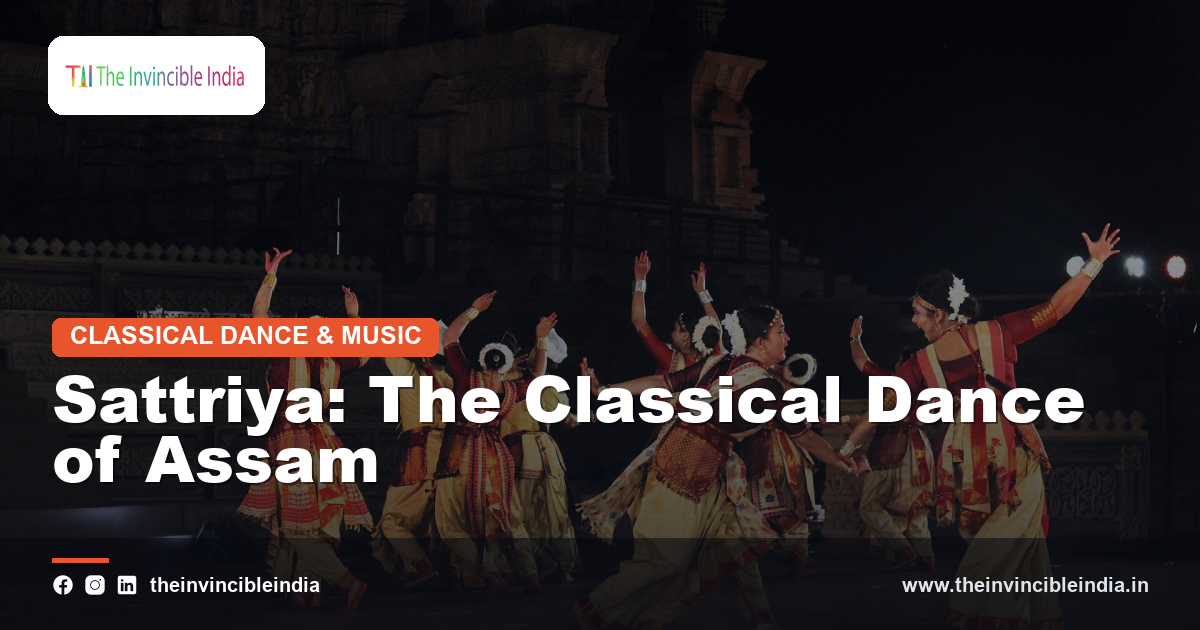
Sattriya is one of the eight classical dance forms of India and the classical dance of Assam, in the country’s north-east. Unlike the other classical forms, it was created by a single towering figure, the fifteenth-century saint and reformer Srimanta Sankardev, and it grew within the sattras, the Vaishnavite monasteries of Assam, as a form of devotional worship. For centuries it was preserved by celibate monks who performed it as part of religious life, and only in recent decades has it moved onto the public stage. Blending pure dance, expression and drama in the service of devotion to Krishna, Sattriya is among the most spiritually rooted of India’s classical arts. This guide explores its history, technique, music and living tradition.
Quick Facts
| Detail | Information |
|---|---|
| Type | One of India’s eight classical dance forms |
| Origin | Assam, north-east India |
| Created by | Srimanta Sankardev, the fifteenth-century saint-reformer |
| Home | The sattras, or Vaishnavite monasteries of Assam |
| Key drum | The khol |
| Classical recognition | Recognised by the Sangeet Natak Akademi as a classical dance in 2000 |
A Dance Born in the Monasteries
Sattriya takes its name from the sattras, the Vaishnavite monasteries of Assam within which it was created and preserved for centuries. Unlike dances that grew in temples or courts, Sattriya developed as an integral part of monastic religious life, performed by monks as an offering of devotion and as a means of teaching and spreading the faith. This unique origin gives the dance a profoundly devotional character and a close bond with the community of the sattra. For some five centuries the art was nurtured within these monasteries, largely hidden from the wider world, which is why its recognition as a national classical form came only recently, though its tradition is very old.
The Legacy of Sankardev
Sattriya is the creation of Srimanta Sankardev, the great fifteenth- and sixteenth-century saint, scholar, poet and social reformer of Assam, who led a devotional movement centred on the worship of Krishna. As part of his mission to make religious teaching accessible to ordinary people, Sankardev developed a form of devotional drama and dance that could convey the stories and teachings of the faith through performance. He composed plays, songs and dances and established the framework of the tradition, which his followers and the sattras he inspired carried forward. Sattriya thus stands as a living monument to one of the most influential figures in Assamese cultural and religious history.
The Vaishnavite Movement
Sattriya arose from the neo-Vaishnavite devotional movement that Sankardev led in Assam, a movement that emphasised loving devotion to a single God, Krishna, and rejected elaborate ritual and social division in favour of a direct and accessible faith. Dance, drama, music and poetry were central to this movement as means of devotion and teaching, drawing people together in shared worship. The sattras became centres not only of religion but of art and learning, sustaining the performing traditions across generations. Sattriya is inseparable from this devotional context, and to understand the dance is to understand the faith and the community from which it grew.
Ankiya Nat and Bhaona
Central to the Sattriya tradition are the Ankiya Nat, the one-act devotional plays composed by Sankardev and his followers, and their performance, known as Bhaona. These dramatic works tell stories from the life of Krishna and the Hindu epics, combining dialogue, song, music and dance into a complete devotional theatre staged in the prayer hall of the sattra. A narrator, or sutradhara, guides the performance, and dance is woven throughout. The Ankiya Nat and Bhaona are the theatrical heart of the tradition, and the dance elements developed within them form an important part of the classical Sattriya repertoire performed today.
The Monk Performers
For most of its history, Sattriya was performed by the celibate monks of the sattras, known as bhokots, who lived within the monastery and dedicated their lives to devotion, learning and the arts. Trained from a young age, these monks preserved the dance, drama and music with great discipline and fidelity, passing the tradition from generation to generation within the monastic community. Their devotion kept the art pure and intact across the centuries. Only in more recent times has Sattriya been performed outside the sattras and by women as well as men, opening the once-cloistered tradition to the wider world while its monastic heart continues.
Recognition as a Classical Dance
Although Sattriya is a very old tradition, it was formally recognised as one of India’s classical dance forms only in the year 2000, when the Sangeet Natak Akademi, the national academy for the performing arts, admitted it to the classical fold. This recognition acknowledged the antiquity, sophistication and grammar of the tradition and brought it to national and international attention. It marked a turning point, as Sattriya moved from the seclusion of the monasteries onto concert stages across India and the world, and dancers of many backgrounds took it up. The recognition secured the dance’s place among the great classical arts and spurred wider interest in its rich heritage.
The Elements of Sattriya
Like the other classical dances, Sattriya is built on the interplay of pure dance, expression and drama, and it follows the principles set out in the classical treatises on performance. It includes passages of pure rhythmic movement, expressive interpretation of devotional songs through gesture and facial expression, and dramatic enactment of stories from the life of Krishna. The dance has its own distinctive vocabulary of movements, postures and hand gestures, developed within the sattra tradition. This blend of rhythm, expression and devotional drama gives Sattriya both technical richness and deep spiritual feeling, and reflects its origins as an art created to convey faith through performance.
Movements and Postures
Sattriya has a graceful yet vigorous style, with its own characteristic postures, footwork and movements that set it apart from the other classical forms. The dance uses distinctive stances and a repertoire of movement units that combine into longer sequences, together with a codified vocabulary of hand gestures for expression and storytelling. Male and female styles have their own qualities, the one more energetic and the other more lyrical. The movements retain the discipline and devotional restraint of their monastic origins while offering beauty and variety. This distinctive grammar of movement, refined over centuries within the sattras, is one of the defining features of the tradition.
The Khol and Music
The music of Sattriya is devotional and distinctive, centred on the khol, a two-faced clay drum with a uniquely high, sharp tone on one side and a deep bass on the other, which drives the rhythm of the dance. Cymbals, or taal, mark the beat, and vocalists sing the devotional songs, many composed by Sankardev and his followers, in the classical style of the sattra tradition, known as Borgeet. The flute and other instruments may also feature. This music, deeply devotional and closely bound to the dance, creates the spiritual atmosphere of a Sattriya performance and is inseparable from the tradition’s identity.
Borgeet: The Devotional Songs
The songs that accompany much of Sattriya belong to the tradition of Borgeet, the devotional lyrics composed by Sankardev and his principal disciple Madhavdev, set to classical melodies. These songs, sung in a distinctive style, express devotion to Krishna and carry the spiritual message of the Vaishnavite movement. They form a treasured part of Assam’s cultural heritage and provide the poetic and devotional content that the dancer interprets through expression. The Borgeet tradition, like the dance itself, was preserved within the sattras and passed down with care, and it remains central to the music and meaning of Sattriya performance.
Costume and Adornment
The Sattriya costume is graceful and rooted in the culture of Assam, traditionally made from the region’s famous silks, including the golden Muga and the white Pat silk woven in the state. The attire, distinct for male and female dancers, is completed with traditional Assamese jewellery of distinctive local designs and a waist cloth, along with the customary make-up that makes expressions read clearly. The use of Assam’s celebrated handwoven silks ties the dance closely to the material culture and craftsmanship of the region. Elegant and dignified, the costume reflects both the devotional restraint of the tradition and the rich artistic heritage of Assam.
From Sattra to Stage
The movement of Sattriya from the seclusion of the monasteries to the public stage has been one of the most significant developments in its long history. As the dance gained recognition, teachers began to present it in concert form, women took it up alongside men, and it entered dance academies and festivals across India. This transition required care to preserve the devotional spirit and authentic technique of the tradition while adapting it to the proscenium stage. Today both streams continue: the dance still lives within the sattras as part of monastic worship, while a flourishing concert tradition has carried Sattriya to audiences far beyond Assam.
Training in the Tradition
Training in Sattriya is rigorous and rooted in discipline, traditionally undertaken within the sattra under the guidance of experienced monks, and now also in dance schools. Students learn the postures, footwork, gestures and repertoire of the dance, along with the devotional music and the meaning of the songs and stories they enact. Beyond technique, the training instils the spiritual values and devotional feeling that lie at the heart of the tradition. Whether learned in a monastery or an academy, Sattriya demands dedication and a deep respect for its sacred origins, and it is through such committed training that the tradition is faithfully carried forward.
Sattriya Today
Today Sattriya flourishes both as a living devotional tradition within the sattras of Assam and as a classical dance performed on stages across India and the world. Its recognition in 2000 brought it new audiences and students, and dancers now carry its graceful, devotional art far beyond its homeland. Contemporary performers create new choreography while preserving the classical repertoire and the spiritual essence of the form. In its unique origins, its deep devotion and its distinctive movement and music, Sattriya offers something found nowhere else in Indian classical dance, and it stands as a proud emblem of the cultural and religious heritage of Assam.
Sources & Further Reading
- Sangeet Natak Akademi, national academy for music, dance and drama, on the recognition of Sattriya as a classical dance (sangeetnatak.gov.in).
- Ministry of Culture, Government of India, on the Sattriya tradition and the sattras of Assam (indiaculture.gov.in).
Frequently Asked Questions
What is Sattriya?
Sattriya is one of the eight classical dance forms of India and the classical dance of Assam. It was created by the saint Sankardev in the fifteenth and sixteenth centuries and preserved within the Vaishnavite monasteries known as sattras as a form of devotional worship.
Who created Sattriya dance?
Sattriya was created by Srimanta Sankardev, the great fifteenth- and sixteenth-century saint, poet and social reformer of Assam, who developed it as part of his devotional movement centred on the worship of Krishna.
When was Sattriya recognised as a classical dance?
Sattriya was formally recognised as one of India’s classical dance forms in the year 2000 by the Sangeet Natak Akademi, the national academy for the performing arts, which brought the tradition to national and international attention.
What is the khol?
The khol is a two-faced clay drum central to the music of Sattriya, with a high, sharp tone on one side and a deep bass on the other. It drives the rhythm of the dance and gives Sattriya music its distinctive sound.
What are the sattras?
The sattras are the Vaishnavite monasteries of Assam, founded within the devotional movement led by Sankardev. They preserved Sattriya dance, drama and music for centuries and remain centres of religion, art and learning.


