

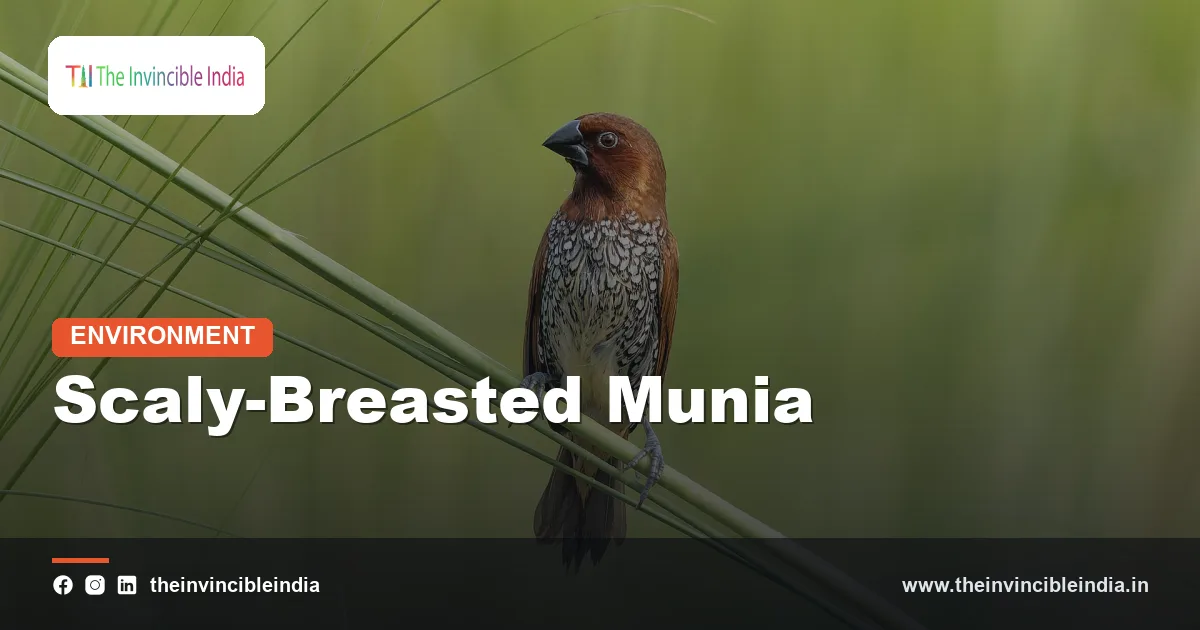
The scaly-breasted munia (Lonchura punctulata) is a tiny, sociable finch, also called the spice finch, whose whitish underparts are marked with scale-like chestnut-brown crescents and which flocks in grasslands, crop fields and gardens to eat grass seeds. The scaly-breasted munia builds a round, ball-shaped nest of grass with a side entrance and is one of the most widespread small seed-eating birds of India.
The scaly-breasted munia is only about 11 to 12 cm long, so it is often overlooked as a “small brown bird” until a flock lands on a stalk and the scaly pattern becomes visible. This explainer describes how the scaly-breasted munia looks, where it lives in India, what it eats, how it nests, how it differs from similar munias and what its conservation position is, as of the latest assessments.
Quick Facts
| Attribute | Detail |
|---|---|
| Common name | Scaly-breasted munia (also spice finch, spotted munia, nutmeg mannikin) |
| Scientific name | Lonchura punctulata |
| Family | Estrildidae (the waxbills, munias and allies) |
| Body length | About 11 to 12 cm |
| Key field marks | Dark brown face and throat, scaly chestnut crescents on the breast and flanks, stout grey bill |
| Habitat in India | Grassland, scrub, crop fields, gardens, forest clearings and bamboo |
| Diet | Mainly grass seeds, millets, rice and other grains; occasional insects |
| Nest | Globular ball of grass with a side entrance |
| IUCN status | Least Concern |
Key Takeaways
- The scaly-breasted munia is a small finch of the family Estrildidae whose breast and flanks carry scale-like chestnut-brown crescents on a whitish background.
- Scaly-breasted munias feed in flocks on grass seeds and cereal grains, and they cling to stalks while they pick out seeds.
- The scaly-breasted munia builds a dome-shaped ball of grass with a small side entrance, normally in a bush, bamboo clump or palm.
- Young scaly-breasted munias are plain buffy-brown and have no scaling, which makes them look quite unlike their parents.
- The scaly-breasted munia is native to South and South-East Asia and has been introduced to many other regions through the cage-bird trade.
- The IUCN lists the scaly-breasted munia as Least Concern, and trapping wild birds is regulated in India under the Wild Life (Protection) Act, 1972.
What is the scaly-breasted munia?
The scaly-breasted munia is a small seed-eating passerine bird belonging to the family Estrildidae, which includes the munias, waxbills, silverbills and mannikins. The scaly-breasted munia is known by its scientific name Lonchura punctulata, and the species has several regional subspecies spread across the Indian subcontinent, the Himalayan foothills, South-East Asia and southern China.
The common English name is based on the scale-like pattern on its underparts, and the alternative name “spice finch” is often traced to its use in the cage-bird trade. In the pet and aviary world, the species is also called nutmeg mannikin or spotted munia. In India, the bird is often referred to by regional names in Hindi and other languages that describe a small, plump, sparrow-like bird. Names vary widely by region, so the scientific name is used for clarity.
What does the scaly-breasted munia look like?
The adult scaly-breasted munia has dark chocolate-brown upperparts, a darker brown face and throat, a short stout grey-blue bill and a whitish belly marked with chestnut scaling on the breast and flanks. The scaling is the key feature and gives the bird its name, and it forms a series of crescents or “U” shapes that look like fish scales. The upper tail coverts are olive-yellow or golden-brown, producing a faint golden glow when the bird flies.
The bill is short, thick and conical, a typical design for cracking seeds. The legs are dark grey. Males and females are alike in plumage, so sex is very hard to determine by sight. Experienced aviculturists identify males in captivity by song.
The juvenile plumage
Young scaly-breasted munias are plain buffy-brown above and pale buff below, with no scaling and a dark bill. Because the juvenile lacks the scaled breast, it can be mistaken for a different species. The scaling begins to appear as the young bird moults and matures, usually within a few months. In a mixed flock of adults and juveniles, the contrast is easy to see, and this is a clue to a good breeding season.
How can the scaly-breasted munia be told apart from other munias?
The scaly-breasted munia can be told apart from other Indian munias by its scaled breast and flanks, whereas similar species have plain, streaked or differently coloured underparts. The table below compares the scaly-breasted munia with other small seed-eaters that share its habitats.
| Species | Key feature | Typical habitat |
|---|---|---|
| Scaly-breasted munia (Lonchura punctulata) | Scaly chestnut crescents on whitish breast and flanks | Grassland, fields, gardens |
| White-rumped munia (Lonchura striata) | White rump, dark brown head and chest, pale belly | Forest edges, scrub, bamboo, hills |
| Black-throated munia (Lonchura kelaarti) | Black throat, pointed tail, found in hills | Hill forest and clearings in southern and eastern regions |
| Tricoloured munia (Lonchura malacca) | Black head, chestnut body, white belly patch | Reedbeds, marshes, paddy fields |
| Indian silverbill (Euodice malabarica) | Pale sandy body, silvery bill, long black tail | Dry scrub, semi-arid country |
In the field, the quickest way to separate the scaly-breasted munia from the white-rumped munia is to check the rump and belly. The white-rumped munia shows a clearly white rump, while the scaly-breasted has a golden-brown rump and a scaly breast.
Where is the scaly-breasted munia found in India?
The scaly-breasted munia is found across most of India, from the Himalayan foothills and the plains to the peninsula, Western Ghats, east coast and north-east. The scaly-breasted munia is a lowland and foothill species and is generally absent from very dry deserts and the highest mountain zones.
The species is also native to Sri Lanka, Nepal, Bangladesh, Myanmar and a large part of South-East Asia. Several subspecies are recognised, with differences in shade and in the extent of scaling. Beyond its natural range, scaly-breasted munias have been introduced, accidentally or deliberately, to places such as Hawaii, Puerto Rico, Australia and parts of the Caribbean and Africa, and they have established wild populations in some of these locations.
Habitats used by the scaly-breasted munia
- Open grassland and the edges of wetlands.
- Paddy, millet and other crop fields.
- Scrub, bamboo clumps and forest clearings.
- Gardens, parks and the edges of towns where seeding grasses grow.
- Roadsides, railway embankments and waste land with tall weeds.
The scaly-breasted munia is quite tolerant of humans and often feeds on lawns and in vacant plots, as long as seeding grasses and shrubs for nesting are present.
What does the scaly-breasted munia eat?
The scaly-breasted munia eats mainly the seeds of grasses and other plants, along with grains such as rice and millets. The scaly-breasted munia forages in flocks, clinging to seed heads and bending stalks to reach the grain, or picking up fallen seeds from the ground. Its short, strong bill is well designed to husk small seeds quickly.
Small insects and other invertebrates may be eaten occasionally, particularly when the birds are feeding chicks, but the diet is overwhelmingly vegetarian. The birds also need water and come to puddles, streams and garden birdbaths to drink and bathe. Because they feed in flocks in crop fields, they may be regarded as minor pests by farmers, but they also eat large numbers of weed seeds, which gives them some benefit as natural weed controllers.
How does the scaly-breasted munia behave in flocks?
The scaly-breasted munia is a gregarious bird that lives in flocks of a few birds to several dozen, and it moves, feeds, drinks and roosts as a group. The scaly-breasted munia flies in a quick, direct, undulating manner, and a flock often rises together from a field, wheels once and drops back into the grass a short distance away.
Living in a flock provides safety, because many birds watch for hawks, shrikes and cats while the others feed. Pairs and family parties often stay within a larger flock outside the breeding season. Flocks may mix with white-rumped munias, silverbills and sparrows at rich feeding patches. Birds frequently sit close together on a branch or wire and preen one another, a behaviour called allopreening that strengthens social bonds.
What does the scaly-breasted munia sound like?
The scaly-breasted munia has a soft, whistled call that is often written as a repeated two-note “kitty-kitty” sound, and it gives a fine, thin contact note while flying in flocks. The scaly-breasted munia is not a loud bird, but a flock produces a constant gentle twitter as it moves through grass.
The male sings a quiet, muffled song, often with the throat feathers puffed, and the song is usually directed at a female. In captivity, the songs of males have been used to tell them apart from females. Flocks keep in touch with their contact calls, and the sound can reveal a hidden group long before the birds are visible.
How does the scaly-breasted munia breed?
The scaly-breasted munia builds a globular nest of dry grass with a side entrance and typically lays four to six white eggs. The nest is a loosely woven ball, often placed in a bush, bamboo clump, hedge or palm and sometimes in the eaves of buildings or in the old nests of other birds. Both the male and the female gather grass and help to build the nest, and the structure can be built within a few days.
Both parents incubate the eggs and feed the nestlings with partially digested seeds. Chicks fledge after roughly three weeks. The breeding season in India is broad and tied to the availability of seeds, so nesting often follows the monsoon, but local patterns vary. The birds may also use dormitory nests for roosting outside the breeding season, and several individuals may crowd into one nest for warmth and safety.
Stages of the nesting cycle
- Nest building: Both partners carry grass and weave the ball nest with a small side opening.
- Egg laying: A clutch of white eggs, generally four to six, is laid in the chamber.
- Incubation: The pair share incubation for about two weeks.
- Fledging: The young leave the nest after around three weeks and join the flock.
Is the scaly-breasted munia kept as a cage bird?
The scaly-breasted munia has been widely kept as a cage and aviary bird around the world, and its trade explains why the species has become established outside its natural range. The scaly-breasted munia is hardy, small and quiet, so it was popular with aviculturists, and escaped birds formed feral groups in several countries.
In India, wild birds are legally protected by the Wild Life (Protection) Act, 1972, and capture of native wild species for the pet trade is restricted. Illegal trapping of small finches, including munias, has nevertheless been reported in several parts of the country. People who wish to keep a pet bird are advised to choose captive-bred species that are legally permitted rather than wild-caught birds. Observing munias in gardens with seed-bearing grasses is a humane alternative.
What is the conservation status of the scaly-breasted munia?
The scaly-breasted munia is assessed as Least Concern on the IUCN Red List, because it has a very large range and is common in many habitats. The scaly-breasted munia benefits from agriculture and gardens, which provide seeds, and its ability to nest in different shrubs and structures helps it remain common near human settlements.
Threats include local trapping, pesticide use on crops and the loss of seeding grasslands through urbanisation and intensive mowing. Maintaining weedy patches, native grasses and hedges helps support the species. Population estimates are uncertain and are best treated as general indications.
How can you attract and watch scaly-breasted munias?
The easiest way to watch scaly-breasted munias is to look for flocks on seeding grasses in the early morning or late afternoon. Leaving a corner of a garden unmown, planting native grasses and providing a shallow dish of water can attract a regular flock of scaly-breasted munias.
- Search for small flocks perched on seed heads or hedges.
- Look for the scaled breast through binoculars, and check the rump colour.
- Listen for the soft whistled call of the flock.
- Avoid disturbing nests, which are small and easy to damage.
- Offer water rather than processed food.
Bottom Line
The scaly-breasted munia is a tiny, social, seed-eating finch that is easy to recognise by the scaled pattern on its breast and flanks. It is widespread in Indian grasslands, fields and gardens, builds a round grass nest and is currently of Least Concern, while its popularity as a cage bird makes legal protection and responsible observation important.
Frequently Asked Questions
What is a scaly-breasted munia?
A scaly-breasted munia is a small seed-eating finch with scale-like chestnut crescents on a whitish breast and flanks. Its scientific name is Lonchura punctulata, and it is also called the spice finch. It is common in Indian grasslands, fields and gardens.
Why is the scaly-breasted munia called a spice finch?
The scaly-breasted munia is called a spice finch mainly because of the name used in the cage-bird trade, and it is also known as the nutmeg mannikin. The name is a trade label and does not refer to the bird eating spices. Its natural diet is grass seeds and grains.
What does a scaly-breasted munia eat?
A scaly-breasted munia eats mostly grass seeds and cereal grains such as millets and rice. It feeds in flocks, clinging to seed heads or picking seeds from the ground. Small insects are eaten occasionally, especially when feeding chicks.
How does a scaly-breasted munia build its nest?
A scaly-breasted munia builds a round ball nest of dry grass with a small side entrance. Both partners help to weave it, normally in a bush, bamboo clump or palm. The female lays about four to six white eggs.
How can you tell a young scaly-breasted munia?
A young scaly-breasted munia is plain buffy-brown with no scaling on the breast. The scale-like pattern develops after the first moult. Juveniles also have darker bills and are often seen with adults in the same flock.
Is the scaly-breasted munia protected in India?
Yes, wild scaly-breasted munias are protected in India as native wild birds under the Wild Life (Protection) Act, 1972, and capturing them is restricted. The species is listed as Least Concern by the IUCN and is still common. Trapping for the cage-bird trade remains a concern in some places.
{“@context”:”https://schema.org”,”@graph”:[{“@type”:”FAQPage”,”mainEntity”:[{“@type”:”Question”,”name”:”What is a scaly-breasted munia?”,”acceptedAnswer”:{“@type”:”Answer”,”text”:”A scaly-breasted munia is a small seed-eating finch with scale-like chestnut crescents on a whitish breast and flanks. Its scientific name is Lonchura punctulata, and it is also called the spice finch. It is common in Indian grasslands, fields and gardens.”}},{“@type”:”Question”,”name”:”Why is the scaly-breasted munia called a spice finch?”,”acceptedAnswer”:{“@type”:”Answer”,”text”:”The scaly-breasted munia is called a spice finch mainly because of the name used in the cage-bird trade, and it is also known as the nutmeg mannikin. The name is a trade label and does not refer to the bird eating spices. Its natural diet is grass seeds and grains.”}},{“@type”:”Question”,”name”:”What does a scaly-breasted munia eat?”,”acceptedAnswer”:{“@type”:”Answer”,”text”:”A scaly-breasted munia eats mostly grass seeds and cereal grains such as millets and rice. It feeds in flocks, clinging to seed heads or picking seeds from the ground. Small insects are eaten occasionally, especially when feeding chicks.”}},{“@type”:”Question”,”name”:”How does a scaly-breasted munia build its nest?”,”acceptedAnswer”:{“@type”:”Answer”,”text”:”A scaly-breasted munia builds a round ball nest of dry grass with a small side entrance. Both partners help to weave it, normally in a bush, bamboo clump or palm. The female lays about four to six white eggs.”}},{“@type”:”Question”,”name”:”How can you tell a young scaly-breasted munia?”,”acceptedAnswer”:{“@type”:”Answer”,”text”:”A young scaly-breasted munia is plain buffy-brown with no scaling on the breast. The scale-like pattern develops after the first moult. Juveniles also have darker bills and are often seen with adults in the same flock.”}},{“@type”:”Question”,”name”:”Is the scaly-breasted munia protected in India?”,”acceptedAnswer”:{“@type”:”Answer”,”text”:”Yes, wild scaly-breasted munias are protected in India as native wild birds under the Wild Life (Protection) Act, 1972, and capturing them is restricted. The species is listed as Least Concern by the IUCN and is still common. Trapping for the cage-bird trade remains a concern in some places.”}}]}]}


