

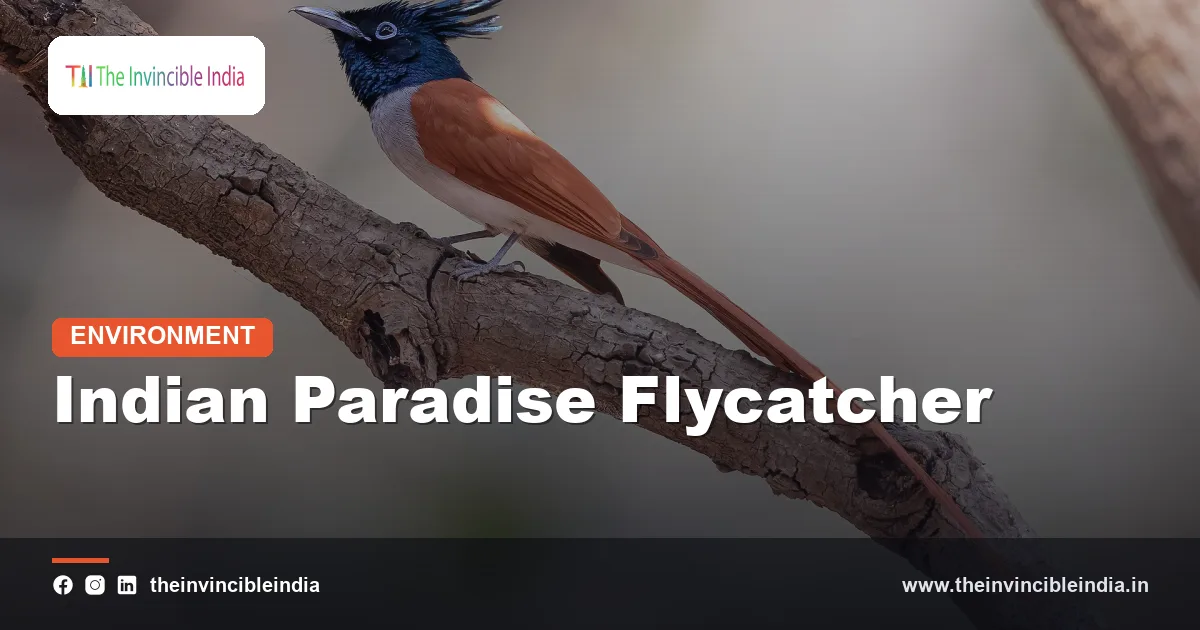
The Indian paradise flycatcher (Terpsiphone paradisi) is a slender insect-eating songbird whose adult male trails two ribbon-like tail streamers, either snowy white or rich rufous, that can be much longer than its body. The Indian paradise flycatcher lives in shady forests, groves and well-wooded gardens across India, where it catches insects in the air and builds a small, neat cup nest in a tree fork.
The Indian paradise flycatcher is also known in Hindi as shah bulbul or doodhraj, and it has long been admired for the dramatic beauty of the white male in flight. It is the state bird of Madhya Pradesh. This explainer covers how the Indian paradise flycatcher looks, why males come in two colour forms, where it lives, how it feeds and breeds and what its conservation status is, as of the latest assessments.
Quick Facts
| Attribute | Detail |
|---|---|
| Common name | Indian paradise flycatcher (also Asian paradise flycatcher in older and broader usage) |
| Scientific name | Terpsiphone paradisi |
| Family | Monarchidae (the monarch flycatchers) |
| Body length | About 20 cm for females; adult males reach roughly 45 to 50 cm including the tail streamers |
| Colour forms of male | White morph and rufous morph |
| Habitat | Shady forest, bamboo, orchards, groves and wooded gardens |
| Diet | Insects caught in flight or gleaned from foliage |
| Official recognition | State bird of Madhya Pradesh |
| IUCN status | Least Concern |
Key Takeaways
- The Indian paradise flycatcher is an insectivorous songbird whose adult male grows two elongated central tail feathers that form long ribbon-like streamers.
- Adult male Indian paradise flycatchers occur in two colour forms, a white morph with a black head and a rufous (chestnut) morph, while females are always rufous with a shorter tail.
- The Indian paradise flycatcher catches flying insects in short aerial sallies from a shady perch inside forests, groves and wooded gardens.
- Both the male and female Indian paradise flycatcher help to build the cup-shaped nest and to incubate the eggs and feed the chicks.
- The Indian paradise flycatcher is the state bird of Madhya Pradesh, where it is commonly called doodhraj.
- The IUCN lists the Indian paradise flycatcher as Least Concern, although it depends on shady tree cover for breeding and wintering.
What is the Indian paradise flycatcher?
The Indian paradise flycatcher is a small to medium-sized flycatcher of the family Monarchidae that is celebrated for the long tail of the male. The Indian paradise flycatcher belongs to the genus Terpsiphone, a group of monarch flycatchers that range across Africa and Asia. Despite the name, the birds are not close relatives of the true flycatchers of the Old World flycatcher family Muscicapidae, even though they hunt in a similar way.
Taxonomy has changed in recent years. The birds once grouped as the Asian paradise flycatcher have been divided by several authorities, and the name Indian paradise flycatcher is now used for the form centred on the Indian subcontinent, while related forms occur in South-East Asia and elsewhere. Checklists differ on the exact limits, so readers may find both names used for the Indian bird.
What does the Indian paradise flycatcher look like?
The Indian paradise flycatcher has a glossy black head with a short crest, a bright blue ring around the eye and a blue-grey bill, and its body colour depends on sex and age. The adult male is either mostly white or mostly rufous, and the female is rufous above with a greyish throat and breast and a much shorter tail.
The eye ring is one of the most striking details, and it can be seen clearly through binoculars even on a bird perched in the shade. The legs are bluish-grey and short. In flight, the white male with a pair of streamers fluttering behind it has an almost ghostly appearance in a dim forest, and this is the image most people remember.
The two colour forms of the male
The male Indian paradise flycatcher exists in two adult plumages. The white morph has a glossy black head and crest, white body and wings with fine black shaft streaks and long white streamers. The rufous morph has a black head, a chestnut back, wings and tail, a pale grey breast and long rufous streamers. The proportion of white and rufous males differs between regions, and in some populations of the Indian subcontinent, white males appear more frequent in the north and rufous males in the south, though this should be read as a general pattern.
Young males start with rufous plumage and a short tail. The white plumage develops over a few years, and the full streamers are usually grown only when the bird is two or three years old. Immature males can therefore look like females with a few unusual feathers, and field observers may need patience to identify them.
How can the sexes and morphs be told apart?
The sexes and morphs of the Indian paradise flycatcher can be told apart by tail length, body colour and the pattern of the breast. The table below summarises the field marks.
| Bird | Body colour | Tail | Notes |
|---|---|---|---|
| Adult white-morph male | White with black head and crest | Very long white streamers | Most conspicuous form; black shaft streaks on wings |
| Adult rufous-morph male | Chestnut above, pale grey below | Long rufous streamers | Often mistaken for a female if the tail is hidden |
| Adult female | Chestnut above, grey throat and breast | Short, no streamers | Black head with crest, blue eye ring |
| Young male | Rufous, often with a duller crest | Short or growing | Turns white over several years if it follows the white pathway |
The streamers are not a permanent feature. Adult males moult after the breeding season, so a bird seen in the winter often has a short tail and can look like a female or a young male. The tail usually regrows before the next breeding season.
Where is the Indian paradise flycatcher found in India?
The Indian paradise flycatcher is found across most of India, breeding in many parts of the north, centre and east and wintering in the peninsula and Sri Lanka. The Indian paradise flycatcher is a partial migrant, which means some populations stay in the same place all year while others make seasonal journeys. Northern breeders in the Himalayan foothills and plains tend to move south or to lower elevations in winter, while many peninsular birds are resident or move short distances.
The species is widely reported from Madhya Pradesh, Uttar Pradesh, Bihar, West Bengal, Odisha, Maharashtra, Karnataka, Kerala and other states, and it is a regular visitor to well-wooded city gardens during migration. Precise seasonal patterns and the status of local populations vary by region, so the information in a local bird checklist is a better guide than a single national summary.
Habitats used by the Indian paradise flycatcher
- Moist and dry deciduous forest with a shady understory.
- Bamboo thickets and forest edges near streams.
- Mango groves, orchards and old plantations.
- Large well-wooded gardens, campuses and temple groves.
- Riverine woodland and shady ravines.
The Indian paradise flycatcher prefers the lower and middle levels of woodland, particularly near water, where insects are abundant. It is rarely found in open, treeless country.
How does the Indian paradise flycatcher feed?
The Indian paradise flycatcher feeds on insects, which it catches in short aerial sallies from a perch or picks from leaves. The Indian paradise flycatcher usually sits upright on a shaded branch, scans for movement, darts out to snap up a flying insect with an audible click of the bill and then returns, often to the same perch. The bird also hovers briefly to glean prey from the underside of leaves.
The diet includes flies, moths, beetles, grasshoppers and other small insects. Because it feeds on many pests, the bird is considered beneficial to orchards and gardens. It often joins mixed-species hunting flocks in forests, alongside warblers, tits and drongos. Occasionally, individuals have been seen to eat small fruits, but insects are by far the main food.
What does the Indian paradise flycatcher sound like?
The Indian paradise flycatcher has a harsh, rasping, cat-like call that is often written as a repeated, scratchy note, and it also has a short, sweet song during the breeding season. The Indian paradise flycatcher is rather quiet outside the breeding months, but the characteristic rasp can give away its presence in the dense vegetation of a forest or garden.
Males sing from a regular perch, and the song is usually a brief series of clear whistled notes mixed with chatter. When disturbed near the nest, both parents give sharp alarm calls and may mob predators such as crows, squirrels or snakes. Listening is therefore a useful way to find the species before it is seen.
How does the Indian paradise flycatcher breed?
The Indian paradise flycatcher builds a neat, compact cup nest in the fork of a thin branch, typically a few metres above the ground, and both the male and the female take part in nesting duties. The nest is woven from fine grass, fibres, plant down and bark, and it is bound with spider silk. It is decorated on the outside with cobwebs and lichens, which camouflage it against the branch.
The female usually lays three to four eggs, which are pale pink or cream with small reddish-brown speckling. Both parents incubate in turn, and both feed the chicks with insects. The white-morph male, despite his long tail, continues to incubate, and the long streamers hang below the nest like a pair of ribbons. Chicks fledge after roughly two weeks, and the family stays together for a short period. Breeding seasons differ across the country, with northern birds nesting mostly in the summer and monsoon months and southern birds in a variety of seasons.
Stages of the nesting cycle
- Territory and courtship: The male defends a patch of shady forest and displays to the female.
- Nest building: The pair constructs the cup within a few days, often reusing familiar sites.
- Incubation: The eggs are warmed by both parents for around two weeks.
- Feeding and fledging: Both parents bring insects until the young can fly.
Why does the Indian paradise flycatcher have such a long tail?
The long tail of the male Indian paradise flycatcher is considered a product of sexual selection, meaning females tend to favour males with longer and more elaborate ornaments. The Indian paradise flycatcher male grows two central tail feathers that are many times longer than the body, and these streamers are costly to carry and can reduce agility in flight and may increase risk from predators.
Because the ornament is costly, it may act as an honest signal of the health and condition of the male. Researchers studying related species have found that tail length can correlate with breeding success, although detailed studies on the Indian paradise flycatcher itself are less extensive. The loss of the tail by moulting after breeding, followed by regrowth in the next season, shows that the ornament is a seasonal investment.
What is the conservation status of the Indian paradise flycatcher?
The Indian paradise flycatcher is classed as Least Concern on the IUCN Red List, as it has a very large range and is generally common in suitable habitat. The Indian paradise flycatcher is protected in India under the Wild Life (Protection) Act, 1972, which covers wild birds, and it is the official state bird of Madhya Pradesh.
The main threats are the loss of shady forest, felling of old trees, trapping for the cage-bird or feather trade in some regions and disturbance at nest sites. Pesticide use may reduce insect prey in agricultural areas. Maintaining wooded corridors, bamboo clumps and old orchards helps the species, especially along its migration routes. Total population figures are uncertain and should be treated as approximate.
Why is the Indian paradise flycatcher culturally important?
The Indian paradise flycatcher is culturally important in India because of its striking appearance, its names in folklore and its status as a state symbol. The Indian paradise flycatcher is known as doodhraj, literally the milk king, and as shah bulbul, the royal nightingale or bulbul, in parts of north and central India, and the white male is often described in poetry and local tales as a graceful, almost celestial bird.
Madhya Pradesh designated the bird as its state bird, and it appears in wildlife publicity and conservation messages. For birdwatchers, seeing a white male in a forest glade is often a highlight. Photographers and naturalists have also helped to document nest sites and migration records, adding to knowledge of how the bird uses gardens and woodlands.
Bottom Line
The Indian paradise flycatcher is a graceful insect-eating songbird of shady Indian woodlands, famous for the long white or rufous tail of the adult male. It breeds in neat cup nests, is common enough to be of Least Concern and depends on well-wooded habitat, which makes it a good indicator of healthy tree cover.
Frequently Asked Questions
What is the Indian paradise flycatcher?
The Indian paradise flycatcher is a slender, insect-eating songbird whose adult male has two long ribbon-like tail streamers. Its scientific name is Terpsiphone paradisi. It is found in shady forests, groves and wooded gardens across India.
Why are some paradise flycatchers white and others brown?
Adult male Indian paradise flycatchers come in a white morph and a rufous morph, while females are always rufous. Young males begin rufous and may turn white over a few years. The share of white and rufous males differs between regions.
Which state has the paradise flycatcher as its state bird?
Madhya Pradesh has the paradise flycatcher as its state bird, where it is commonly called doodhraj. The bird is also known as shah bulbul in parts of north India. It is admired for the long tail of the white male.
What does the Indian paradise flycatcher eat?
The Indian paradise flycatcher eats insects, mostly caught in flight or picked from leaves. Flies, moths, beetles and grasshoppers are typical prey. It rarely eats fruit and is considered useful for natural pest control.
Does the Indian paradise flycatcher migrate?
The Indian paradise flycatcher is a partial migrant, so some populations stay put while others move seasonally. Northern breeding birds often move south or to lower elevations in winter. Many peninsular birds are resident or travel short distances.
Is the Indian paradise flycatcher endangered?
No, the Indian paradise flycatcher is not endangered and is listed as Least Concern by the IUCN. It has a wide range and is fairly common in suitable habitat. Loss of shady forest and nest-site disturbance are the main local concerns, and wild birds are protected under the Wild Life (Protection) Act, 1972.
{“@context”:”https://schema.org”,”@graph”:[{“@type”:”FAQPage”,”mainEntity”:[{“@type”:”Question”,”name”:”What is the Indian paradise flycatcher?”,”acceptedAnswer”:{“@type”:”Answer”,”text”:”The Indian paradise flycatcher is a slender, insect-eating songbird whose adult male has two long ribbon-like tail streamers. Its scientific name is Terpsiphone paradisi. It is found in shady forests, groves and wooded gardens across India.”}},{“@type”:”Question”,”name”:”Why are some paradise flycatchers white and others brown?”,”acceptedAnswer”:{“@type”:”Answer”,”text”:”Adult male Indian paradise flycatchers come in a white morph and a rufous morph, while females are always rufous. Young males begin rufous and may turn white over a few years. The share of white and rufous males differs between regions.”}},{“@type”:”Question”,”name”:”Which state has the paradise flycatcher as its state bird?”,”acceptedAnswer”:{“@type”:”Answer”,”text”:”Madhya Pradesh has the paradise flycatcher as its state bird, where it is commonly called doodhraj. The bird is also known as shah bulbul in parts of north India. It is admired for the long tail of the white male.”}},{“@type”:”Question”,”name”:”What does the Indian paradise flycatcher eat?”,”acceptedAnswer”:{“@type”:”Answer”,”text”:”The Indian paradise flycatcher eats insects, mostly caught in flight or picked from leaves. Flies, moths, beetles and grasshoppers are typical prey. It rarely eats fruit and is considered useful for natural pest control.”}},{“@type”:”Question”,”name”:”Does the Indian paradise flycatcher migrate?”,”acceptedAnswer”:{“@type”:”Answer”,”text”:”The Indian paradise flycatcher is a partial migrant, so some populations stay put while others move seasonally. Northern breeding birds often move south or to lower elevations in winter. Many peninsular birds are resident or travel short distances.”}},{“@type”:”Question”,”name”:”Is the Indian paradise flycatcher endangered?”,”acceptedAnswer”:{“@type”:”Answer”,”text”:”No, the Indian paradise flycatcher is not endangered and is listed as Least Concern by the IUCN. It has a wide range and is fairly common in suitable habitat. Loss of shady forest and nest-site disturbance are the main local concerns, and wild birds are protected under the Wild Life (Protection) Act, 1972.”}}]}]}


