

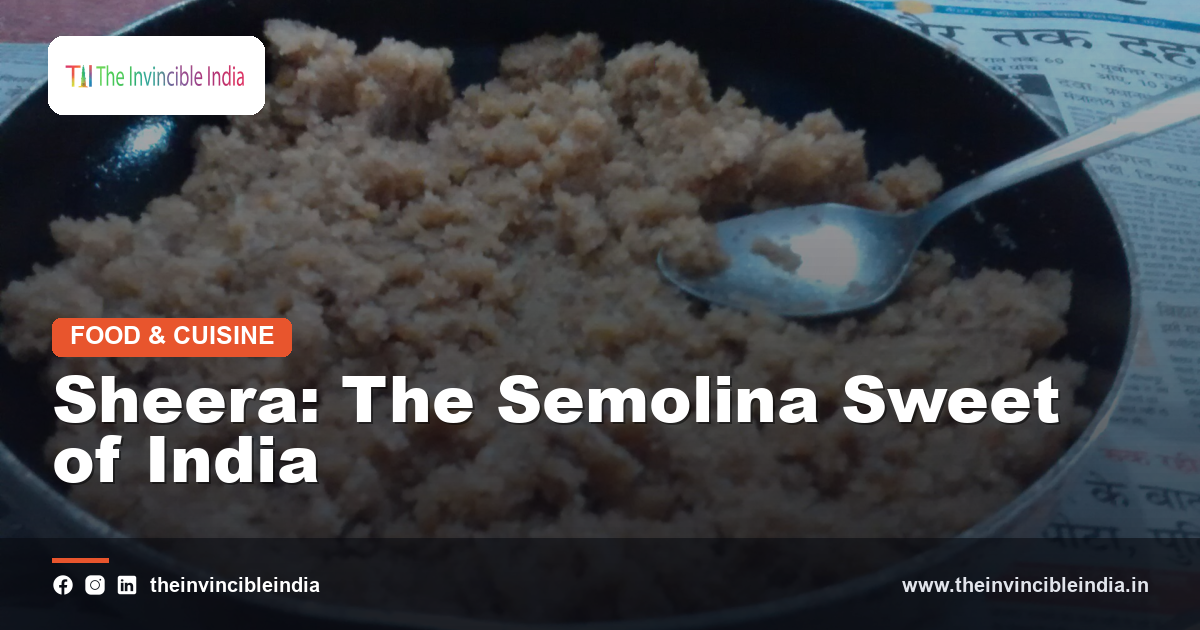
Sheera, also spelled sheera or shira and widely known as sooji halwa, rava sheera, or semolina halwa, is a soft, fragrant sweet made by roasting semolina in ghee and cooking it with sugar and liquid. It is among the simplest and most comforting desserts of the subcontinent, prepared in a few minutes yet served at occasions ranging from household worship to festive meals. Among the many treats covered in our guide to famous sweets of India, sheera is notable for how little it asks of a cook and how much it gives in warmth and aroma. This guide explains what sheera is, how it is made, and why it holds such a steady place in Indian homes.
Quick answer: Sheera is an Indian sweet made by roasting semolina (rava or sooji) in ghee, then cooking it with sugar and hot water or milk until it turns soft and pudding-like, and flavouring it with cardamom, nuts, and raisins. It is also called sooji halwa, rava sheera, or rava kesari, depending on the region. It is widely served as prasad at religious ceremonies and as a quick home dessert.
Key Takeaways
- Sheera is a semolina-based Indian sweet, also called sooji halwa, rava sheera, or rava kesari.
- The dish is made by roasting semolina in ghee and cooking it with sugar and hot water or milk until soft.
- Cardamom, saffron, cashews, almonds, and raisins are the traditional flavourings and garnishes.
- Sheera is commonly offered as prasad at pujas, especially in Maharashtra, where it is closely linked with household worship.
- Popular variations include banana sheera, pineapple sheera, and the saffron-coloured kesari bath of Karnataka.
- The dish is valued because it can be prepared quickly from a few pantry ingredients.
Read on for the ingredients, method, serving customs, and cultural role in detail.
Quick Facts
| Detail | Information |
|---|---|
| Dish | Sheera (sooji halwa, rava sheera) |
| Type | Semolina sweet / halwa |
| Main ingredient | Semolina (rava or sooji) |
| Cooked in | Ghee, with sugar and water or milk |
| Flavourings | Cardamom, saffron, nuts, raisins |
| Associated regions | Maharashtra, Karnataka, Gujarat and across India |
| Common role | Prasad, festival sweet, quick dessert |
| Texture | Soft, moist, pudding-like |
What Is Sheera?
Sheera is a soft sweet of roasted semolina cooked in ghee and sweetened with sugar, and it belongs to the large family of Indian halwas. The grains are first toasted until they turn fragrant and lightly golden, then combined with hot liquid and sugar and stirred until the mixture thickens and pulls away from the pan. The finished dish is moist, glossy, and slightly grainy, with a gentle sweetness and the aroma of cardamom and ghee. It is usually shaped into a mound on a plate and garnished with cashews, almonds, and raisins fried in ghee. Because it needs no elaborate technique, sheera is often one of the first sweets a young cook learns. Its simplicity does not make it ordinary, however, since small details of roasting and stirring decide whether it turns out airy and fragrant or heavy and pasty.
What Is Sheera Called in Different Places?
Sheera is known by many names across India, and the same basic dish appears as sooji halwa, rava sheera, rava kesari, and suji ka halwa. In Maharashtra the name sheera is standard, in Karnataka the saffron-coloured version is known as kesari bath, and in Gujarat the dish is called sheero. Hindi-speaking regions often say sooji halwa, while the Tamil and Telugu communities use rava kesari for a bright, ghee-rich variant. The word sheera itself is generally traced to older words for syrup or sweet preparations, though the exact path of its origin is not firmly settled. These different names point to the same idea of semolina cooked in ghee with sugar. Seeing the dish under so many labels shows how widely the sweet has spread and how each region has made it its own.
What Is Semolina, the Grain Behind Sheera?
Semolina, known in India as rava, sooji, or suji, is a coarsely ground product of wheat that forms the base of sheera and of many other everyday dishes. It is made by milling wheat into granules that are larger than flour but smaller than broken wheat, and it is sold in fine and medium grades. Indian kitchens use it for upma, idli, dosa batter, and many sweets, so a packet of rava is a near-universal pantry item. For sheera, fine or medium grain is preferred because it cooks quickly and absorbs ghee and liquid evenly. The grain has a mild, slightly nutty taste when roasted, which is exactly what the dish relies on. The importance of the grain shows why sheera is so accessible: the main ingredient is cheap, long-lasting, and found in almost every home.
What Ingredients Are Needed for Sheera?
Sheera needs only a few ingredients: semolina, ghee, sugar, water or milk, and a little cardamom. Ghee is the most important, since it both roasts the grain and gives the sweet its richness and aroma. Sugar provides sweetness, and some cooks dissolve it in the hot liquid first to make a quick syrup. Hot water gives a lighter result, while milk or a mix of milk and water produces a creamier one. Saffron strands soaked in warm milk lend a golden colour and delicate fragrance, and cardamom powder is almost always added. Cashews, almonds, and raisins fried in ghee are the usual garnish. The short list means that quality counts, so good ghee and fresh semolina make a clear difference. A pinch of salt is sometimes added to sharpen the sweetness, though it is entirely optional.
How Is Sheera Made?
Sheera is made by roasting semolina in ghee, adding hot liquid and sugar, and stirring until the mixture thickens into a soft mass. The cook first fries nuts and raisins in ghee and sets them aside, then adds the semolina to the same pan and roasts it on a low flame until it smells toasted and darkens slightly. Hot water or milk is poured in carefully, since the grain will sputter, and the mixture is stirred quickly to avoid lumps. Sugar and cardamom follow, and the pan is covered briefly so that the semolina steams and swells. Finally the sheera is stirred again, finished with a spoon of ghee, and topped with the fried nuts. The whole process takes only a short time, but constant stirring and gentle heat are the habits that give a smooth, well-cooked result.
Why Is Roasting the Semolina So Important?
Roasting the semolina in ghee is the most important step because it gives sheera its flavour, texture, and colour. Properly roasted grains develop a nutty aroma and separate cleanly, so they absorb liquid without clumping into a paste. Under-roasted semolina tastes raw and turns sticky, while over-roasted grain can become bitter. Cooks traditionally judge the moment by smell and by the way the grains begin to look dry and lightly coloured. The roasting also coats each granule in ghee, which helps the finished sweet stay soft and moist and gives it a sheen. This is why many home cooks say that patience at the start decides the outcome of the whole dish. Even though sheera is quick to prepare, the roasting stage cannot be hurried, and it is the point where experience shows most clearly.
What Is the Usual Ratio of Ingredients?
A commonly remembered guide for sheera is roughly equal parts of semolina, ghee, and sugar, with about twice as much hot liquid, although every household adjusts it to taste. Cooks who prefer a richer sweet use more ghee, while those who want a lighter result reduce it and increase the water. Milk makes the dish softer, and a larger proportion of liquid gives a looser, more porridge-like sheera. The ratio is passed down by observation rather than written measure in many families, and elders often say that the right feel comes from watching the grain swell. Such flexibility is typical of Indian home cooking, where a dish is learned by sight and smell. The rule of thumb is useful for beginners, but the best guide remains the texture in the pan, which should be moist and glossy but not runny.
Why Is Sheera Served as Prasad?
Sheera is served as prasad, the blessed food offered to a deity and then shared among devotees, because it is simple, pure, and quick to prepare with ingredients found in any home. In Maharashtra and neighbouring regions it is closely associated with household worship such as the Satyanarayan puja, where a sweet made of semolina, ghee, sugar, and sometimes banana is offered and then distributed. The dish suits ritual use because it can be made in large quantity with few items and without elaborate equipment. Its warm, ghee-rich aroma is also considered auspicious. Prasad is meant to be humble rather than extravagant, and sheera fits that spirit well. The practice shows how food in India often joins daily domestic life with devotion, turning a plain semolina sweet into a carrier of shared blessing.
What Role Does Sheera Play in Festivals and Family Life?
Sheera plays a flexible role in Indian celebrations, appearing at festivals, birthdays, housewarmings, and quiet family evenings alike. Because it can be prepared in minutes, it is a common choice when guests arrive unexpectedly or when a sweet is needed to mark a small good news. In many homes it is also served at the end of a meal or offered at the start of a new venture as a sign of good luck, in keeping with the custom of eating something sweet before beginning an important task. The dish is soft and easy to chew, which makes it a favourite for children and elders. Its place in family life is therefore as much emotional as culinary. Sheera is rarely the centrepiece of a grand feast, yet it is remembered fondly as the sweet of everyday occasions and small rituals.
What Are the Popular Variations of Sheera?
Sheera has many popular variations, most of which add fruit or change the flavouring while keeping the basic method. Banana sheera folds mashed ripe banana into the roasting semolina, giving a naturally sweet, fragrant version often prepared for worship. Pineapple sheera adds chopped pineapple for a tangy brightness and is especially popular in Karnataka, where it is sometimes served with the savoury upma as part of a combined breakfast dish. Saffron sheera, or kesari bath, uses saffron or a food colour for a golden hue. Other versions use coconut, dried fruits, or a little jaggery in place of sugar for a deeper, earthier sweetness. Each variation keeps the central character of ghee-roasted semolina while giving the dish a new identity. The range shows how easily the basic recipe adapts to local fruit, taste, and occasion.
How Does Sheera Differ From Other Halwas?
Sheera differs from other halwas mainly in its base ingredient, since it uses semolina while the better-known carrot halwa uses grated carrots and the Punjabi karah prasad uses whole wheat flour. All halwas share the principle of cooking a main ingredient in ghee with sugar until it thickens, a technique that has many regional forms across the country and beyond. Sheera is lighter and quicker than most, and it needs neither long simmering nor grating. Its texture is softer and more granular than the dense, fudge-like halwas made from lentils or gourds. Among the many sweets described in our survey of regional cuisines, the halwa family shows how one cooking idea can be repeated with different grains, vegetables, and fruits. Sheera is the semolina member of that family and probably its most approachable.
How Does Sheera Fit Into a Breakfast or Meal?
Sheera is eaten at several points in the day: as a dessert after a meal, as a light sweet snack, and in some regions as part of breakfast. In Karnataka the combination of savoury upma and sweet kesari bath, served together as chow chow bath, is a well-known breakfast plate that pairs the two dishes side by side. In Maharashtra sheera may be served after a simple meal or on its own at an afternoon gathering. It is also commonly served warm, since the aroma of ghee and cardamom is strongest when the sweet is freshly made. Leftovers are eaten cold or gently reheated with a spoon of ghee. These varied uses reflect a flexible attitude to sweetness in Indian food, where a sweet dish is not confined to the end of a meal. Sheera adapts comfortably to whichever role it is given.
How Can the Texture of Sheera Be Judged?
The ideal sheera is soft, moist, and glossy, with grains that are fully cooked but still distinct, and it should leave the sides of the pan cleanly. If the mixture looks dry and stiff, it needs a little more hot liquid and a brief steam. If it looks runny, a few more minutes of stirring over low heat will thicken it. Lumps usually mean the liquid was added too fast or the semolina was not stirred immediately, and a quick, steady stir helps break them up. A good sheera should hold a gentle mound on the plate without spreading, and a thin film of ghee on the surface is a sign of proper richness. These simple tests are learned by watching the pan rather than by measuring. Judging texture is the real skill behind the dish, and it comes naturally with a little practice.
What Mistakes Should Cooks Avoid When Making Sheera?
The most common mistakes in making sheera are rushing the roasting, adding cold liquid, and neglecting to stir. Cold water poured onto hot semolina can cause lumps and uneven cooking, which is why the liquid is added hot. Pouring it in too quickly can also make the mixture splatter, so cooks pour gradually and stand back slightly. Too little ghee produces a dry, heavy sweet, while too much can leave it greasy, so a balanced measure matters. Adding sugar too early can interfere with the grain swelling in some methods, and overcooking can make the dish pasty. Covering the pan briefly and then fluffing the sheera with a fork helps keep it light. Avoiding these small errors takes little effort, and the result is a fragrant, soft sweet that justifies the care taken with such a modest set of ingredients.
Why Is Sheera So Widely Loved?
Sheera is widely loved because it combines comfort, speed, and tradition in one humble dish. It is made from ingredients that almost every Indian kitchen holds, it takes little time, and it satisfies the craving for something warm and sweet without fuss. For many people it recalls childhood, a mother stirring a pan at the stove, and the smell of cardamom filling the house. It is also approachable for all ages, with a soft texture that suits both children and the elderly. Its modest cost makes it available to every household, and its ritual role gives it a dignity beyond that of a casual dessert. The dish crosses boundaries of region and community more easily than many sweets, because the idea of roasted semolina cooked in ghee is understood everywhere. This broad appeal has kept sheera in daily use for generations.
Sheera Today
Sheera today remains one of the most familiar sweets of Indian kitchens and a regular offering at temples, homes, and restaurants. Packaged instant mixes and ready-to-eat versions are sold in many shops, although most cooks still prefer to prepare it fresh because the aroma of roasting semolina is part of its charm. Younger cooks experiment with fruit, dried nuts, and reduced-sugar versions, while traditional households continue to make it exactly as their elders did. Food writers and chefs increasingly present sheera as a quiet classic that deserves recognition alongside more elaborate sweets. Its role as prasad, comfort food, and quick dessert has not diminished with changing lifestyles. The sweet endures because it is simple to make and easy to share, and in a time of fast change it offers a dependable link to home, ritual, and the long tradition of Indian sweet-making.
Sources & Further Reading
- Ministry of Culture, Government of India (indiaculture.gov.in).
- Ministry of Tourism, Government of India (incredibleindia.gov.in).
Frequently Asked Questions
What is sheera?
Sheera is an Indian sweet made by roasting semolina in ghee and cooking it with sugar and hot water or milk until soft. It is flavoured with cardamom and garnished with nuts and raisins. It is also known as sooji halwa or rava sheera.
Is sheera the same as sooji halwa?
Yes, sheera and sooji halwa are essentially the same semolina sweet under different regional names. Sheera is the common name in Maharashtra, while sooji halwa is used widely in Hindi-speaking regions. In Karnataka and the south the similar dish is called rava kesari or kesari bath.
What is sheera made of?
Sheera is made of semolina (rava or sooji), ghee, sugar, and hot water or milk. Cardamom, saffron, cashews, almonds, and raisins are added for flavour and garnish. Fruit such as banana or pineapple is used in popular variations.
Why is sheera offered as prasad?
Sheera is offered as prasad because it is simple, quick to prepare, and made from ingredients found in every home. It is closely associated with household worship such as the Satyanarayan puja, especially in Maharashtra. Its ghee-rich aroma is also considered auspicious.
How is sheera different from kesari bath?
Kesari bath is the Karnataka version of sheera, usually coloured golden with saffron or food colour and made with generous ghee. The two dishes share the same method of roasting semolina and cooking it with sugar and liquid. The main differences are regional naming, colour, and sometimes the use of pineapple.
How can lumps in sheera be avoided?
Lumps in sheera are avoided by adding the liquid hot rather than cold and stirring immediately and steadily as it goes in. The semolina should also be properly roasted so the grains stay separate. Pouring the liquid gradually helps keep the mixture smooth.


