

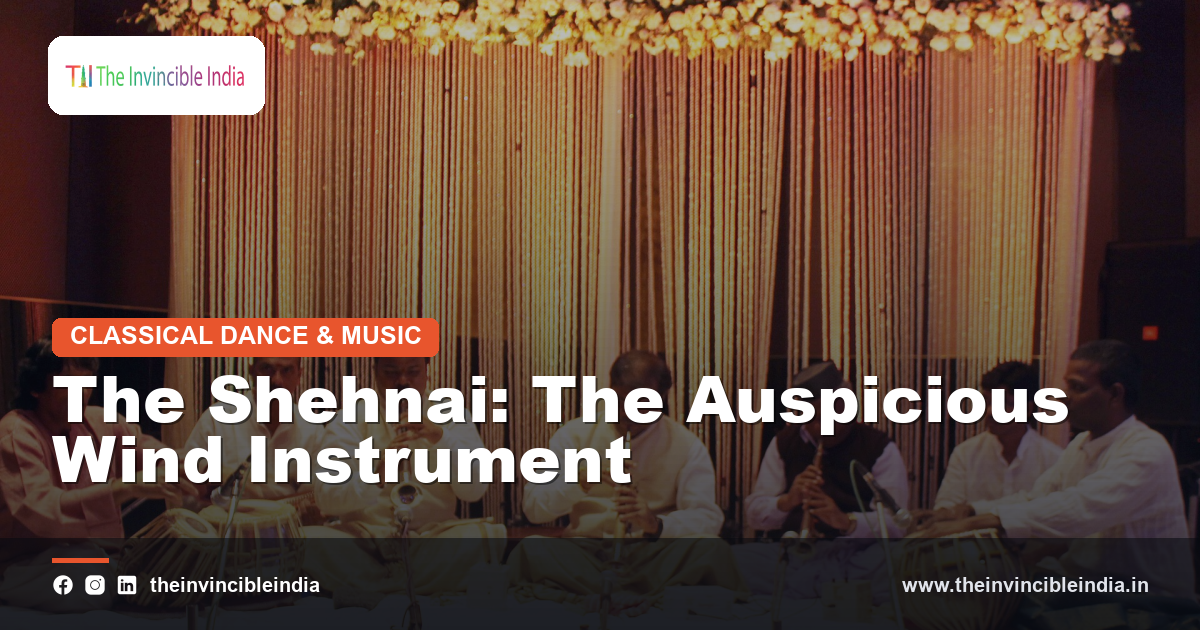
The shehnai is a slender, conical double-reed wind instrument whose bright, penetrating sound has long been regarded in North India as mangal vadya, an instrument of auspiciousness, played at weddings, temple ceremonies and festive processions to mark moments of celebration and blessing. Distinct from South India’s related raga-based wind traditions in its specific construction and social role, the shehnai occupied for centuries a place at the threshold of ritual life, sounding at dawn from temple gateways and announcing joyous family occasions. In the twentieth century it was carried onto the classical concert stage, where its expressive capacity for raga performance won it a lasting place alongside India’s other great melodic instruments. This guide explores its structure, sound, traditional role and classical journey.
Quick Facts
| Detail | Information |
|---|---|
| Type | Double-reed conical wind instrument (aerophone) |
| Origin | North India, long associated with Uttar Pradesh |
| Body | Tapering wooden tube with a flared metal bell |
| Reed | A double reed fitted at the narrow end |
| Traditional role | Mangal vadya, played at weddings and temple rituals |
| Concert elevation | Brought to classical stage prominence in the twentieth century |
What Is the Shehnai
The shehnai is a wind instrument of the double-reed family, meaning its sound is produced by breath passing between two thin reeds bound tightly together at the narrow end of a tapering wooden tube. This construction gives it a bright, nasal, carrying tone that projects clearly even in open-air settings, which is one reason it became so closely associated with outdoor ceremonies and processions. Held vertically and played with continuous breath control, the shehnai belongs to the broader family of conical double-reed instruments found across Asia, yet its particular tone, repertoire and ceremonial associations mark it as a distinctly Indian voice within that wider tradition.
Structure and Materials
A shehnai consists of a tapering wooden body, traditionally turned from a hardwood such as blackwood, pierced with finger holes along its length and fitted at one end with a small double reed and at the other with a flared metal bell. The gradual widening of the bore from the reed end to the bell is central to its characteristic tone, shaping the way harmonics develop as air passes through the instrument. Careful craftsmanship in shaping the bore and placing the finger holes accurately is essential, since even small variations affect intonation and tone quality, making skilled instrument makers as important to the tradition as skilled players.
The Double Reed Mechanism
The shehnai’s sound begins at its double reed, two thin blades of cane bound together so that the player’s breath sets them vibrating rapidly against one another. Controlling this reed demands considerable skill, since the pressure and shaping of the lips and breath directly affect pitch, tone and expression, allowing an experienced player to bend notes and add subtle ornamentation in ways not possible on instruments with a single reed or none at all. Reeds must be carefully prepared and maintained, and players often keep several on hand, since the reed’s condition has an immediate and noticeable effect on the instrument’s responsiveness and sound.
A Sound Considered Auspicious
Across much of North India the shehnai has long been regarded as mangal vadya, an instrument whose sound itself is considered auspicious and capable of blessing an occasion. This association placed it at the centre of ceremonies marking important transitions in life and community, from weddings to religious festivals, where its bright tone was believed to invite good fortune and ward off inauspiciousness. The belief in its auspicious quality gave the shehnai a ritual significance beyond ordinary music-making, so that its presence, or absence, at a ceremony carried real cultural weight, a status that few other instruments in Indian tradition have held so consistently.
The Shehnai at Weddings
The shehnai’s most familiar role in Indian life is at weddings, where its music traditionally announces the various stages of the ceremony, from the arrival of the groom’s procession to the sacred rites at the wedding altar. Played live by hired musicians in many communities, its melodies are woven into the emotional fabric of the occasion, lending both festivity and solemnity as required by each stage of the ritual. Even as recorded music has become common at modern celebrations, the sound of the shehnai remains instantly recognisable as the signature music of Indian weddings, evoking the occasion in popular imagination whether or not it is actually performed live.
The Shehnai in Temple Ritual
Beyond weddings, the shehnai has long held a place in temple ritual across parts of North India, traditionally played from temple gateways at dawn and dusk as part of the daily cycle of worship. This practice placed the instrument within the structured rhythm of devotional life, its sound marking the opening and closing of the day’s rites much as bells and conch shells do in other contexts. The tradition of temple shehnai playing, passed down through hereditary musician families in some regions, tied the instrument closely to sacred space and helped preserve its repertoire and technique across generations of ritual practice.
Ustad Bismillah Khan and Concert Elevation
The shehnai’s transformation from a ceremonial folk and temple instrument into a respected voice of the classical concert stage owes an enormous debt to Ustad Bismillah Khan, whose lifelong dedication to the instrument demonstrated its capacity for the full depth and discipline of Hindustani raga performance. Through decades of concert performances he introduced audiences across India and abroad to the shehnai as a serious classical instrument capable of sustained melodic development, rather than solely an accompaniment to ritual occasions. His work is widely regarded as central to the instrument’s modern reputation and remains a touchstone for shehnai players who have followed him.
Playing Technique and Breath Control
Mastering the shehnai demands exceptional breath control, since a continuous, steady airflow must be maintained to sustain long melodic phrases without the interruptions that would break the flow of a raga performance. Players develop techniques of circular breathing and careful reed management to achieve this sustained sound, alongside precise finger technique on the instrument’s holes to shape pitch and ornamentation. The physical demands of the instrument are considerable, and building the necessary breath capacity and embouchure control typically requires years of dedicated practice, much like the training required for other wind instruments used in extended classical performance.
Shehnai Repertoire and Ragas
In its classical concert form, the shehnai performs the standard architecture of Hindustani instrumental music, beginning with a slow, unmetered alap that explores the chosen raga before moving into rhythmic compositions accompanied by tabla. Its bright, sustained tone lends itself especially well to ragas associated with festive or auspicious moods, reflecting the instrument’s traditional ceremonial associations, while skilled players also bring depth and subtlety to more contemplative ragas. This body of repertoire, developed and refined through the instrument’s concert history, sits alongside its continuing ceremonial role, giving the shehnai a dual life as both ritual and classical voice.
Ensemble and Accompaniment
The shehnai is traditionally performed with a small supporting ensemble, most often including a drone instrument such as the tanpura to establish the tonal centre and a second shehnai or similar instrument providing a sustained harmonic support beneath the main melodic line. Percussion accompaniment, typically on the tabla, joins for the rhythmic sections of a performance, following the same ensemble logic used across Hindustani instrumental music. This combination allows the lead player considerable freedom for melodic exploration while the ensemble maintains the tonal and rhythmic foundation, a structure shared broadly across North Indian classical performance.
Regional Variations
While the shehnai is most closely associated with North India, related conical double-reed instruments appear under different names and with variations in construction and repertoire across other regions of the subcontinent, each shaped by local musical traditions and ceremonial customs. These instruments share the shehnai’s basic double-reed principle and celebratory associations even as their exact form and playing style differ. Such regional variety reflects the broader pattern in Indian instrumental music, in which a shared underlying technology, in this case the double reed, gives rise to a family of related but distinct instruments across the country’s diverse musical landscape.
Making a Shehnai
Crafting a shehnai is a specialised skill, requiring careful selection and seasoning of wood, precise boring of the internal bore, and exact placement of finger holes to achieve correct intonation across the instrument’s range. The metal bell must be shaped and fitted so as to complement the tone produced by the reed and body, and the reed itself, prepared from cane, requires ongoing skill to cut and bind correctly. Instrument makers often work within family workshops where techniques are passed down through generations, and the quality of a shehnai depends heavily on this accumulated craftsmanship, much as it does with other classical Indian instruments.
Learning the Shehnai
Training in the shehnai traditionally follows the guru-shishya method, with students learning directly from an experienced player over an extended period, absorbing not only technique but also the ceremonial and classical repertoire associated with the instrument. Early lessons focus on breath control, embouchure and basic fingering, gradually progressing to the melodic ornamentation and raga structures required for concert performance. Because many shehnai players historically came from hereditary musician families serving temples or royal courts, the instrument’s transmission has often carried strong ties to family lineage, though today it is also taught more widely in music institutions.
Shehnai in Film and Public Life
The shehnai’s evocative, ceremonial sound has made it a familiar presence in Indian film music, where it is frequently used to underscore wedding scenes or moments of celebration, reinforcing its cultural association with joyous occasions. It has also featured at significant public and national events, its sound chosen to lend an air of auspicious solemnity to important occasions of state and civic life. This broader visibility, alongside its everyday role in weddings and rituals, has kept the shehnai firmly present in Indian public consciousness even as musical tastes and technologies have changed considerably over recent decades.
Cultural Symbolism of the Shehnai
Few instruments in India carry as immediate a set of cultural associations as the shehnai, whose sound is instantly linked in popular imagination with weddings, festivity and auspicious beginnings. This symbolic weight has given the instrument a significance that extends beyond its purely musical qualities, making it a recognisable emblem of celebration across regional and linguistic lines within North India. Even listeners with no formal knowledge of classical music readily identify the shehnai’s tone with joyous occasions, a testament to how deeply its traditional ceremonial role has embedded itself in the country’s broader cultural consciousness over generations.
The Shehnai Today
Today the shehnai continues its dual existence as both a ceremonial instrument at weddings and temples and a respected voice on the classical concert stage, sustained by dedicated performers and teachers who carry forward its demanding technique. While recorded music has reduced the frequency of live shehnai performances at some celebrations, its cultural symbolism remains as strong as ever, and classical recitals continue to draw audiences appreciative of its distinctive tone. The instrument’s journey from temple gateway to concert hall stands as a notable chapter in the history of Indian classical music, and its future rests with the musicians still training in its exacting craft.
Sources & Further Reading
- Sangeet Natak Akademi, national academy for music, dance and drama (sangeetnatak.gov.in).
- Ministry of Culture, Government of India (indiaculture.gov.in).
Frequently Asked Questions
What is a shehnai?
The shehnai is a conical double-reed wind instrument from North India, known for its bright, penetrating tone and its traditional role as mangal vadya, an auspicious instrument played at weddings and temple ceremonies.
Why is the shehnai played at weddings?
The shehnai is considered an auspicious instrument, or mangal vadya, whose sound is believed to bless an occasion. Its music traditionally accompanies key stages of Indian wedding ceremonies, making it closely associated with celebration.
Who is known for elevating the shehnai to classical music?
Ustad Bismillah Khan is widely credited with establishing the shehnai as a serious classical concert instrument, performing full Hindustani raga recitals that demonstrated its expressive and technical depth to audiences across India and abroad.
How does the shehnai produce sound?
The shehnai produces sound through a double reed at its narrow end, which vibrates as the player blows air through it. This vibration travels through the tapering wooden body and flared bell, producing its characteristic bright tone.
Is the shehnai only a ceremonial instrument?
No. While the shehnai retains its traditional ceremonial role at weddings and temples, it is also performed as a solo classical instrument in Hindustani raga recitals, a status it gained largely during the twentieth century.


