

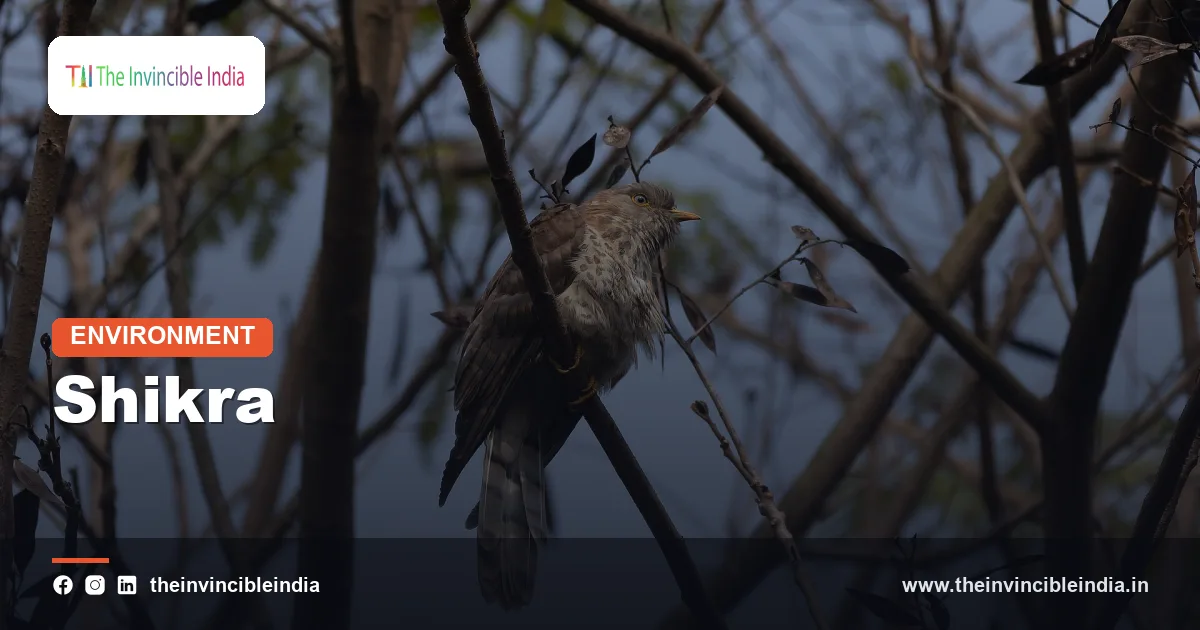
The shikra (Accipiter badius) is a small, grey-backed hawk of South Asia, a sparrowhawk-sized raptor with short rounded wings, a long barred tail and red or orange eyes, found in gardens, groves, farmland and open woodland across India. It ambushes small birds, lizards, rodents and large insects with a sudden dash from cover.
The shikra is one of the most commonly seen birds of prey in Indian towns and villages, and it has a long history in falconry, where its name became a household word for hunting. This explainer covers how to identify the shikra, where it lives, what it eats, how it hunts and breeds, how it differs from similar raptors, and how it was used by falconers. Last updated: 23 October 2026.
| Quick Facts | Shikra |
|---|---|
| Scientific name | Accipiter badius |
| Family | Accipitridae (hawks, eagles and kites) |
| Approximate length | About 30 to 36 cm; the female is larger than the male |
| Adult appearance | Pale grey back, finely barred rufous-orange underparts, red or orange eyes |
| Range | Across the Indian subcontinent; related forms occur in Africa and South-East Asia |
| Habitat | Gardens, groves, farmland, scrub, open woodland and the edges of forests |
| Diet | Small birds, lizards, rodents, frogs and large insects |
| Nesting | Small stick nest in a tree, with about three to four eggs |
| Conservation status | IUCN Least Concern; protected under the Wildlife (Protection) Act, 1972 |
Key Takeaways
- The shikra (Accipiter badius) is a small grey hawk, about 30 to 36 cm long, that is widespread in Indian gardens, groves and farmland.
- The shikra hunts by ambush, launching a fast, low dash from a hidden perch to catch small birds, lizards and large insects.
- The female shikra is noticeably larger than the male, a pattern known as reversed sexual size dimorphism that is common in birds of prey.
- The word shikra is linked to the Persian and Hindustani vocabulary of hunting, and the bird was trained in falconry to catch quail and other small game.
- The common hawk-cuckoo, known as the brainfever bird, closely resembles the shikra in plumage and is thought to gain protection from that likeness.
- The IUCN lists the shikra as Least Concern, and the bird is legally protected in India under the Wildlife (Protection) Act, 1972.
What is the shikra?
The shikra is a small hawk in the genus Accipiter, the group of agile woodland raptors that includes sparrowhawks and goshawks, and it is the commonest of the small Accipiter hawks in India. The scientific name is Accipiter badius, where “badius” means chestnut-brown and refers to the rufous markings on the underparts.
Accipiter hawks are built for manoeuvring through trees and cluttered habitat. The shikra has short, rounded wings that allow quick turns, a long tail that works as a rudder, and long legs and toes for grasping small prey. These features contrast with falcons and large eagles, which are designed for open-sky pursuit or soaring.
In India the shikra is a year-round resident across most of the country, from the plains up to the foothills of the Himalaya. It is usually solitary or found in pairs, and it is often noticed because small birds suddenly go silent or fly in alarm when it appears.
How can you identify a shikra?
A shikra can be identified by its pale bluish-grey upperparts, whitish underparts finely barred with rufous or orange-brown, a thin dark line down the throat and bright red or orange eyes. In flight, the short rounded wings and long banded tail give a distinctive “flap-flap-glide” silhouette.
Adult male and female
- The adult male has a bluish-grey back, a pale throat, and the underparts barred in a warm orange-brown, with eyes that are usually deep red.
- The adult female is larger and slightly browner above, with less orange on the underparts and eyes that are often yellow to orange.
- Both sexes show a faint central stripe on the throat, and the tail has several dark bands.
- The cere (the fleshy base of the bill) and legs are yellow.
Juvenile plumage
The young shikra is brownish above and has bold dark spots or streaks on the chest, with vertical drop-shaped marks on the underparts instead of fine horizontal bars. Its eyes are yellowish. A young shikra can be confused with other small hawks, and a good view of the throat stripe and the pattern of the underparts is useful for identification.
Voice
The shikra’s call is a loud, ringing, repeated “ti-tui, ti-tui” or a sharp, piping series of notes, given especially in the breeding season and during aerial display. Its call is often the first sign that the bird is present, as it can be heard long before the hawk is seen.
Where does the shikra live in India?
The shikra lives in nearly every part of India outside dense wet evergreen forest and the highest mountains, with a strong preference for open woodland, farmland with trees, village groves and gardens. It is a bird of edges and mixed habitats rather than deep forest.
The species is common in the plains and peninsular regions, in dry scrub and thorn forest, and in leafy residential colonies in cities such as Delhi, Jaipur, Pune and Bengaluru. It does well in places that provide small prey and trees for cover, including campuses, cemeteries, parks and old orchards.
Habitat requirements
- Trees or tall shrubs for perching and for hiding while waiting for prey.
- Open ground or gaps nearby, where small birds and lizards come into view.
- A supply of prey such as sparrows, mynas, doves, lizards and large insects.
- Large enough trees for a small stick nest, often with a good canopy for concealment.
The shikra is considered mostly resident, although some local movement is likely. In the broader range, other populations or closely related forms occur in Africa and South-East Asia, and the Indian bird is treated as a distinct subspecies in many references.
What does the shikra eat?
The shikra eats small birds, lizards, rodents, frogs and large insects such as grasshoppers, and it takes whatever it can reach and overpower. Birds make up a large share of its diet in many areas, while lizards, particularly garden lizards, are a staple in towns and scrubland.
Prey size is limited by the hawk’s own size. Typical prey includes sparrows, bulbuls, babblers, mynas and doves, small squirrels or rodents, geckos, skinks and calotes lizards, and in monsoon seasons, flying termites and other insects. A female may take larger prey than a male, which reduces competition between the two partners within a territory.
Food by type
| Prey type | Examples | How the shikra usually catches it |
|---|---|---|
| Small birds | Sparrows, bulbuls, babblers, mynas, pigeons and doves | Surprise dash from a perch or low pursuit through foliage |
| Reptiles | Garden lizards, skinks, geckos | Pounce from a perch onto ground or tree trunks |
| Mammals | Mice, young rats, small squirrels | Short chase or ambush near cover |
| Amphibians | Frogs and toads near water | Pounce, mainly in the rainy season |
| Insects | Grasshoppers, beetles, flying termites | Snatched from the ground or in the air |
By removing rodents, lizards and large insects, the shikra plays a minor role in controlling pests in farmland and gardens. Its predation on birds is part of natural food chains, and the effect on bird populations is generally small compared to the effects of habitat loss.
How does the shikra hunt?
The shikra hunts mainly by ambush, sitting hidden in foliage or on a low branch, then launching a quick, low and direct attack on prey that comes into view. This method is known as a still-hunt or perch-and-pounce strategy, and it relies on surprise and speed rather than a long chase.
After a successful strike the shikra usually carries the prey to a concealed perch, plucks the feathers and eats it. It may also hunt on foot on the ground for insects or lizards, hopping and peering into grass and leaf litter. In towns, hunting hawks use walls, hedges and building edges as cover to approach flocks of pigeons and sparrows.
How small birds respond
Small birds respond to a shikra with alarm calls, mobbing or sudden silence. Crows, drongos, mynas and babblers often gather to harass the hawk, calling loudly until it leaves. Birdwatchers sometimes locate a shikra simply by following these alarm calls. Because the hawk depends on surprise, being spotted often ends the hunt.
How does the shikra breed?
The shikra breeds by building a small, flat nest of sticks in a tree, often well hidden in the foliage, where the female lays about three to four pale bluish-white eggs. Breeding in much of India occurs in the hot, dry months before the monsoon, though timing varies with region.
The male does much of the hunting during the breeding season and brings food to the female, who incubates the eggs and stays near the nest. Once the chicks hatch, the male continues to supply prey, and the female tears it into small pieces for the young. Display flights over the nest area, with circling and loud calling, are typical at the start of the season.
The chicks fledge after several weeks, but remain dependent on their parents for food for some time afterwards. Nests in towns are often placed in large trees in compounds, and they can be easy to miss because the birds are quiet and secretive near the nest.
How is the shikra different from similar hawks and cuckoos?
The shikra differs from similar small hawks mainly in size, throat markings and tail pattern, and it also has a famous look-alike in the common hawk-cuckoo. Distinguishing between them often requires a clear view of the face and underparts.
| Species | Scientific name | Size and build | Notes for identification |
|---|---|---|---|
| Shikra | Accipiter badius | Small, about 30 to 36 cm | Pale grey back, barred orange-brown underparts, red or orange eye, faint throat stripe |
| Besra | Accipiter virgatus | Small, comparable to the shikra | Bold dark stripe on the throat, darker above, found more in forest |
| Eurasian sparrowhawk | Accipiter nisus | Small, comparable to the shikra | A mainly winter visitor in India, more heavily barred underparts, yellow or orange eye |
| Common hawk-cuckoo | Hierococcyx varius | Slightly larger and slimmer | A cuckoo, not a hawk, with a thin curved bill and a loud, repeated “brain-fever” call |
The hawk-cuckoo look-alike
The common hawk-cuckoo, widely known in India as the brainfever bird, resembles the shikra in its grey upperparts and barred underparts. Researchers suggest that this likeness may offer protection from small birds that avoid hawks, and it could help the cuckoo to approach the nests of babblers, which it parasitises. The difference is clear on close view: the cuckoo has a thinner bill, softer features and a different flight style.
Why was the shikra used in falconry and what does the name mean?
The shikra was used in falconry because it is small, bold and easily trained to take quail, partridges, doves and other small game from the hand, and its name has come to be associated with hunting in South Asia. The word “shikra” is generally linked to the Persian and Hindustani terms for hunting and hunter, the same root family as “shikar” and “shikari”.
Indian falconry has a long history, dating back several centuries with strong traditions in the Mughal and princely courts. Falconers traditionally divided hawks into long-winged falcons, which hunted in open country, and short-winged hawks, which hunted in cover. The shikra belongs to the second group, and it was valued as an accessible, relatively inexpensive hawk for taking small birds and, in some accounts, for catching lizards and insects.
Today, trapping and keeping wild raptors is illegal in India, and the shikra is protected under the Wildlife (Protection) Act, 1972. Traditional falconry in India survives only in a small, regulated or historical sense, and any keeping of wild birds without permission is an offence. The shikra’s historical use mostly persists in language and in cultural references.
Is the shikra threatened and how can people live alongside it?
The shikra is not threatened: the International Union for Conservation of Nature (IUCN) rates it as Least Concern because it has a large range and can live in human-modified landscapes. Its numbers are likely to be healthy in many areas, though precise population figures are not well established.
Threats do exist at a local level. Loss of trees and hedgerows, heavy use of pesticides that affects prey animals, illegal trapping for the cage-bird or falconry trade, and electrocution or collision with infrastructure can all harm individual birds.
Practical points for gardens and neighbourhoods
- Keep large trees and dense shrubs, since the shikra uses them for cover and nesting.
- Reduce pesticide use, which reduces the lizards, insects and small birds the hawk depends on.
- Do not disturb nests or chase hawks away during the breeding season.
- If a shikra visits a feeder, remember that it is a natural predator doing what it has always done, and moving feeders near cover can reduce risk to small birds.
- Report injured or trapped raptors to the local forest department or a wildlife rescue group.
Bottom Line
The shikra is a small, agile, red-eyed hawk that fits easily into Indian gardens, groves and farmland, hunting by ambush and well known from the traditions of falconry. It remains common and legally protected, and it benefits from the simple preservation of trees and cover in and around settlements.
Frequently Asked Questions
What is a shikra?
The shikra (Accipiter badius) is a small hawk of South Asia, about 30 to 36 cm long, with a pale grey back, barred orange-brown underparts and red or orange eyes. It is common in Indian gardens, groves and farmland. It hunts small birds, lizards and large insects by ambush.
What does the shikra eat?
The shikra eats small birds, lizards, rodents, frogs and large insects. Sparrows, mynas, doves and garden lizards are typical prey in Indian towns and villages. It usually hunts by surprise from a hidden perch rather than by a long chase.
How can you tell a male shikra from a female?
The female shikra is larger than the male and is slightly browner above. The adult male usually has deeper red eyes and more orange barring on the underparts, while the female’s eyes are often yellow to orange. Size is hard to judge without both birds together, so eye colour and underpart colour help.
Why is the bird called a shikra?
The name shikra is generally linked to Persian and Hindustani words for hunting and hunter, related to shikar and shikari. The bird earned the name through its use in falconry in South Asia. It was trained to catch quail, partridges and other small game.
Is the common hawk-cuckoo the same as the shikra?
No, the common hawk-cuckoo (Hierococcyx varius) is a cuckoo that looks like a shikra but is a different bird. It has a thinner bill, softer features and a loud, repeated call known as brainfever. The resemblance may help it avoid attacks from small birds.
Is the shikra protected in India?
Yes, the shikra is protected under the Wildlife (Protection) Act, 1972, which prohibits hunting, trapping and keeping wild raptors. The IUCN lists it as Least Concern globally. Traditional falconry with wild-caught birds is no longer legal without permission.
{“@context”:”https://schema.org”,”@graph”:[{“@type”:”FAQPage”,”mainEntity”:[{“@type”:”Question”,”name”:”What is a shikra?”,”acceptedAnswer”:{“@type”:”Answer”,”text”:”The shikra (Accipiter badius) is a small hawk of South Asia, about 30 to 36 cm long, with a pale grey back, barred orange-brown underparts and red or orange eyes. It is common in Indian gardens, groves and farmland. It hunts small birds, lizards and large insects by ambush.”}},{“@type”:”Question”,”name”:”What does the shikra eat?”,”acceptedAnswer”:{“@type”:”Answer”,”text”:”The shikra eats small birds, lizards, rodents, frogs and large insects. Sparrows, mynas, doves and garden lizards are typical prey in Indian towns and villages. It usually hunts by surprise from a hidden perch rather than by a long chase.”}},{“@type”:”Question”,”name”:”How can you tell a male shikra from a female?”,”acceptedAnswer”:{“@type”:”Answer”,”text”:”The female shikra is larger than the male and is slightly browner above. The adult male usually has deeper red eyes and more orange barring on the underparts, while the female’s eyes are often yellow to orange. Size is hard to judge without both birds together, so eye colour and underpart colour help.”}},{“@type”:”Question”,”name”:”Why is the bird called a shikra?”,”acceptedAnswer”:{“@type”:”Answer”,”text”:”The name shikra is generally linked to Persian and Hindustani words for hunting and hunter, related to shikar and shikari. The bird earned the name through its use in falconry in South Asia. It was trained to catch quail, partridges and other small game.”}},{“@type”:”Question”,”name”:”Is the common hawk-cuckoo the same as the shikra?”,”acceptedAnswer”:{“@type”:”Answer”,”text”:”No, the common hawk-cuckoo (Hierococcyx varius) is a cuckoo that looks like a shikra but is a different bird. It has a thinner bill, softer features and a loud, repeated call known as brainfever. The resemblance may help it avoid attacks from small birds.”}},{“@type”:”Question”,”name”:”Is the shikra protected in India?”,”acceptedAnswer”:{“@type”:”Answer”,”text”:”Yes, the shikra is protected under the Wildlife (Protection) Act, 1972, which prohibits hunting, trapping and keeping wild raptors. The IUCN lists it as Least Concern globally. Traditional falconry with wild-caught birds is no longer legal without permission.”}}]}]}


