

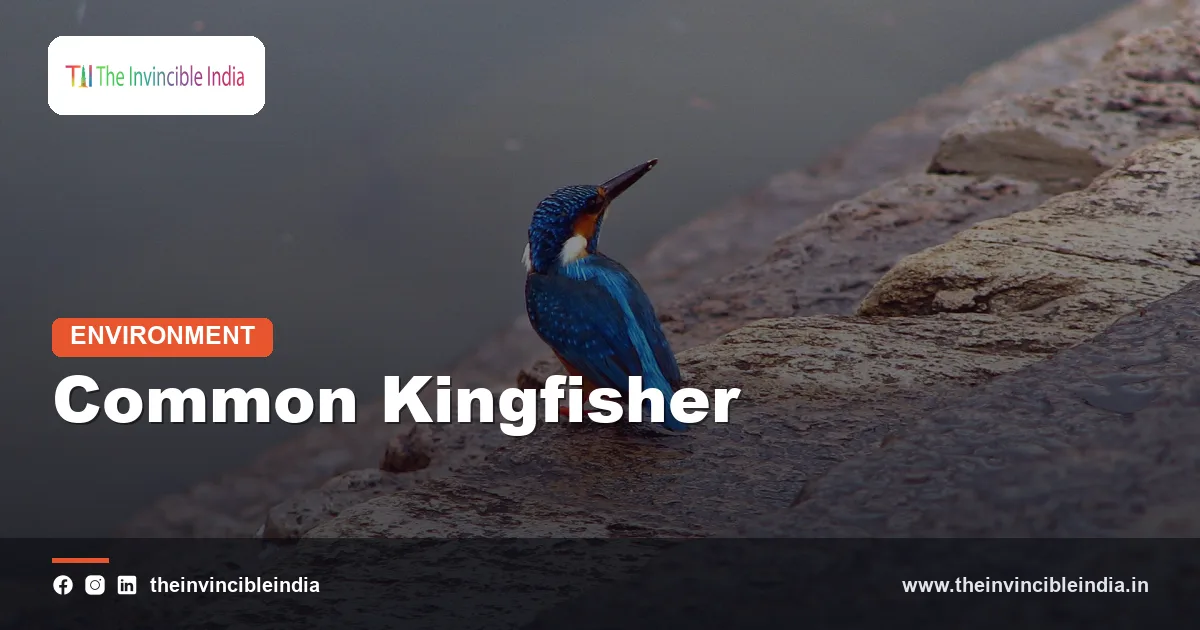
The common kingfisher (Alcedo atthis) is a small, brilliantly blue-and-orange bird with a long dagger-like bill that plunge-dives into clear water to catch small fish, and it is found along streams, rivers, ponds, canals and coastal creeks across India. Measuring only about 16 to 17 cm, it is one of the smallest kingfishers in the country and one of the most eye-catching.
The common kingfisher is also widely treated as a sign of clean, healthy water, because it hunts by sight and needs clear water and a supply of small fish. This explainer covers how to identify the bird, where it lives in India, how it fishes, why its blue colour is special, how it nests in a riverbank tunnel, and how it differs from other Indian kingfishers. Last updated: 23 October 2026.
| Quick Facts | Common kingfisher |
|---|---|
| Scientific name | Alcedo atthis |
| Family | Alcedinidae (kingfishers) |
| Other names | Small blue kingfisher, river kingfisher, Eurasian kingfisher |
| Approximate length | About 16 to 17 cm |
| Appearance | Bright blue-green upperparts, orange underparts, white throat and neck patch, short tail, long dark bill |
| Range | Across Europe, Asia and North Africa; in India both resident birds and winter visitors |
| Habitat | Clear streams, rivers, ponds, lakes, canals, paddy channels and sheltered coasts |
| Diet | Small fish, tadpoles, aquatic insects and crustaceans |
| Nesting | Tunnel dug into an earthen bank, usually ending in an unlined chamber with several eggs |
| Conservation status | IUCN Least Concern; protected under the Wildlife (Protection) Act, 1972 |
Key Takeaways
- The common kingfisher (Alcedo atthis) is a small blue-and-orange kingfisher, about 16 to 17 cm long, that is widespread along Indian waterways.
- The common kingfisher catches fish by diving headfirst from a perch or from a short hover, then returns to the perch to stun and swallow its prey.
- The blue of the common kingfisher is a structural colour created by the microscopic structure of its feathers, not by a blue pigment.
- The common kingfisher nests in a tunnel that the pair digs into an earthen bank, and the tunnel can be roughly half a metre or more in length.
- The common kingfisher needs clear water and a supply of small fish, so its presence is often used as a rough sign of a healthy waterway.
- The IUCN lists the common kingfisher as Least Concern, but pollution, silting, bank destruction and drying wetlands can remove it from local stretches.
What is the common kingfisher?
The common kingfisher is a small bird in the family Alcedinidae, a group of mostly water-hunting birds with large heads, short legs and strong bills, and it is the best-known representative of the genus Alcedo. Despite its name, it is not “common” in every location, since it depends on clean and quiet stretches of water.
The species has a very large global range that covers Europe, North Africa and Asia, extending east to the Pacific and south into the islands of South-East Asia. In India it is found nearly throughout the country. Resident birds are joined in winter by migrants that move south from colder northern regions, so the number of birds along a river can rise in the cold months.
It is often called the small blue kingfisher in Indian field guides, to separate it from the larger white-throated kingfisher and the pied kingfisher, which are more often seen in towns. The Latin word alcedo means kingfisher, and the bird features in classical myth as the halcyon, which gave rise to the phrase “halcyon days” for a time of calm.
How can you identify a common kingfisher?
A common kingfisher can be identified by its bright blue-green back and wings, a brilliant electric-blue stripe on the back, rich orange-chestnut underparts, a white throat and neck patch, a very short tail and a long, straight, pointed bill. At roughly the size of a sparrow, it is much smaller than most other Indian kingfishers.
Key field marks
- Upperparts are greenish-blue with fine pale spotting on the crown and wing coverts, and a bright turquoise streak that shows when the bird flies away.
- The cheek is orange, with a white patch on the side of the neck and a white throat.
- The underparts are a warm orange to chestnut.
- The legs and feet are small and bright red.
- The bill is long and dagger-like, held pointing down while the bird watches the water.
Male and female differences
The male common kingfisher has an all-black bill, whereas the female has a bill with an orange-red base to the lower half. This simple difference is one of the easier sex distinctions among Indian birds, and it can be checked at close range with binoculars. The plumage of the two sexes is otherwise very similar.
Flight and voice
The common kingfisher flies low and fast over water on rapidly whirring wings, usually in a straight line and often giving a thin, high “chee” or “tsee” call as it goes. Many observers first notice the bird as a streak of blue flashing past rather than as a perched bird, because the species is shy and moves quickly.
Where does the common kingfisher live in India?
The common kingfisher lives near fresh and brackish water across India, particularly along clear streams, rivers, ponds, lakes, canals and the sheltered creeks of the coast. It needs a perch over the water, such as an overhanging branch, a reed, a rock or a fence post, and a nearby earthen bank for nesting.
Typical Indian habitats include hill streams in the Himalayan foothills and the Western Ghats, slow rivers on the plains, wetlands and village ponds, irrigation canals, and mangrove creeks in coastal areas. The bird is often seen at urban lakes and garden ponds in winter, if fish are available and there is a quiet perch.
Seasonal patterns
Many common kingfishers in India are residents, staying in one stretch of water throughout the year, while others are winter visitors from cooler northern regions. Birds on migration or in winter often use more varied habitats than in the breeding season, including small ponds and tidal creeks that they would not use for nesting.
Because of this, observers often notice more kingfishers in winter, and the exact status of the species varies by region. Local bird checklists and citizen-science records give the most reliable picture for a particular place.
How does the common kingfisher catch fish?
The common kingfisher catches fish by watching from a low perch, dropping headfirst into the water, seizing the prey in its bill and flying back to the perch. Occasionally it hovers over the water for a moment before diving, particularly when there is no suitable perch nearby.
The hunting sequence takes only a second or two. The bird fixes on a fish from above, closes a protective inner eyelid called the nictitating membrane as it hits the water, and uses its wings to push down and then back out. It then returns to its perch and beats the fish against the branch to stun it, usually turning the prey around so that it can be swallowed headfirst. This avoids the fins and scales catching in the throat.
Adaptations for fishing
- A long, straight, sharp bill, which acts like a spear to grip fish.
- Binocular vision and the ability to adjust for the bending of light at the water surface.
- A transparent third eyelid that shields the eye on impact.
- A streamlined head and body, and a short tail that reduces drag in the dive.
The bird feeds mostly on fish of a few centimetres in length, though tadpoles, small crustaceans, water beetles and dragonfly larvae are also taken. Indigestible parts such as bones and scales are later coughed up as small pellets.
Why is the blue of the common kingfisher special?
The blue of the common kingfisher is a structural colour, produced by microscopic structures in the feather barbs that scatter blue light, rather than by a blue pigment. This is why the colour can shift from blue to green depending on the angle of the light.
Many blue birds, including the kingfisher, contain a dark pigment called melanin under the surface of the feather, and the nanostructure above it reflects blue wavelengths while the melanin absorbs the rest. Because the colour depends on structure, a feather that is crushed or damaged can lose its blue, and a feather viewed against the light can look dull brown.
The orange on the underparts, by contrast, is created by pigments. The combination of structural blue above and pigmented orange below gives the bird its striking contrast, and the same combination is common among kingfishers worldwide.
How does the common kingfisher nest?
The common kingfisher nests in a tunnel that the pair digs into a steep earthen bank beside water, and the tunnel usually ends in a small chamber where the female lays several glossy white eggs. Both partners take turns in digging, using the bill to loosen the soil and the feet to push it out.
The tunnel is commonly around half a metre long or more, and it slopes slightly upward to keep water out. The chamber is not lined with leaves or grass, and over time it collects fish bones and regurgitated pellets. The female typically lays five to seven eggs, and both parents share incubation. The chicks are fed small fish, and they fledge after several weeks.
Nesting banks need to be steep and stable, with soft soil but little disturbance. Riverbank sand mining, concrete lining of canals and bank erosion can destroy suitable nesting sites, which makes the species vulnerable at a local level even when it is secure globally.
How is the common kingfisher different from other Indian kingfishers?
The common kingfisher differs from other Indian kingfishers mainly in its small size, its blue-and-orange colouring and its dependence on small fish in clear water. India has a rich variety of kingfishers, from tiny forest species to large river birds, and several can be seen near the same waterbodies.
| Kingfisher | Scientific name | Approximate size | Main identification clues | Typical prey |
|---|---|---|---|---|
| Common kingfisher | Alcedo atthis | About 16 to 17 cm | Bright blue back, orange underparts, white throat patch | Small fish and aquatic insects |
| Blue-eared kingfisher | Alcedo meninting | Similar small size | Deeper blue overall, with a blue ear patch, mostly in forested streams | Small fish and insects |
| White-throated kingfisher | Halcyon smyrnensis | About 28 cm | Chestnut head and belly, bright blue back, white throat and chest | Fish, lizards, large insects and small animals |
| Pied kingfisher | Ceryle rudis | About 25 to 31 cm | Black and white, hovers before diving | Fish |
| Stork-billed kingfisher | Pelargopsis capensis | Large, about 35 cm or more | Huge red bill, brown head, blue-green back | Fish, crabs and other animals |
The white-throated kingfisher is the species most people see in gardens and fields, since it often hunts away from water. The common kingfisher, by comparison, is closely tied to water, which is one reason it is regarded as a better indicator of aquatic quality. The pied kingfisher, in contrast, is notable for its habit of hovering over open water.
Is the common kingfisher threatened and what does its presence say about water quality?
The common kingfisher is not globally threatened: the International Union for Conservation of Nature (IUCN) rates it as Least Concern because of its vast range, but it is sensitive to polluted and silted water at a local level. Its presence suggests that a waterway has clear water, a healthy fish population and intact banks, although it is a general indicator and not a laboratory test.
Exact population numbers in India are not precisely known. The bird is generally regarded as widespread, but it can disappear from rivers and ponds that have become heavily polluted, muddy or lined with concrete.
Main pressures
- Water pollution from sewage, industry and agricultural runoff, which can reduce fish and clarity.
- Silting and turbidity, which stop the bird from seeing its prey.
- Sand mining, bank erosion and concrete embankments that remove nesting sites and perches.
- Drying of wetlands and ponds, and removal of overhanging vegetation.
- Disturbance by people and dogs near nest banks.
How people can help
Keeping riverbanks natural, leaving perches such as overhanging branches and reeds, avoiding dumping waste in ponds and streams, and keeping a quiet distance from nest banks all help the species. The bird is protected under the Wildlife (Protection) Act, 1972, so capture or disturbance of nests is not permitted.
How can you watch common kingfishers without disturbing them?
The best way to watch a common kingfisher is to sit quietly beside a clear stream or pond at a distance, in early morning or late afternoon, and wait for the bird to return to a favourite perch. Kingfishers are shy and tend to flee from sudden movement, so patience works better than approaching.
- Look for small perches over the water, such as low branches, reeds and rocks, and scan them carefully with binoculars.
- Listen for the thin, high call that often announces a bird in flight.
- Stay away from steep banks with small round holes during the breeding season, as these may be active nests.
- Avoid using playback calls or baiting the water with fish to attract the bird, as both can cause stress and change natural behaviour.
- Wear muted colours and keep still, so that the bird returns to hunt in its normal manner.
Bottom Line
The common kingfisher is a tiny, brilliantly coloured fish-eater whose blue plumage, plunge-diving skill and tunnel nest make it one of India’s most appealing waterside birds. Its survival along any stretch of river or pond is closely tied to clean water, quiet banks and a healthy supply of small fish.
Frequently Asked Questions
What is the common kingfisher?
The common kingfisher (Alcedo atthis) is a small bird, about 16 to 17 cm long, with a bright blue back, orange underparts, a white throat patch and a long dagger-like bill. It lives along streams, rivers, ponds and coastal creeks across India. It catches small fish by diving from a perch or a short hover.
Why is the common kingfisher blue?
The common kingfisher looks blue because of structural colour, in which microscopic structures in its feathers scatter blue light. It is not caused by a blue pigment. This is why the colour can look green or dull brown at different angles or when a feather is damaged.
How does the common kingfisher catch fish?
The common kingfisher watches from a low perch over clear water, dives headfirst to grab a small fish and returns to the perch. It then beats the fish against the branch to stun it and swallows it headfirst. It sometimes hovers briefly before diving when no perch is available.
Where does the common kingfisher nest?
The common kingfisher nests in a tunnel dug into a steep earthen bank beside water. The tunnel is often around half a metre or more long and ends in a bare chamber where the female lays about five to seven white eggs. Both parents dig the tunnel and share the care of the eggs and chicks.
How can you tell a male common kingfisher from a female?
A male common kingfisher has an all-black bill, while the female has an orange-red base to the lower half of her bill. The plumage of the two sexes is otherwise very similar. Binoculars and a close view are usually needed.
Is the common kingfisher a sign of clean water?
Yes, the common kingfisher is generally regarded as a rough sign of clean water, because it needs clear water to see its prey and a healthy supply of small fish. It tends to disappear from polluted, silted or concrete-lined waterways. It is a general indicator, not a substitute for water testing.
{“@context”:”https://schema.org”,”@graph”:[{“@type”:”FAQPage”,”mainEntity”:[{“@type”:”Question”,”name”:”What is the common kingfisher?”,”acceptedAnswer”:{“@type”:”Answer”,”text”:”The common kingfisher (Alcedo atthis) is a small bird, about 16 to 17 cm long, with a bright blue back, orange underparts, a white throat patch and a long dagger-like bill. It lives along streams, rivers, ponds and coastal creeks across India. It catches small fish by diving from a perch or a short hover.”}},{“@type”:”Question”,”name”:”Why is the common kingfisher blue?”,”acceptedAnswer”:{“@type”:”Answer”,”text”:”The common kingfisher looks blue because of structural colour, in which microscopic structures in its feathers scatter blue light. It is not caused by a blue pigment. This is why the colour can look green or dull brown at different angles or when a feather is damaged.”}},{“@type”:”Question”,”name”:”How does the common kingfisher catch fish?”,”acceptedAnswer”:{“@type”:”Answer”,”text”:”The common kingfisher watches from a low perch over clear water, dives headfirst to grab a small fish and returns to the perch. It then beats the fish against the branch to stun it and swallows it headfirst. It sometimes hovers briefly before diving when no perch is available.”}},{“@type”:”Question”,”name”:”Where does the common kingfisher nest?”,”acceptedAnswer”:{“@type”:”Answer”,”text”:”The common kingfisher nests in a tunnel dug into a steep earthen bank beside water. The tunnel is often around half a metre or more long and ends in a bare chamber where the female lays about five to seven white eggs. Both parents dig the tunnel and share the care of the eggs and chicks.”}},{“@type”:”Question”,”name”:”How can you tell a male common kingfisher from a female?”,”acceptedAnswer”:{“@type”:”Answer”,”text”:”A male common kingfisher has an all-black bill, while the female has an orange-red base to the lower half of her bill. The plumage of the two sexes is otherwise very similar. Binoculars and a close view are usually needed.”}},{“@type”:”Question”,”name”:”Is the common kingfisher a sign of clean water?”,”acceptedAnswer”:{“@type”:”Answer”,”text”:”Yes, the common kingfisher is generally regarded as a rough sign of clean water, because it needs clear water to see its prey and a healthy supply of small fish. It tends to disappear from polluted, silted or concrete-lined waterways. It is a general indicator, not a substitute for water testing.”}}]}]}


