

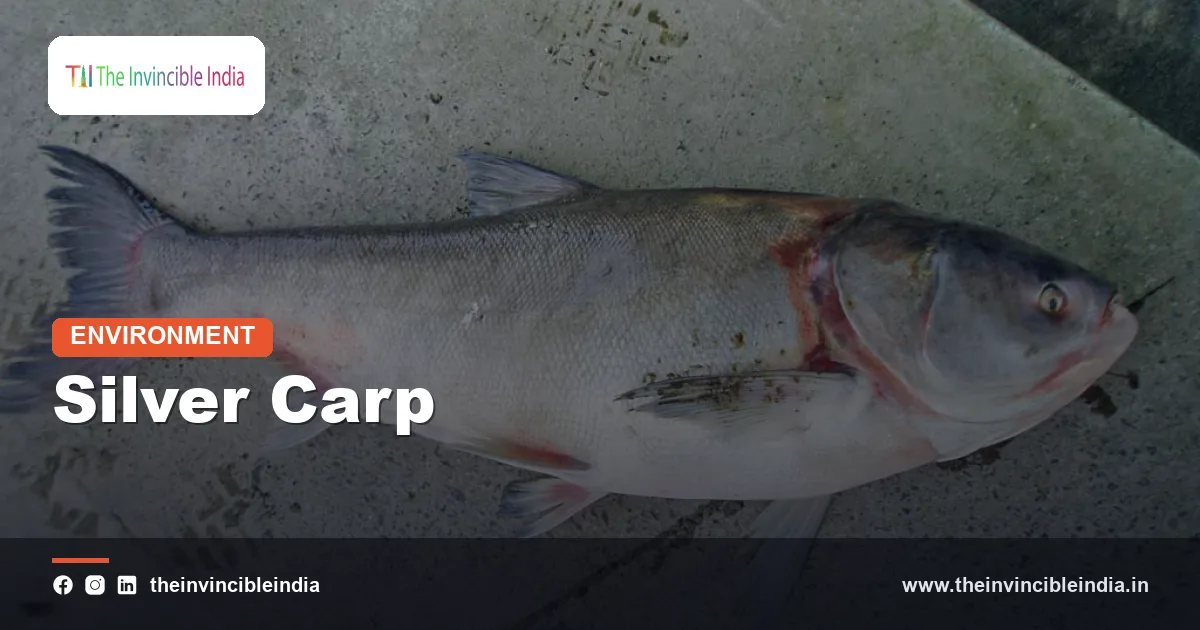
The silver carp (Hypophthalmichthys molitrix) is a fast-growing, silvery freshwater fish of the carp family that feeds on microscopic floating algae, and it was introduced from East Asia to Indian reservoirs, ponds and fish farms to raise fish production. It is one of the exotic carps used in Indian aquaculture, and it is well known for its habit of leaping clear of the water when startled.
In India the silver carp is farmed together with native species such as catla, rohu and mrigal in what is called composite carp culture. This article explains what the fish is, how it feeds and breeds, why it was brought to India, where it is found, and what benefits and risks come with it.
| Feature | Detail |
|---|---|
| Common name | Silver carp (one of the Chinese or exotic carps in India) |
| Scientific name | Hypophthalmichthys molitrix |
| Family | Cyprinidae (the carp and minnow family) |
| Native range | Large rivers of eastern Asia, including the Amur basin and rivers of China |
| Size | Commonly grows to about a metre in length in large waters; farmed fish are usually harvested far smaller |
| India range and habitat | Introduced in the late 1950s and now stocked in ponds, tanks, reservoirs and lakes across many states |
| Diet | Mainly phytoplankton (microscopic floating algae), filtered from the upper water layer |
| Breeding | Does not usually breed in still ponds; bred in hatcheries by hormone-induced spawning |
| Economic importance | Low-cost food fish and a surface-feeding component of composite carp culture |
Key Takeaways
- The silver carp (Hypophthalmichthys molitrix) is a plankton-eating carp native to the large rivers of eastern Asia and introduced to India in the late 1950s for aquaculture.
- A silver carp strains tiny algae from the water with a fine, sponge-like filter of fused gill rakers, so it needs no feed in a well-fertilised pond.
- Silver carp occupy the surface layer of a pond, which lets fish farmers stock them with rohu, mrigal and other carps that feed at lower depths.
- Silver carp rarely spawn in still water and are produced in Indian hatcheries through hormone-induced breeding.
- Silver carp can leap more than a metre out of the water when disturbed by boats or nets, and this behaviour has made the species notorious in places where it has escaped.
- An exotic fish such as the silver carp can compete with native surface feeders like the catla and can change plankton communities if it escapes into natural waters.
What is the silver carp?
The silver carp is a large, deep-bodied, silver-coloured freshwater fish in the family Cyprinidae, the same family that includes the Indian major carps. Its scientific name is Hypophthalmichthys molitrix, and the genus name refers to the eyes, which sit low on the sides of the head, below the level of the mouth.
The fish has a compressed body, small scales, a large upturned mouth and a keel of skin along the belly from the throat toward the vent. Its colour is bright silver with a slightly darker greenish back, which gives the species its name. The head is large compared with the body, and there are no barbels around the mouth.
The silver carp belongs to a group often called the Chinese carps, which also includes the grass carp and the bighead carp. In Indian fisheries literature these are classed as exotic carps because they did not occur in Indian rivers before they were brought in for culture.
Where does the silver carp come from?
The silver carp is native to the big rivers of eastern Asia, from the Amur River along the Russia and China border south through the major rivers of China. In its home range it lives in the slow, wide lower reaches of large rivers and in connected floodplain lakes.
The species is a migratory spawner in its native rivers. Adults travel upstream at the start of the flood season, and the fertilised eggs drift downstream with the current while they develop. This life cycle needs long stretches of flowing river, which is why the fish does not reproduce naturally in small ponds anywhere in the world.
In its native range the silver carp has been affected by dams, overfishing and river regulation. It is therefore treated as a species of conservation concern in parts of its original range, even while it is abundant as an introduced fish elsewhere.
How did the silver carp reach India?
The silver carp was brought to India in the late 1950s from abroad as part of a government effort to diversify and raise fish yields in ponds and reservoirs. The early imports of Chinese carps were made at research centres of the Central Inland Fisheries Research Institute and its predecessor institutions, and the fish were then multiplied and distributed to states.
The reason for the introduction was practical. Indian ponds often hold plenty of natural plankton, and the native major carps do not use the algae in the upper layer fully. A fish that converts surface phytoplankton directly into flesh was expected to increase total production per hectare without extra feed.
Along with silver carp, the common carp and grass carp were also introduced. Together they allowed fish farmers to build multi-species systems in which each species occupies a different feeding niche.
How does the silver carp feed?
The silver carp feeds by filtering microscopic algae from the water, and it is one of the most efficient plankton feeders among freshwater fishes. Water enters the mouth and passes over the gill arches, where closely set, fused gill rakers form a fine mesh that traps phytoplankton, which is then swallowed.
This filter is so fine that the fish can take particles only a few hundredths of a millimetre across. Because of this, the silver carp does well in fertile, green water and poorly in clear, nutrient-poor water.
Young silver carp eat zooplankton, which are tiny animals such as water fleas and rotifers. As they grow, they shift almost entirely to phytoplankton. Like other members of its family, the fish has no true stomach and passes food quickly through a long intestine, so it feeds almost continuously through the day.
Why does feeding style matter in a pond?
A pond has several feeding layers, and a fish farmer can match each carp species to one of them. The silver carp uses the algae near the surface, which would otherwise be wasted or would cause oxygen problems when it dies and decays. Green water that is grazed by silver carp tends to stay cleaner and less prone to dramatic algal blooms.
Which fish is the silver carp farmed with in India?
The silver carp is farmed with the catla, rohu, mrigal, grass carp and common carp in a system known as composite carp culture. In this system each species occupies a different layer of the pond, so the fish use the available food without competing heavily with each other.
| Fish | Feeding zone | Main food |
|---|---|---|
| Silver carp | Surface | Phytoplankton |
| Catla | Surface to upper column | Zooplankton |
| Rohu | Column (middle layer) | Plankton, decaying plant matter |
| Mrigal | Bottom | Detritus and decomposed matter |
| Common carp | Bottom | Insect larvae, worms, detritus |
| Grass carp | Column to surface | Aquatic weeds and plant matter |
The table shows why the silver carp and catla are often stocked in controlled numbers. Both live in the upper layer, and when too many are stocked together the catla may grow more slowly because the silver carp grows faster and takes much of the plankton.
Farmers adjust the stocking ratio to the fertility of the pond. In a heavily fertilised pond with abundant algae a larger share of silver carp is useful. In a pond with low natural food the share is reduced.
How fast does the silver carp grow?
The silver carp grows quickly, and in a fertile Indian pond it commonly reaches a kilogram or more within the first year. Growth depends on water temperature, plankton density and stocking density, and the fish grows best in warm, productive water.
Its fast early growth is one of the reasons for its popularity in aquaculture. Large individuals can grow much larger in big reservoirs where there is plenty of food and room, and fish of several kilograms are regularly caught.
The species is a relatively long-lived fish by pond standards and can live for well over a decade in natural waters. However, in farms it is harvested within one or two years, long before it reaches its maximum size.
How does the silver carp breed?
The silver carp does not normally breed in ponds, tanks or reservoirs, and it is produced in hatcheries by induced breeding. Natural spawning needs a rising river, strong currents and a long drifting distance for the eggs, and these conditions are rare in still waters.
In Indian hatcheries, ripe brood fish are given a hormone injection, either from pituitary extract of other fish or from synthetic preparations. The fish then spawn within hours, and the eggs are incubated in hatching jars or circular tanks with flowing water. The eggs are semi-buoyant and swell in water, and they hatch in roughly a day at warm temperatures.
The development of induced breeding in the 1960s was a milestone for Indian aquaculture. It made large-scale seed production possible for the Chinese carps and, later, for the Indian major carps as well.
- Brood fish are kept in separate ponds and fed well before the breeding season.
- Males are recognised by a rough pectoral fin surface, and ripe females by a soft, swollen belly.
- Spawning is carried out during the monsoon months when water temperature is suitable.
- Hatchlings are reared in nursery ponds before being sold as fingerlings.
Why does the silver carp jump?
The silver carp jumps because it is easily startled by noise and vibration, and the leap is a reflex escape response to disturbance. A fish may leap more than a metre above the surface, and groups of them can fly from the water when a boat engine passes.
The behaviour is harmless in a pond with only a few visitors, but it is hazardous in open waters. Boat users in rivers of North America, where the species escaped from fish farms and spread widely, have been struck by leaping fish. The animal has therefore become a striking symbol of the problems caused by introduced species.
In India, the same behaviour is known to fishers and farmers. During netting in a pond, silver carp are quick to jump over the net, and fish workers often use a higher net or lower the cork line to prevent escape.
Is the silver carp good to eat?
The silver carp is edible and is sold as a cheap fish in Indian markets, but it is generally less valued than rohu and catla. The flesh is white and soft, and its flavour is mild, which suits curries and frying.
The main drawback is the large number of fine intermuscular bones, which make the fish troublesome to eat. The meat can also have a slightly muddy or weedy taste if the fish is raised in very green water. For these reasons, silver carp usually fetch a lower price per kilogram than the native major carps.
Its low cost is an advantage for poorer consumers. In many places it is a source of affordable animal protein, and it is also processed into dried or smoked products and used as a source of fish meal.
- It is rich in protein and low in fat compared with many marine fishes.
- It is usually sold fresh and whole, and sometimes cut into steaks.
- Fish raised in clean water have a better flavour than those from very fertile, algae-heavy ponds.
Where is the silver carp found in India today?
The silver carp is found in fish ponds and village tanks across most Indian states, in many large reservoirs, and in some natural waters where escaped fish have established themselves. States with strong freshwater aquaculture, such as West Bengal, Andhra Pradesh, Odisha, Punjab, Haryana, Uttar Pradesh and Bihar, stock it routinely.
Reservoir fisheries have used silver carp as a stocking species since the early period of reservoir management. In large Himalayan reservoirs such as Gobind Sagar in Himachal Pradesh, silver carp became an important component of the catch after stocking.
The species appears in catches from rivers and floodplain lakes where flooding has carried fish out of ponds. Such escapes are a continuing concern for fisheries managers because they are hard to reverse once a population is established.
What are the risks of introducing the silver carp?
The main risk of introducing the silver carp is that escaped fish can compete with native plankton feeders and alter the food web of natural waters. A fast-growing filter feeder can remove large amounts of plankton, which reduces the food available for native fish larvae and for other zooplankton feeders.
In India the greatest concern is the overlap with the catla, which occupies the same surface layer. Where native fish are already under pressure from overfishing, dams and pollution, an introduced competitor can make their decline worse.
Ecologists also point to indirect effects, such as changes in water clarity and shifts in the plankton community. The risks are the reason that exotic species are regulated, and the Indian fisheries authorities require care in the import, quarantine and movement of aquatic animals.
Can the silver carp help clean water?
Silver carp have been used in biomanipulation, a method in which fish are used to reduce algal blooms in lakes and reservoirs. By grazing on phytoplankton they can lower algal density in the short term. However, the results are mixed, because the fish can also release nutrients that feed further algal growth, and the practice carries the risk of escape.
What is the conservation status of the silver carp?
The silver carp is assessed by the International Union for Conservation of Nature (IUCN) as Near Threatened across its native range, even though it is widely farmed and introduced in many countries. The assessment reflects pressure on the species in its original rivers, where dams and overfishing have reduced natural spawning runs.
This contrast shows that a species can be both a conservation concern in one place and an invasive problem in another. In India the silver carp is regarded mainly as a cultured fish, not as a species needing protection, and it has no special protected status under Indian wildlife law.
Management therefore focuses on responsible use. This includes stocking only in closed or controlled waters, preventing escape during floods, and keeping records of introductions.
Bottom Line
The silver carp is a productive and inexpensive plankton-feeding fish that has become a standard part of Indian composite carp culture since the late 1950s. Its value lies in using the algae that other carps leave unused, but its fast growth, jumping habit and ability to compete with native fish call for careful management.
Frequently Asked Questions
What is a silver carp?
A silver carp is a silvery freshwater fish of the carp family, Hypophthalmichthys molitrix, that feeds on microscopic floating algae. It is native to the rivers of eastern Asia and was introduced to India in the late 1950s for aquaculture. It is now farmed in ponds and stocked in reservoirs across the country.
What does the silver carp eat?
The silver carp eats mainly phytoplankton, which it filters from the water with a fine mesh of fused gill rakers. Young fish also eat zooplankton. Because of this diet, it grows well in fertile, green ponds without any supplementary feed.
Why does the silver carp jump out of the water?
The silver carp jumps because noise and vibration trigger a startle reflex that sends it leaping out of the water. Fish can rise more than a metre above the surface. This is why farm nets for silver carp need to be high enough to stop fish jumping over them.
Is the silver carp native to India?
No, the silver carp is not native to India. It was brought in from abroad in the late 1950s as one of the exotic or Chinese carps. It is now present in many Indian ponds, reservoirs and some natural waters.
Can the silver carp breed in ponds?
No, the silver carp does not normally breed in still ponds. It needs a flowing river with a rising flood to spawn naturally, so Indian hatcheries produce its seed by hormone-induced breeding. The fertilised eggs are then hatched in tanks with flowing water.
Is the silver carp harmful to native fish?
The silver carp can be harmful to native fish if it escapes into natural waters. It competes for plankton with surface feeders such as the catla and can change the plankton community. For this reason it is best kept in closed or well-managed waters.
{“@context”:”https://schema.org”,”@graph”:[{“@type”:”FAQPage”,”mainEntity”:[{“@type”:”Question”,”name”:”What is a silver carp?”,”acceptedAnswer”:{“@type”:”Answer”,”text”:”A silver carp is a silvery freshwater fish of the carp family, Hypophthalmichthys molitrix, that feeds on microscopic floating algae. It is native to the rivers of eastern Asia and was introduced to India in the late 1950s for aquaculture. It is now farmed in ponds and stocked in reservoirs across the country.”}},{“@type”:”Question”,”name”:”What does the silver carp eat?”,”acceptedAnswer”:{“@type”:”Answer”,”text”:”The silver carp eats mainly phytoplankton, which it filters from the water with a fine mesh of fused gill rakers. Young fish also eat zooplankton. Because of this diet, it grows well in fertile, green ponds without any supplementary feed.”}},{“@type”:”Question”,”name”:”Why does the silver carp jump out of the water?”,”acceptedAnswer”:{“@type”:”Answer”,”text”:”The silver carp jumps because noise and vibration trigger a startle reflex that sends it leaping out of the water. Fish can rise more than a metre above the surface. This is why farm nets for silver carp need to be high enough to stop fish jumping over them.”}},{“@type”:”Question”,”name”:”Is the silver carp native to India?”,”acceptedAnswer”:{“@type”:”Answer”,”text”:”No, the silver carp is not native to India. It was brought in from abroad in the late 1950s as one of the exotic or Chinese carps. It is now present in many Indian ponds, reservoirs and some natural waters.”}},{“@type”:”Question”,”name”:”Can the silver carp breed in ponds?”,”acceptedAnswer”:{“@type”:”Answer”,”text”:”No, the silver carp does not normally breed in still ponds. It needs a flowing river with a rising flood to spawn naturally, so Indian hatcheries produce its seed by hormone-induced breeding. The fertilised eggs are then hatched in tanks with flowing water.”}},{“@type”:”Question”,”name”:”Is the silver carp harmful to native fish?”,”acceptedAnswer”:{“@type”:”Answer”,”text”:”The silver carp can be harmful to native fish if it escapes into natural waters. It competes for plankton with surface feeders such as the catla and can change the plankton community. For this reason it is best kept in closed or well-managed waters.”}}]}]}


