

The common cuckoo (Cuculus canorus) is a slim, long-tailed, grey bird of the cuckoo family, famous for its two-note “cuck-oo” call and for laying its eggs in the nests of other birds instead of raising its own young. In India it is a bird of the Himalayan hills and a visitor elsewhere, and it is often heard long before it is seen. Its habit of brood parasitism has made it one of the most closely studied birds in the world.
This guide explains how the common cuckoo looks, where it occurs in India, how it tricks its hosts, and how it differs from look-alike species such as the common hawk-cuckoo, the Indian cuckoo and the Asian koel. It is written for general readers who want a clear, reliable overview of this familiar yet widely misunderstood bird.
| Quick Facts | Common cuckoo |
|---|---|
| Scientific name | Cuculus canorus |
| Family and order | Cuculidae (cuckoos), order Cuculiformes |
| Size | About 32 to 34 cm long, with a wingspan of roughly 55 to 60 cm |
| Appearance | Grey head, back and breast; whitish underparts with dark bars; long, white-spotted tail; yellow eye ring, bill base and feet |
| India range and habitat | Breeds in the Himalayan hills and nearby forested and open country; seen on passage and in winter in other parts of the country, including the peninsula and the north-east |
| Diet | Mainly insects, especially hairy caterpillars; also beetles and other invertebrates |
| Breeding | Obligate brood parasite; the female lays one egg in each host nest and the chick evicts the host’s eggs or young |
| Migration | Long-distance migrant; Eurasian breeders winter mainly in Africa and southern Asia |
| Conservation status | Least Concern on the IUCN Red List, though several local populations have declined |
Key Takeaways
- The common cuckoo (Cuculus canorus) is a grey, hawk-shaped bird in the family Cuculidae that measures about 32 to 34 cm in length.
- The common cuckoo never builds a nest; each female lays eggs in the nests of other small birds, a strategy called brood parasitism.
- The male common cuckoo gives the classic two-note “cuck-oo” call, while the female makes a bubbling, laughing trill.
- A newly hatched common cuckoo chick pushes the host’s eggs and young out of the nest, so it receives all the food the foster parents bring.
- The common cuckoo feeds heavily on caterpillars, including hairy species that most other birds avoid.
- The common cuckoo is classed as Least Concern globally, but it depends on healthy insect populations and on the survival of its host species.
What is the common cuckoo?
The common cuckoo is a medium-sized migratory bird in the family Cuculidae, and it is the species that gave the whole cuckoo family its name. It is also called the Eurasian cuckoo, to separate it from other cuckoos, and its scientific name Cuculus canorus roughly means “melodious cuckoo”. The word “cuckoo” itself imitates the male’s call.
The species breeds across a vast belt from western Europe through Russia and central Asia to Japan, and it winters mostly in Africa and tropical Asia. Several subspecies are recognised, and the birds that breed in the Himalayas are separated from European birds by slight differences in size and plumage. Despite this wide range, the common cuckoo is a shy bird that spends most of its time hidden in the foliage of trees and shrubs.
Across cultures the cuckoo is linked with the arrival of spring. In India, however, the bird is more commonly associated with the hills and with the early summer months, when the male calls persistently from tree tops and forest edges.
What does the common cuckoo look like?
The adult male common cuckoo has slate-grey upperparts, a grey throat and breast, and whitish underparts closely barred with dark grey or black. The tail is long and dark, edged and spotted with white, and the bill is dark with a yellow base. The eye ring and the feet are yellow, and the wings are long and pointed.
The female looks similar but often has a faint buff or rufous wash on the breast. A small number of females are “hepatic”, meaning that the whole upper body is reddish-brown with dark bars. Young birds are browner and show a pale patch on the nape, which fades with age. Because a hepatic female can be mistaken for a different species, careful observation of the barring and tail pattern is essential.
In flight the common cuckoo looks surprisingly like a small hawk, with pointed wings, a long tail and a rapid, direct wingbeat. This resemblance is not an accident of shape. Small birds often mob or avoid a flying hawk, which may give a lurking cuckoo extra time to approach a nest.
Size and structure
- Length: about 32 to 34 cm, similar to a collared dove.
- Weight: usually around 100 to 130 g.
- Feet: zygodactyl, with two toes pointing forward and two backward, typical of the cuckoo family.
- Wings: long and pointed, built for sustained migration.
Where is the common cuckoo found in India?
The common cuckoo is found chiefly in the Himalayan region of India, where it breeds in forests, scrub, meadows and open woodland across a wide range of altitudes. Local populations arrive in the hills in spring and leave after the breeding season. Outside the breeding area, birds may be recorded on passage and in winter, although these records are harder to confirm because several other grey cuckoos look and sound alike.
Birders in India often treat the identification of grey cuckoos as a puzzle. The common cuckoo is told from similar species mainly by its voice, the pattern of its tail, and the width of the barring on the underparts. A bird that is heard but not seen is easier to name than one glimpsed briefly in thick foliage.
The bird is usually found at forest edges, in clearings, along riverbanks with bushes, and in cultivated land with scattered trees. It prefers places where small insect-eating songbirds nest, because the species needs a supply of suitable hosts.
How does the common cuckoo reproduce?
The common cuckoo reproduces by brood parasitism: the female lays her eggs in the nests of other bird species and leaves the foster parents to incubate them and raise the chick. The cuckoo builds no nest, does not sit on eggs and does not feed its own young. This makes the species an “obligate” brood parasite, because it cannot breed in any other way.
A female watches potential hosts from a hidden perch and waits until the owners leave the nest. She then glides down, removes one host egg, often swallowing it, and lays a single egg in its place. The entire visit can take only a few seconds. A single female may lay a dozen or more eggs in a season, each in a different nest.
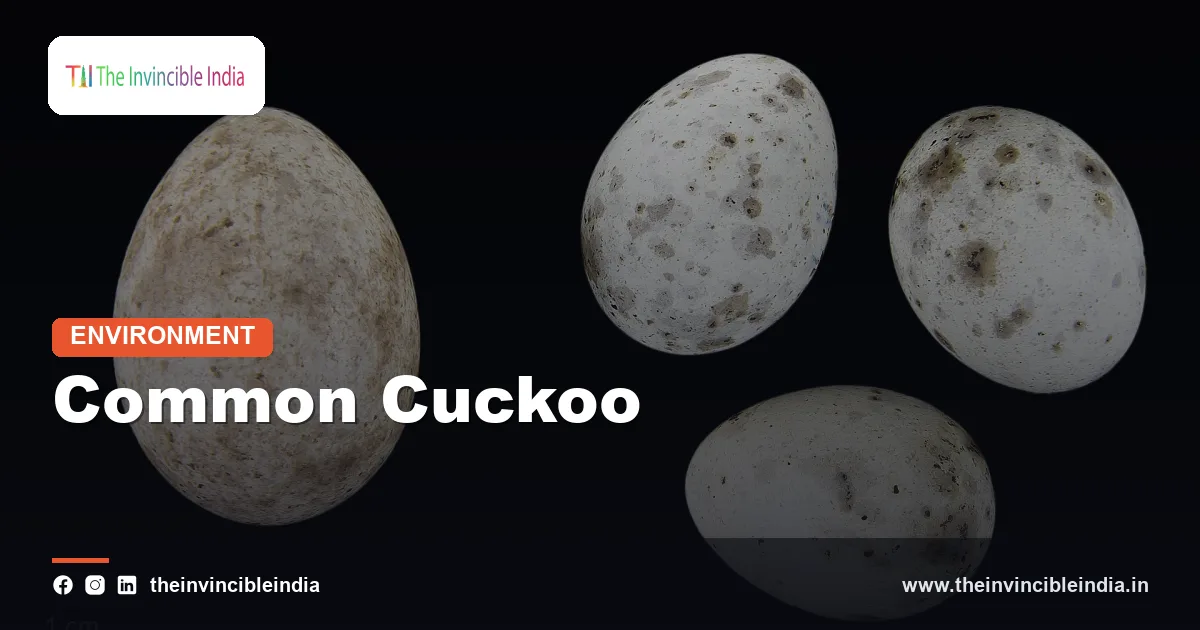
The cuckoo egg is small for the size of the bird, roughly the same size as the eggs of its host. This small size lets the egg incubate quickly. The egg usually hatches slightly before the host’s own eggs, giving the chick a head start.
Why the eggs look like the host’s eggs
The eggs of the common cuckoo often match the colour and pattern of the eggs of the host species. Individual females tend to specialise in one host species and lay a matching egg type, a pattern ornithologists call host races or gentes. This matching is thought to be passed down the female line, which helps explain why cuckoos in a given area can use different hosts without confusion.
How does a cuckoo chick get rid of the host’s eggs?
A newly hatched common cuckoo chick is blind, naked and tiny, yet within hours it begins to push every other egg and chick out of the nest. The chick works its way under an egg, balances it on its back, and heaves it over the rim of the nest until it drops. This instinctive behaviour usually begins within a few hours of hatching and continues for a few days.
By removing all competition, the cuckoo chick receives every insect the foster parents bring. A common cuckoo chick grows very quickly and soon becomes many times larger than its foster parents. It may leave the nest after about three weeks, but it is still fed for some time afterwards.
The chick also uses sound as a tool. Its begging call, when rapid and repeated, resembles the sound of a whole brood of hungry host chicks, which encourages the foster parents to bring more food. Nobody teaches the young cuckoo any of this; the behaviour is inherited.
Which birds does the common cuckoo use as hosts?
The common cuckoo uses many small insect-eating birds as hosts, and the exact list depends on the region. In Europe, the best-known hosts include reed warblers, dunnocks and meadow pipits. In Asia, the hosts include other warblers, pipits, accentors, wagtails and similar songbirds that nest in grass, shrubs and low trees.
Not every bird accepts a cuckoo egg. Some hosts have learned to recognise and reject foreign eggs, either by pushing them out or by abandoning the nest. This sets off an evolutionary arms race: hosts evolve sharper egg recognition, and cuckoos evolve better imitations. The race is slow, and different populations are at different stages.
| Feature | What the cuckoo does | How the host may respond |
|---|---|---|
| Egg colour | Mimics the host’s egg pattern | Learns to spot odd eggs and rejects them |
| Timing | Lays when the host nest is unattended | Guards the nest more closely |
| Hatching | Hatches early and evicts other eggs | Little defence once the chick has hatched |
| Begging | Imitates a whole brood’s calls | Continues to feed the chick |
What does the common cuckoo eat?
The common cuckoo eats mainly insects, and caterpillars form the most important part of its diet. It is one of the few birds that regularly eats hairy caterpillars, which are bitter or irritating to many other species. The cuckoo is able to shed the lining of its stomach, which removes the sharp hairs it has swallowed.
Besides caterpillars, the bird takes beetles, grasshoppers, ants, spiders and the occasional small snail. It hunts mostly by watching from a branch and dropping onto prey, or by picking insects from leaves. In this way the common cuckoo acts as a natural check on insects that might otherwise defoliate trees and damage crops. It does not eat grain or fruit in significant quantities.
What is the call of the common cuckoo?
The call of the male common cuckoo is a clear, two-note “cuck-oo”, with the second note lower than the first. The male repeats it many times, often for several minutes, usually from an open perch or while flying between trees. The female does not give this call; she makes a bubbling, rippling trill sometimes described as laughter.
Calling is most active in the breeding season and at certain times of day, especially in the morning. Experienced birders in India rely on the call to separate the common cuckoo from the Indian cuckoo, which gives a four-note phrase often rendered as “one more bottle”. The common cuckoo is rarely seen calling, but its voice is distinctive once learned.
The cuckoo clock, a famous craft of the Black Forest in Germany, imitates this two-note song. It has helped make the call recognisable even to people who have never seen the bird.
How is the common cuckoo different from the common hawk-cuckoo?
The common cuckoo and the common hawk-cuckoo are different species in different genera, and they differ in plumage, call and range. The common hawk-cuckoo (Hierococcyx varius), widely known in India as the “brainfever bird”, is a resident or local migrant of the Indian plains. It is browner above, has a rufous wash on the belly in adults, and gives a rising, repeated “pee-pee-ah” call that grows more frantic and louder. The common cuckoo, in contrast, has a calm two-note call and grey, finely barred underparts.
Both are brood parasites, and both look like small hawks, but the hosts, habitat and seasonal patterns differ. The hawk-cuckoo is well known to many Indians because of its loud, repeated call in the hot season. The common cuckoo is more strongly associated with hills and with migration.
| Feature | Common cuckoo | Common hawk-cuckoo |
|---|---|---|
| Scientific name | Cuculus canorus | Hierococcyx varius |
| Call | Two-note “cuck-oo” | Rising, repeated “pee-pee-ah” |
| Underparts | White with dark bars | Whitish with streaks on the breast and a rufous belly |
| Typical range in India | Himalayan hills and passage elsewhere | Plains and foothills, widely resident |
| Local name | Eurasian cuckoo | Brainfever bird |
Other cuckoos that can be confused with it
- Indian cuckoo (Cuculus micropterus): similar in shape, but with a four-note call and a broad dark band near the tip of the tail.
- Oriental cuckoo (Cuculus optatus): a very similar grey cuckoo that passes through India and is separated mainly by voice and subtle plumage details.
- Asian koel (Eudynamys scolopaceus): another brood parasite, but with glossy black males, red eyes and a loud “ko-el” call.
Is the common cuckoo a migratory bird?
Yes, the common cuckoo is a long-distance migrant, and its journeys are among the most remarkable in the bird world. Eurasian breeders leave their summer range in late summer and travel to Africa or southern Asia, where they spend the winter. Adult cuckoos usually leave before the young do, so the young birds make their first long journey without any parent to guide them.
The young cuckoos find their way to the correct wintering grounds using an inherited sense of direction, not by following adults. Satellite tracking in recent years has revealed that individuals follow quite different routes, and that some cross deserts, seas and mountain ranges in a few days. The same technology has shown that birds often return to the same breeding area each year.
In India, the species is therefore best described as a seasonal visitor and a breeder in hill regions, with the details differing from region to region.
Why is the common cuckoo important, and is it threatened?
The common cuckoo is important because it controls insect populations, shows how species evolve in response to each other, and acts as a signal of ecosystem health. It is listed as Least Concern by the International Union for Conservation of Nature (IUCN) because its overall range and population are large. However, in some countries its numbers have declined sharply.
The main threats are the loss of insect prey, the decline of host species, and changes in habitat along migration routes and on wintering grounds. Pesticide use reduces the caterpillars that the cuckoo relies on, and the loss of scrub, hedgerows and wetland margins reduces nesting sites for hosts. Climate change may also disturb the timing of arrival, since the cuckoo must reach the breeding area when the hosts are nesting.
In India, the bird is protected along with most wild birds under the Wildlife (Protection) Act, 1972. Protecting forests, scrub and grassland at various altitudes helps both the cuckoo and the many small birds that serve as its hosts.
Bottom Line
The common cuckoo is a grey, hawk-like migrant whose two-note call and egg-laying habits make it one of the most distinctive birds in India’s hills. It is a brood parasite, not a nest builder, and it is quite different from the brainfever bird or the Asian koel. Learning its voice and shape is the surest way to recognise it.
Frequently Asked Questions
Is the common cuckoo found in India?
Yes, the common cuckoo is found in India, mainly as a breeding bird of the Himalayan hills. It also occurs as a passage and winter visitor in other regions, although identification is difficult because several grey cuckoos look alike. Voice is the most reliable way to confirm the species.
Why does the common cuckoo lay eggs in other birds’ nests?
The common cuckoo lays eggs in other birds’ nests because it is an obligate brood parasite, which means it has evolved to leave parental care to others. The strategy saves the female the time and energy of building a nest and feeding chicks, so she can lay many more eggs in a season. The cost falls on the host, which loses its own young.
How does a cuckoo chick push out the other eggs?
A newly hatched cuckoo chick pushes out other eggs and chicks using its back, which has a small hollow where an egg can rest. It wriggles beneath the egg, backs up to the edge of the nest and tips it over the side. This instinctive behaviour begins within hours of hatching and ensures that the foster parents feed only the cuckoo.
What is the difference between the common cuckoo and the Asian koel?
The common cuckoo is a grey, barred bird with a two-note “cuck-oo” call, while the Asian koel is a larger bird in which the male is glossy black with a red eye. Both are brood parasites, but the koel mainly uses crows as hosts and is a familiar resident of Indian towns. The common cuckoo is far shyer and more often found in hill forests.
What does the common cuckoo eat?
The common cuckoo eats mainly insects, particularly caterpillars, including hairy species that many birds reject. It also takes beetles, grasshoppers, ants and spiders. Its diet makes it useful in controlling insects that damage trees and crops.
Is the common cuckoo the same as the brainfever bird?
No, the common cuckoo is not the brainfever bird. The brainfever bird is the common hawk-cuckoo, a different species with a loud, rising, repeated call and a rufous belly. The common cuckoo is greyer, has a calm two-note call and is more closely linked with hill regions.
{“@context”:”https://schema.org”,”@graph”:[{“@type”:”FAQPage”,”mainEntity”:[{“@type”:”Question”,”name”:”Is the common cuckoo found in India?”,”acceptedAnswer”:{“@type”:”Answer”,”text”:”Yes, the common cuckoo is found in India, mainly as a breeding bird of the Himalayan hills. It also occurs as a passage and winter visitor in other regions, although identification is difficult because several grey cuckoos look alike. Voice is the most reliable way to confirm the species.”}},{“@type”:”Question”,”name”:”Why does the common cuckoo lay eggs in other birds’ nests?”,”acceptedAnswer”:{“@type”:”Answer”,”text”:”The common cuckoo lays eggs in other birds’ nests because it is an obligate brood parasite, which means it has evolved to leave parental care to others. The strategy saves the female the time and energy of building a nest and feeding chicks, so she can lay many more eggs in a season. The cost falls on the host, which loses its own young.”}},{“@type”:”Question”,”name”:”How does a cuckoo chick push out the other eggs?”,”acceptedAnswer”:{“@type”:”Answer”,”text”:”A newly hatched cuckoo chick pushes out other eggs and chicks using its back, which has a small hollow where an egg can rest. It wriggles beneath the egg, backs up to the edge of the nest and tips it over the side. This instinctive behaviour begins within hours of hatching and ensures that the foster parents feed only the cuckoo.”}},{“@type”:”Question”,”name”:”What is the difference between the common cuckoo and the Asian koel?”,”acceptedAnswer”:{“@type”:”Answer”,”text”:”The common cuckoo is a grey, barred bird with a two-note “cuck-oo” call, while the Asian koel is a larger bird in which the male is glossy black with a red eye. Both are brood parasites, but the koel mainly uses crows as hosts and is a familiar resident of Indian towns. The common cuckoo is far shyer and more often found in hill forests.”}},{“@type”:”Question”,”name”:”What does the common cuckoo eat?”,”acceptedAnswer”:{“@type”:”Answer”,”text”:”The common cuckoo eats mainly insects, particularly caterpillars, including hairy species that many birds reject. It also takes beetles, grasshoppers, ants and spiders. Its diet makes it useful in controlling insects that damage trees and crops.”}},{“@type”:”Question”,”name”:”Is the common cuckoo the same as the brainfever bird?”,”acceptedAnswer”:{“@type”:”Answer”,”text”:”No, the common cuckoo is not the brainfever bird. The brainfever bird is the common hawk-cuckoo, a different species with a loud, rising, repeated call and a rufous belly. The common cuckoo is greyer, has a calm two-note call and is more closely linked with hill regions.”}}]}]}


