

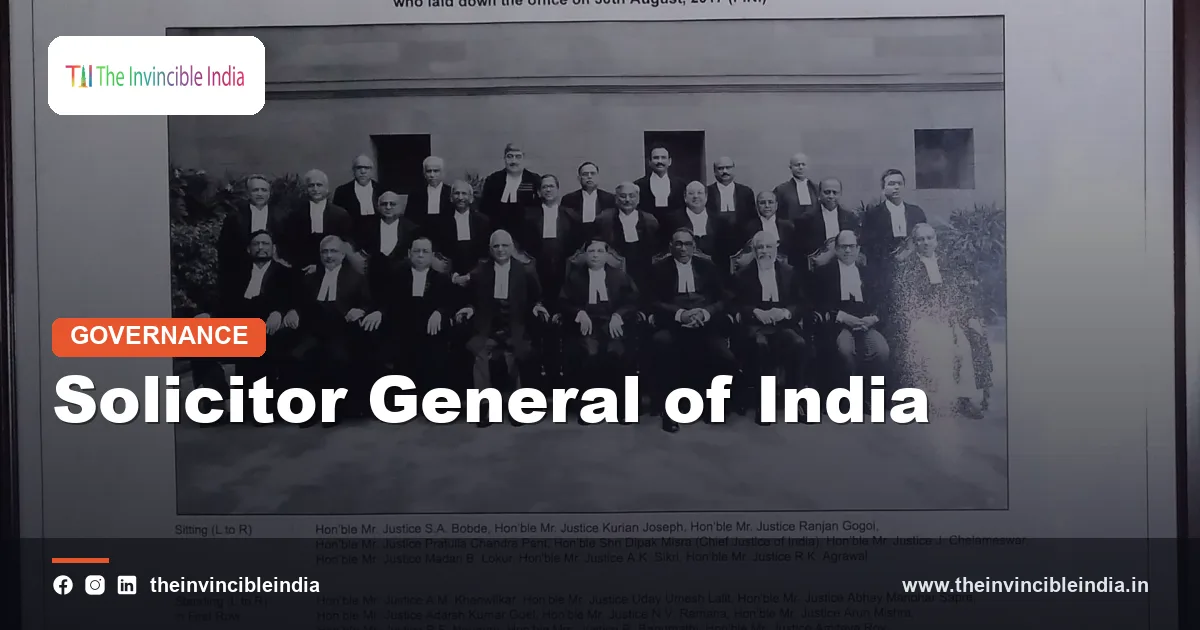
The Solicitor General of India is the second-highest law officer of the Union Government, ranking immediately below the Attorney General for India. While the Attorney General is a constitutional functionary named in Article 76, the Solicitor General holds a post created by the executive and statute-like rules rather than by the text of the Constitution. The office exists because the Union is a party to an enormous volume of litigation, and a single law officer cannot appear in every important matter before the Supreme Court and the High Courts.
In practice, the Solicitor General argues some of the most consequential cases in the country, from questions of federalism and fundamental rights to challenges against central legislation. This explainer sets out how the post came about, how appointments are made, what the office-holder does, how the role differs from that of the Attorney General, and why the office matters in India’s system of government.
| Feature | Detail |
|---|---|
| Rank | Second-highest law officer of the Union, after the Attorney General |
| Constitutional status | Not mentioned in the Constitution; Article 76 provides only for the Attorney General |
| Appointing authority | Appointments Committee of the Cabinet, formalised by an order of the Government |
| Administrative home | Department of Legal Affairs, Ministry of Law and Justice |
| Assisted by | Additional Solicitors General and other government counsel |
| Principal role | Assists the Attorney General and represents the Union Government in courts |
| First holder | C. K. Daphtary, appointed in 1950 after the Constitution came into force |
| Tenure | No fixed constitutional term; serves while the Government desires, usually for a defined period that may be extended |
What the Solicitor General of India Does
The Solicitor General is, in essence, the Union Government’s second senior-most advocate. The office-holder gives legal advice to the Government on matters referred to it and appears on its behalf in the Supreme Court of India, the High Courts and, at times, other tribunals and forums. Where the Union is a petitioner, respondent or intervener in a major constitutional case, the Solicitor General frequently leads the legal team.
Core responsibilities
- Representing the Union of India and its ministries in important cases before the Supreme Court.
- Assisting the Attorney General in cases that demand more than one senior law officer, and acting as the leading counsel when the Attorney General is unavailable.
- Advising the Government on questions of law that are referred by the Ministry of Law and Justice or other ministries.
- Appearing in references made by the President to the Supreme Court under Article 143, when asked to do so.
- Supervising, in a general way, the team of Additional Solicitors General and panel counsel working for the Centre.
Unlike a private advocate, a law officer owes a duty not only to the client but also to the court, since the Union Government is expected to act as a model litigant. This is why the Solicitor General’s submissions are often treated with particular seriousness by the bench.
Constitutional Background: Article 76 and the Attorney General
To understand the Solicitor General, it helps to begin with Article 76, which provides for an Attorney General for India. The Attorney General is appointed by the President and must be a person qualified to be appointed a judge of the Supreme Court. The Attorney General holds office during the pleasure of the President and receives remuneration decided by the President. The duties include advising the Government of India on legal matters and performing legal duties assigned by the President.
Article 88 gives the Attorney General the right to speak and take part in the proceedings of either House of Parliament and their committees, without a right to vote. Article 105 extends the privileges of parliamentarians to the Attorney General in this capacity.
Nothing in these provisions refers to a Solicitor General. The framers placed only the Attorney General in the constitutional text. The Solicitor General and the Additional Solicitors General evolved as support structures, created by the Government because the workload of the Attorney General grew steadily in the decades after Independence. Their authority therefore flows from executive decisions and administrative rules, not from a specific constitutional article.
Appointment: The Role of the Appointments Committee of the Cabinet
The Solicitor General is not appointed by the President on the direct recommendation of a constitutional body in the way a Supreme Court judge is. Instead, the appointment is cleared by the Appointments Committee of the Cabinet (ACC), a high-level committee of the Union Cabinet that decides senior civil service and statutory appointments. The ACC is chaired by the Prime Minister and includes the Union Home Minister.
The usual sequence is as follows.
- The Ministry of Law and Justice, through the Department of Legal Affairs, processes a proposal for the post.
- The proposal is placed before the ACC, which approves a name and the terms of appointment.
- An official order, issued by the Government, notifies the appointment and states the period for which it is made.
Because the process is executive in nature, the Government has wide latitude in choosing the person. In practice, the choice has usually fallen on a distinguished senior advocate or a lawyer with a long record of appearing before the Supreme Court. There is no formal collegium or panel for these posts, and no parliamentary confirmation is required.
Eligibility, Tenure and Conditions of Service
The Constitution lays down an eligibility test for the Attorney General, namely qualification to be a Supreme Court judge. For the Solicitor General there is no equally explicit constitutional condition. In practice the appointment goes to an advocate of high standing and long experience, and the Government generally follows a similar benchmark of professional eminence.
Tenure
There is no fixed constitutional term. The Solicitor General serves at the pleasure of the Government. In modern practice, appointment orders usually mention a specific period, which may be extended, and the term often tracks the life of the Government that made the appointment. When the Government changes, it is common for the new Government to decide afresh whether to continue the incumbent or to appoint someone else.
Conditions of service
Terms such as fees, allowances and the rules on private practice are governed by the Law Officers (Conditions of Service) Rules, 1987, together with orders issued from time to time. Law officers of the Union are generally permitted to continue limited private practice, subject to restrictions. In particular, they should not advise or appear against the Union Government or in matters where a conflict of interest could arise. Because the rules are administrative, they can be changed by the Government without the need for a constitutional amendment.
Solicitor General vs Attorney General: Key Differences
The two posts are often mentioned together, which leads to confusion. The table below sets out the main points of difference.
| Aspect | Attorney General | Solicitor General |
|---|---|---|
| Source of the post | Article 76 of the Constitution | Government order and administrative rules |
| Appointed by | The President, on the advice of the Union Government | Approval of the Appointments Committee of the Cabinet |
| Rank | Chief legal adviser and highest law officer | Second-highest law officer |
| Qualification | Must be qualified to be a Supreme Court judge | No express constitutional qualification |
| Right in Parliament | Right to speak and participate under Article 88 | No such constitutional right |
| Privileges | Parliamentary privileges under Article 105 for the Attorney General | No specific constitutional privileges |
| Removal | Holds office during the pleasure of the President | Serves at the pleasure of the Government |
| Role | Principal legal adviser to the Union and its chief advocate | Assists the Attorney General and appears for the Union |
The central difference is constitutional versus administrative status. Both serve the same client, the Union of India, and both appear before the Supreme Court, but only the Attorney General has a defined place in the constitutional text.
The Additional Solicitors General and the Law Officers’ Team
Beneath the Solicitor General sits a layer of Additional Solicitors General (ASGs), who are also appointed through the executive process. Their number is decided by the Government and has varied over time. ASGs appear in the Supreme Court and in several High Courts across the country, so that the Union is represented in every important region.
Together, the Attorney General, the Solicitor General and the Additional Solicitors General are described as the Law Officers of the Government of India. Below them are Senior Panel Counsel, Central Government Standing Counsel and Government Advocates who handle the day-to-day litigation in different courts. This pyramid allows the Union to appear in a large number of cases, while keeping the highest-profile matters in the hands of the most senior counsel.
The allocation of cases between the Attorney General, the Solicitor General and the ASGs is decided administratively. A major constitutional matter may be argued by the Attorney General and the Solicitor General together, while routine matters involving ministries are distributed among ASGs and panel counsel.
Representation of the Union in Courts
The Solicitor General’s most visible function is appearing in court. The Union of India is frequently a party in writ petitions challenging statutes, executive orders, policy decisions and the actions of central agencies. In such cases, the Solicitor General defends the Government’s position and assists the court in understanding the statutory scheme and the intent of Parliament.
Categories of matters
- Constitutional challenges: petitions questioning the validity of central laws or constitutional amendments.
- Federal disputes: original suits between the Union and States under Article 131.
- Regulatory and economic matters: cases on taxation, telecom, energy, banking and similar subjects of Union concern.
- Public interest litigation: petitions on environment, rights and governance where the Union is a respondent.
- Presidential references: opinions sought by the President under Article 143.
In these matters, the Solicitor General is expected to present the Government’s case firmly but fairly, to cite adverse authority where the law requires, and to assist the court candidly. The standard is higher than in ordinary private litigation.
Advisory Functions and the Department of Legal Affairs
Besides appearing in court, the Solicitor General advises the Government when asked. Legal opinions can be sought on proposed legislation, interpretation of statutes, international agreements, and the legal consequences of administrative decisions. Such advice is usually routed through the Department of Legal Affairs, which functions as the Government’s principal legal advisory department within the Ministry of Law and Justice.
The advice given by law officers is treated as privileged communication between a lawyer and the client. This allows ministries to seek frank opinions on sensitive questions without the discussion being open to public scrutiny. At the same time, the law officer does not decide policy. Policy remains the responsibility of the Council of Ministers, and the law officer supplies the legal framework within which a decision may be taken.
Because the Solicitor General is closely involved in the Government’s legal strategy, the post demands both courtroom skill and sound judgement on institutional matters such as limits of executive power, scope of judicial review, and conflicts between Union and State authority.
Parallel Posts in the States and Notable Early Office-Holders
The States have a comparable constitutional office under Article 165, the Advocate General, who is the chief law officer of the State. Many States have also created posts of Additional Advocates General and, in some cases, a Solicitor General, to assist the Advocate General. Their status is likewise a matter of State executive order, not constitutional text.
At the national level, the first Solicitor General, C. K. Daphtary, was appointed in 1950 and later served as Attorney General. Several other well-known advocates have held the post over the decades, and some later rose to become Attorney General. This pattern, where the Solicitor General is promoted to the senior post, reflects the traditional view of the office as a stepping stone but is not a rule of law.
- The Attorney General and the Solicitor General are not members of the Council of Ministers.
- They are not full-time government employees in the way civil servants are.
- They are paid fees and allowances under the applicable rules instead of a regular salary scale.
Why the Office Matters and How It Is Debated
The Solicitor General plays an important part in India’s constitutional machinery. A Government that litigates widely needs experienced counsel who can present its stand clearly and also help the court reach the correct legal conclusion. The presence of a second-ranking law officer ensures continuity: when the Attorney General is unavailable, or when multiple important cases are listed together, the Union is not left without leadership at the bar.
Commentators sometimes raise questions about the executive nature of the appointment. Because the Government chooses and can replace the Solicitor General, the office is seen as closely tied to the political executive. Supporters of the arrangement point out that a lawyer representing the Government needs the Government’s confidence, in the same way that any client must trust its advocate. Others argue that a clearer statutory framework, with stated qualifications and terms, would add transparency. These are matters of continuing discussion, not settled doctrine.
What remains undisputed is that the office carries the professional obligations of a law officer: honesty to the court, independence of judgement in giving legal opinion, and fidelity to the Constitution.
Conclusion
The Solicitor General of India occupies a distinctive place between politics and law. The post is not found in the Constitution, yet it has become indispensable to how the Union conducts litigation and obtains legal advice. Appointed through the Appointments Committee of the Cabinet, the Solicitor General assists the Attorney General, leads a team of Additional Solicitors General, and represents the Union in the country’s highest courts. Understanding the difference between this administrative post and the constitutional office of the Attorney General helps students, aspirants and citizens understand how the Government of India is advised and defended in court.
Frequently Asked Questions
Is the Solicitor General of India a constitutional post?
No. The Constitution mentions only the Attorney General for India in Article 76. The Solicitor General and the Additional Solicitors General are posts created by the Government through executive orders and administrative rules to assist the Attorney General.
Who appoints the Solicitor General of India?
The appointment is approved by the Appointments Committee of the Cabinet, which is chaired by the Prime Minister, and then notified through an official order of the Government. There is no collegium or parliamentary confirmation involved in the process.
What is the difference between the Attorney General and the Solicitor General?
The Attorney General is the highest law officer and holds a constitutional office under Article 76, with the right to speak in Parliament under Article 88. The Solicitor General is the second-highest law officer, holds an administrative post, and assists the Attorney General in advising and representing the Union Government.
How long does the Solicitor General serve?
There is no fixed constitutional tenure. The Solicitor General serves at the pleasure of the Government, and appointment orders usually specify a period that can be extended. The term often depends on the Government that made the appointment.
Can the Solicitor General appear in Parliament?
The right to speak and take part in the proceedings of Parliament under Article 88 is given to the Attorney General, not to the Solicitor General. The Solicitor General’s work is therefore concentrated in the courts and in advising the Government.
Who assists the Solicitor General?
The Solicitor General is assisted by Additional Solicitors General, who also appear in the Supreme Court and High Courts, along with senior panel counsel and standing counsel who handle cases on behalf of the Union in different courts.


