

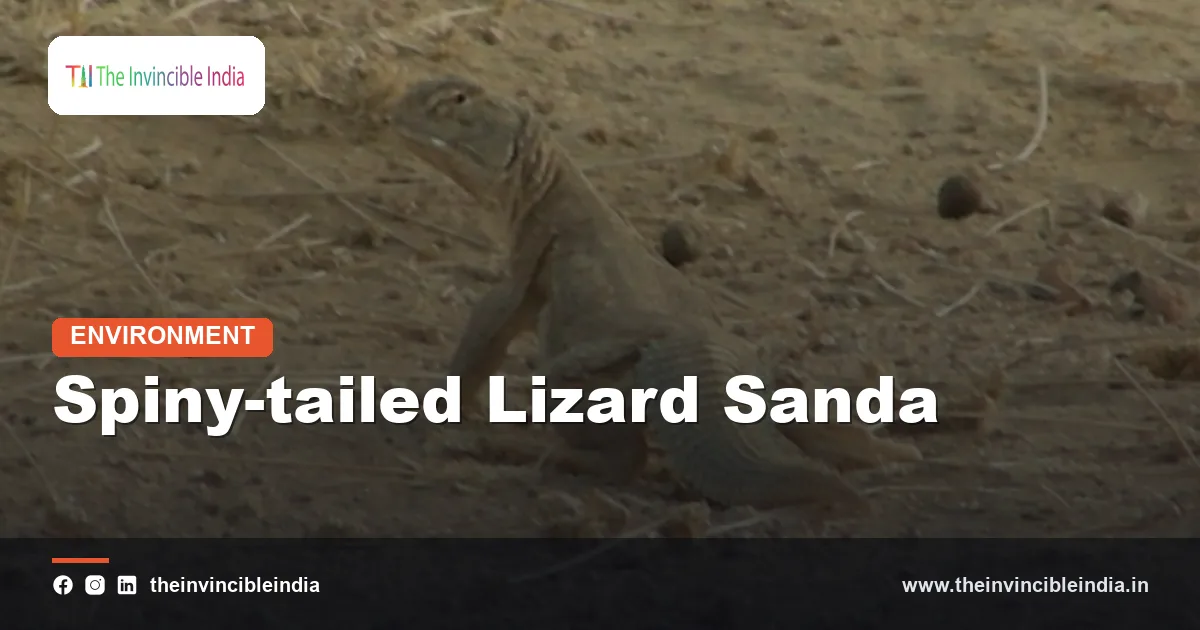
The spiny-tailed lizard of India, known locally as the sanda (Saara hardwickii), is a stocky, burrowing, mostly plant-eating agamid lizard of the Thar Desert and neighbouring arid plains, easily recognised by its thick tail ringed with rows of sharp spines. It spends its life in deep burrows, emerges to bask in the morning sun and feeds on desert grasses, leaves and flowers.
The spiny-tailed lizard is a protected species that is still poached for its meat and for a so-called “sanda oil” sold as a folk remedy, with no scientific support for the claims. This explainer covers its biology, range, behaviour, the legal protection it holds and the pressures that threaten it.
| Attribute | Detail |
|---|---|
| Common names | Spiny-tailed lizard, Indian spiny-tailed lizard, Hardwicke’s spiny-tailed lizard, sanda |
| Scientific name | Saara hardwickii (formerly placed in the genus Uromastyx) |
| Family | Agamidae, subfamily Uromastycinae |
| Size | Roughly 30 to 40 cm long including the tail, with a heavy, flattened body |
| Range | Thar Desert and nearby arid plains of north-western India, extending into Pakistan |
| Habitat | Hard, sandy or gravelly semi-desert and scrub with grass and low shrubs |
| Diet | Mostly leaves, flowers, seeds and grasses; young animals also take insects |
| Shelter | Self-dug burrows, often with a plugged entrance and a winter dormancy period |
| Protection | Covered by the Wildlife (Protection) Act, 1972; listed in CITES Appendix II |
Key Takeaways
- The spiny-tailed lizard of India, or sanda (Saara hardwickii), is a burrowing desert agamid that lives mainly in the Thar Desert of Rajasthan and in adjoining arid parts of north-western India.
- The spiny-tailed lizard uses its thick tail, covered in rings of spiny scales, to block its burrow entrance and to lash at predators.
- The spiny-tailed lizard is largely herbivorous and gets most of its water from the plants it eats, which lets it survive in extremely dry country.
- The spiny-tailed lizard is protected under India’s Wildlife (Protection) Act, 1972, and the international trade in its genus is regulated under CITES Appendix II.
- “Sanda oil” sold by roadside hawkers as a cure for joint pain or weakness has no proven medical value, yet the demand continues to drive the hunting of spiny-tailed lizards.
- The spiny-tailed lizard’s burrows shelter other desert animals, so the loss of its colonies affects the wider arid ecosystem.
What is the spiny-tailed lizard?
The spiny-tailed lizard is a heavily built, ground-dwelling member of the agamid family, the same family that contains garden lizards and fan-throated lizards, but adapted for life in sandy desert rather than trees. The Indian species, Saara hardwickii, is commonly called the sanda in Hindi and Rajasthani, and its English name honours Thomas Hardwicke, a British army officer and naturalist in India.
Its body is broad and flattened from top to bottom, with a short, blunt head, a small mouth and strong limbs with sturdy claws for digging. The tail is shorter and much thicker than in most lizards. It is wrapped in whorls of enlarged, pointed scales, so it looks like a spiked club.
The skin is yellowish, olive or sandy brown, with darker mottling and patterns on the back. Individuals appear dull and dark on a cold morning and become brighter as they warm up, because the colour shifts with body temperature.
Why is it no longer called Uromastyx?
Older books and many websites refer to the Indian sanda as Uromastyx hardwickii. The spiny-tailed lizards of Africa and Arabia remain in Uromastyx, but the Asian forms were moved to a separate genus, Saara, after studies of their anatomy and genes. This is why both names still appear in the literature, and why the CITES listing is often written for Uromastyx.
Where does the spiny-tailed lizard live in India?
The spiny-tailed lizard lives in the arid zones of north-western India, above all in the Thar Desert of Rajasthan, and its range also reaches adjoining dry parts of Gujarat, Haryana and Punjab before continuing into Pakistan. Districts such as Jaisalmer, Bikaner and Barmer in Rajasthan are well-known strongholds.
The lizard prefers firm ground where a burrow will hold its shape, such as compacted sand, gravel plains and dry scrub with scattered grasses. It is less common on very loose, shifting dunes, where tunnels collapse easily. Protected areas such as the Desert National Park near Jaisalmer provide some of the best remaining habitat.
Colonies can consist of many burrows close together, and each adult normally keeps a favourite entrance where it basks. Because the animals are so dependent on suitable soil and plant cover, changes in land use, such as canal irrigation, large-scale cultivation and the spread of invasive trees, can reduce the area they can use.
How does the spiny-tailed lizard survive in the desert?
The spiny-tailed lizard survives desert heat by spending most of its time underground, basking only at mild times of day and getting water from its food rather than from drinking. Temperatures inside a deep burrow stay much cooler and steadier than the surface, which can heat up well past what the lizard can tolerate.
Several features help the animal in this harsh environment.
- Deep burrows: The tunnel runs at an angle and can reach more than a metre below the surface, with chambers for resting.
- Behavioural thermoregulation: The lizard warms up by basking at the burrow mouth in the morning, then retreats to cool down and comes out again later.
- Water-saving physiology: It gets moisture from succulent leaves and flowers and loses little water in its waste.
- Salt glands: Related spiny-tailed lizards excrete excess salt from the nose, which helps in a diet of dry plants.
- Dormancy: In the cold part of winter, the lizard becomes inactive and stays in the burrow for weeks.
The thick tail also works as a storage organ in some spiny-tailed species, holding reserves of fat that carry the animal through lean periods.
What does the spiny-tailed lizard eat?
The spiny-tailed lizard is mainly a herbivore that eats leaves, flowers, seeds and grasses of desert plants, while hatchlings and young animals also take some insects. This is unusual among Indian lizards, most of which are insect-eaters, and it is why the species is sometimes described as a vegetarian of the desert.
After the monsoon, when grasses and annual herbs flush with new growth, the lizards feed heavily and build up fat for the dry season and for winter. Adults generally forage close to their burrows and retreat quickly at the first sign of danger, so they rarely stray far from a refuge.
By eating and dispersing seeds, the lizard probably plays a small role in desert plant ecology, although this has not been studied in detail in India.
How does the spiny-tailed lizard defend itself?
The spiny-tailed lizard defends itself by retreating into its burrow tail first and using its spiked tail as a plug and a weapon. A predator that follows into the tunnel meets a hard, spiny barrier that is difficult to bite or pull out.
When a threat appears while the lizard is some distance from its burrow, it runs for the entrance, and if caught in the open it lashes the tail from side to side, puffs up its body and may hiss. The animal can also wedge itself inside the tunnel by pressing its body against the sides.
Its natural enemies include birds of prey, desert foxes, monitor lizards and snakes. People are now the most serious predator, because hunters can dig out or smoke out the lizards, or use traps and nooses placed at burrow openings.
How does the spiny-tailed lizard breed?
The spiny-tailed lizard breeds once a year, with mating in spring and the female laying her eggs in a burrow or a nest chamber in the soil. The eggs hatch some weeks later, and the hatchlings emerge as miniature versions of the adults.
Exact numbers vary with the age and condition of the female and the local climate, and published field data from the Thar are limited. In general, the animals grow slowly and reach maturity after a few years, so a population that has been heavily hunted takes a long time to recover.
This slow life history is one of the main reasons that poaching is so damaging. Removing breeding adults repeatedly from a colony weakens the next generation, even if the habitat is untouched.
Why is the spiny-tailed lizard hunted, and is it protected?
The spiny-tailed lizard is hunted for its meat and for sanda oil, a fat-based product sold by itinerant sellers as a remedy for joint pain, weakness and sexual problems, and it is legally protected in India. There is no scientific evidence that the oil has any of these effects, but belief in it is old and widespread.
Under the Wildlife (Protection) Act, 1972, hunting, possessing or trading the animal is prohibited, and offenders can face penalties. Internationally, the genus is in CITES Appendix II, which regulates cross-border trade, and a smaller trade in live animals for the pet market has existed for spiny-tailed lizards in general.
The table below lists the main pressures and the responses that conservationists and the forest department suggest.
| Pressure | Effect | Possible response |
|---|---|---|
| Hunting for meat and sanda oil | Removes breeding adults from colonies | Enforcement, awareness, action against sellers |
| Spread of cultivation and canals | Reduces burrowing habitat and food plants | Protect grassland and gravel plains, limit conversion |
| Invasive trees and overgrazing | Alters plant cover and soil | Manage grazing, restore native vegetation |
| Road and wind-farm construction | Fragments colonies and crushes burrows | Careful siting and environmental assessment |
What is the spiny-tailed lizard’s role in the desert ecosystem?
The spiny-tailed lizard acts as a plant eater, a prey species and a burrow builder, and it therefore links several levels of the Thar Desert food web. As prey it supports raptors, foxes and reptiles, and its tunnels offer shelter to insects, geckos, small snakes and rodents.
In a landscape with few trees, burrows modify the soil, and the abandoned ones provide refuge from heat to many other animals. Conservationists often use the sanda as an indicator of healthy grassland, because it needs undisturbed ground and diverse vegetation.
How is the spiny-tailed lizard different from a monitor lizard?
The spiny-tailed lizard differs from a monitor lizard in almost every respect: it is smaller, plant-eating, spiny-tailed and an agamid, whereas monitors are larger, meat-eating, long-tailed lizards of a different family. In everyday speech, large desert lizards of different kinds are sometimes confused with each other, which can affect how people treat the animals.
- Tail: The sanda has a short, thick, spiny tail; a monitor has a long, tapering, whip-like tail.
- Diet: The sanda eats plants; a monitor eats eggs, insects, small vertebrates and carrion.
- Tongue: The sanda has a short, fleshy tongue; a monitor has a long, forked tongue that it flicks to sense scent.
- Body plan: The sanda is squat and flat; a monitor has a long neck, a long snout and a muscular, elongated body.
Correct identification matters for conservation, since field surveys that confuse species can give wrong population figures.
How can people help protect the spiny-tailed lizard?
People can help protect the spiny-tailed lizard by refusing to buy sanda oil or sanda meat, reporting illegal trade to the forest department and supporting the preservation of desert grasslands. Consumer demand is the engine of poaching, so reducing it matters as much as enforcement.
Other useful steps include supporting local communities that practise sustainable grazing, and encouraging field researchers to carry out systematic surveys, because reliable counts of burrows in the Thar are still scarce. Schools and village institutions in desert districts can also explain that the animal is harmless, protected and valuable, and that its supposed medicinal benefits are a myth.
How do researchers study the spiny-tailed lizard?
Researchers study the spiny-tailed lizard mainly by counting active burrows along set routes, watching basking animals from a distance and recording what plants they eat. Burrow counts are the standard method, because the animal spends most of its time underground and is easily disturbed.
Because each adult usually keeps a main burrow, the number of occupied entrances gives a rough index of population size. Repeated surveys across seasons show how numbers change with rainfall, grazing and hunting, and they allow managers to identify the colonies that need the most urgent protection.
Bottom Line
The spiny-tailed lizard, or sanda, is a specialist of India’s driest country, built to live underground and on plants alone. Protecting it means enforcing the law against the oil trade and keeping its gravel plains and grasslands intact, and correcting the myth that sanda oil cures anything is part of the same effort.
Frequently Asked Questions
What is the sanda lizard?
The sanda is the local name for the Indian spiny-tailed lizard, Saara hardwickii, a burrowing desert lizard of the Thar. It has a heavy body and a thick tail covered with rings of sharp spines.
Is the spiny-tailed lizard herbivorous?
Yes, the spiny-tailed lizard feeds mostly on leaves, flowers, seeds and grasses. Young animals also eat some insects, but adults are largely plant-eaters.
Does sanda oil really work?
No, there is no scientific evidence that sanda oil cures joint pain, weakness or any other condition. The oil is made by killing spiny-tailed lizards, which are legally protected in India.
Where is the spiny-tailed lizard found in India?
The spiny-tailed lizard is found mainly in the Thar Desert of Rajasthan and in adjoining dry areas of north-western India, extending into Pakistan. It prefers firm sandy or gravelly ground where it can dig a stable burrow.
Is it legal to keep or hunt a spiny-tailed lizard in India?
No, hunting, keeping or trading the spiny-tailed lizard is prohibited under the Wildlife (Protection) Act, 1972. The genus is also covered by CITES Appendix II, which regulates international trade.
How does the spiny-tailed lizard protect itself?
The spiny-tailed lizard retreats into its burrow and blocks the tunnel with its spiked tail. When caught in the open it lashes the tail and puffs up its body to deter predators.
{“@context”:”https://schema.org”,”@graph”:[{“@type”:”FAQPage”,”mainEntity”:[{“@type”:”Question”,”name”:”What is the sanda lizard?”,”acceptedAnswer”:{“@type”:”Answer”,”text”:”The sanda is the local name for the Indian spiny-tailed lizard, Saara hardwickii, a burrowing desert lizard of the Thar. It has a heavy body and a thick tail covered with rings of sharp spines.”}},{“@type”:”Question”,”name”:”Is the spiny-tailed lizard herbivorous?”,”acceptedAnswer”:{“@type”:”Answer”,”text”:”Yes, the spiny-tailed lizard feeds mostly on leaves, flowers, seeds and grasses. Young animals also eat some insects, but adults are largely plant-eaters.”}},{“@type”:”Question”,”name”:”Does sanda oil really work?”,”acceptedAnswer”:{“@type”:”Answer”,”text”:”No, there is no scientific evidence that sanda oil cures joint pain, weakness or any other condition. The oil is made by killing spiny-tailed lizards, which are legally protected in India.”}},{“@type”:”Question”,”name”:”Where is the spiny-tailed lizard found in India?”,”acceptedAnswer”:{“@type”:”Answer”,”text”:”The spiny-tailed lizard is found mainly in the Thar Desert of Rajasthan and in adjoining dry areas of north-western India, extending into Pakistan. It prefers firm sandy or gravelly ground where it can dig a stable burrow.”}},{“@type”:”Question”,”name”:”Is it legal to keep or hunt a spiny-tailed lizard in India?”,”acceptedAnswer”:{“@type”:”Answer”,”text”:”No, hunting, keeping or trading the spiny-tailed lizard is prohibited under the Wildlife (Protection) Act, 1972. The genus is also covered by CITES Appendix II, which regulates international trade.”}},{“@type”:”Question”,”name”:”How does the spiny-tailed lizard protect itself?”,”acceptedAnswer”:{“@type”:”Answer”,”text”:”The spiny-tailed lizard retreats into its burrow and blocks the tunnel with its spiked tail. When caught in the open it lashes the tail and puffs up its body to deter predators.”}}]}]}


