

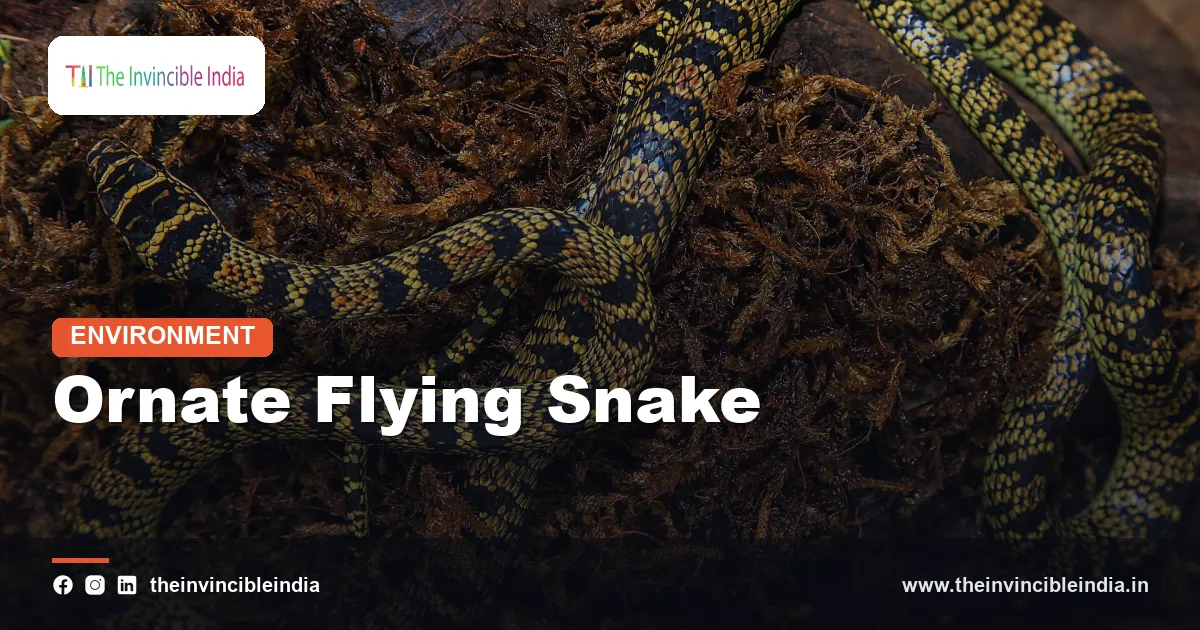
The ornate flying snake (Chrysopelea ornata) is a slender, brightly patterned, mildly venomous tree snake of South and Southeast Asia that can flatten its body and glide from one tree to another. In India it lives in the moist forests of the Western Ghats and the north-east, in plantations and even in large gardens, where it hunts lizards by day. It does not truly fly, and its venom is too weak to endanger people.
The ornate flying snake is also called the golden tree snake or the ornate tree snake, and it is one of the few reptiles on Earth with a dedicated gliding behaviour. Researchers have studied its aerial movement to understand how a limbless animal can steer through the air, which makes it one of the most closely examined snakes in the world despite being little known to the public.
| Attribute | Detail |
|---|---|
| Common names | Ornate flying snake, golden tree snake, ornate tree snake |
| Scientific name | Chrysopelea ornata |
| Family | Colubridae (rear-fanged colubrid snakes) |
| Typical length | About 1 metre, occasionally up to roughly 1.3 metres |
| Habitat in India | Evergreen and moist deciduous forest, plantations, gardens, mainly the Western Ghats, the north-east and the eastern foothills |
| Diet | Lizards, geckos, frogs, small birds, bats and small rodents |
| Venom | Mild, delivered by rear fangs, used to subdue small prey; not considered dangerous to humans |
| Activity | Diurnal (active in the daytime) and arboreal |
| Conservation | Assessed as Least Concern by the IUCN; protected under India’s Wildlife (Protection) Act, 1972 |
Key Takeaways
- The ornate flying snake (Chrysopelea ornata) glides rather than flies: it launches from a branch, flattens its body to roughly double its normal width and travels downward and forward through the air.
- The ornate flying snake is rear-fanged and mildly venomous, but its venom is meant for lizards and frogs and is not regarded as medically dangerous to humans.
- In India, the ornate flying snake is found chiefly in the Western Ghats, the north-eastern states and the eastern foothills, and it also enters plantations and gardens.
- The ornate flying snake is a daytime hunter that feeds mostly on geckos, agamid lizards and tree frogs, so it quietly controls small reptile and amphibian populations.
- Gliding helps the ornate flying snake cross gaps between trees, escape predators and save the energy of climbing down and up again.
- The IUCN lists the ornate flying snake as Least Concern, but forest loss and mistaken killing of harmless snakes remain local pressures.
What is the ornate flying snake?
The ornate flying snake is a medium-sized, slender colubrid snake of the genus Chrysopelea, whose members are known for gliding between trees. Its scientific name, Chrysopelea ornata, combines Greek roots that suggest “golden” and Latin for “adorned”, and both fit the species well. Its body is usually green, yellowish or pale with a dense net of black markings and, in many individuals, small red or orange spots along the back.
The head is distinct from the neck and carries large eyes with round pupils, which suit a snake that hunts by sight in daylight. The scales of the belly have sharp lateral keels, or ridges, along their edges. These keels let the snake grip the rough bark of a tree trunk and climb almost vertically, a skill that also sets up its launches.
The genus Chrysopelea has five recognised species. Taxonomists have separated the Sri Lankan form from the mainland snake in recent decades, so older field guides may describe the Indian snake with different names or subspecies labels. The Indian population is still generally called Chrysopelea ornata.
How does the ornate flying snake glide?
The ornate flying snake glides by launching from a high perch, spreading its ribs to flatten its body and then undulating sideways in the air so that it travels forward while descending. It is a controlled glide, not powered flight, and the snake loses height all the way down.
The sequence has recognisable stages that researchers have described from high-speed filming of related species.
- Preparation: The snake climbs to the tip of a branch and hangs the front part of its body in a J-shaped curve below the perch.
- Launch: It pushes off with a rapid upward and outward lunge, moving the body away from the support.
- Flattening: In mid-air the ribs swing outward and the belly is drawn in, so the body becomes wide and concave on the underside, close to twice its resting width.
- Undulation: The snake sends S-shaped waves along its body, side to side, which appears to help it stay stable and steer.
- Landing: It catches a branch or trunk with the front of the body, usually without injury, and resumes climbing.
A cross-section of the gliding body acts like a very simple wing, and the sideways waves help the long, thin animal keep a stable orientation. Reported glide distances run to many metres, and the longest figures in popular accounts are hard to verify. What scientists agree on is that the snake can cover a gap far wider than it could ever jump.
Where is the ornate flying snake found in India?
The ornate flying snake occurs in the Western Ghats, in the forests of north-eastern India and in the eastern foothills of the subcontinent, and it is generally associated with warm, humid, well-wooded country. Within these regions it is usually found below about 1,000 metres, though it can reach higher in some hill ranges.
Its overall range extends well beyond India. The species is found across parts of Nepal, Bangladesh, Myanmar, Thailand, Malaysia, Vietnam and southern China, so the Indian populations form the western edge of a very large distribution.
Habitat preferences
The ornate flying snake prefers areas with tall trees in close contact with each other, because gliding requires launch points and landing points. It is recorded in evergreen forests, moist deciduous forests, coffee and areca plantations, rubber estates and well-planted gardens. In rural Kerala, Karnataka and the north-east, people sometimes see one on a house wall or a mango tree, usually because it is chasing a gecko.
What does the ornate flying snake eat?
The ornate flying snake eats mainly lizards, especially geckos and small agamids, along with frogs, small birds, bats and sometimes small rodents. It hunts actively in the daytime, searching along branches, tree holes and the walls of buildings.
Because the snake climbs so well, it reaches places where ground-hunting predators cannot go. It will enter hollow trunks and the roofs of old houses, where geckos shelter. After a bite the snake holds its prey while the weak venom, delivered by enlarged teeth at the back of the upper jaw, slows the animal down. It then swallows the prey headfirst, which is usual in snakes.
Its diet puts the ornate flying snake in a useful ecological role. By feeding on arboreal lizards and tree frogs it helps keep their numbers in balance, and it is itself food for forest raptors such as crested serpent eagles and for larger snakes, including the king cobra.
Is the ornate flying snake venomous or dangerous to humans?
The ornate flying snake is mildly venomous, but it is not considered dangerous to humans. It is a rear-fanged snake, which means the grooved fangs sit far back in the mouth, and the snake usually has to chew on a victim to deliver any venom. The venom is built to subdue small cold-blooded prey rather than large mammals.
Bites to people are rare and, when they happen, usually cause only local pain, mild swelling or redness. The snake is nervous and fast, and it prefers to escape by climbing or gliding rather than fight. If it is cornered it may flatten its body, flare its neck and strike, which is bluff behaviour more than real aggression.
All the same, a bite from any wild snake should be washed with clean water and checked by a doctor, especially because it is hard for a non-expert to identify a snake correctly in a moment of panic. People should not try to catch or handle the snake, and should call a trained rescuer or the local forest department if one enters a house.
How do ornate flying snakes breed and live?
The ornate flying snake is oviparous, meaning the female lays eggs, and she normally lays a small clutch of roughly half a dozen to a dozen eggs in a hollow tree, a rotting stump or leaf litter. The young hatch several weeks later and are fully formed, with the same pattern as adults but a more delicate build, and they start hunting small lizards at once.
Not every detail of the reproductive biology of the species is well documented in the wild, and observations in India are patchy. Breeding appears to be linked to the warmer, wetter part of the year in many regions, but the timing varies with the local climate.
The snake is solitary. It spends most of its day foraging and basking in the canopy, and at night it rests in a hollow, a crevice or a tangle of vines. In captivity it can live several years, but the species is notoriously difficult to keep, since it needs space to climb and a live food supply, and wild capture for the pet trade harms local populations in some Asian countries.
How does the ornate flying snake compare with other flying snakes?
The ornate flying snake is the species of Chrysopelea that people are most likely to meet in India, while the other four species live mostly in Southeast Asia or Sri Lanka. The table below summarises the genus in broad terms.
| Species | Common name | General range |
|---|---|---|
| Chrysopelea ornata | Ornate flying snake | South Asia, Southeast Asia, southern China |
| Chrysopelea paradisi | Paradise tree snake | Southeast Asia and nearby islands |
| Chrysopelea pelias | Twin-barred tree snake | Southeast Asia |
| Chrysopelea rhodopleuron | Moluccan flying snake | Eastern Indonesia |
| Chrysopelea taprobanica | Sri Lankan flying snake | Sri Lanka |
Much of the published research on gliding mechanics uses the paradise tree snake, which is easier to film in captive trials. The results are thought to apply broadly across the genus, because all of its members share the same ability to flatten the body and undulate in the air.
Why does the ornate flying snake glide?
The ornate flying snake glides mainly to move between trees quickly and safely, since this allows it to escape predators, reach new hunting areas and save the effort of descending to the ground. Descending to the forest floor exposes an arboreal snake to mongooses, monitor lizards and other predators, so gliding lowers its risk.
The ability also seems to help in hunting. A snake that can leap across gaps can follow prey from tree to tree and reach foliage that would otherwise be isolated. Scientists treat these benefits as plausible explanations, but they remain hypotheses, as the snake’s decisions in the wild are hard to observe.
The glide has also interested engineers. A limbless glider whose shape changes during flight suggests new ideas for small robots and for understanding how animals steer without wings or fins.
What threatens the ornate flying snake and how is it protected?
The ornate flying snake is mainly threatened by the loss of forest and large trees, by road deaths and by being killed out of fear because it is mistaken for a dangerous snake. Fragmented forest breaks the chain of tall trees that the snake needs for travel and hunting.
Although the IUCN lists the species as Least Concern because of its wide range, local declines can occur where continuous canopy is cleared. Snakes in India are covered by the Wildlife (Protection) Act, 1972, which prohibits hunting or capturing wild species of this kind without permission. Protected areas across the Western Ghats and the north-east shelter healthy populations.
Simple steps help people live alongside the snake: keep tree branches trimmed away from roofs, avoid killing snakes seen in gardens, store food so that rats and geckos are not attracted in large numbers, and call a local rescue group when a snake needs relocating.
Bottom Line
The ornate flying snake is a harmless-to-humans, beautifully marked glider that plays a quiet role in the canopies of India’s forests and plantations. Understanding that it glides instead of flying, and that its venom is mild, replaces fear with accurate knowledge and supports the protection of the tall, connected trees on which it depends.
Frequently Asked Questions
Can the ornate flying snake really fly?
No, the ornate flying snake cannot fly; it glides. It launches from a branch, flattens its body to about twice its normal width and undulates sideways, which carries it forward while it loses height.
Is the ornate flying snake poisonous?
The ornate flying snake is venomous, not poisonous, and its venom is mild. It is rear-fanged and uses the venom on lizards and frogs, and bites to people are rare and generally cause only local pain or swelling.
How far can the ornate flying snake glide?
The ornate flying snake can glide across gaps of many metres between trees. The very long distances quoted in popular accounts are hard to verify, but scientists confirm that glides far longer than any jump are routine.
Where is the ornate flying snake found in India?
The ornate flying snake is found mainly in the Western Ghats, the forests of north-eastern India and the eastern foothills, as well as in plantations and gardens. Its wider range runs across South and Southeast Asia into southern China.
What does the ornate flying snake eat?
The ornate flying snake eats mainly geckos and other small lizards, along with frogs, small birds, bats and occasionally small rodents. It hunts by day in trees, tree holes and the walls of buildings.
Is the ornate flying snake protected in India?
Yes, the ornate flying snake is protected in India under the Wildlife (Protection) Act, 1972, which restricts hunting and capture of wild snakes. The IUCN rates the species as Least Concern globally, although forest loss can affect local populations.
{“@context”:”https://schema.org”,”@graph”:[{“@type”:”FAQPage”,”mainEntity”:[{“@type”:”Question”,”name”:”Can the ornate flying snake really fly?”,”acceptedAnswer”:{“@type”:”Answer”,”text”:”No, the ornate flying snake cannot fly; it glides. It launches from a branch, flattens its body to about twice its normal width and undulates sideways, which carries it forward while it loses height.”}},{“@type”:”Question”,”name”:”Is the ornate flying snake poisonous?”,”acceptedAnswer”:{“@type”:”Answer”,”text”:”The ornate flying snake is venomous, not poisonous, and its venom is mild. It is rear-fanged and uses the venom on lizards and frogs, and bites to people are rare and generally cause only local pain or swelling.”}},{“@type”:”Question”,”name”:”How far can the ornate flying snake glide?”,”acceptedAnswer”:{“@type”:”Answer”,”text”:”The ornate flying snake can glide across gaps of many metres between trees. The very long distances quoted in popular accounts are hard to verify, but scientists confirm that glides far longer than any jump are routine.”}},{“@type”:”Question”,”name”:”Where is the ornate flying snake found in India?”,”acceptedAnswer”:{“@type”:”Answer”,”text”:”The ornate flying snake is found mainly in the Western Ghats, the forests of north-eastern India and the eastern foothills, as well as in plantations and gardens. Its wider range runs across South and Southeast Asia into southern China.”}},{“@type”:”Question”,”name”:”What does the ornate flying snake eat?”,”acceptedAnswer”:{“@type”:”Answer”,”text”:”The ornate flying snake eats mainly geckos and other small lizards, along with frogs, small birds, bats and occasionally small rodents. It hunts by day in trees, tree holes and the walls of buildings.”}},{“@type”:”Question”,”name”:”Is the ornate flying snake protected in India?”,”acceptedAnswer”:{“@type”:”Answer”,”text”:”Yes, the ornate flying snake is protected in India under the Wildlife (Protection) Act, 1972, which restricts hunting and capture of wild snakes. The IUCN rates the species as Least Concern globally, although forest loss can affect local populations.”}}]}]}


