

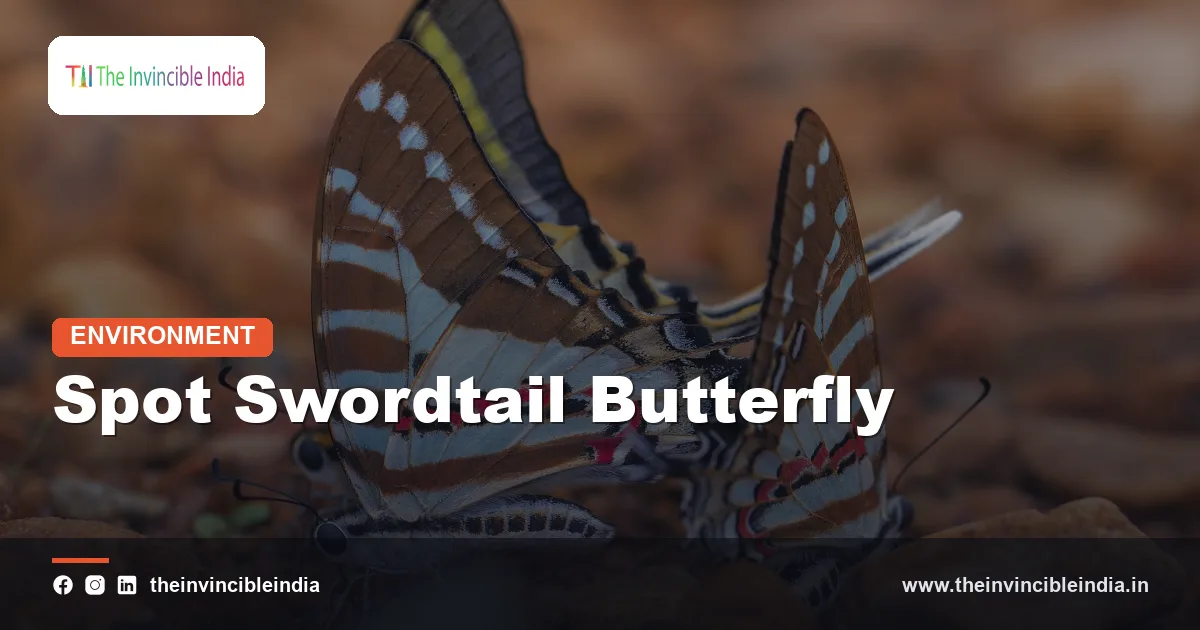
The spot swordtail (Graphium nomius) is a fast-flying, pale, long-tailed swallowtail butterfly of Indian forests, known for its slender sword-like tails, its black-spotted wings and its habit of gathering at damp mud. It belongs to the swallowtail family Papilionidae and is one of the more elegant, but also more difficult to photograph, forest butterflies of the Indian peninsula.
Unlike the showy birdwings and mormons, the spot swordtail is a restless and nervous flier that rarely settles for long. Understanding how it lives, what its caterpillars eat and where it can be seen helps explain why this modest-looking species is a good indicator of healthy, tree-rich habitat.
| Quick Fact | Detail |
|---|---|
| Common name | Spot swordtail |
| Scientific name | Graphium nomius |
| Family | Papilionidae (swallowtails) |
| Wingspan | Roughly 7 to 9 cm |
| Caterpillar host plants | Trees and shrubs of the custard apple family (Annonaceae), such as Polyalthia and Miliusa species |
| Range and habitat in India | Forests and forest edges of peninsular India, including the Western Ghats and Eastern Ghats, extending to parts of central and north-eastern India |
| Flight and season | Day-flying; seen for much of the year, most often in and after the monsoon |
| Notable features | Long tails on the hindwings, black-spotted pale wings, rapid flight, mud-puddling in groups |
Key Takeaways
- The spot swordtail is a swallowtail butterfly (family Papilionidae) with the scientific name Graphium nomius, found in forests across much of peninsular India.
- Spot swordtail adults have pale, black-spotted wings and long, narrow tails on the hindwings, which give the butterfly its “swordtail” name.
- Spot swordtail caterpillars feed on trees of the custard apple family (Annonaceae), so the butterfly depends on native forest trees rather than on garden flowers.
- Male spot swordtails gather at damp sand and mud to drink water and absorb dissolved minerals, a behaviour called mud-puddling.
- The spot swordtail is a very fast flier that seldom stays long on one flower, which makes it hard to photograph and easy to confuse with other swordtails and jays.
- The spot swordtail is not regarded as globally threatened, but its survival in any area depends on intact forest and clean streams.
What is the spot swordtail butterfly?
The spot swordtail is a medium-sized swallowtail butterfly, scientifically named Graphium nomius, that lives in the forests of India and neighbouring countries. It is a member of the genus Graphium, a group often called swordtails, jays and kites because of their sharply pointed tails and their quick, darting flight.
Swallowtails form one of the best-known butterfly families, and India hosts dozens of species, from the large Southern Birdwing to the common lime butterfly of city gardens. Among them, the spot swordtail stands out for its pale colouring and its long, fine tails. The word “spot” in the common name refers to the dark spots and bars that mark the pale ground colour of its wings.
Butterfly watchers in India usually meet the spot swordtail on forest tracks, along streams and near the edges of dry and moist deciduous woodland. It is rarely a butterfly of open cities, and sightings are therefore often treated as a sign of reasonably intact tree cover.
What does the spot swordtail look like?
The spot swordtail has pale, whitish to pale greenish wings marked with black bars and spots, and each hindwing ends in a long, slim tail tipped with white. The overall effect is a light, almost translucent butterfly with a clean black-and-white pattern, which flashes as it flies past in dappled forest light.
Key identification features
- Tails: a long, narrow tail on each hindwing, noticeably longer and slimmer than the short tails of many other swallowtails.
- Ground colour: pale, whitish to light greenish, rather than the dark body colour of many tailed jays.
- Markings: black bars and spots on the forewing and a black border on the hindwing.
- Size: a wingspan of roughly 7 to 9 cm, which is large for a forest butterfly but smaller than a birdwing.
- Posture: when it does settle, particularly at mud, it often keeps its wings partly raised or flutters them rapidly.
Males and females look broadly similar, although females are usually slightly larger and rounder-winged. Because the butterfly tends to fly fast and low along forest paths, a quick view of the pale colour and long tails is often enough for an experienced observer to name it.
Where is the spot swordtail found in India?
The spot swordtail is found in forests and forest edges across peninsular India, including the Western Ghats and Eastern Ghats, and extends into parts of central and north-eastern India. Outside India, the species also occurs in Sri Lanka and in parts of mainland South-East Asia.
Within India, the butterfly prefers wooded country where its caterpillar host trees grow. This means it is far more likely along a shaded forest road in a tiger reserve or a forested hill than in an open farmland landscape. It is usually found at low and moderate elevations rather than on high mountain tops.
Typical habitats include:
- Moist and dry deciduous forest, especially near streams and seepages
- Semi-evergreen forest edges and clearings
- Forested river banks with exposed damp sand
- Well-wooded hill slopes in the Western Ghats and Eastern Ghats
Because the species needs both host trees for caterpillars and damp patches for adult males, small pockets of natural forest next to a stream can support a local population even when the surrounding landscape has changed.
What do spot swordtail caterpillars and adults eat?
Spot swordtail caterpillars eat the leaves of trees in the custard apple family (Annonaceae), while the adult butterflies drink flower nectar and, in the case of males, moisture from damp ground. This split diet is typical of swallowtails: the caterpillar is a specialist on a narrow group of plants, whereas the adult is a more flexible visitor to flowers.
Caterpillar host plants
Recorded host plants of the spot swordtail include native Annonaceae such as Polyalthia and Miliusa species. Females lay their eggs singly on young, tender leaves, and the hatching caterpillar feeds on the soft new growth. Several other Graphium butterflies in India use the same plant family, which is why swordtails and jays are often found in the same patches of forest.
Adult food
Adult spot swordtails sip nectar from a range of forest flowers but are far more famous for visiting damp ground. They are typically quick feeders, taking a brief drink before flying off again, which is one reason that field observers describe the species as restless.
How does the spot swordtail life cycle work?
The spot swordtail passes through complete metamorphosis, with four stages: egg, caterpillar, pupa and adult butterfly. The whole cycle can be completed within roughly a month or two in warm, humid conditions, which allows several generations in a year where host plants flush with new leaves.
| Stage | What happens |
|---|---|
| Egg | A small, rounded egg is laid singly on a young host-plant leaf by the female. |
| Caterpillar | A green, smooth-bodied larva feeds on soft Annonaceae leaves and rests on a silken pad; it grows through several moults called instars. |
| Pupa | The mature caterpillar attaches itself upright to a twig or leaf with a silk girdle and forms a green or brownish chrysalis that blends with the foliage. |
| Adult | The butterfly emerges, dries its wings, feeds, mates and begins the next cycle. |
Like other swallowtails, the spot swordtail chrysalis is held upright by a girdle of silk, which is a useful field clue if someone finds one on a host tree. Camouflage is the main defence at every stage: the egg is tiny, the caterpillar is leaf-green and the chrysalis resembles a bud or a curled leaf.
Why does the spot swordtail gather at mud?
The spot swordtail gathers at mud because males need salts and minerals that are scarce in nectar, and wet sand or soil provides them. This behaviour, known as mud-puddling, is common among swallowtails, pierids and many other butterflies, and it is mostly practised by males.
Minerals such as sodium are thought to be passed to the female during mating and to help in reproduction and survival of the offspring. A puddling male therefore improves the quality of his contribution to the next generation.
What a puddling gathering looks like
- Several butterflies, sometimes of different swallowtail species, crowd onto a single patch of damp sand.
- Wings are kept half open or fluttering, ready for a quick escape.
- The group lifts off together when disturbed, then returns within minutes.
- Gatherings are most common on warm mornings, near forest streams and wet road edges.
For photographers and naturalists, a puddling site is often the best place to study a spot swordtail at close range. Standing still and keeping a low shadow usually gives better results than approaching quickly.
How can the spot swordtail be told apart from similar butterflies?
The spot swordtail is told apart from similar butterflies mainly by its pale ground colour and unusually long, slim tails, while jays and tailed jays have darker wings with green or blue bands. Several Graphium species share forest tracks and puddling sites, so a side-by-side comparison is useful.
| Butterfly | Main difference from the spot swordtail |
|---|---|
| Common jay (Graphium doson) | Darker wings with blue-green spots and a much shorter tail. |
| Tailed jay (Graphium agamemnon) | Dark wings with bright green spots and only a short tail. |
| Five-bar swordtail (Graphium antiphates) | Pale yellowish with prominent dark bars and a very long tail; found in wetter and hillier forest. |
| Spot swordtail (Graphium nomius) | Pale whitish to greenish wings with black bars and spots, and very long, slender tails. |
Experienced observers also note flight style. The spot swordtail tends to fly fast and straight along a path, banking sharply when disturbed, whereas jays often flutter more slowly around flowers and mud.
When and where is the best time to see a spot swordtail?
The best time to see a spot swordtail is usually the monsoon and the weeks after it, when forests are green, host trees carry fresh leaves and butterfly numbers are highest. The species can be seen in other months as well, especially in humid forest, but it is generally scarcer in the hottest, driest weeks.
A few simple habits improve the chance of a good sighting:
- Visit forest streams, damp road edges and sandy river banks in the morning.
- Walk slowly and watch the ground for clusters of pale butterflies.
- Look near stands of native Annonaceae trees, where females search for egg-laying spots.
- Carry a camera with a fast shutter speed, because the butterfly rarely stays still.
Visits to protected areas must follow local forest department rules. Collecting butterflies in reserves is not permitted, and observation and photography are the responsible way to enjoy them.
Is the spot swordtail threatened?
The spot swordtail is not generally regarded as a globally threatened species, but local populations can decline when forests are cleared or fragmented. Because its caterpillars depend on particular native trees and its males depend on clean, damp ground, the butterfly is sensitive to changes in land use.
Main pressures include:
- Loss and fragmentation of natural forest cover
- Removal of native trees along roads and streams
- Pollution or drying of forest streams that provide puddling sites
- Heavy pesticide use along forest-farm boundaries
In India, the legal protection of butterflies is covered by the Wildlife (Protection) Act, 1972, and protection status differs from species to species. Anyone interested in a particular butterfly should check the current schedules rather than assume that all butterflies are protected or unprotected.
Why does the spot swordtail matter?
The spot swordtail matters because it is both a pollinator and a useful indicator of forest health. Adult swallowtails carry pollen between flowers as they feed, and their presence suggests that the host trees, nectar sources and damp ground they need are all still available.
Butterflies also form part of the forest food web. Eggs, caterpillars and pupae are food for ants, wasps, spiders and birds, and the adults are prey for lizards, birds and dragonflies. For citizens, the spot swordtail is also a gateway species: its elegant appearance often draws beginners into butterfly watching, and records from citizen science projects help researchers track changes in distribution over time.
Bottom Line
The spot swordtail is a pale, long-tailed swallowtail of Indian forests that depends on custard apple family trees for its caterpillars and on damp ground for its males. Protecting native forest, streams and host trees is the simplest way to keep this elegant butterfly flying.
Frequently Asked Questions
What is the spot swordtail butterfly?
The spot swordtail (Graphium nomius) is a pale, black-spotted swallowtail butterfly with long, slender tails, found in forests of peninsular India and nearby regions. It belongs to the family Papilionidae and is known for its fast flight and its habit of gathering at damp mud.
What do spot swordtail caterpillars eat?
Spot swordtail caterpillars eat the leaves of trees in the custard apple family (Annonaceae), such as Polyalthia and Miliusa species. Females lay eggs singly on young leaves, and the green caterpillars feed on the soft new growth.
Why do spot swordtail butterflies gather at mud?
Spot swordtail males gather at mud to take up salts and minerals that nectar does not supply. This behaviour, called mud-puddling, is common among swallowtails and is thought to support reproduction.
Where can I see a spot swordtail in India?
A spot swordtail is most often seen along forest streams, damp road edges and sandy river banks in the forests of peninsular India, including the Western Ghats and Eastern Ghats. Morning visits during and just after the monsoon usually give the best chance.
How is the spot swordtail different from the common jay and tailed jay?
The spot swordtail has pale whitish to greenish wings with very long, slim tails, whereas the common jay and tailed jay have darker wings with green or blue spots and much shorter tails. Flight also differs, as the spot swordtail is typically faster and straighter.
Is the spot swordtail an endangered butterfly?
The spot swordtail is not generally regarded as globally threatened, but local populations can decline when forests are cleared or streams dry up. Legal protection of butterflies in India is set by schedules of the Wildlife (Protection) Act, 1972, which should be checked for the current status of any species.
{“@context”:”https://schema.org”,”@graph”:[{“@type”:”FAQPage”,”mainEntity”:[{“@type”:”Question”,”name”:”What is the spot swordtail butterfly?”,”acceptedAnswer”:{“@type”:”Answer”,”text”:”The spot swordtail (Graphium nomius) is a pale, black-spotted swallowtail butterfly with long, slender tails, found in forests of peninsular India and nearby regions. It belongs to the family Papilionidae and is known for its fast flight and its habit of gathering at damp mud.”}},{“@type”:”Question”,”name”:”What do spot swordtail caterpillars eat?”,”acceptedAnswer”:{“@type”:”Answer”,”text”:”Spot swordtail caterpillars eat the leaves of trees in the custard apple family (Annonaceae), such as Polyalthia and Miliusa species. Females lay eggs singly on young leaves, and the green caterpillars feed on the soft new growth.”}},{“@type”:”Question”,”name”:”Why do spot swordtail butterflies gather at mud?”,”acceptedAnswer”:{“@type”:”Answer”,”text”:”Spot swordtail males gather at mud to take up salts and minerals that nectar does not supply. This behaviour, called mud-puddling, is common among swallowtails and is thought to support reproduction.”}},{“@type”:”Question”,”name”:”Where can I see a spot swordtail in India?”,”acceptedAnswer”:{“@type”:”Answer”,”text”:”A spot swordtail is most often seen along forest streams, damp road edges and sandy river banks in the forests of peninsular India, including the Western Ghats and Eastern Ghats. Morning visits during and just after the monsoon usually give the best chance.”}},{“@type”:”Question”,”name”:”How is the spot swordtail different from the common jay and tailed jay?”,”acceptedAnswer”:{“@type”:”Answer”,”text”:”The spot swordtail has pale whitish to greenish wings with very long, slim tails, whereas the common jay and tailed jay have darker wings with green or blue spots and much shorter tails. Flight also differs, as the spot swordtail is typically faster and straighter.”}},{“@type”:”Question”,”name”:”Is the spot swordtail an endangered butterfly?”,”acceptedAnswer”:{“@type”:”Answer”,”text”:”The spot swordtail is not generally regarded as globally threatened, but local populations can decline when forests are cleared or streams dry up. Legal protection of butterflies in India is set by schedules of the Wildlife (Protection) Act, 1972, which should be checked for the current status of any species.”}}]}]}


