

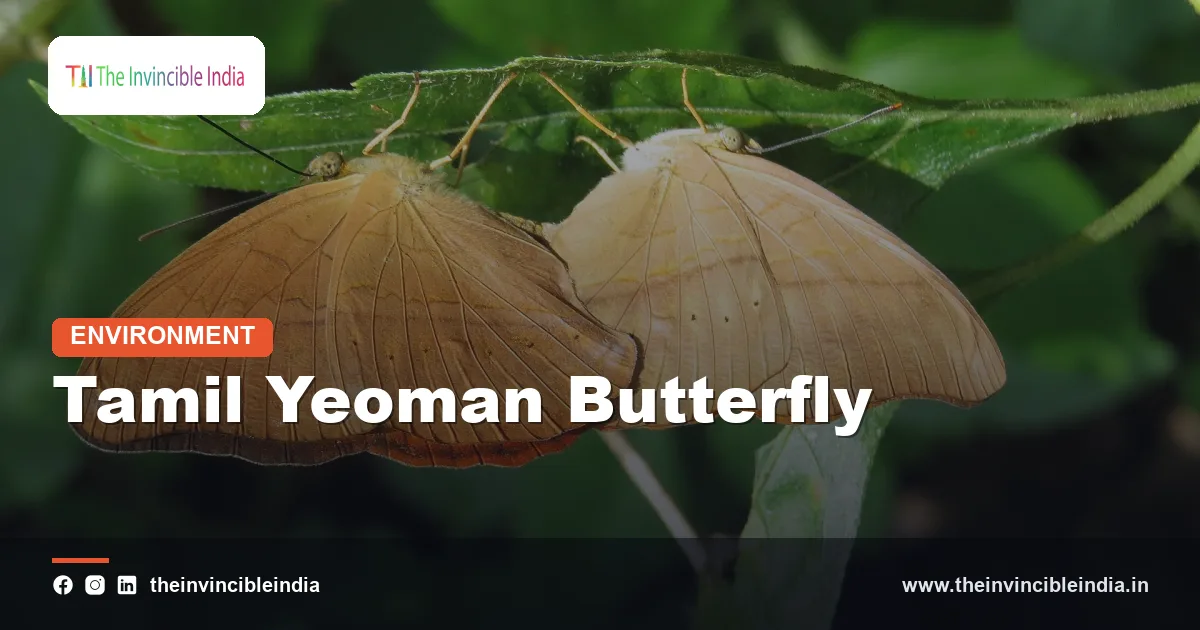
The Tamil yeoman (Cirrochroa thais) is a bright orange forest butterfly of the Western Ghats and hill forests of southern India, and it was adopted as the state butterfly of Tamil Nadu in 2019, where it is locally known as Tamil Maravan. It belongs to the brush-footed butterfly family Nymphalidae and is among the most eye-catching butterflies of the southern hills.
Despite its glowing colour, the Tamil yeoman is a quick, restless butterfly that spends much of its time high in the forest or along sunlit ridges. Learning how to recognise it, what its caterpillars feed on and why it was chosen as a state symbol helps explain its place in southern India’s natural heritage.
| Quick Fact | Detail |
|---|---|
| Common name | Tamil yeoman (Tamil Maravan in Tamil) |
| Scientific name | Cirrochroa thais |
| Family | Nymphalidae (brush-footed butterflies) |
| Wingspan | Roughly 6 to 7 cm |
| Caterpillar host plants | Hydnocarpus trees, locally called maratti or chaulmoogra trees |
| Range and habitat in India | Evergreen and semi-evergreen forests of the Western Ghats and associated southern hills; a related race occurs in Sri Lanka |
| Flight and season | Day-flying; fast, gliding flight; most often seen in and after the monsoon |
| Notable features | State butterfly of Tamil Nadu; vivid orange wings with dark borders; males puddle and perch on ridges |
Key Takeaways
- The Tamil yeoman (Cirrochroa thais) is an orange brush-footed butterfly of the Western Ghats and southern hill forests of India.
- The Tamil yeoman was declared the state butterfly of Tamil Nadu in 2019 and is known in Tamil as Tamil Maravan.
- Tamil yeoman caterpillars feed on Hydnocarpus trees, so the butterfly is tied to the evergreen forests where those trees grow.
- Tamil yeoman adults have bright orange upper wings with dark borders and a paler, patterned underside that provides camouflage when the wings are closed.
- The Tamil yeoman is a fast, gliding flier, and males are often seen at damp ground or on sunlit forest ridges.
- Protection of the Tamil yeoman in practice means protecting the Western Ghats evergreen forest and its native host trees.
What is the Tamil yeoman butterfly?
The Tamil yeoman is a medium-sized, orange butterfly of the family Nymphalidae, scientifically named Cirrochroa thais, found in the forests of southern India and Sri Lanka. The genus Cirrochroa contains the butterflies commonly called yeomen, a group of tawny, fast-flying species found across South and South-East Asia.
The English name “yeoman” is an old term for a small landholder or attendant, and it is used for several butterflies whose looks are modest but neat. The “Tamil” part of the name points to the southern hills of the Tamil-speaking region where the species is a conspicuous member of the forest fauna.
In Tamil the butterfly is called Tamil Maravan, which can be translated roughly as the Tamil warrior. The name was popularised when the state chose it as its official butterfly.
Why is the Tamil yeoman the state butterfly of Tamil Nadu?
The Tamil yeoman is the state butterfly of Tamil Nadu because it is closely associated with the Western Ghats of the state, is easily recognised and carries a name that reflects the region’s language and culture. The state government adopted it as the official state butterfly in 2019, making it a symbol of the state’s forest biodiversity.
State butterflies have been designated by several Indian states in recent years as a way to draw public attention to insects and to the forests they depend on. Examples include:
- Maharashtra: the Blue Mormon
- Karnataka: the Southern Birdwing
- Uttarakhand: the Common Peacock
- Kerala: the Buddha Peacock
- Goa: the Malabar Tree Nymph
- Tamil Nadu: the Tamil Yeoman
Such designations carry no new legal protection by themselves, but they raise awareness and encourage schools, nature clubs and forest departments to take up butterfly conservation and public education.
What does the Tamil yeoman look like?
The Tamil yeoman has rich orange upper wings with dark, scalloped borders and small black markings, while its underside is paler and finely patterned in brown and cream. The effect is that of a vivid orange butterfly in flight that suddenly turns into a leaf-like, sandy one when it lands with wings closed.
Main identification features
- Upper wings: bright orange with a dark margin and a few black spots or bands.
- Underside: paler tawny with fine lines, helping the butterfly blend into leaf litter and bark.
- Size: a wingspan of roughly 6 to 7 cm, comparable to a medium-sized fritillary.
- Shape: forewings that are slightly pointed and hindwings with a rounded, lightly scalloped edge.
- Flight: rapid, with bursts of wingbeats followed by short glides.
Males and females are broadly alike in colour. Females tend to be slightly larger and rounder, and they are seen less often because they spend more time among the foliage searching for host plants.
Where does the Tamil yeoman live?
The Tamil yeoman lives mainly in the evergreen and semi-evergreen forests of the Western Ghats and associated hills of southern India, with a related race in Sri Lanka. Within India, this means the forested slopes of Kerala, Karnataka and Tamil Nadu, where there is high rainfall and dense tree cover.
The Western Ghats are a recognised global biodiversity hotspot and a UNESCO World Heritage Site, and they hold many butterflies that do not occur elsewhere in India. The Tamil yeoman is not confined to a single protected area, but its fortunes are tied to the health of these forests.
Typical places to look for it include:
- Shaded forest roads and wide tracks in evergreen forest
- Streamsides and damp, sandy patches
- Forest clearings with sun and flowering shrubs
- Ridges and hilltops where males perch and patrol
What do Tamil yeoman caterpillars eat?
Tamil yeoman caterpillars eat the leaves of Hydnocarpus trees, a group of evergreen forest trees sometimes called maratti or chaulmoogra trees. The female butterfly lays eggs on these trees, and the caterpillars feed on the leaves as they grow.
The importance of a single host genus is one reason why butterflies are so sensitive to forest change. If native Hydnocarpus trees are felled, or if evergreen forest is converted to plantations, the Tamil yeoman loses the plants on which its young depend, however many nectar flowers remain.
Adult Tamil yeomans drink nectar from forest flowers, but they are also attracted to rotting fruit, animal droppings and wet mud. These sources provide sugars and mineral salts that the butterflies cannot get from nectar alone.
How does the Tamil yeoman life cycle work?
The Tamil yeoman goes through complete metamorphosis in four stages: egg, caterpillar, pupa and adult. In warm and humid forest, the full cycle takes roughly a few weeks to a couple of months, so more than one generation can appear in a year.
| Stage | What happens |
|---|---|
| Egg | The female lays eggs on host leaves, usually on young foliage of Hydnocarpus trees. |
| Caterpillar | The larva is a spiny, plant-eating caterpillar that grows through several moults and rests on the leaf surface between meals. |
| Pupa | The caterpillar hangs head-down from a twig or leaf and forms a chrysalis with a camouflaged, leaf-like or bark-like look. |
| Adult | The butterfly emerges, expands its wings and begins feeding and searching for a mate. |
Like other brush-footed butterflies, the Tamil yeoman has reduced front legs, which is why the family is called brush-footed. The adult walks on only four of its six legs, a feature that helps entomologists identify the family even when the wings are damaged.
How do Tamil yeomans behave?
Tamil yeomans are fast, gliding fliers that spend time perched in sunny spots, puddling at damp ground and, in the case of males, patrolling ridges. Males commonly watch for females from a favourite perch and dart out to investigate passing insects.
Behaviours worth noticing
- Mud-puddling: males gather at wet sand and mud to take up salts and minerals.
- Perching: butterflies often rest on the upper surface of a leaf in a patch of sun with wings partly open.
- Territorial flights: males chase intruders, including other butterflies, in short loops before returning to the same perch.
- Roosting: at night butterflies settle in the shelter of foliage with wings closed.
Because the underside is paler and patterned, a perched Tamil yeoman with closed wings may be mistaken for a dead leaf, while the sudden flash of orange as it takes off is easy to spot.
How can the Tamil yeoman be distinguished from similar butterflies?
The Tamil yeoman can be distinguished from similar butterflies by its uniform orange upper surface with dark borders and its pale, finely marked underside. Several orange nymphalids share the southern hills, so careful comparison is useful.
| Butterfly | Key difference from the Tamil yeoman |
|---|---|
| Common yeoman (Cirrochroa tyche) | A related yeoman, more typical of north-eastern India; markings and underside patterns differ in detail. |
| Tawny coster (Acraea terpsicore) | Smaller, with spotted orange wings and a weak, fluttering flight; common in open scrub and gardens. |
| Common leopard (Phalanta phalantha) | Yellow-orange with spots; prefers open country and gardens. |
| Tamil yeoman (Cirrochroa thais) | Strong orange wings with dark borders; fast flight in hill forest. |
Observers also use habitat as a clue. In shaded evergreen forest of the Western Ghats, a large orange butterfly with a fast, gliding flight is likely to be a yeoman.
Is the Tamil yeoman threatened?
The Tamil yeoman is not generally listed as a globally threatened species, but it is vulnerable to the loss of evergreen forest. Habitat conversion to plantations, roads, quarries and settlements reduces the number of host trees and shaded, damp places that the butterfly needs.
Pressures that matter in the Western Ghats include:
- Clearing of evergreen forest for crops and plantations
- Fragmentation of forest by roads and infrastructure
- Drying of streams and loss of damp puddling sites
- Climate change, which can shift the temperature and rainfall patterns on which forest insects depend
The Wildlife (Protection) Act, 1972 covers certain butterflies in its schedules, and the status of individual species can change, so readers who want to know the current legal position of the Tamil yeoman should check the latest schedules.
Why does the Tamil yeoman matter?
The Tamil yeoman matters because it is a visible symbol of the Western Ghats forests, a pollinator and a food source within the forest ecosystem. Its state butterfly status gives teachers, naturalists and officials an easy example to use when explaining why insects deserve attention.
Butterflies are also valuable indicators. A healthy population of a forest-dependent species such as the Tamil yeoman suggests that host trees, streams and the shaded forest floor are still in good condition. Citizen science platforms and butterfly counts in Tamil Nadu and neighbouring states allow ordinary people to contribute records that help scientists follow changes over time.
How can people watch Tamil yeomans responsibly?
People can watch Tamil yeomans responsibly by observing and photographing them from a distance, staying on established paths and avoiding the collection of specimens. Responsible butterfly watching causes little disturbance and gives the best chance of seeing natural behaviour.
- Walk quietly along forest tracks in the morning, when butterflies are active at damp patches.
- Avoid trampling vegetation near streams, where host trees and puddling sites occur.
- Do not use bait or chase butterflies for photographs, because repeated disturbance wastes their energy.
- Record sightings on citizen science platforms with the date and place so that distribution data improve over time.
- Follow the rules of the forest department in reserves and protected areas.
Schools in Tamil Nadu and neighbouring states can also use the Tamil yeoman as a teaching example. Butterfly gardens, nature trails and school biodiversity registers all benefit from a recognisable local species with a clear link to the state’s identity.
Bottom Line
The Tamil yeoman is an orange forest butterfly of the Western Ghats and Tamil Nadu’s official state butterfly. Its future depends on Hydnocarpus trees and intact evergreen forest, so protecting those habitats is the surest way to protect the butterfly.
Frequently Asked Questions
What is the Tamil yeoman butterfly?
The Tamil yeoman (Cirrochroa thais) is a bright orange brush-footed butterfly of the Western Ghats and southern hill forests of India. It is known in Tamil as Tamil Maravan and belongs to the family Nymphalidae.
Why is the Tamil yeoman the state butterfly of Tamil Nadu?
The Tamil yeoman was adopted as the state butterfly of Tamil Nadu in 2019 because it is closely linked with the state’s Western Ghats forests and carries a name reflecting the region’s culture. The designation raises public awareness of butterflies and forest conservation.
What do Tamil yeoman caterpillars eat?
Tamil yeoman caterpillars eat the leaves of Hydnocarpus trees, sometimes called maratti or chaulmoogra trees. These evergreen forest trees are essential for the butterfly, so loss of such trees directly affects it.
Where does the Tamil yeoman live?
The Tamil yeoman lives mainly in the evergreen and semi-evergreen forests of the Western Ghats and associated southern hills of India, with a related race in Sri Lanka. It is seen along forest tracks, streams and sunlit ridges.
What does a Tamil yeoman look like?
A Tamil yeoman has bright orange upper wings with dark borders and a few black markings, and a paler, finely patterned underside. Its wingspan is roughly 6 to 7 cm, and it flies fast with gliding bursts.
Is the Tamil yeoman endangered?
The Tamil yeoman is not generally listed as globally threatened, but it is vulnerable to loss of evergreen forest and host trees. Its long-term survival depends on protecting the Western Ghats forest where it lives.
{“@context”:”https://schema.org”,”@graph”:[{“@type”:”FAQPage”,”mainEntity”:[{“@type”:”Question”,”name”:”What is the Tamil yeoman butterfly?”,”acceptedAnswer”:{“@type”:”Answer”,”text”:”The Tamil yeoman (Cirrochroa thais) is a bright orange brush-footed butterfly of the Western Ghats and southern hill forests of India. It is known in Tamil as Tamil Maravan and belongs to the family Nymphalidae.”}},{“@type”:”Question”,”name”:”Why is the Tamil yeoman the state butterfly of Tamil Nadu?”,”acceptedAnswer”:{“@type”:”Answer”,”text”:”The Tamil yeoman was adopted as the state butterfly of Tamil Nadu in 2019 because it is closely linked with the state’s Western Ghats forests and carries a name reflecting the region’s culture. The designation raises public awareness of butterflies and forest conservation.”}},{“@type”:”Question”,”name”:”What do Tamil yeoman caterpillars eat?”,”acceptedAnswer”:{“@type”:”Answer”,”text”:”Tamil yeoman caterpillars eat the leaves of Hydnocarpus trees, sometimes called maratti or chaulmoogra trees. These evergreen forest trees are essential for the butterfly, so loss of such trees directly affects it.”}},{“@type”:”Question”,”name”:”Where does the Tamil yeoman live?”,”acceptedAnswer”:{“@type”:”Answer”,”text”:”The Tamil yeoman lives mainly in the evergreen and semi-evergreen forests of the Western Ghats and associated southern hills of India, with a related race in Sri Lanka. It is seen along forest tracks, streams and sunlit ridges.”}},{“@type”:”Question”,”name”:”What does a Tamil yeoman look like?”,”acceptedAnswer”:{“@type”:”Answer”,”text”:”A Tamil yeoman has bright orange upper wings with dark borders and a few black markings, and a paler, finely patterned underside. Its wingspan is roughly 6 to 7 cm, and it flies fast with gliding bursts.”}},{“@type”:”Question”,”name”:”Is the Tamil yeoman endangered?”,”acceptedAnswer”:{“@type”:”Answer”,”text”:”The Tamil yeoman is not generally listed as globally threatened, but it is vulnerable to loss of evergreen forest and host trees. Its long-term survival depends on protecting the Western Ghats forest where it lives.”}}]}]}


