

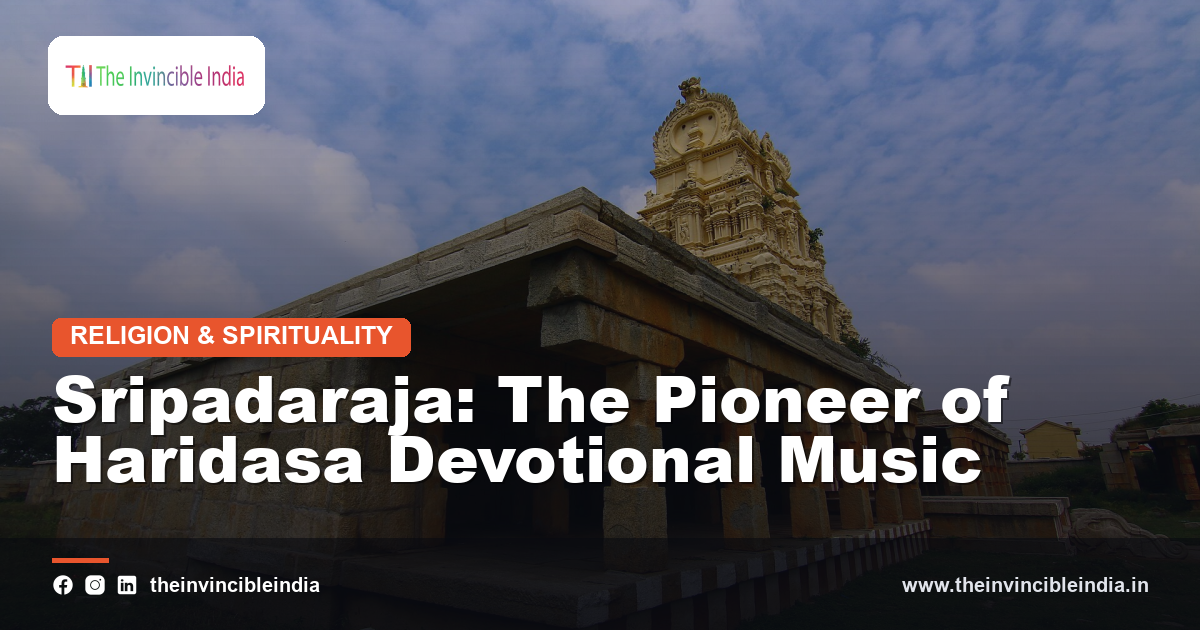
Sripadaraja, also spelled Sripadaraya or Sripadaraja Tirtha and known in his monastic name as Lakshminarayana Tirtha, is a Madhva Vaishnava pontiff and saint-composer of Karnataka who is remembered as a pioneer of Haridasa devotional music. He is traditionally linked with Mulbagal in the Kolar region, where his monastery and brindavana are honoured, and he is dated in general terms to the fifteenth century. His songs in Kannada, signed with the name Ranga Vittala, helped to shape a lasting tradition of devotional composition. He belongs to the great stream of Vishnu devotion described in the Vaishnavism guide.
Quick answer: Sripadaraja is a fifteenth-century Madhva Vaishnava pontiff and saint-composer of Karnataka, traditionally linked with Mulbagal, who is remembered as a pioneer of the Haridasa tradition of Kannada devotional music. He composed songs in Kannada under the name Ranga Vittala and taught Vyasatirtha, who in turn guided later Haridasas such as Purandara Dasa. His work opened the way for devotional music to reach ordinary people in their own language.
Key Takeaways
- Sripadaraja is a Madhva Vaishnava pontiff and saint-composer of Karnataka, remembered as a pioneer of the Haridasa tradition.
- He is traditionally linked with Mulbagal in the Kolar region of Karnataka, where a monastery and brindavana honour him.
- He is dated in general terms to the fifteenth century, and exact dates are not firmly established.
- His devotional songs in Kannada carry the signature name Ranga Vittala.
- Tradition counts Vyasatirtha, the great Dvaita scholar of the Vijayanagara era, among his disciples.
- The Haridasa tradition he helped to begin later flowered in the work of Purandara Dasa and Kanaka Dasa.
The sections below explain the life, works, teachings and continuing legacy in more detail.
Quick Facts
| Detail | Information |
|---|---|
| Also known as | Sripadaraya, Sripadaraja Tirtha, Lakshminarayana Tirtha |
| Role | Madhva Vaishnava pontiff, scholar and saint-composer |
| Tradition | Dvaita Vedanta and the Haridasa movement |
| Signature name in songs | Ranga Vittala |
| Associated place | Mulbagal, Kolar region, Karnataka |
| Language of songs | Kannada |
| Era | Fifteenth century (approximate) |
Who Was Sripadaraja?
Sripadaraja was a Madhva Vaishnava pontiff, scholar and devotional composer of Karnataka who is honoured as a pioneer of Haridasa music. He led a monastic lineage of the Dvaita tradition and wrote and taught in the learned language of Sanskrit while also composing songs in Kannada, the language of the people. This double role made him an important bridge between scholarship and popular devotion.
The accounts of his life come from devotional tradition and later biographical writing, and details such as exact dates are not firmly documented. Respectful readers treat the stories as sacred biography that expresses the character of a great teacher. What is consistent across the accounts is the picture of a learned, humble and deeply devout monk who held that devotion should be sung in a language everyone could understand.
What Is the Haridasa Tradition?
The Haridasa tradition is a devotional movement of Karnataka whose followers, called Haridasas or servants of Hari, sing the praise of Vishnu in Kannada. Its songs are known as kirtanas, devaranamas, ugabhogas and suladis, and they speak of devotion, ethics and the nature of the world in simple language. The movement is closely connected with the Dvaita philosophy of Madhvacharya.
Sripadaraja is regarded as one of the pioneers who gave this movement its early shape, and later saints such as Vyasatirtha, Purandara Dasa and Kanaka Dasa carried it forward. The tradition is notable because it brought deep philosophical ideas to ordinary listeners through music. It also forms an important root of the later Carnatic devotional repertoire.
Where Is Mulbagal and Why Is It Important?
Mulbagal is a town in the Kolar region of Karnataka, near the border with Andhra Pradesh, and it is traditionally linked with Sripadaraja and his monastic lineage. The town is the site of a monastery associated with his name, and his brindavana, the memorial shrine of a saint, is honoured there by devotees. Mulbagal is therefore a place of pilgrimage for followers of the Dvaita tradition.
The town also has other ancient shrines and a long history as a centre on routes between the Karnataka plateau and the east. The memory of the pontiff gives it special importance in the religious map of South India. Mulbagal stands as a reminder that centres of learning and devotion flourished in many smaller towns as well as in the great capitals.
What Is the Madhva Tradition and Dvaita Vedanta?
The Madhva tradition is a Vaishnava school founded on the teaching of Madhvacharya, who taught Dvaita Vedanta, the philosophy of duality. Dvaita holds that God and the individual soul are eternally distinct, and that devotion to Vishnu as the supreme being is the path to liberation. The tradition developed a rich body of commentary, debate and ritual, and it maintains monasteries across Karnataka, especially around Udupi.
Sripadaraja was a pontiff within this tradition, and his teaching was shaped by its principles. His songs express the same ideas in a simple devotional mood, speaking of surrender to Hari and the transience of worldly things. In this way his work shows that a demanding philosophy and a warm devotional music can belong together.
How Did Sripadaraja Begin Haridasa Music?
Sripadaraja began Haridasa music by composing devotional songs in Kannada that could be sung by anyone, rather than keeping devotion within the Sanskrit of the scholar. Tradition regards him as one of the first major figures to give this form a settled place in the religious life of Karnataka. His compositions used simple melodies, direct language and strong devotional feeling.
The shift to the language of the people was significant, because it allowed farmers, merchants and women to join in worship with understanding. Such a step was in tune with the wider Bhakti movement of India, which also favoured the languages of the common people. Sripadaraja’s contribution is therefore honoured as a foundation on which later Haridasas built.
What Does the Name Ranga Vittala Mean?
Ranga Vittala is the signature name, called the ankita, that Sripadaraja is traditionally said to have used in his songs. It is a name of the Lord in the form worshipped by him, combining Ranga, a name linked with Vishnu reclining at Srirangam, and Vittala, the name of the deity of Pandharpur, who is also known as Vitthal. The ankita acts as a signature of the composer.
Each Haridasa used an ankita of this kind, and later composers such as Purandara Dasa, with Purandara Vittala, and Vyasatirtha, with Krishna, followed the practice. The signature helps listeners to identify the author and also expresses the singer’s relationship with the Lord. For Sripadaraja it is a mark of devotion as well as of authorship.
What Types of Songs Are Linked With Sripadaraja?
The songs linked with Sripadaraja include kirtanas, ugabhogas and suladis, which are the main forms of early Haridasa composition. A kirtana is a devotional song with a refrain, an ugabhoga is a freer verse of melodic recitation, and a suladi is a structured song in a set of talas. These forms gave the movement its musical vocabulary.
Scholars note that attribution in old devotional literature can be uncertain, and the number of compositions securely ascribed to him is small compared with those of later saints. The songs are nevertheless remembered as models of simplicity and depth. They speak of praise, humility and trust in Hari, and they show the range of expression available to the early Haridasas.
Who Were the Disciples and Successors of Sripadaraja?
The most famous disciple of Sripadaraja is Vyasatirtha, also called Vyasaraja, the great Dvaita scholar who served at the court of the Vijayanagara empire. Tradition describes Vyasatirtha as having studied with Sripadaraja and as having carried his teacher’s devotion into public life. Through this connection the Haridasa movement gained a powerful and learned patron.
Vyasatirtha in turn guided Purandara Dasa and Kanaka Dasa, who are among the best-known Haridasa saints, and Purandara Dasa is often called the father of Carnatic music. A line of teaching therefore runs from Sripadaraja through Vyasatirtha to these later masters. This lineage explains why Sripadaraja is regarded as the early source of a movement that grew very large.
What Was the Relationship With Vyasatirtha and the Vijayanagara Court?
Sripadaraja is traditionally linked with the Vijayanagara empire through his disciple Vyasatirtha, who became a respected religious adviser of the court. The empire was a great patron of religion, art and learning in South India, and Haridasa music flourished in its cultural setting. Tradition holds that the teacher’s influence reached the court through his pupil.
The details of this relationship are known mainly through devotional and later literary sources, and respectful readers treat them with that in mind. The overall picture is one of a monastic teacher whose students helped to make devotional music a part of public religious life. The connection shows how the spiritual and political worlds of medieval Karnataka were joined in cultural exchange.
What Is the Devotion to Venkateshwara and Other Deities in the Tradition?
Tradition describes Sripadaraja as devoted to Vishnu in several forms, including Krishna, Narasimha and Venkateshwara of Tirumala. Devotees recall that he sang to these forms of the Lord and that his devotion was both scholarly and tender. Such accounts are part of the sacred biography of the pontiff and are not documented history.
The variety of forms in his devotion reflects the broad Vaishnava practice of South India, where pilgrims visit many shrines of Vishnu. The Haridasa songs that followed him often mention the temples and deities of Karnataka and the neighbouring regions. In this way the tradition ties devotion to place, and it links the saint’s memory with a wide landscape of sacred sites.
How Do Monastic Lineages Preserve His Memory?
Monastic lineages preserve the memory of Sripadaraja through the monastery associated with his name at Mulbagal and through the continuing succession of pontiffs. Such a monastery, called a matha, is a centre of study, worship and charity, and its head carries the spiritual authority of the line. The Sripadaraja matha is known among the Madhva institutions of Karnataka.
Annual observances at the brindavana, the memorial shrine, recall the pontiff through worship, recitation and the singing of his songs. Scholars and devotees gather for these occasions. The lineage therefore keeps alive not only the memory of a person but also a method of teaching, which is a vital link between the past and present of the tradition.
Why Is Sripadaraja Important in Indian Culture?
Sripadaraja is important in Indian culture because he helped to turn devotion into a shared musical experience in the Kannada language. His example opened the door to a large body of devotional song that continues to be sung in homes, temples and concert halls. For this reason he is honoured as a pioneer of an entire literary and musical tradition.
The Haridasa songs also contributed to the growth of Kannada literature and to the Carnatic musical repertoire, where compositions of the Haridasas are still performed. By linking scholarship with simple song, he showed that philosophy and music can serve a common purpose. His legacy is a reminder that cultural movements often begin with the quiet work of a single teacher.
What Is the Link Between Haridasa Songs and Carnatic Music?
Haridasa songs are linked with Carnatic music because many compositions of Purandara Dasa and other Haridasas became part of the teaching and concert repertoire of South Indian classical music. Beginners often start their lessons with devotional pieces attributed to Purandara Dasa, whose work grew from the movement that Sripadaraja helped to start. The connection gives the Haridasa tradition a place in the history of the art.
Many Haridasa songs are also sung in the style of devotional music rather than the concert platform, in temples and gatherings. They continue to be heard in both forms. In this way the early work of Sripadaraja can be traced through a long chain of teachers and performers into the living music of today.
How Do Devotees Honour Sripadaraja?
Devotees honour Sripadaraja by visiting his brindavana at Mulbagal, by singing his songs and by attending observances held in his memory. Followers of the Madhva tradition and lovers of Haridasa music recall him with respect as one of the early lights of the movement. Students of music sometimes remember him as part of the lineage of the Haridasas.
The worship is simple and devotional, in keeping with the spirit of the tradition. It includes prayer, recitation, the offering of food and the singing of Kannada devotional songs. The occasion unites scholars, musicians and ordinary pilgrims, and it keeps alive the humility and joy that the pontiff is said to have shown in his own life.
What Lessons Does His Life Offer?
The life of Sripadaraja offers the lesson that learning and devotion are partners and that spiritual truth should be shared in a language people can understand. He is held up as an example of a scholar who did not keep wisdom for the few. These qualities appeal to readers of every background, whether or not they share the Dvaita faith.
The tradition also teaches that a single teacher can begin a stream that flows for centuries, because his pupils carry the work onward. The success of the Haridasa movement shows the value of patient teaching and of trust in disciples. Taken together, his story presents a picture of leadership based on humility, music and love for the Lord.
Sripadaraja Today
Sripadaraja today is remembered as the pioneer of Haridasa devotional music and as a respected pontiff of the Madhva tradition in Karnataka. His brindavana at Mulbagal is visited by devotees, and his songs are recalled in discussions of the origins of Haridasa sahitya. Scholars of Kannada literature and music study his place at the start of the movement.
For students of Indian religion and music, he is an important example of how devotion found a new voice in regional languages during the medieval period. The accounts that survive are traditional, and respectful readers treat them as sacred narrative that carries real devotional meaning. His memory lives on in the monastery at Mulbagal and in every Kannada devotional song sung in praise of Hari.
Sources & Further Reading
- Ministry of Culture, Government of India (indiaculture.gov.in).
- Sangeet Natak Akademi, India’s National Academy for Music, Dance and Drama (sangeetnatak.gov.in).
Frequently Asked Questions
Who was Sripadaraja?
Sripadaraja was a fifteenth-century Madhva Vaishnava pontiff and saint-composer of Karnataka, traditionally linked with Mulbagal. He is remembered as a pioneer of Haridasa devotional music in Kannada.
Where is the brindavana of Sripadaraja?
The brindavana of Sripadaraja is traditionally located at Mulbagal in the Kolar region of Karnataka. It is honoured by devotees of the Madhva tradition and lovers of Haridasa music.
What is the ankita of Sripadaraja?
His ankita, or signature name, is Ranga Vittala. Haridasa composers placed such a name in their songs to mark authorship and to express devotion to the Lord.
Who was the famous disciple of Sripadaraja?
The most famous disciple of Sripadaraja is Vyasatirtha, also called Vyasaraja, the great Dvaita scholar of the Vijayanagara era. Tradition says that Vyasatirtha later guided Haridasas such as Purandara Dasa and Kanaka Dasa.
What is Haridasa sahitya?
Haridasa sahitya is the body of Kannada devotional literature and songs composed by the Haridasas, the servants of Hari. It includes kirtanas, ugabhogas and suladis and is closely tied to Dvaita Vedanta.
Why is Sripadaraja important?
Sripadaraja is important because he helped to begin the Haridasa tradition, which brought devotion to ordinary people in the Kannada language. His teaching lineage led to later masters whose songs are still sung today.


