

The Srisailam temple, also known as the Srisailam Mallikarjuna Temple, the Bhramaramba Mallikarjuna Temple or the Sri Sailam Devasthanam, is a renowned Hindu pilgrimage centre set on the forested Nallamala hills above the Krishna River in Andhra Pradesh. It is celebrated as the home of one of the twelve Jyotirlingas of Shiva and also as a Shakti Peetha dedicated to the goddess Bhramaramba, a rare combination of both sacred traditions in one place. Its massive stone walls, towering gateways and long history of royal patronage make it a major monument as well as a place of worship, and it belongs to the same sacred landscape explored in the guide to Indian temple architecture. This guide explains its history, art and meaning.
Quick answer: The Srisailam temple, or Srisailam Mallikarjuna Temple, is a Hindu temple on the Nallamala hills beside the Krishna River in Andhra Pradesh, India, dedicated to Shiva as Mallikarjuna and to the goddess Bhramaramba. It is one of the twelve Jyotirlinga shrines and is also counted among the Shakti Peethas, which makes it unusually sacred. It has been a centre of pilgrimage for many centuries and was patronised by several dynasties.
Key Takeaways
- The Srisailam temple is a Hindu temple in Andhra Pradesh dedicated to Shiva as Mallikarjuna and to the goddess Bhramaramba.
- It is one of the twelve Jyotirlingas, the most sacred shrines of Shiva.
- It is also counted among the Shakti Peethas, which makes it one of the few places that holds both a Jyotirlinga and a Shakti Peetha.
- The temple stands on the Nallamala hills on the bank of the Krishna River, close to the Srisailam dam and a large tiger reserve.
- Its high stone enclosure walls are covered with sculpted panels, and the complex was supported by many rulers including the Vijayanagara kings.
- Major festivals such as Maha Shivaratri draw very large numbers of pilgrims every year.
The sections below describe the sacred meaning, history, architecture and pilgrimage traditions of Srisailam.
Quick Facts
| Detail | Information |
|---|---|
| Location | Srisailam, on the Nallamala hills beside the Krishna River, Andhra Pradesh |
| Also known as | Sri Sailam, Srisailam Mallikarjuna Temple, Bhramaramba Mallikarjuna Temple |
| Deities | Shiva as Mallikarjuna; goddess Bhramaramba |
| Sacred status | One of the twelve Jyotirlingas and a Shakti Peetha |
| Setting | Forested hills and the Krishna River gorge |
| Notable features | Fortress-like stone walls, sculpted panels, gateways, nearby dam and tiger reserve |
What Is the Srisailam Temple?
The Srisailam temple is a major Hindu temple complex in Andhra Pradesh, dedicated to Shiva in the form of Mallikarjuna and to the goddess Bhramaramba. It stands on the Nallamala hills, a range of forested uplands that rises above the Krishna River, and it has been a place of pilgrimage for many centuries. The temple is notable for combining two great sacred traditions, since it houses a Jyotirlinga and also a Shakti Peetha within the same enclosure. Its architecture is dominated by massive stone walls and tall gateways that give it a fortress-like appearance. For devotees it is a place where divine presence is felt in both the hills and the shrine. The Srisailam temple therefore stands as one of the most important centres of Shaiva and Shakta devotion in southern India.
Where Is the Srisailam Temple Located?
The Srisailam temple is located in the town of Srisailam in Andhra Pradesh, on a plateau of the Nallamala hills on the south bank of the Krishna River. The surrounding country is a forested range that forms part of the Eastern Ghats, and the temple stands within a large wildlife reserve known as the Nagarjunasagar-Srisailam Tiger Reserve. The nearby Srisailam dam, built across the river gorge, has created a vast reservoir that adds to the beauty of the landscape. The town is reached by road through winding forest routes, and the journey itself is part of the experience for many pilgrims. The setting of hills, river and forest suits a shrine of Shiva, who is traditionally associated with mountains. The location of the Srisailam temple thus gives the pilgrimage both spiritual meaning and natural grandeur.
Why Is Srisailam One of the Twelve Jyotirlingas?
Srisailam is one of the twelve Jyotirlingas because tradition holds that Shiva manifested here as a pillar of light, and the Mallikarjuna linga is the sacred sign of that manifestation. The twelve Jyotirlingas are spread across India and are among the most revered shrines of Shiva, and a pilgrimage to all twelve is considered a great act of devotion. The Srisailam Jyotirlinga is the only one located in the Andhra region and is often listed second in the traditional sequence of twelve. Devotees believe that darshan here confers peace, liberation from sin and fulfilment of wishes. The tradition is recorded in the Puranas and in devotional hymns. Srisailam therefore holds a place of special honour among the twelve, and its Jyotirlinga draws pilgrims from every part of the country.
What Does the Name Mallikarjuna Mean?
The name Mallikarjuna is a compound that is traditionally explained as joining Mallika, the jasmine flower, with Arjuna, a name associated with the white arjuna tree, though popular tradition connects the second part with the hero Arjuna of the Mahabharata. The name is used for Shiva as worshipped at Srisailam, where he is honoured together with his consort Bhramaramba. According to local belief, the goddess offered jasmine garlands to the Lord, and the name recalls that offering. The hill itself is called Sriparvata or Srigiri in ancient texts, which means the sacred mountain. Names and explanations differ between sources, and the meanings are part of living devotional tradition. The name Mallikarjuna thus reflects the poetic and symbolic way in which devotees have understood the deity of Srisailam for centuries.
Who Is the Goddess Bhramaramba?
Bhramaramba is the goddess of Srisailam, worshipped as the consort of Mallikarjuna and as a powerful form of the Divine Mother. Her name is linked with the bee, bhramara in Sanskrit, and a well-known legend says that she took the form of a bee to overcome a demon. Her shrine stands within the temple complex, close to that of Mallikarjuna, and it is one of the places counted among the Shakti Peethas, the sacred sites where parts of the goddess are believed to have fallen. Devotees offer prayers to her especially during festivals and on auspicious days. The joint worship of the Lord and the Goddess is central to the temple. The goddess Bhramaramba thus gives Srisailam its dual character as a shrine of both Shiva and Shakti.
How Old Is the Srisailam Temple?
The Srisailam temple is very old, and references to the sacred hill appear in ancient Sanskrit literature, though the age of the present buildings is far more recent. Tradition regards the shrine as extremely ancient, and inscriptions and literary references show that it was a place of pilgrimage and patronage over many centuries. The temple as seen today is the result of long development, with additions and repairs by successive rulers. Because the site has been continuously used, it is difficult to assign a single date to the whole complex. Exact origins are uncertain, and scholars treat the oldest traditions with care. What is clear is that Srisailam has been revered for a very long time. The age of the Srisailam temple therefore lies in the depth of its tradition as much as in the age of its stones.
Which Dynasties Patronised the Srisailam Temple?
Several dynasties patronised the Srisailam temple over the centuries, and their gifts shaped the complex that survives today. Early rulers of the Deccan, including the Satavahanas and later the Chalukyas, are associated with the region, and inscriptions record royal donations. The Kakatiyas and the Reddy kings of the Telugu country also supported the temple, and the Reddy rulers are credited with building stairways and other works for pilgrims. The Vijayanagara emperors were especially generous, constructing halls and gateways, and Krishnadevaraya is remembered for his gifts. Later Maratha rulers are also associated with additions. This long line of patrons reflects the temple’s national importance. The dynasties that patronised the Srisailam temple therefore left their marks in its walls, halls and inscriptions, and the monument is a record of many reigns.
What Is the Architecture of the Srisailam Temple?
The architecture of the Srisailam temple is of the southern Dravidian tradition, adapted to a hilltop setting and surrounded by a massive fortified enclosure. Within the walls lie the main shrines of Mallikarjuna and Bhramaramba, pillared halls, smaller shrines and open courtyards. Tall gateways, known as gopurams, mark the entrances and rise in carved tiers above the walls. The main sanctum is topped with a tower, and the halls are supported by sculpted pillars of the kind seen across southern India. The overall plan is orderly and processional, leading the pilgrim from the outer gate toward the sacred centre. The architecture of Srisailam thus shows how Dravidian temple design could be shaped to fit a hill shrine.
What Are the Sculpted Enclosure Walls of Srisailam?
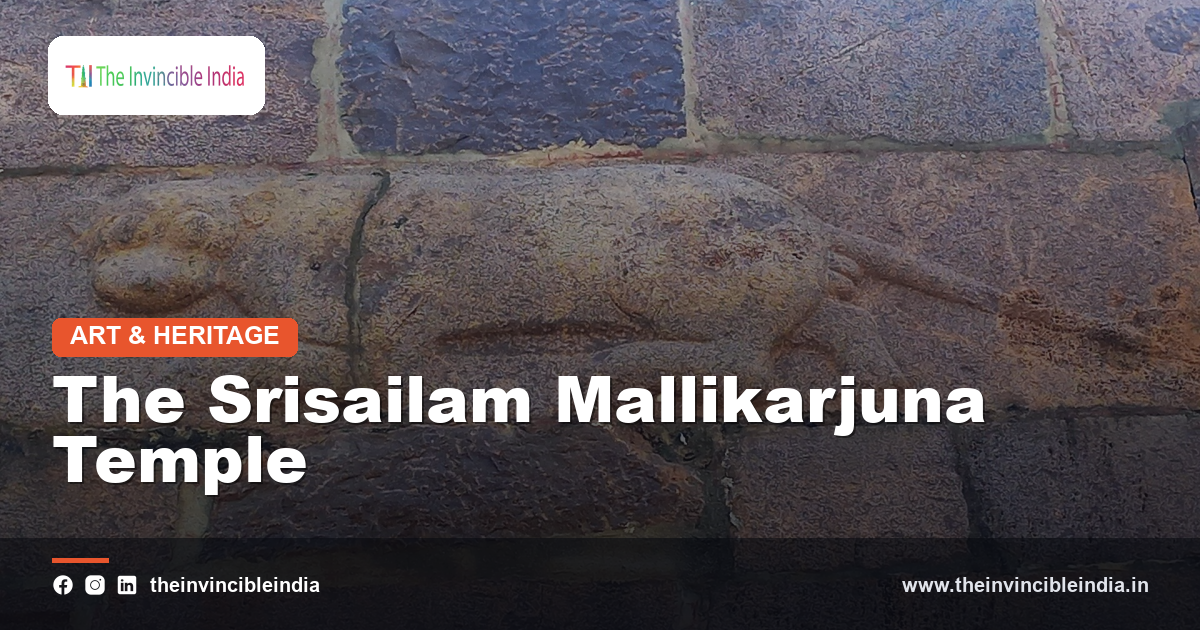
The sculpted enclosure walls of Srisailam are among the most distinctive features of the temple, forming a high stone rampart that surrounds the entire complex. The walls are built of large blocks of stone and are covered with panels of relief carving that illustrate scenes from the epics, the Puranas and the lives of saints. These carved bands give the walls a narrative quality, so that a pilgrim walking around the temple sees a continuous story told in stone. The scale of the walls also gives the temple the look of a fortress, which suited its remote hill setting. Although time and weather have worn some panels, many remain clear and impressive. The sculpted enclosure walls of Srisailam thus combine defence, devotion and storytelling in a single monumental form.
What Is the Story of Mallikarjuna and Bhramaramba?
The story of Mallikarjuna and Bhramaramba is told in the Puranas and in local tradition as a tale of divine union and devotion. In one popular account, Shiva and Parvati came to the Sriparvata hill and settled there as Mallikarjuna and Bhramaramba, and the place became a centre of their worship. Another tradition tells how the goddess took the form of a bee to slay a demon who had threatened the world, which explains her name. There are also stories about devotees who offered garlands of jasmine, linking the name Mallikarjuna with that gesture. These legends vary from source to source and form part of a rich oral and literary heritage. The story of Mallikarjuna and Bhramaramba thus supplies the spiritual narrative that gives the temple its meaning and draws devotees year after year.
Which Saints and Teachers Are Linked with Srisailam?
Several saints and teachers are linked with Srisailam, which has long been a meeting place of devotion, learning and ascetic life. Tradition holds that Adi Shankaracharya visited the hill and composed a hymn in praise of Mallikarjuna, and the site is remembered in accounts of his travels. The Veerashaiva poet-saint Akka Mahadevi is also associated with the forests near Srisailam, where she is said to have spent her later life in meditation. Many other sages, poets and mystics are believed to have visited, and the hill came to be seen as a place of spiritual attainment. Details of these traditions differ in the sources, and some are known mainly through devotional memory. The saints linked with Srisailam thus add a layer of intellectual and mystical history to the temple, and they reinforce its stature as a centre of Shaiva thought.
What Other Sacred Sites Are Near Srisailam?
Other sacred sites near Srisailam include a number of smaller shrines, viewpoints and natural spots that make up the larger pilgrimage circuit of the hill. Among the places commonly visited are the Sakshi Ganapati shrine, where pilgrims report their arrival to the elephant-headed god, and the Hatakeshwaram and Sikharam viewpoints, which are associated with Shiva and offer wide views over the forest. The Paladhara Panchadhara spring is another site linked with the Adi Shankaracharya tradition. Pathala Ganga, a section of the Krishna River below the hill, is a place of ritual bathing, reached by steps or a ropeway. These places surround the main temple like a halo of devotion. The nearby sacred sites thus extend the Srisailam pilgrimage beyond the main shrine and give visitors a fuller sense of the sanctity of the hill.
What Festivals Are Celebrated at Srisailam?
The festivals celebrated at Srisailam draw very large numbers of pilgrims, and the most important is Maha Shivaratri, the great night of Shiva. During this period the temple is richly decorated, special rituals are performed and devotees stay awake in worship through the night. The Ugadi festival, which marks the new year in the Telugu and Kannada regions, is also celebrated with great enthusiasm, and many devotees from Karnataka and Andhra Pradesh walk long distances to attend it. The Navaratri days are observed with special worship of the goddess Bhramaramba. Processions, music and community meals add to the festive atmosphere. Such festivals show that Srisailam is a living centre of faith and not only an ancient monument. The festivals of Srisailam thus keep alive a tradition of collective devotion that has continued for generations.
How Can Visitors Reach and Visit Srisailam?
Visitors can reach Srisailam mainly by road, since the temple town lies in the hills and is connected by highways that pass through forested country. The journey from Hyderabad takes the traveller through the Nallamala forest, and the route is scenic but winding. Accommodation is provided by the temple administration and by local hotels, and demand rises sharply during festivals. Visitors should dress modestly, follow the temple’s rules for darshan and be prepared for queues on busy days. Because the area lies within a tiger reserve, there are restrictions on travel at night and rules about behaviour on the forest roads. Checking current arrangements before travel is wise. A visit to Srisailam, with a little planning, becomes a deeply rewarding journey that combines pilgrimage, natural beauty and a sense of history.
Why Is the Srisailam Temple Important?
The Srisailam temple is important because it holds a unique place in the religious geography of India as both a Jyotirlinga and a Shakti Peetha. It is a centre of devotion that has attracted pilgrims from across the country for many centuries, and it has long been a point of contact between the cultures of Andhra, Karnataka and beyond. The temple’s architecture, with its great walls and carved panels, is also a major achievement of medieval south Indian art. The setting among hills, river and forest adds to its significance as a sacred landscape. For historians it is a rich source of inscriptions and evidence of royal patronage. The importance of the Srisailam temple therefore lies in its sanctity, its art and its living tradition, which together make it one of the great pilgrimage centres of India.
The Srisailam Temple Today
The Srisailam temple today is a thriving pilgrimage centre that welcomes large numbers of devotees throughout the year. Managed by a devasthanam, or temple administration, it provides facilities for darshan, lodging and festival arrangements, and it continues to maintain the rituals that have been followed for generations. The surrounding forests, river and dam add to its appeal for visitors who seek both spiritual and natural experiences. Conservation efforts aim to protect the old walls and sculptures while accommodating the needs of modern pilgrims. The temple remains an important part of the cultural life of Andhra Pradesh and the neighbouring states. The Srisailam temple thus stands as a living monument, where ancient faith, grand architecture and the beauty of the Nallamala hills come together in a single and enduring sacred place.
Sources & Further Reading
- Archaeological Survey of India (asi.nic.in).
- Department of Tourism, Government of Andhra Pradesh (tourism.ap.gov.in).
Frequently Asked Questions
What is the Srisailam temple famous for?
The Srisailam temple is famous as the home of the Mallikarjuna Jyotirlinga, one of the twelve most sacred shrines of Shiva, and as a Shakti Peetha dedicated to the goddess Bhramaramba. It is also known for its fortress-like carved stone walls and its forest setting.
Where is the Srisailam temple located?
The Srisailam temple is located on the Nallamala hills beside the Krishna River in Andhra Pradesh, within a large tiger reserve. The town of Srisailam is reached by road through forested country. The Srisailam dam lies nearby.
Is Srisailam both a Jyotirlinga and a Shakti Peetha?
Yes, Srisailam is both a Jyotirlinga and a Shakti Peetha, which makes it one of the few places in India with both distinctions. The Jyotirlinga is Mallikarjuna, a form of Shiva, and the Shakti Peetha is the shrine of the goddess Bhramaramba. The two shrines stand within the same temple complex.
What does the name Mallikarjuna mean?
Mallikarjuna is the name of Shiva as worshipped at Srisailam, and it is traditionally explained as joining Mallika, meaning jasmine, with Arjuna. Local tradition says the goddess offered jasmine garlands to the Lord. Explanations vary between sources.
Which festivals are celebrated at Srisailam?
The main festivals at Srisailam are Maha Shivaratri, Ugadi and Navaratri, each drawing large numbers of pilgrims. Maha Shivaratri is the most important, with night-long worship. Ugadi is especially popular with devotees from Karnataka and Andhra Pradesh.
How do I reach the Srisailam temple?
The Srisailam temple is reached mainly by road, and the journey from Hyderabad passes through the Nallamala forest. The route is scenic but winding. Because it crosses a tiger reserve, travel rules apply, so current arrangements should be checked in advance.


