

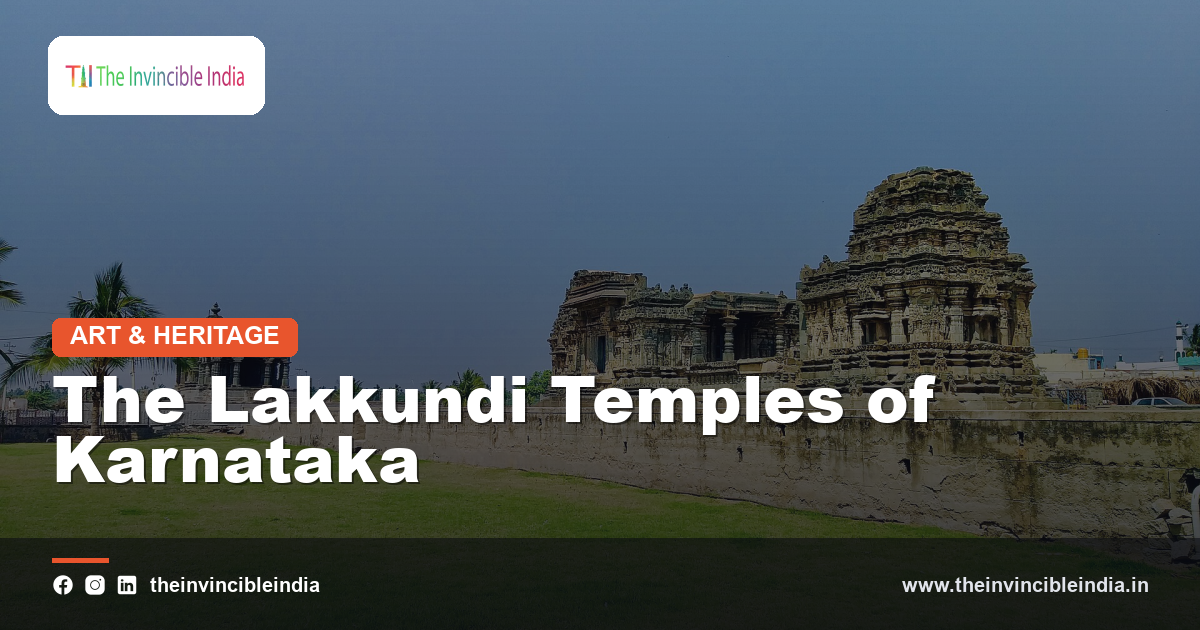
The Lakkundi temples, also spelled Lakkundi or Lokkigundi in older records, are a remarkable cluster of medieval stone shrines in Gadag district of northern Karnataka. Built mainly in the age of the Western Chalukyas, they are admired for their ornate pillars, finely shaped towers and richly carved doorways, and they include both Hindu and Jain temples. The village was once an important town and centre of art, and its monuments now rank among the finest in the Karnataka tradition. Their style is a refined branch of the broader Dravidian family discussed in the guide to Dravidian temple architecture. This guide explains their history, design and meaning.
Quick answer: The Lakkundi temples are a group of medieval Hindu and Jain stone temples in the village of Lakkundi (Lokkigundi) in Gadag district, Karnataka, India. They were built mainly under the Western Chalukyas in about the eleventh and twelfth centuries and are celebrated for ornate carving in the Karnata Dravida style. The best known are the Kasivisvesvara temple, the Manikeshvara temple and the Brahma Jinalaya.
Key Takeaways
- The Lakkundi temples are medieval stone temples in Gadag district, Karnataka, built mainly in the Western Chalukya period.
- They are generally dated to about the eleventh and twelfth centuries, a high point of Western Chalukya art.
- The Kasivisvesvara temple is the most admired, with a double-shrine plan and richly carved doorways and pillars.
- The group includes both Shaiva temples and a major Jain temple, the Brahma Jinalaya.
- Lakkundi is also known for its elaborately built stepped wells, called kalyanis or bavis.
- Lakkundi lies near other Western Chalukya sites such as Gadag, Dambal and Itagi.
The sections below describe the history, design and principal monuments of Lakkundi and how a visitor can explore them today.
Quick Facts
| Detail | Information |
|---|---|
| Location | Lakkundi village, Gadag district, northern Karnataka |
| Also known as | Lokkigundi (older name), Gadag-Lakkundi style temples |
| Type | Medieval Hindu and Jain stone temples |
| Approximate era | Mainly eleventh to twelfth centuries CE |
| Dynasty | Western Chalukyas (Kalyani Chalukyas) |
| Principal monuments | Kasivisvesvara, Manikeshvara, Brahma Jinalaya, stepped wells |
What Are the Lakkundi Temples?
The Lakkundi temples are a group of medieval stone temples in the village of Lakkundi in northern Karnataka, built mostly during the rule of the Western Chalukyas. They include shrines dedicated to Shiva and other Hindu deities and a significant Jain temple, which reflects the religious diversity of the age. The temples are admired for the precision of their stone carving, the elegance of their towers and the richness of their pillars, doorways and ceilings. Although the village is small today, it once held considerable importance, and its monuments show the high level of art that flourished here. Together they form one of the most complete groups of Western Chalukya architecture in the region. The Lakkundi temples therefore offer a rare opportunity to study a refined style of medieval Indian temple building in a single compact setting.
Where Are the Lakkundi Temples Located?
The Lakkundi temples are located in the village of Lakkundi in Gadag district, in the northern part of Karnataka. The village lies a short distance from the town of Gadag, which is itself an important regional centre with a number of historic temples. This part of Karnataka sits on the dry Deccan plateau, with open farmland, black soil and low rocky hills, and the stone used for the temples comes from the surrounding area. The monuments are scattered through the village streets, so that a walk through Lakkundi becomes a walk among shrines, wells and old houses. The region lies between the better known sites of Hampi, Badami and Pattadakal, which makes Lakkundi a rewarding addition to a longer tour. The location of the Lakkundi temples thus places them in the heartland of northern Karnataka’s architectural heritage.
Why Is Lakkundi Historically Important?
Lakkundi is historically important because it was a prosperous town and an important centre of art, trade and religion in the medieval Deccan. Records from the period refer to it under the name Lokkigundi, and it appears in inscriptions that record gifts to temples and the building of new shrines. Under the Western Chalukyas it was associated with skilled sculptors, wealthy patrons and a thriving community of merchants. The town also had a mint, according to historical accounts, which suggests its economic strength. Both Shaiva and Jain traditions flourished here, and the town became a meeting point of different faiths and artistic ideas. The historical importance of Lakkundi therefore rests on its role as a lively urban and cultural centre, whose surviving temples are only the visible part of a once larger and busier settlement.
Who Were the Western Chalukyas?
The Western Chalukyas, also called the Later or Kalyani Chalukyas, were a powerful dynasty that ruled much of the Deccan in the medieval period from their capital at Kalyani. They are remembered as great patrons of art, literature and religion, and their reign saw the building of many fine temples in northern Karnataka. Their architects developed a distinctive style that is often called the Karnata Dravida or Gadag style, characterised by richly carved pillars, layered towers and elaborately decorated doorways. Scholars and poets also flourished at their court, and the Kannada language gained literary prestige. The Lakkundi temples belong to this golden age of the dynasty. The Western Chalukyas therefore provide the political and cultural background for the temples, and their patronage explains the refined quality and variety of the art found in Lakkundi.
What Is the Gadag Style of Architecture?
The Gadag style, also called the Western Chalukya or Karnata Dravida style, is a regional form of temple architecture known for its ornate stonework and its skilful blending of northern and southern ideas. Temples in this style usually have a sanctum, a vestibule and a hall, with the whole structure raised on a decorated platform. The towers rise in clear tiers, and the walls are divided by pilasters and miniature shrines. The most striking feature is the lathe-turned look of the pillars, which are polished and shaped with remarkable precision. Doorways and ceilings are often covered with deeply cut foliage, figures and geometric patterns. Lakkundi is one of the finest centres of this style. The Gadag style thus gives the temples their distinct character, and it connects them with a wider family of Dravidian-inspired shrines across the Deccan.
What Is the Kasivisvesvara Temple at Lakkundi?
The Kasivisvesvara temple is the most celebrated monument of Lakkundi, and it is regarded as one of the masterpieces of Western Chalukya architecture. The temple is dedicated to Shiva and has a twin-shrine plan, with two sanctums linked by a shared hall, which gives the building an unusual and balanced form. Its pillars are exquisitely turned, its doorways are richly carved, and its walls are decorated with finely cut sculpture. The tower above the shrine rises in clear and graceful tiers. Inscriptions and style place the temple in the Western Chalukya period, and it is often visited as the highlight of the village. Standing before it, a visitor can see how stone was shaped with extraordinary delicacy. The Kasivisvesvara temple thus shows the Lakkundi school at its most accomplished and is the natural starting point for any visit.
What Is Special About the Carving at Lakkundi?
The carving at Lakkundi is special for its delicacy, its depth and its unusual variety, which together make the temples feel almost like works of metal or ivory rendered in stone. Craftsmen worked in a fine-grained stone that allowed sharp detail, and they covered doorways, pillars, ceilings and wall panels with intricate designs. Scrolling foliage, dancing figures, mythical creatures and divine images appear in layered bands. The pillars are often turned to a glossy finish, and the ceilings are carved with lotus patterns in concentric rings. Such work demanded great patience and an expert understanding of the material. The overall effect is richness without crowding, as each motif is clearly shaped and given room. The carving at Lakkundi thus stands as a high point of Karnataka sculpture, and it rewards slow and close looking.
What Is the Manikeshvara Temple?
The Manikeshvara temple is another important Shaiva shrine at Lakkundi, and it adds to the picture of Western Chalukya temple building in the village. Like the other major temples here, it has a sanctum, an entrance hall and a tower, and it is built of carefully fitted stone. Its sculpture and ornament follow the same refined style, with decorated doorways, turned pillars and carved bands along the walls. The temple stands near a large stepped well, and the two together form an attractive architectural group. Local worship has continued here for generations, which gives the monument a living quality. Visitors often compare the Manikeshvara temple with the Kasivisvesvara temple to see how designs varied within a single tradition. The Manikeshvara temple therefore helps show the depth and diversity of temple building at Lakkundi.
What Is the Brahma Jinalaya?
The Brahma Jinalaya is the principal Jain temple of Lakkundi, and it shows that the town was an important centre of Jainism as well as Shaivism. Tradition associates the temple with Attimabbe, a noblewoman of the Western Chalukya period renowned for her generosity to Jain causes and for sponsoring temples and manuscripts. The temple has a sanctum with an image of a Jina, a hall and a tall, tiered tower, and its pillars and doorways are finely carved. The building is thought to belong to the same age as the Hindu temples, and its style fits the wider Western Chalukya tradition. Its presence in the same village shows peaceful coexistence between different faiths. The Brahma Jinalaya thus demonstrates the pluralism of medieval Karnataka and adds a Jain chapter to the story of Lakkundi.
What Are the Stepped Wells of Lakkundi?
The stepped wells of Lakkundi are elaborately built water structures, known as kalyanis or bavis, which show that the builders gave care and beauty even to practical works. A stepped well is a deep reservoir reached by flights of stone steps, with niches, platforms and small shrines built into its sides. At Lakkundi these wells are lined with carved stonework, and some have rows of miniature shrines around the water. They served religious and everyday purposes, providing water for bathing, ritual and use by villagers. Their geometry, with descending tiers and sharp stone edges, gives them a striking visual quality. The stepped wells of Lakkundi therefore remind visitors that medieval temple complexes were designed with water in mind, and that the combination of utility and art was a hallmark of the age.
What Do the Inscriptions at Lakkundi Reveal?
The inscriptions at Lakkundi are important sources of history because they record grants, donors and events connected with the temples and the town. Written in the Kannada language and script, they preserve the names of rulers and local officials and mention gifts made for worship, lamps and maintenance. Together they reveal how temples were supported economically by endowments of land and revenue. They also provide evidence for the dating of the buildings and for the religious life of the community. Some inscriptions are found on stones set in the temple walls or on separate slabs in the village. Such records make Lakkundi a valuable site for historians of the Deccan. The inscriptions at Lakkundi thus allow the stone buildings to be understood not only as art but also as part of a documented social and economic world.
How Does Lakkundi Compare with Other Chalukyan Sites?
Lakkundi compares with other Chalukyan sites as a later and more refined stage in the development of Karnataka temple architecture. The earlier Chalukyas of Badami built the experimental temples of Aihole and Pattadakal, which are among the cradle sites of Indian temple building. The Western Chalukyas, who ruled several centuries later, continued the tradition but gave it greater ornament and polish, as seen at Lakkundi, Gadag, Dambal and Itagi. Visitors to the region can follow this evolution by visiting sites in sequence. Lakkundi is notable for the high concentration of fine monuments within a small village. The comparison shows continuity and change within the Chalukyan heritage. Lakkundi therefore occupies an important place in the long story of temple architecture in Karnataka, which spans several dynasties.
What Are the Main Features of a Lakkundi Temple?
The main features of a Lakkundi temple include a raised platform, a sanctum with a tiered tower, a pillared hall and elaborately carved doorways. The platform lifts the temple above the ground and gives it presence, while the tower rises in diminishing levels topped by a stone crown. Inside, the hall is supported by polished pillars, and the ceilings are decorated with intricate lotus patterns. The outer walls are broken into rhythmic bays with pilasters and miniature shrines, giving a sense of movement. Sculpture is used with restraint and precision, and the overall composition is balanced and harmonious. These features were repeated in various ways across the village. The main features of a Lakkundi temple thus reflect a mature architectural language, in which structure, ornament and proportion are carefully held together.
How Can Visitors Explore the Lakkundi Temples?
Visitors can explore the Lakkundi temples on foot, since the main monuments are scattered through the village within comfortable walking distance. The village is reached from the town of Gadag by a short road journey, and many travellers combine it with visits to Gadag, Dambal and Itagi. The cooler months from autumn to early spring are the best time, because the plateau can be very hot in summer. A guide or local caretaker can help in locating the lesser known shrines and wells. Visitors should dress modestly, remove footwear where required and avoid touching the carved surfaces. A small museum in the village displays sculptures and fragments found locally. With patience and curiosity, the Lakkundi temples reward visitors with a quiet, atmospheric day of discovery in the heart of northern Karnataka.
The Lakkundi Temples Today
The Lakkundi temples today stand as protected monuments, admired by architects, historians and travellers from across India and abroad. Conservation work continues to preserve the stone, and many of the temples are still associated with local worship and festivals. Although the village is quiet, the monuments give it great cultural weight, and efforts have been made to promote it as part of a wider heritage circuit in northern Karnataka. Researchers continue to study the architecture, sculpture and inscriptions for what they reveal about medieval society. For visitors the temples offer a sense of discovery that is less hurried than at more famous sites. The Lakkundi temples thus remain a vivid reminder of the artistic brilliance of the Western Chalukyas and of the enduring skill of Karnataka’s stone carvers.
Sources & Further Reading
- Archaeological Survey of India (asi.nic.in).
- Department of Tourism, Government of Karnataka (karnatakatourism.org).
Frequently Asked Questions
What are the Lakkundi temples?
The Lakkundi temples are a group of medieval Hindu and Jain stone temples in Lakkundi village, Gadag district, Karnataka. They were built mainly under the Western Chalukyas and are famed for refined carving and elegant towers.
Where is Lakkundi located?
Lakkundi is located in Gadag district in northern Karnataka, a short distance from the town of Gadag. It lies on the Deccan plateau between sites such as Hampi, Badami and Pattadakal. The temples are spread through the village and can be visited on foot.
Which dynasty built the Lakkundi temples?
The Lakkundi temples were built mainly under the Western Chalukyas, also called the Kalyani Chalukyas, in about the eleventh and twelfth centuries. This dynasty was a great patron of art and architecture in the Deccan. Their style is often called the Gadag or Karnata Dravida style.
What is the Kasivisvesvara temple known for?
The Kasivisvesvara temple is known as the finest temple at Lakkundi, with a twin-shrine plan, polished pillars and richly carved doorways. It is dedicated to Shiva. It is widely regarded as a masterpiece of Western Chalukya architecture.
What is the Brahma Jinalaya at Lakkundi?
The Brahma Jinalaya is the main Jain temple at Lakkundi and is traditionally associated with Attimabbe, a noble patron of Jain art. It has a sanctum, a hall and a tiered tower. It shows that Jainism and Shaivism both flourished in the town.
What is the best time to visit Lakkundi?
The best time to visit Lakkundi is generally from autumn to early spring, when the weather is cooler and walking through the village is comfortable. Summer can be very hot. Early morning gives pleasant light for viewing the carvings.


