

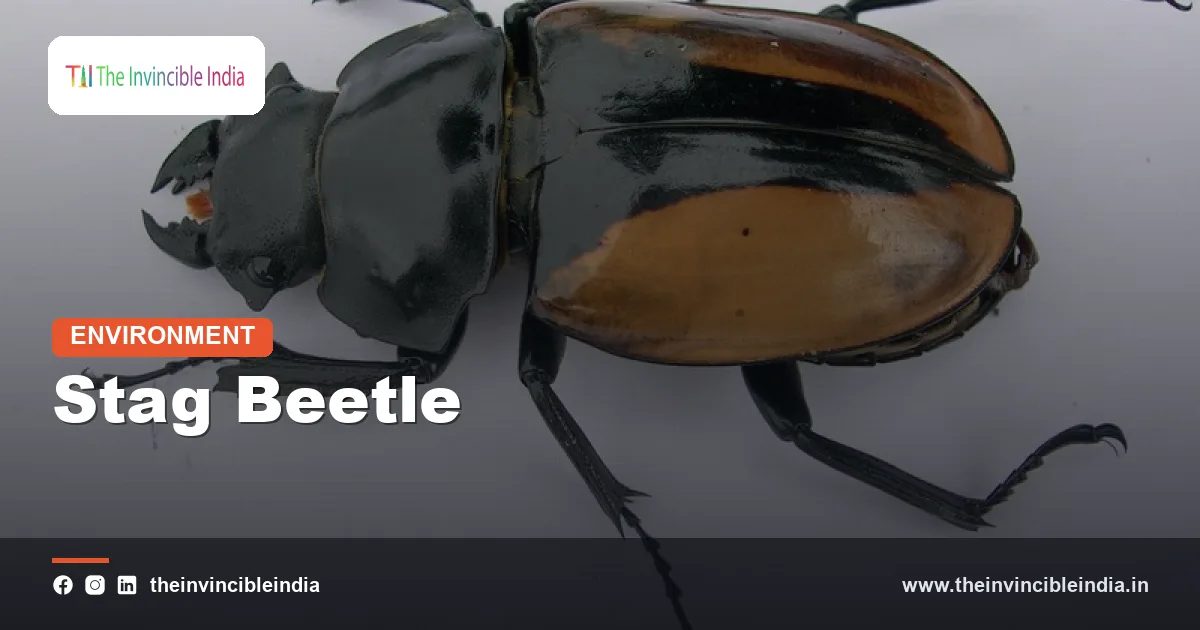
A stag beetle is a large, dark, wood-associated beetle of the family Lucanidae, in which the males carry enlarged, antler-like jaws that they use to wrestle rivals rather than to feed. Stag beetles occur in forests, hill woodlands and even wooded gardens across India, from the Himalayan foothills and the north-east to the Western Ghats, and their grubs spend most of their lives inside rotting wood.
Despite their fierce look, stag beetles are slow, shy and largely harmless insects, and they play a quiet but useful part in recycling dead timber. This explainer covers how to recognise a stag beetle, what its jaws are for, how the life cycle unfolds, where the beetle lives in India and why it matters to forests.
| Quick Fact | Detail |
|---|---|
| Scientific classification | Order Coleoptera (beetles), family Lucanidae; several genera occur in India, including Lucanus, Dorcus, Prosopocoilus, Odontolabis and Hexarthrius |
| Size | Roughly 2 cm to well over 7 cm depending on the species, with males usually larger than females because of their jaws |
| Habitat in India | Moist and dry forests, hill woodlands, the Himalayan foothills, the north-east, the Western Ghats, and wooded gardens near old trees |
| Diet | Larvae eat decaying wood and root material; adults lick tree sap, rotting fruit and other sugary fluids |
| Life cycle | Complete metamorphosis: egg, larva (grub), pupa and adult; the larval stage lasts much longer than the adult stage |
| Ecological role | Decomposer of dead wood, returning nutrients to the soil; also food for birds, lizards and small mammals |
| Notable features | Enlarged branched mandibles in males, elbowed (geniculate) antennae ending in a comb-like club, dark glossy body |
| Activity | Mostly nocturnal; adults are often drawn to lights during the monsoon months |
Key Takeaways
- A stag beetle is a beetle of the family Lucanidae, named for the male’s antler-like jaws that resemble the horns of a stag.
- The oversized jaws of a male stag beetle are used mainly to wrestle rival males for mates, not to catch or chew food.
- Stag beetle larvae live in rotting wood for a long time, often several months to years, while adults live for only a short period.
- Adult stag beetles feed on tree sap and fruit juices, and they are not agricultural pests.
- Stag beetles are not dangerous to people; the larger-jawed males are awkward biters, and a pinch from a female can be firmer but is not medically serious.
- Stag beetles help recycle dead wood in Indian forests, so loss of old trees and fallen timber is the main threat to them.
What is a stag beetle?
A stag beetle is a member of the beetle family Lucanidae, a group of roughly 1,200 or more species worldwide that are known for their large, often branched jaws. The name comes from the resemblance of those jaws to the antlers of a stag deer. The family belongs to the order Coleoptera, the largest order of insects, which also includes ladybirds, weevils and dung beetles.
Stag beetles are generally robust, flattened or slightly convex insects with a hard wing case (the elytra) that protects folded flight wings beneath. Colours are usually black, dark brown or chestnut, sometimes with a metallic gleam. The antennae are bent like an elbow and end in a small comb-like club, which is a reliable way to separate stag beetles from many other large beetles.
In India the family is represented by a good number of species, and several are found only in particular hill regions. Because many stag beetles are active at night and spend most of their life as larvae hidden inside wood, most people meet them only when a male blunders into a lit verandah or when a rotting stump is broken open.
Why do male stag beetles have such large jaws?
Male stag beetles have large jaws because the jaws work as weapons and display structures in contests between rival males, not as tools for eating. During the breeding season males grapple, push and sometimes lift one another, and the winner usually keeps access to a female on a favoured tree.
The enlarged mandibles are an example of sexual selection, the same process that gives peacocks their trains. Larger males with longer jaws tend to win more contests, so the trait has been favoured over many generations. In many species the jaw size varies widely within a population, depending on how well a grub fed during its growth years.
The jaws are not used for feeding. The real mouthparts of an adult are small brush-like structures that lap up liquids. Females have much shorter jaws, and because their jaw muscles are proportionally stronger, a female can sometimes deliver a firmer pinch than a male whose long jaws are mechanically less efficient.
How do stag beetles fight?
Stag beetles fight by locking their jaws around an opponent’s body and trying to flip or push the rival off the branch or trunk. Contests are usually ritualised and rarely end in serious injury, because the hard body armour protects the beetle and the loser simply drops or retreats.
Where do stag beetles live in India?
Stag beetles live in many forested regions of India, with the greatest variety recorded in the Himalayan belt, the north-eastern hills and the Western Ghats. These regions are rich in old trees and fallen timber, which provide the breeding material the grubs need.
Some species prefer cool, moist mountain woods, while others live in drier deciduous forests or in the wooded edges of towns. Large forms of the genus Hexarthrius and related genera are associated with the dense forests of the north-east, whereas smaller species of Dorcus and Prosopocoilus are more widely spread and are the ones most often found near human settlements.
Stag beetles are generally found where there is dead or decaying wood: old stumps, fallen logs, hollows in mature trees and buried roots. Gardens and orchards with old trees and a leaf-litter layer can support them, but clean, heavily trimmed urban landscapes seldom do.
When are stag beetles most often seen?
Stag beetles are most often seen at the start of the rains, when adults emerge from the pupal stage and fly at dusk and after dark in search of mates. Because they are attracted to bright lights, individuals sometimes appear on walls, porch lamps and stairwells in monsoon evenings.
How does the stag beetle life cycle work?
The stag beetle life cycle has four stages: egg, larva, pupa and adult, which together form complete metamorphosis. The larval stage is by far the longest, and the adult stage is comparatively brief.
- Egg: The female lays eggs in or near decaying wood, buried roots or rotting stumps, so that the newly hatched grubs have food immediately.
- Larva: The grub is pale, C-shaped, soft-bodied and has a hard brown head with strong jaws. It feeds and grows through several moults. In temperate stag beetles the larval stage can last several years, while tropical species generally develop faster but still need many months.
- Pupa: When fully grown, the larva builds a chamber of wood fragments and soil and pupates inside it. The adult body forms during this resting stage.
- Adult: The new adult may remain in the chamber for a while before it emerges, often when the rains soften the soil. Adults live for a few weeks to a few months, concentrating on feeding and breeding.
The size of a male’s jaws is largely decided during the larval stage. A grub that finds plenty of nutritious wood grows large and becomes a big-jawed male, whereas a poorly fed grub gives a smaller adult with shorter jaws.
What do stag beetles eat?
Stag beetle larvae eat decaying wood, while adults feed on liquids such as tree sap and the juice of ripe or fermenting fruit. The two stages therefore use very different food sources, which is typical of insects that undergo complete metamorphosis.
The grubs do not eat living trees. They chew wood that is already softened by fungi and bacteria, and the microbes living in their guts help to break down cellulose and lignin. In this way they convert tough dead timber into frass, a crumbly material that enriches the soil around the log.
Adults are lapping feeders. They scrape bark wounds or sap flows with their brush-like mouthparts and take in oozing sap, honeydew and overripe fruit. Because they are not leaf-eaters or borers of living wood, stag beetles do not damage crops or standing timber, which sets them apart from many other beetles that farmers worry about.
Do stag beetles eat living plants?
Stag beetles do not eat living plants in any damaging way. Adults take sap and fruit juice, usually from wounded bark, and larvae live only in dead or decaying wood.
Are stag beetles dangerous or harmful?
Stag beetles are not dangerous to humans, and they are not poisonous or venomous. A beetle held in the hand may clamp down with its jaws, which can pinch, but a bite from an Indian stag beetle is not a medical concern and heals on its own.
The intimidating jaws of a male are more show than strength. If handled, a male usually raises its jaws and tries to look threatening, yet the structure is poorly suited for biting. The smaller, shorter jaws of a female are stronger in proportion, so the firmer pinch comes from the female.
The best way to deal with a stag beetle that has flown indoors is to leave it alone, cover it gently with a cup and slide a card underneath, and release it near a wooded patch or on the base of a large tree outside. Stag beetles are not pests: they do not infest stored grain, bite livestock or damage buildings.
How is a stag beetle different from other large Indian beetles?
A stag beetle differs from other large beetles mainly in its jaws, antennae and body shape. People often confuse stag beetles with rhinoceros beetles, longhorn beetles and dung beetles, but each has recognisable features, summarised below.
| Beetle | Key feature | Typical habit |
|---|---|---|
| Stag beetle (Lucanidae) | Males have large, antler-like jaws; elbowed antennae with a comb-like club | Grubs in rotting wood; adults on sap and fruit juice |
| Rhinoceros beetle (Dynastinae) | Males have a horn on the head or thorax rather than enlarged jaws | Grubs in compost, manure and rotting plant matter; some adults damage palms |
| Longhorn beetle (Cerambycidae) | Very long, thread-like antennae, often longer than the body | Grubs bore in living or dead wood; some are pests of timber and fruit trees |
| Dung beetle (Scarabaeidae) | Compact rounded body, shovel-like front legs | Feeds on and buries dung, helping to recycle nutrients |
Another quick check is the shape of the antennae. Stag beetle antennae are bent and end in a few flattened plates held like a small comb, while longhorns have long, straight, segmented antennae and dung beetles have a short club of fan-like plates.
Why are stag beetles important to forests?
Stag beetles are important to forests because their grubs break down dead wood, release nutrients back to the soil and create microhabitats for other organisms. Without decomposers of this type, fallen timber would accumulate far more slowly into usable soil.
As grubs chew through logs they fragment the wood, allowing fungi, bacteria and other invertebrates to colonise it more rapidly. The tunnels and chambers also hold moisture, which supports further decomposition. Adult beetles in turn serve as prey for night birds such as owlets and nightjars, lizards, rodents and mongooses.
Stag beetles are also seen as indicators of forest condition. Because they need old stumps and logs to breed, a healthy population suggests that a woodland still has dead wood, old trees and an intact leaf-litter layer, which many other species depend on.
What threats do stag beetles face?
Stag beetles face threats mainly from habitat loss and the removal of dead wood, together with collection of showy males for the pet and specimen trade. Because their grubs need undisturbed rotting timber for a long time, tidy forestry and urban clearing can leave them without a place to breed.
- Loss of old trees and stumps: Felling, firewood collection and the clearing of fallen logs remove the breeding substrate.
- Forest fragmentation: Adults fly only short distances, so isolated woodlands can hold small, separated populations.
- Light pollution and roads: Night-flying beetles are drawn to lamps and are often killed on roads or by predators gathering at lights.
- Specimen and pet trade: Large, showy males are valued by some collectors, and unregulated collecting from the wild can be harmful, especially for rare hill species. Collecting in protected areas needs official permission.
Conservation of stag beetles is largely a matter of leaving some dead wood in place. Retaining old stumps, logs and mature trees in forests, orchards and larger gardens is a simple step that supports a wide range of wood-dependent insects, fungi and birds.
How can you identify a stag beetle?
A stag beetle can be identified by its large size, hard glossy dark body, elbowed antennae with a comb-like tip and, in males, the prominent branched jaws projecting forward from the head. Females lack the large jaws but share the same antennae and body structure.
- Jaws: Males have long, curved mandibles, often with teeth along the inner edge; females have short, stout mandibles.
- Antennae: The antennae bend sharply near the base and end in a short club of three to six small plates.
- Body: The body is flattened or slightly oval, with a smooth or lightly pitted wing case, usually black or brown.
- Behaviour: Stag beetles fly with a heavy, buzzing motion at dusk, walk slowly, and often rear up and open their jaws when disturbed.
- Location: They are found near old trees, stumps and logs, or on lit walls at night in the rainy season.
A careful look at the head is often enough. If the beetle has branched jaws that look like a miniature set of antlers, it is a male stag beetle. If no such jaws are visible, the antennae and hard, flattish body will usually settle the matter.
Bottom Line
The stag beetle is a harmless, wood-recycling insect whose male jaws are built for contests rather than for biting or feeding. Protecting old trees, stumps and fallen logs in forests and large gardens is the most direct way to keep stag beetles, and the many species that share their habitat, living in India.
Frequently Asked Questions
What is a stag beetle?
A stag beetle is a large beetle of the family Lucanidae, in which males have enlarged antler-like jaws. The jaws are used to wrestle rival males during the breeding season, not to eat. The grubs live in rotting wood, and the adults feed on sap and fruit juices.
Is a stag beetle dangerous to humans?
No, a stag beetle is not dangerous to humans. It is neither poisonous nor venomous, and the jaws of a male are poorly suited to biting. A female may give a firmer pinch if handled, but the pinch is not medically serious and a stag beetle indoors can be safely released outside.
Why do male stag beetles have large jaws?
Male stag beetles have large jaws because the jaws are weapons and display structures used in contests for mates. Larger-jawed males tend to win more fights, which has favoured the trait over generations. The jaws are not used for feeding, since adults only lap up liquids.
What do stag beetles eat?
Stag beetle larvae eat decaying wood, while adults feed on tree sap and the juice of ripe or fermenting fruit. They are not pests of living crops or standing trees. Their feeding helps to break down dead timber and return nutrients to the soil.
How long does a stag beetle live?
Most of a stag beetle’s life is spent as a grub inside decaying wood, which can last from many months to several years depending on the species and climate. The adult stage is much shorter, usually lasting only a few weeks to a few months. Adults spend that time feeding and breeding.
Where are stag beetles found in India?
Stag beetles are found across India in forests and wooded areas, with the greatest variety in the Himalayan region, the north-east and the Western Ghats. They live wherever there is dead or decaying wood for the grubs, including old stumps, logs and wooded gardens. They are most visible at night during the monsoon.
{“@context”:”https://schema.org”,”@graph”:[{“@type”:”FAQPage”,”mainEntity”:[{“@type”:”Question”,”name”:”What is a stag beetle?”,”acceptedAnswer”:{“@type”:”Answer”,”text”:”A stag beetle is a large beetle of the family Lucanidae, in which males have enlarged antler-like jaws. The jaws are used to wrestle rival males during the breeding season, not to eat. The grubs live in rotting wood, and the adults feed on sap and fruit juices.”}},{“@type”:”Question”,”name”:”Is a stag beetle dangerous to humans?”,”acceptedAnswer”:{“@type”:”Answer”,”text”:”No, a stag beetle is not dangerous to humans. It is neither poisonous nor venomous, and the jaws of a male are poorly suited to biting. A female may give a firmer pinch if handled, but the pinch is not medically serious and a stag beetle indoors can be safely released outside.”}},{“@type”:”Question”,”name”:”Why do male stag beetles have large jaws?”,”acceptedAnswer”:{“@type”:”Answer”,”text”:”Male stag beetles have large jaws because the jaws are weapons and display structures used in contests for mates. Larger-jawed males tend to win more fights, which has favoured the trait over generations. The jaws are not used for feeding, since adults only lap up liquids.”}},{“@type”:”Question”,”name”:”What do stag beetles eat?”,”acceptedAnswer”:{“@type”:”Answer”,”text”:”Stag beetle larvae eat decaying wood, while adults feed on tree sap and the juice of ripe or fermenting fruit. They are not pests of living crops or standing trees. Their feeding helps to break down dead timber and return nutrients to the soil.”}},{“@type”:”Question”,”name”:”How long does a stag beetle live?”,”acceptedAnswer”:{“@type”:”Answer”,”text”:”Most of a stag beetle’s life is spent as a grub inside decaying wood, which can last from many months to several years depending on the species and climate. The adult stage is much shorter, usually lasting only a few weeks to a few months. Adults spend that time feeding and breeding.”}},{“@type”:”Question”,”name”:”Where are stag beetles found in India?”,”acceptedAnswer”:{“@type”:”Answer”,”text”:”Stag beetles are found across India in forests and wooded areas, with the greatest variety in the Himalayan region, the north-east and the Western Ghats. They live wherever there is dead or decaying wood for the grubs, including old stumps, logs and wooded gardens. They are most visible at night during the monsoon.”}}]}]}


