

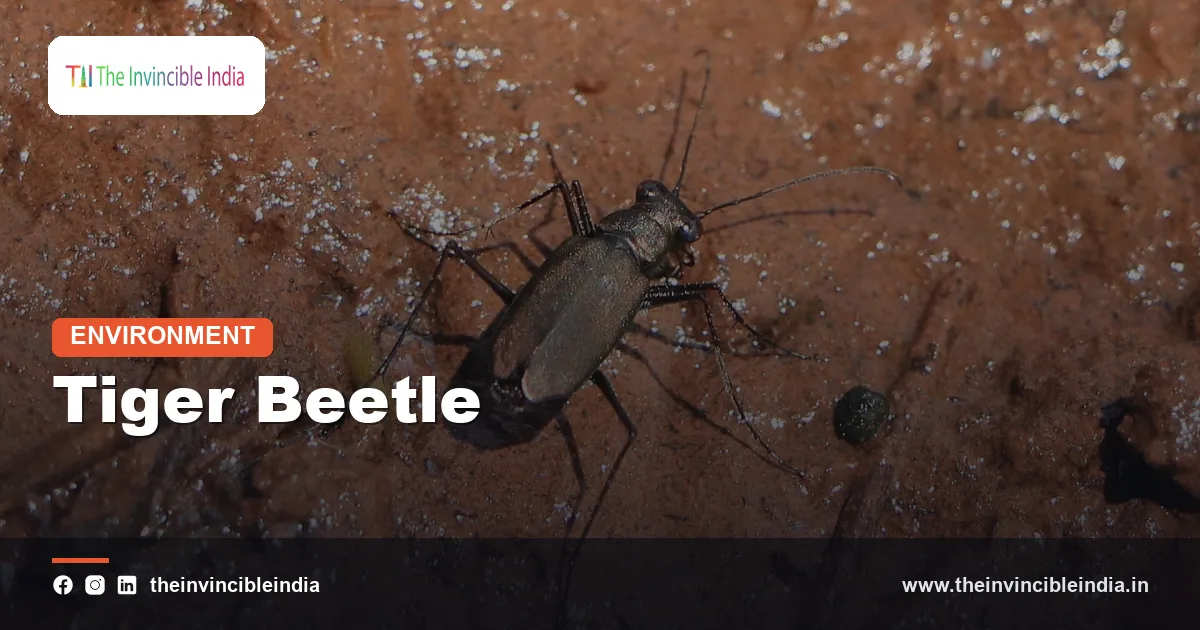
A tiger beetle is a fast-running, long-legged, predatory beetle with large eyes, sickle-shaped jaws and often a shining metallic body, found on sunlit sand, mud and bare ground beside Indian rivers, beaches and forest paths. It is regarded as one of the fastest running insects in the world for its size and hunts other small animals by sprinting at them and seizing them in its jaws.
The tiger beetle’s name comes from its ferocity as a hunter, and the larva is as formidable as the adult, waiting at the mouth of a burrow to snatch passing prey. This article explains what a tiger beetle is, how it runs and hunts, what its larvae do, where it lives in India and why its presence says something about the health of sandy and riverine habitats.
| Attribute | Details |
|---|---|
| Order and family | Coleoptera (beetles); Cicindelidae, treated by many taxonomists as the subfamily Cicindelinae of the ground beetles (Carabidae) |
| Common Indian genera | Cicindela, Calomera, Cosmodela, Cylindera, Myriochila, Lophyra and the tree-dwelling Neocollyris |
| Typical size | Mostly about 1 to 2.5 cm in body length |
| Habitat in India | Sandy riverbanks, beaches, mudflats, salt flats, bare forest tracks, clay banks and, for some species, tree trunks and foliage |
| Diet | Small insects such as ants, flies and beetles, and other small invertebrates; both adults and larvae are predators |
| Life cycle | Complete metamorphosis: egg, three larval stages in a vertical burrow, pupa, adult |
| Ecological role | Predator of small invertebrates and an indicator of undisturbed sandy and riverside habitat |
| Notable features | Very high running speed, large compound eyes, toothed sickle jaws, metallic structural colours and hump-anchored larvae |
Key Takeaways
- A tiger beetle is a predatory beetle whose adults run so fast that they can outpace their own vision and must stop to re-locate prey.
- The tiger beetle’s long, sickle-shaped, toothed jaws grip and cut small insects such as ants and flies.
- Tiger beetle larvae live in vertical burrows and ambush passing prey, anchoring themselves to the burrow wall with a pair of hooks on the back.
- The shimmering green, copper and blue colours of many tiger beetles come from the structure of the cuticle, not from pigment alone.
- In India, tiger beetles live on sandy riverbanks, beaches, mudflats and bare forest tracks, and some species live in trees.
- Tiger beetles are sensitive to disturbance of their habitat, so sand mining, river engineering and beach development can reduce their numbers.
What Is a Tiger Beetle?
A tiger beetle is a member of the beetle group Cicindelidae, a family of fast, visually hunting predators that is considered a subfamily of the ground beetles by many modern taxonomists. The group contains well over two thousand species worldwide, and India has a large and diverse tiger beetle fauna, with over a hundred species recorded.
Tiger beetles are easy to recognise once seen. They have a slim body, long legs and large bulging eyes set on the sides of the head. The jaws, or mandibles, are long, curved and armed with sharp teeth. Many species are brightly iridescent, in shades of green, bronze, copper, blue and purple, often with pale spots or bands on the wing covers.
These beetles are strictly day-active in most species. They prefer bright, warm weather and are most conspicuous on sunny mornings and afternoons, when they dash across open ground and take short, low flights before landing again.
How Fast Is a Tiger Beetle?
A tiger beetle is among the fastest-running insects in the world relative to its body size, with the quickest species recorded at roughly 9 km per hour, which is more than 100 body lengths per second. In human terms, this would be like a person running faster than a racing car.
The speed is so great that the beetle’s vision cannot keep up. At full speed, the image falling on the eye is blurred, and the insect cannot process fine detail. For this reason, a tiger beetle hunts in a stop-and-go pattern. It sprints a short distance toward its prey, stops to check the position again, and then sprints once more. This behaviour is famous among biologists and is often described when explaining the limits of insect vision.
The speed depends on long, slim legs and strong muscles, and also on temperature. As a cold-blooded animal, the beetle is most active when its body is warm, so it basks in the sun and sprints across heated sand.
How Does a Tiger Beetle Hunt?
A tiger beetle hunts by spotting prey with its large eyes, rushing toward it, seizing it in its toothed jaws and chewing it until it can be swallowed. It is an active, visual predator that does not use webs or traps.
- Spotting: the beetle scans the ground from a perch or from a pause in its run, and its large, wide-set eyes help it detect movement.
- Sprint: it runs rapidly toward the prey, often with a series of short bursts.
- Strike: it grasps the victim with its jaws, which are strong enough to crush the armour of ants and small beetles.
- Feeding: the beetle chews the prey and releases digestive fluid, taking in the liquefied food.
- Cleaning: it wipes its mouthparts clean before looking for the next target.
Prey includes ants, flies, small beetles, caterpillars, spiders and other small invertebrates. Because tiger beetles remove so many small animals from the ground surface, they have a modest role in limiting insect numbers, although they do not control any one pest in a decisive way.
Tiger beetles themselves are hunted by birds, lizards, robber flies and spiders, and some species rely on speed, flight and alert behaviour to escape. When a tiger beetle is handled it can give a sharp pinch with its jaws, which is harmless but surprisingly strong for such a small animal.
What Does a Tiger Beetle Larva Do?
A tiger beetle larva lives in a vertical burrow dug into soil or sand and ambushes any small animal that walks past, seizing it with its jaws and dragging it down. The larva stays at the burrow mouth with its flat head, which plugs the entrance like a lid.
The larva has a distinctive body, and two features stand out. Its head and the first part of the body form a flat, armoured plate that fits the burrow opening exactly. On the fifth segment of its abdomen it has a pair of curved hooks on a raised hump, which grip the burrow wall. When a victim comes within reach, the larva flips backwards to snatch it and the hooks stop the larva from being pulled out of the burrow by a struggling insect.
The larva passes through three stages, called instars, enlarging its burrow as it grows. In many species, this stage lasts from several months to a year or two, depending on food and climate. When fully grown, the larva seals its burrow and transforms into a pupa. The adult then emerges, digs out and begins its life above ground.
Why Are Tiger Beetles So Colourful?
Tiger beetles are colourful because their outer shell contains layers of tiny structures that reflect certain wavelengths of light, producing a shimmering metallic colour that changes with the angle of view. This is called structural colour, and it is the same principle that creates the sheen of a peacock feather or a soap bubble.
The colour has several possible uses. On bare, bright ground, an iridescent beetle can be hard for a bird to follow when it runs and flashes in and out of view. The pale marks on the wing covers can break up the outline of the beetle and help it blend into dappled light. Colour and pattern may also help individuals recognise members of the same species.
Many tiger beetles are patterned to match their habitat. Sand-dwelling species are often sandy brown with white markings, while those of forest tracks or foliage are green or bronze. Photographers value them for their glossy, jewel-like appearance, but the beetles are quick and difficult to approach.
Where Do Tiger Beetles Live in India?
Tiger beetles live across India in open, sunlit habitats with bare or sparsely vegetated ground, and they are most often seen on sandy riverbanks, sea beaches, mudflats, salt pans and forest paths. Some species live on tree trunks or on leaves and branches, and others on rocky streams.
| Habitat | Typical tiger beetle behaviour |
|---|---|
| Sandy riverbanks and sandbars | Fast running on warm sand; larvae in burrows just above the water line |
| Sea beaches and estuaries | Species adapted to salt and tide-washed sand and mud |
| Salt flats and clay banks | Specialist species in hard, bare, sparsely vegetated ground |
| Forest paths and clearings | Metallic species that sprint across sunlit tracks |
| Trees and shrubs | Slender, long-legged arboreal beetles, such as those in the genus Neocollyris |
The Western Ghats, the Himalayan foothills, the Gangetic plain and the north-eastern states all contain diverse tiger beetle communities, and many species are restricted to a narrow type of habitat. Because each species is so closely tied to its own kind of ground, a change in the landscape can quickly remove it.
What Is the Life Cycle of a Tiger Beetle?
The life cycle of a tiger beetle includes four stages, egg, larva, pupa and adult, in a pattern known as complete metamorphosis. Adults mate in warm weather, and the female lays eggs singly in small holes that she digs in the soil.
The egg hatches into a small larva that digs its own burrow and begins hunting. The larva grows through three instars, deepening its burrow as it develops. When the larva is ready, it closes the entrance of the burrow and becomes a pupa, which is soft and pale. After a few weeks, the adult beetle emerges, hardens and colours up, and climbs to the surface.
The timing of the cycle depends on species and climate. Some tiger beetles complete their life in one year, with adults emerging at the start of the monsoon or the spring warm period, while others need two years or more. In seasonal places in India, adult activity often peaks in the months when the ground is warm and prey is abundant, and the larvae may remain below ground in hot, dry or cold spells.
Are Tiger Beetles Useful or Harmful?
Tiger beetles are useful rather than harmful, since they eat small insects and spiders and do not damage crops, stored food or buildings. They are not dangerous to people, and the only risk is a mild pinch if one is picked up.
Their direct value to agriculture is limited, because they live mostly on bare ground, not in dense crops. Their larger value lies in what they reveal about their habitat. Because tiger beetles need particular types of open ground, such as clean river sand or undisturbed salt flats, scientists use them as biological indicators of habitat condition.
- Presence of many species: usually suggests a natural riverbank, beach or forest track that is not heavily disturbed.
- Loss of species: often follows sand mining, trampling, vehicle traffic, bank concrete work or pollution.
- Study value: tiger beetles are used in studies of biodiversity, evolution, and the effects of land use change.
What Threatens Tiger Beetles in India?
The main threats to tiger beetles in India are habitat loss and disturbance, especially sand mining, riverbank engineering, coastal construction and the compaction of sandy ground by vehicles and crowds. These pressures damage the open sandy and muddy habitats on which most species depend.
Other threats include pesticide use near riverbanks and farmland, water pollution, the spread of invasive plants that cover bare ground, and artificial lights that attract and disorient adults at night. Changes in river flow can wash away burrows or bury them under silt.
Conservation of tiger beetles generally means conserving the habitats themselves. Leaving sections of riverbank and beach in a natural state, regulating sand extraction, limiting off-road vehicle use and keeping some sunny, bare patches within protected areas all help. Surveys by naturalists continue to add new species records for India, and some species are known from only a few places.
How Can You Find and Watch a Tiger Beetle?
The best way to find a tiger beetle is to walk slowly along a sunny, sandy or muddy stretch of riverbank or beach on a warm morning and watch for small, shiny insects that run ahead of you and fly a short way. Moving gently and keeping low improves the chance of a close look.
- Choose a warm, bright day, as the beetles retreat in cool or cloudy weather.
- Approach slowly and stop when a beetle pauses, since tiger beetles often run, stop and then run again.
- Use a camera with a zoom or macro setting rather than trying to catch the insect.
- Look for small round burrow holes in the sand, which may belong to larvae, and do not poke at them.
- Avoid trampling bare ground at the edge of water where larvae may be living.
Recording the location, date and photograph on a citizen-science platform contributes to knowledge of species distribution in India, which remains incomplete for many groups of insects.
Bottom Line
The tiger beetle is a small hunter with extraordinary speed, striking colour and a fierce larva, and it is closely tied to open sandy and riverine habitats. Looking after those habitats is the surest way to keep these shining sprinters on Indian riverbanks, beaches and forest paths.
Frequently Asked Questions
What is a tiger beetle?
A tiger beetle is a fast, predatory beetle of the family Cicindelidae, with long legs, large eyes and sickle-shaped jaws. Many species are metallic green, copper or blue. India has over a hundred species, found on sandy riverbanks, beaches and forest paths.
How fast can a tiger beetle run?
The fastest tiger beetles run at roughly 9 km per hour, which is over 100 body lengths per second and among the fastest relative speeds of any land animal. The speed is so high that the beetle must stop repeatedly to re-focus on its prey. This is why it runs in short bursts.
What does a tiger beetle eat?
A tiger beetle eats small insects and other tiny animals, including ants, flies, small beetles and spiders. It catches them by sprinting at them and seizing them in its jaws. The larvae are predators too, ambushing passing prey from their burrows.
Is a tiger beetle dangerous to humans?
No, a tiger beetle is not dangerous to humans. It does not sting, carry venom or spread disease. If picked up, it may give a quick pinch with its strong jaws, but this is harmless.
Where can I see tiger beetles in India?
You can see tiger beetles on sunny, sandy or muddy ground near rivers, beaches and forest paths. They are most active on warm mornings and afternoons. Some slender species live on tree trunks and foliage.
Why are tiger beetle larvae called ambush predators?
Tiger beetle larvae are called ambush predators because they wait in a vertical burrow with their head at the opening and seize prey that walks past. A pair of hooks on the larva’s back anchors it to the burrow wall. This lets the larva hold onto struggling prey without being pulled out.
{“@context”:”https://schema.org”,”@graph”:[{“@type”:”FAQPage”,”mainEntity”:[{“@type”:”Question”,”name”:”What is a tiger beetle?”,”acceptedAnswer”:{“@type”:”Answer”,”text”:”A tiger beetle is a fast, predatory beetle of the family Cicindelidae, with long legs, large eyes and sickle-shaped jaws. Many species are metallic green, copper or blue. India has over a hundred species, found on sandy riverbanks, beaches and forest paths.”}},{“@type”:”Question”,”name”:”How fast can a tiger beetle run?”,”acceptedAnswer”:{“@type”:”Answer”,”text”:”The fastest tiger beetles run at roughly 9 km per hour, which is over 100 body lengths per second and among the fastest relative speeds of any land animal. The speed is so high that the beetle must stop repeatedly to re-focus on its prey. This is why it runs in short bursts.”}},{“@type”:”Question”,”name”:”What does a tiger beetle eat?”,”acceptedAnswer”:{“@type”:”Answer”,”text”:”A tiger beetle eats small insects and other tiny animals, including ants, flies, small beetles and spiders. It catches them by sprinting at them and seizing them in its jaws. The larvae are predators too, ambushing passing prey from their burrows.”}},{“@type”:”Question”,”name”:”Is a tiger beetle dangerous to humans?”,”acceptedAnswer”:{“@type”:”Answer”,”text”:”No, a tiger beetle is not dangerous to humans. It does not sting, carry venom or spread disease. If picked up, it may give a quick pinch with its strong jaws, but this is harmless.”}},{“@type”:”Question”,”name”:”Where can I see tiger beetles in India?”,”acceptedAnswer”:{“@type”:”Answer”,”text”:”You can see tiger beetles on sunny, sandy or muddy ground near rivers, beaches and forest paths. They are most active on warm mornings and afternoons. Some slender species live on tree trunks and foliage.”}},{“@type”:”Question”,”name”:”Why are tiger beetle larvae called ambush predators?”,”acceptedAnswer”:{“@type”:”Answer”,”text”:”Tiger beetle larvae are called ambush predators because they wait in a vertical burrow with their head at the opening and seize prey that walks past. A pair of hooks on the larva’s back anchors it to the burrow wall. This lets the larva hold onto struggling prey without being pulled out.”}}]}]}


