

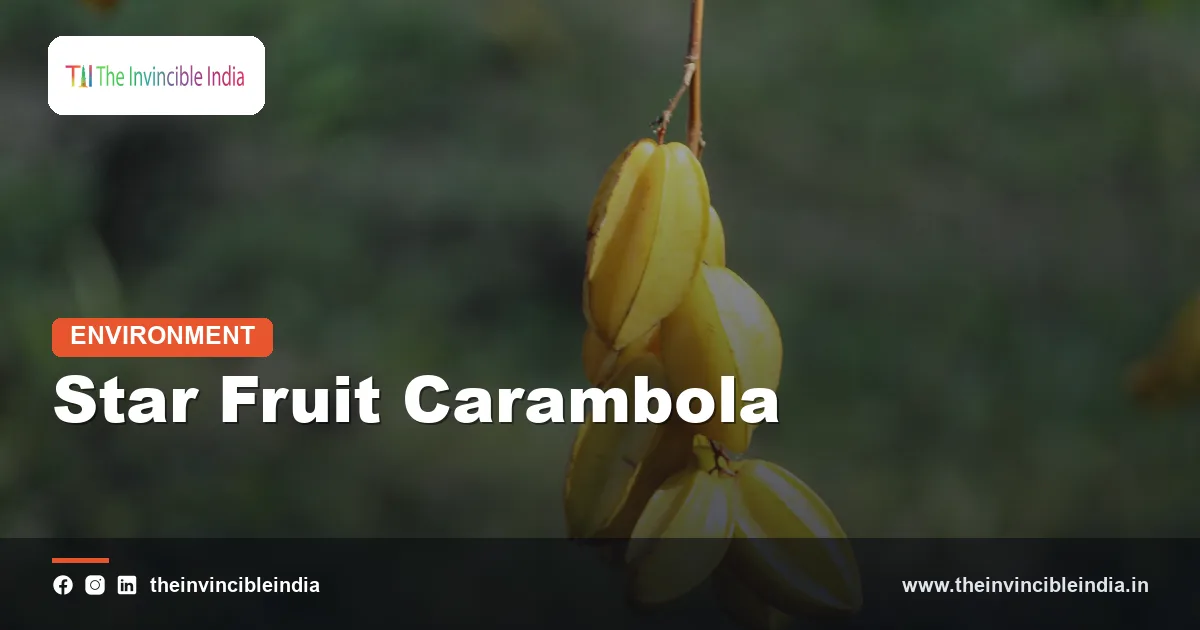
The star fruit, also called carambola or kamrakh in Hindi, is the ribbed, waxy yellow-green fruit of the tropical tree Averrhoa carambola, which forms a five-pointed star when sliced across. It tastes crisp, juicy and somewhere between sweet and tart, and it is grown in home gardens and small orchards across southern, eastern and northeastern India. The star fruit is rich in vitamin C and fibre, but it contains oxalates and a neurotoxin that make it dangerous for people with kidney disease.
This explainer covers what the star fruit is, how the tree looks and grows, where and when it fruits in India, how the fruit is eaten, what it contains and why kidney patients are told to avoid it. It also separates the sweet and sour types and explains how the star fruit differs from its close relative, the bilimbi. It was last updated on 23 October 2026.
Quick Facts
| Scientific name | Averrhoa carambola |
|---|---|
| Family | Oxalidaceae (the wood-sorrel family) |
| Common Indian names | Kamrakh (Hindi); kamranga (Bengali, Assamese); karmal or karambal (Marathi); carambola and star fruit in English |
| Plant type and height | Slow-growing, evergreen, bushy tree, usually 5 to 10 metres tall, often kept smaller in gardens |
| Fruiting season | Mostly from the monsoon into winter; in warm, humid regions it may fruit more than once a year |
| Native range | Tropical Southeast Asia, now cultivated throughout the tropics |
| Nutrition highlights | Vitamin C, dietary fibre, water, small amounts of potassium and B vitamins; also contains oxalic acid |
| Main uses | Fresh fruit, juice, pickles, chutneys, curries, garnish, cleaning of metal in folk practice |
| Key health caution | Should be avoided by people with kidney disease because of oxalate and caramboxin |
Key Takeaways
- The star fruit is the fruit of Averrhoa carambola, a tropical tree of the Oxalidaceae family that originated in Southeast Asia and is grown widely in India.
- A star fruit has five prominent ridges, and a slice cut across the fruit forms a five-pointed star, which explains the English name.
- Star fruit is a good source of vitamin C and fibre, is low in calories, and can be eaten whole including the thin skin once the brown edges of the ribs are trimmed.
- Star fruit contains oxalic acid and a neurotoxin called caramboxin, which can cause serious illness, confusion and seizures in people with kidney disease.
- Sweet types of star fruit are eaten fresh, while sour types, which contain more oxalate, are traditionally used in pickles, chutneys and cooking.
- The star fruit tree is a close relative of the bilimbi (Averrhoa bilimbi), and both are grown in coastal and humid parts of India.
What is the star fruit?
The star fruit is a juicy, thin-skinned tropical fruit with five longitudinal ribs, borne by the evergreen tree Averrhoa carambola. A mature fruit is typically 8 to 12 centimetres long and shifts from green to a glossy yellow or golden shade as it ripens. When cut across, each slice forms a neat star, which makes the fruit popular as a garnish for salads, drinks and desserts.
The flesh is crisp, translucent and watery, with a flavour often compared to a mixture of apple, grape and citrus. A few flat brown seeds may sit in the centre of the fruit, and they are normally discarded. The skin is edible, but the ridges may have darker, slightly fibrous edges that cooks usually trim away.
The species was probably domesticated in Southeast Asia, and it travelled through trade and colonial plant exchange to southern Asia, Africa, the Pacific and the Americas. In India it has long been grown in kitchen gardens, especially in Kerala, Karnataka, Tamil Nadu, West Bengal, Assam and the northeastern states, where the humid climate suits it well.
What does the star fruit tree look like?
The star fruit tree is a bushy, slow-growing evergreen with a short trunk and a rounded, spreading crown, reaching about 5 to 10 metres in height. Its leaves are compound, with several pairs of smooth, oval leaflets arranged along a central stalk. The leaflets tend to fold in the evening and when disturbed, a mild movement that is also seen in several other members of the wood-sorrel family.
The tree produces clusters of tiny, bell-like flowers in shades of pink to purple on the branches and sometimes on the trunk. The flowers are small but attractive and draw bees and other insects. They are followed by green fruits that develop their ridges early and slowly ripen to yellow.
Gardeners value the tree because it is ornamental, compact and generous in fruiting when well tended. It can be pruned to a manageable height, which also makes harvesting easier and helps keep the fruit within reach for bagging against pests.
Where and when does star fruit grow in India?
Star fruit grows best in the warm, humid tropical regions of India, particularly along the south and the east, and it fruits mostly from the monsoon into the winter months. Trees are common in Kerala, Karnataka, Tamil Nadu, coastal Andhra Pradesh, Odisha, West Bengal, Assam and neighbouring northeastern states, and they also grow in parts of Maharashtra and Goa. They are seen less often in cold or very dry regions.
In consistently warm and moist conditions, a star fruit tree can flower and fruit more than once a year, so it may produce one main crop and one or two lighter ones. The exact schedule depends on rainfall, local temperature and variety. Dry spells followed by rain commonly trigger flowering.
| Requirement | What the star fruit tree needs |
|---|---|
| Climate | Warm and humid; young trees are damaged by frost and prolonged cold |
| Rainfall | Moderate to high, with regular moisture during growth and fruiting |
| Soil | Well-drained, fertile loam; tolerates a range of soils but dislikes waterlogging |
| Sunlight | Full sun for best fruit; light shade is tolerated when young |
| Propagation | Grafting or budding for named varieties; seeds for rootstocks |
How is star fruit eaten and used?
Star fruit is eaten fresh as a snack, sliced into fruit salads, pressed into juice, or cooked in pickles, chutneys and savoury dishes. Ripe, sweet fruits are best eaten raw, simply washed and cut across into stars. Sour types are valued in the kitchen because their acidity works in the same way as tamarind or raw mango.
- Fresh slices: used as a garnish in fruit chaat, salads and cold drinks.
- Juice and sherbet: the fruit is pressed or blended with water, sugar and a pinch of salt for a cooling drink.
- Pickles and chutneys: sour star fruit is sliced, salted and spiced into pickles that keep for months.
- Curries and dals: in the east and south, slices are added to fish curries and lentil dishes as a souring agent.
- Jams and preserves: the sweet-tart flesh combines well with sugar and spices.
The juice contains oxalic acid, and in some households it has been used to clean tarnished brass and copper or to remove rust stains from cloth. That folk use reflects the acidity of the fruit, not any special property.
What is the nutritional value of star fruit?
Star fruit is a low-calorie, water-rich fruit that provides vitamin C, dietary fibre and small amounts of potassium, along with natural antioxidants. Most of its weight is water, which is why it feels crisp and refreshing. The fibre content supports digestion, and the vitamin C contributes to the normal functioning of the immune system when eaten as part of a varied diet.
Exact nutrient values vary with variety, ripeness and growing conditions, so any figure quoted should be treated as an approximation. The sweet types have more sugar and less acid, while the sour types are richer in organic acids.
The same fruit also contains oxalic acid in significant amounts. In healthy people with normal kidney function, moderate quantities are usually handled by the body, because oxalate is removed in urine. The problem arises when the kidneys cannot clear it, which is why the nutritional picture of star fruit has to include the caution below.
Why is star fruit dangerous for kidney patients?
Star fruit is dangerous for people with kidney disease because it contains high levels of oxalate and a neurotoxin called caramboxin, which healthy kidneys remove but damaged kidneys cannot. In people with chronic kidney disease or those on dialysis, eating the fruit or drinking its juice has been linked to serious symptoms, including persistent hiccups, vomiting, confusion, weakness and seizures. In rare cases it has led to coma and death.
Who should avoid star fruit?
- People with chronic kidney disease at any stage, and those on dialysis.
- People who have had kidney stones made of calcium oxalate, who are often advised to limit oxalate-rich foods.
- People with reduced kidney function, even if undiagnosed, such as some elderly people or those with long-standing diabetes or high blood pressure.
- Anyone advised by a nephrologist or dietitian to follow a low-oxalate or kidney-friendly diet.
Is star fruit safe for healthy people?
Star fruit is generally considered safe for people with healthy kidneys when eaten in moderate amounts. Risk rises when large quantities are eaten, when the juice is concentrated, or when the fruit is consumed on an empty stomach or while dehydrated. Anyone who develops hiccups, nausea, confusion or reduced urination after eating star fruit should seek medical care promptly. When in doubt about kidney health, a doctor should be consulted before including the fruit in the diet.
What is the difference between sweet and sour star fruit?
Sweet star fruit has wide, thick ribs and a mild, sugary flavour that is pleasant for eating raw, whereas sour star fruit has narrower ribs, a sharper acidic taste and a higher oxalic acid content. The distinction is useful in cooking and in health. Sweet types are the ones most often sold in markets as dessert fruit, while sour types are more often found on village trees and are used as a souring ingredient.
As a rough rule, thinner, more slender fruits with narrow ridges tend to be more acidic, while larger fruits with thick, fleshy ribs are sweeter. This is not an exact test, and the safest approach for anyone with kidney concerns is to avoid both types. Named improved varieties have been introduced in several countries for their sweetness and size, and nurseries in India supply grafted plants of such selections.
The related species, bilimbi (Averrhoa bilimbi), is much more sour and is almost never eaten raw. It looks like a small green cucumber, grows in clusters on the trunk, and is used in pickles and curries in Kerala and coastal Karnataka. Both fruits contain oxalic acid, and kidney patients are advised to take the same caution with each.
How is the star fruit tree grown?
The star fruit tree is grown from grafted or budded plants for reliable fruit quality, though it can also be raised from seed. Seeds lose their ability to germinate fairly quickly, so they must be sown fresh. Seed-grown trees vary in fruit quality and take longer to bear, which is why nurseries prefer grafting.
- Planting: pits are prepared and filled with soil and compost; planting is done at the start of the rains.
- Watering: regular watering is needed, especially during flowering and fruit set; the tree dislikes drought and standing water alike.
- Feeding: compost and balanced nutrients encourage steady growth and fruiting.
- Pruning: light pruning after harvest shapes the tree and opens the canopy to light and air.
- Protection: fruit flies are the main pest, and growers often wrap young fruits in bags to prevent egg-laying.
A grafted tree can start bearing within a few years and is productive for many more. Its small size, ornamental flowers and edible fruit make it a popular choice for gardens in warm Indian towns.
How should star fruit be chosen and stored?
A good star fruit is firm, glossy and mostly yellow, with only a faint green tint on the ribs and a mild sweet fragrance. Fruits with deep brown bruises, soft patches or shrivelled ribs have usually been handled roughly or are past their best. Slight browning on the very edge of the ridges is normal and can be trimmed off with a knife or a peeler.
- Ripening: green fruit ripens at room temperature in a few days, turning more yellow and sweet.
- Storage: ripe fruit keeps for about a week in the refrigerator, ideally in a loose bag to prevent moisture build-up.
- Preparation: wash the fruit, trim the edges of the ribs, slice across into stars, and remove any visible seeds.
- Freezing: slices can be frozen for use in drinks, though the texture softens after thawing.
Because the fruit bruises easily, growers pick it by hand when it is firm and ready, and traders handle it gently. Backyard growers can enjoy fruit straight from the tree at peak ripeness, which is the best way to taste its fragrance.
What is the history of the star fruit in India?
The star fruit was introduced to India and other parts of tropical Asia long ago from its Southeast Asian homeland, and it has since become a familiar fruit tree in coastal and eastern gardens. The exact dates and routes of introduction are not firmly documented, but its early spread followed the same trade routes that carried other tropical fruits and spices across the Indian Ocean and the Bay of Bengal.
Today, star fruit is more commonly a backyard and market-stall fruit than an orchard crop, and commercial plantations in India are comparatively small. Gardeners, horticulture departments and nurseries promote improved selections, which have bigger, sweeter and less sour fruit than the older village seedlings. Because the tree bears heavily in a good year, surplus fruit is often shared with neighbours or turned into pickles and preserves.
Bottom Line
The star fruit is a refreshing, vitamin C-rich tropical fruit that is easy to grow in warm, humid parts of India. It is a pleasant food for healthy people in moderation, but anyone with kidney disease or a history of oxalate kidney stones should avoid it completely.
Frequently Asked Questions
What is star fruit called in Hindi?
Star fruit is called kamrakh in Hindi, and carambola in English and botanical writing. In Bengali and Assamese it is kamranga, and in Marathi it is known as karmal or karambal. The tree is Averrhoa carambola, of the family Oxalidaceae.
Why is star fruit bad for kidney patients?
Star fruit is bad for kidney patients because it contains oxalate and a neurotoxin called caramboxin that damaged kidneys cannot filter out. The build-up can cause hiccups, vomiting, confusion, seizures and, in severe cases, death. People with any kidney disease, including those on dialysis, should avoid the fruit and its juice.
Is star fruit safe to eat every day?
Star fruit is generally safe for healthy people with normal kidney function in moderate amounts, but eating it every day in large quantities is not advisable. The oxalic acid content can contribute to kidney stones in susceptible people. It is better to eat it occasionally as part of a varied diet and to avoid concentrated juice on an empty stomach.
Can you eat the skin of a star fruit?
Yes, the skin of a ripe star fruit is thin and edible, and it is usually eaten along with the flesh. Cooks normally trim the brown, slightly fibrous edges of the ribs and wash the fruit well before slicing. The seeds in the centre are small and are usually discarded.
How can you tell if a star fruit is ripe?
A ripe star fruit turns from green to a glossy yellow or golden colour, with only a little green left, and it smells faintly sweet. The ribs may show slight brown edges, which is normal. Fruit that is still fully green tastes sour, while very dark brown patches indicate overripeness.
What is the difference between star fruit and bilimbi?
Star fruit and bilimbi are close relatives in the genus Averrhoa, but the star fruit has five ribs and is sweet to tart, while the bilimbi is a small, smooth, cucumber-like fruit that is very sour. Star fruit is often eaten fresh, whereas bilimbi is used in pickles and curries. Both contain oxalic acid, so kidney patients should avoid both.
{“@context”:”https://schema.org”,”@graph”:[{“@type”:”FAQPage”,”mainEntity”:[{“@type”:”Question”,”name”:”What is star fruit called in Hindi?”,”acceptedAnswer”:{“@type”:”Answer”,”text”:”Star fruit is called kamrakh in Hindi, and carambola in English and botanical writing. In Bengali and Assamese it is kamranga, and in Marathi it is known as karmal or karambal. The tree is Averrhoa carambola, of the family Oxalidaceae.”}},{“@type”:”Question”,”name”:”Why is star fruit bad for kidney patients?”,”acceptedAnswer”:{“@type”:”Answer”,”text”:”Star fruit is bad for kidney patients because it contains oxalate and a neurotoxin called caramboxin that damaged kidneys cannot filter out. The build-up can cause hiccups, vomiting, confusion, seizures and, in severe cases, death. People with any kidney disease, including those on dialysis, should avoid the fruit and its juice.”}},{“@type”:”Question”,”name”:”Is star fruit safe to eat every day?”,”acceptedAnswer”:{“@type”:”Answer”,”text”:”Star fruit is generally safe for healthy people with normal kidney function in moderate amounts, but eating it every day in large quantities is not advisable. The oxalic acid content can contribute to kidney stones in susceptible people. It is better to eat it occasionally as part of a varied diet and to avoid concentrated juice on an empty stomach.”}},{“@type”:”Question”,”name”:”Can you eat the skin of a star fruit?”,”acceptedAnswer”:{“@type”:”Answer”,”text”:”Yes, the skin of a ripe star fruit is thin and edible, and it is usually eaten along with the flesh. Cooks normally trim the brown, slightly fibrous edges of the ribs and wash the fruit well before slicing. The seeds in the centre are small and are usually discarded.”}},{“@type”:”Question”,”name”:”How can you tell if a star fruit is ripe?”,”acceptedAnswer”:{“@type”:”Answer”,”text”:”A ripe star fruit turns from green to a glossy yellow or golden colour, with only a little green left, and it smells faintly sweet. The ribs may show slight brown edges, which is normal. Fruit that is still fully green tastes sour, while very dark brown patches indicate overripeness.”}},{“@type”:”Question”,”name”:”What is the difference between star fruit and bilimbi?”,”acceptedAnswer”:{“@type”:”Answer”,”text”:”Star fruit and bilimbi are close relatives in the genus Averrhoa, but the star fruit has five ribs and is sweet to tart, while the bilimbi is a small, smooth, cucumber-like fruit that is very sour. Star fruit is often eaten fresh, whereas bilimbi is used in pickles and curries. Both contain oxalic acid, so kidney patients should avoid both.”}}]}]}


