

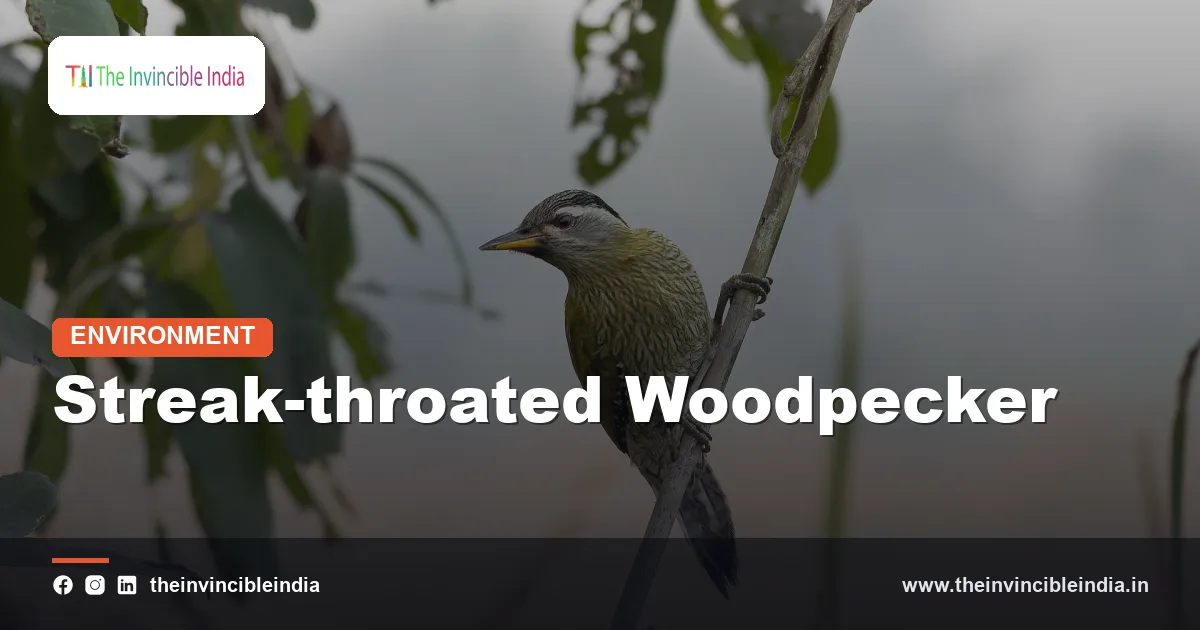
The streak-throated woodpecker (Picus xanthopygaeus) is a medium-sized, olive-green woodpecker of the Indian subcontinent, easily recognised by the dark streaks on its pale throat and the scale-like marks on its underparts. It lives in open forests, wooded plains, orchards and village groves, and it feeds mostly on ants and termites that it picks from tree trunks, branches and the ground.
Unlike the larger woodpeckers that hammer deep into dead wood, the streak-throated woodpecker is a gentle, rather quiet forager that often goes unnoticed until its ringing call gives it away. This explainer covers how to identify the bird, where it is found in India, what it eats, how it breeds and why it matters to the trees and birds around it.
Quick Facts
| Common name | Streak-throated woodpecker |
|---|---|
| Scientific name | Picus xanthopygaeus |
| Family and order | Picidae (woodpeckers); order Piciformes |
| Size | About 30 cm from bill tip to tail tip |
| Range in India | Himalayan foothills, northern and central plains, peninsular India and the northeast |
| Habitat | Open deciduous forest, scrub forest, orchards, groves and wooded farmland |
| Diet | Ants, termites, beetle larvae and other small insects; occasionally some fruit |
| Breeding | Nests in a hole excavated in a tree; usually lays 3 to 4 white eggs in the drier months of the year |
| Conservation status | Least Concern on the IUCN Red List; protected under Indian wildlife law |
Key Takeaways
- The streak-throated woodpecker is an olive-green woodpecker about 30 cm long, named for the fine dark streaks on its pale throat and breast.
- The streak-throated woodpecker belongs to the genus Picus, the “green woodpeckers”, which forage on the ground and on trunks more often than they hammer into timber.
- Ants and termites form the bulk of the streak-throated woodpecker’s diet, and the bird captures them with a very long, sticky tongue.
- Male streak-throated woodpeckers have a largely red crown, while females have a dark, finely streaked crown, which is the simplest way to tell the sexes apart.
- The streak-throated woodpecker nests in a hole that it chisels into a tree trunk or branch, and abandoned holes are later used by other birds and small animals.
- The streak-throated woodpecker is a resident bird across much of India and is currently assessed as Least Concern, though loss of old trees can reduce its nesting sites.
What is the streak-throated woodpecker?
The streak-throated woodpecker is a medium-sized woodpecker in the family Picidae that is native to South Asia and parts of Southeast Asia. Its scientific name is Picus xanthopygaeus, and the species belongs to the same genus as the green woodpeckers of Europe and Asia. In older field guides it was often placed in a different genus, so books published decades apart may list slightly different scientific names for the same bird.
The common name describes one of its key features: the throat and upper breast are marked with fine dark streaks on a pale background. The name “xanthopygaeus” is a Greek-derived word that refers to a yellow rump, and the yellowish rump patch is indeed visible when the bird flies away from an observer.
Like all woodpeckers, the streak-throated woodpecker is built for life on tree trunks. It has a straight, chisel-tipped bill, strong feet and a stiff tail. It is, however, one of the less dramatic members of its family. Its bill is not heavy enough for deep excavation of hard, healthy timber, so it works mainly on bark surfaces, soft dead wood, termite galleries and the soil beneath trees.
The bird is non-migratory in most of its range. A pair typically holds a home area through the year, and individuals are usually seen alone or in pairs rather than in flocks, although they may join mixed hunting parties of small birds in forest.
How can you identify a streak-throated woodpecker?
A streak-throated woodpecker can be identified by its olive-green upperparts, yellowish rump, pale underparts with scaly dark marks, and a throat and breast streaked with fine dark lines. The bird is about the size of a myna or slightly larger, and its overall look is that of a plain green woodpecker with a pale, mottled front.
Plumage in detail
- Upperparts: olive-green on the back and wings, with a brighter yellowish-green rump that shows in flight.
- Underparts: whitish to buff, with dark crescent-shaped markings that look like fish scales on the belly and flanks.
- Throat and breast: fine dark streaks, which give the species its name.
- Bill and legs: a dark, straight, pointed bill with a paler base, and greyish-green legs.
- Tail: dark and stiff, used as a prop when the bird clings to vertical trunks.
Telling males from females
The male streak-throated woodpecker has a red crown that extends toward the nape, while the female has a dark crown with fine pale streaking and lacks the broad red cap. This difference in head colour is the easiest field clue to the sex of the bird, since the body plumage of the two sexes is similar.
Similar species
Several other green woodpeckers occur in Indian woodland, and the streak-throated woodpecker is often confused with them. The table below sets out how each can be separated by sight.
| Species | Key difference from the streak-throated woodpecker |
|---|---|
| Scaly-bellied woodpecker | Larger and a Himalayan bird of higher forests; its underparts look more boldly scaled and its plumage is a deeper green. |
| Grey-headed woodpecker | Has a grey head and neck in place of the streaked pale throat, and a black stripe through the face. |
| Black-naped woodpecker | Shows a clear black band on the nape and more plain, unmarked underparts. |
| Lesser yellownape | Has a distinct yellow nape and crest, and a more crested appearance. |
Observers should note the habitat as well as the plumage. The streak-throated woodpecker is the green woodpecker most often seen in open, drier woodland and village groves at lower elevations.
Where does the streak-throated woodpecker live in India?
The streak-throated woodpecker lives across a wide belt of India that runs along the Himalayan foothills, over the northern and central plains, through peninsular India and into the northeast. It is a bird of lowlands and foothills rather than of high mountains, and it is generally found where trees are scattered or the forest is not too dense.
Its favoured habitats include:
- Open deciduous and dry forest with a mix of large and small trees.
- Scrub forest and wooded grassland edges.
- Mango, tamarind and other orchards and mature village groves.
- Tree-lined roads, canal banks and old parks in towns.
- Forest clearings where termite mounds and ant trails are common.
Outside India the streak-throated woodpecker is found in neighbouring countries such as Nepal, Bangladesh and Myanmar, and its range continues into parts of mainland Southeast Asia. The bird is far more likely to be seen in open, sunny woodland than in the deep shade of evergreen rainforest.
Because it tolerates mild human disturbance, the species can persist in farmland that keeps a good number of old trees. This habit makes it one of the green woodpeckers that ordinary birdwatchers in plains districts have the best chance of meeting.
What does the streak-throated woodpecker eat?
The streak-throated woodpecker eats mainly ants and termites, along with beetle larvae and other small insects, which it collects from tree bark, rotting wood and the ground. Ants are the staple food, and the bird will follow ant trails along a branch or trunk and probe the nests that social ants build in crevices and hollow limbs.
The bird’s feeding method is distinctive. Instead of drilling long tunnels, it often taps lightly, scratches the bark, and then pushes its bill into a crack or an ant nest. It then extends its tongue deep into the opening to pick up insects. Like other green woodpeckers, it also spends time on the ground, hopping over soil and leaf litter and digging into anthills or termite mounds.
Typical food items
- Several species of tree-living ants and their eggs and pupae.
- Termites found under bark or in mounds.
- Wood-boring beetle larvae in decaying branches.
- Small caterpillars and other insects found on the bark.
- Occasionally, small amounts of fruit or sweet sap.
Eating large numbers of ants and termites makes the streak-throated woodpecker a natural controller of insects that can damage trees. A single bird may work through many trees in a day, and a pair keeps a fairly regular circuit through their home range.
How does the streak-throated woodpecker climb and feed on tree trunks?
The streak-throated woodpecker climbs trunks with the help of specially shaped feet, a stiff tail and strong leg muscles. These features are shared by almost all woodpeckers and allow the bird to hold itself upright on a vertical surface while it works on the bark.
Zygodactyl feet
Woodpeckers have two toes pointing forward and two pointing backward, an arrangement called zygodactyl. This gives a firm, pincer-like grip on rough bark. The claws are sharp and curved, so the bird can hitch itself upward in short hops without slipping.
Tail as a prop
The central tail feathers of a woodpecker are stiff and pointed. When the bird clings to a trunk, it presses the tail against the bark to form a third support point, like a tripod. This lets it use its head and bill freely without losing balance.
The long tongue
The tongue of the streak-throated woodpecker is long, thin and tipped with a sticky coating and tiny barbs. It extends well beyond the bill and, in woodpeckers generally, is anchored by bones and muscles that wrap around the back of the skull. This lets the bird reach insects that sit deep inside narrow tunnels in wood and nests.
Head and skull
Woodpeckers have a strong, thick skull bone and a bill that is firmly anchored. Muscles and the internal structure of the head help to absorb repeated shocks. Green woodpeckers like this one tap more gently than the large hammering species, but they share the same basic design.
Why does the streak-throated woodpecker drum and call?
The streak-throated woodpecker drums and calls mainly to communicate with other woodpeckers, either to claim a territory or to attract a mate. Drumming is the rapid, rhythmic tapping of the bill on a resonant branch or dead trunk. It is different from feeding taps, which are slower and more irregular.
Drumming serves the same purpose for a woodpecker that song serves for many other birds. A resonant dead limb carries the sound over a long distance, and each bird tends to choose a favourite drumming post. In the breeding season, both males and females may drum, and pairs often exchange calls as they move through their territory.
The voice of the streak-throated woodpecker is a loud, sharp and ringing call, often repeated several times and carrying well through open woodland. Birdwatchers frequently hear the bird before they see it. The call is used to keep contact between mates, to warn off intruders and to give an alarm when a predator is nearby.
A listener who learns to tell feeding taps from drumming and from the bird’s calls can follow a woodpecker through a grove without ever seeing it clearly.
How does the streak-throated woodpecker breed?
The streak-throated woodpecker breeds by excavating a nest hole in a tree trunk or large branch, where the female lays a small clutch of white eggs. Breeding usually takes place in the drier months of the year, from late winter through early summer, although exact timing varies across regions.
Nest site
Both members of the pair take part in digging the nest chamber. They prefer a dead or partly rotten branch or a soft-wooded tree, because the wood is easier to chisel. The entrance is a neat round hole, and the chamber widens below it. The floor is usually bare wood covered with fine chips, without any lining of grass or leaves.
Eggs and chicks
- A typical clutch has 3 to 4 plain white eggs.
- Both parents take turns incubating, and the eggs hatch after roughly two weeks.
- The chicks are naked and helpless at first, and both parents feed them with insects.
- The young leave the nest after about three to four weeks and stay near their parents for a time.
White eggs are typical of hole-nesting birds, since the eggs are hidden from view and have no need of camouflage. The parents keep the nest tidy, and they carry droppings away from the hole to avoid attracting predators.
Does the streak-throated woodpecker migrate?
The streak-throated woodpecker does not undertake long migrations and is considered a resident bird across most of its Indian range. Adults hold a home area throughout the year, and they remain in the same woodland or grove for many seasons if food and nest sites remain available.
Some local movements do occur. Birds living in the foothills may move a short distance downhill in cold weather, and young birds disperse to find territories of their own once they become independent. These movements are small compared with the great seasonal journeys of ducks, waders or warblers.
Because the bird is a year-round resident, birdwatchers can look for it in any season. Cooler mornings in winter are often productive because the bird is active and vocal, while the breeding season in spring brings more calling and drumming.
Is the streak-throated woodpecker threatened?
The streak-throated woodpecker is not currently regarded as threatened, and the International Union for Conservation of Nature (IUCN) lists it as a species of Least Concern. Its wide range and its ability to live in modified habitats such as groves and orchards help it to remain relatively common.
Even so, certain pressures can affect local populations:
- Felling of old and dead trees, which removes nest sites and foraging wood.
- Clearing of village groves and roadside avenues for development.
- Heavy pesticide use in farmland, which can reduce insect food and build up in the food chain.
- Over-tidy forestry, where dead wood is removed completely.
Woodpeckers in India are covered by wildlife protection law, which makes hunting and trapping of wild birds an offence. The most effective help for the species is simple: leaving standing dead trees where it is safe, protecting large old trees and keeping groves intact.
Why does the streak-throated woodpecker matter to other wildlife?
The streak-throated woodpecker matters because the holes it excavates are later used by many other species, and because its appetite for ants and termites helps regulate insect numbers. Ecologists call birds like this “ecosystem engineers”, since their work changes the habitat available to others.
Once the woodpecker pair has finished with a nest hole, it is often taken over by secondary cavity nesters. These can include barbets, mynas, parakeets, owlets, tits, flycatchers and even small mammals such as squirrels and bats. In regions where suitable old trees are scarce, a hole chiselled by a woodpecker may be the only available nest site for such animals.
The bird also acts as an indicator of woodland health. A grove that contains breeding woodpeckers usually has dead and decaying wood, a rich insect community and mature trees, all signs of a reasonably healthy ecosystem. For ordinary people, the bird is a useful reminder that dead trees, which look untidy, support a good deal of life.
How and where can you watch a streak-throated woodpecker?
You can watch a streak-throated woodpecker by visiting open woodland or a mature grove early in the morning, listening for its loud call and scanning tree trunks and the ground below. Patience helps, since the bird often moves quietly and tends to circle to the far side of a trunk when it notices a person.
Practical tips
- Go early in the morning or in the late afternoon, when the bird is most active.
- Learn the call first, because the bird is usually heard before it is seen.
- Scan the lower trunks and the ground near termite mounds and ant trails.
- Look for old trees with holes and dead branches, which are favoured perches.
- Keep a steady distance and avoid approaching a nest hole, since disturbance can cause the pair to abandon it.
Many Indian national parks, wildlife sanctuaries and city green spaces with old trees have records of the species, and it is a regular on local birdwatching checklists in suitable areas.
Bottom Line
The streak-throated woodpecker is a quiet, ant-eating green woodpecker of Indian open forests and groves, and it plays a modest but useful role in controlling insects and creating nest holes. Protecting old trees and village groves is the most practical way to keep the species common.
Frequently Asked Questions
What is a streak-throated woodpecker?
The streak-throated woodpecker is a medium-sized, olive-green woodpecker (Picus xanthopygaeus) found across the Indian subcontinent. It is named for the dark streaks on its pale throat and breast. It feeds mainly on ants and termites and lives in open forests and groves.
How big is a streak-throated woodpecker?
The streak-throated woodpecker is about 30 cm long from bill tip to tail tip. That makes it roughly the size of a myna or slightly larger. It is smaller than the big flamebacks and larger than the tiny pygmy woodpeckers.
What does a streak-throated woodpecker eat?
The streak-throated woodpecker eats mostly ants and termites, along with beetle larvae and other small insects. It gathers them from bark, rotten wood and the ground using a long, sticky tongue. It may occasionally take small amounts of fruit.
How can you tell a male from a female streak-throated woodpecker?
The male has a largely red crown, whereas the female has a dark crown with fine pale streaks. The rest of the plumage is similar in both sexes. The head colour is the easiest way to separate them in the field.
Where do streak-throated woodpeckers nest?
Streak-throated woodpeckers nest in a hole that the pair excavates in a tree trunk or branch, usually in softer or dead wood. The female lays about 3 to 4 white eggs in the drier months. Both parents incubate the eggs and feed the chicks.
Is the streak-throated woodpecker endangered?
No, the streak-throated woodpecker is classified as Least Concern by the IUCN, meaning it is not currently threatened with extinction. Its wide range and use of groves and orchards help it survive. Loss of old trees and heavy pesticide use can still harm local populations.
{“@context”:”https://schema.org”,”@graph”:[{“@type”:”FAQPage”,”mainEntity”:[{“@type”:”Question”,”name”:”What is a streak-throated woodpecker?”,”acceptedAnswer”:{“@type”:”Answer”,”text”:”The streak-throated woodpecker is a medium-sized, olive-green woodpecker (Picus xanthopygaeus) found across the Indian subcontinent. It is named for the dark streaks on its pale throat and breast. It feeds mainly on ants and termites and lives in open forests and groves.”}},{“@type”:”Question”,”name”:”How big is a streak-throated woodpecker?”,”acceptedAnswer”:{“@type”:”Answer”,”text”:”The streak-throated woodpecker is about 30 cm long from bill tip to tail tip. That makes it roughly the size of a myna or slightly larger. It is smaller than the big flamebacks and larger than the tiny pygmy woodpeckers.”}},{“@type”:”Question”,”name”:”What does a streak-throated woodpecker eat?”,”acceptedAnswer”:{“@type”:”Answer”,”text”:”The streak-throated woodpecker eats mostly ants and termites, along with beetle larvae and other small insects. It gathers them from bark, rotten wood and the ground using a long, sticky tongue. It may occasionally take small amounts of fruit.”}},{“@type”:”Question”,”name”:”How can you tell a male from a female streak-throated woodpecker?”,”acceptedAnswer”:{“@type”:”Answer”,”text”:”The male has a largely red crown, whereas the female has a dark crown with fine pale streaks. The rest of the plumage is similar in both sexes. The head colour is the easiest way to separate them in the field.”}},{“@type”:”Question”,”name”:”Where do streak-throated woodpeckers nest?”,”acceptedAnswer”:{“@type”:”Answer”,”text”:”Streak-throated woodpeckers nest in a hole that the pair excavates in a tree trunk or branch, usually in softer or dead wood. The female lays about 3 to 4 white eggs in the drier months. Both parents incubate the eggs and feed the chicks.”}},{“@type”:”Question”,”name”:”Is the streak-throated woodpecker endangered?”,”acceptedAnswer”:{“@type”:”Answer”,”text”:”No, the streak-throated woodpecker is classified as Least Concern by the IUCN, meaning it is not currently threatened with extinction. Its wide range and use of groves and orchards help it survive. Loss of old trees and heavy pesticide use can still harm local populations.”}}]}]}


