

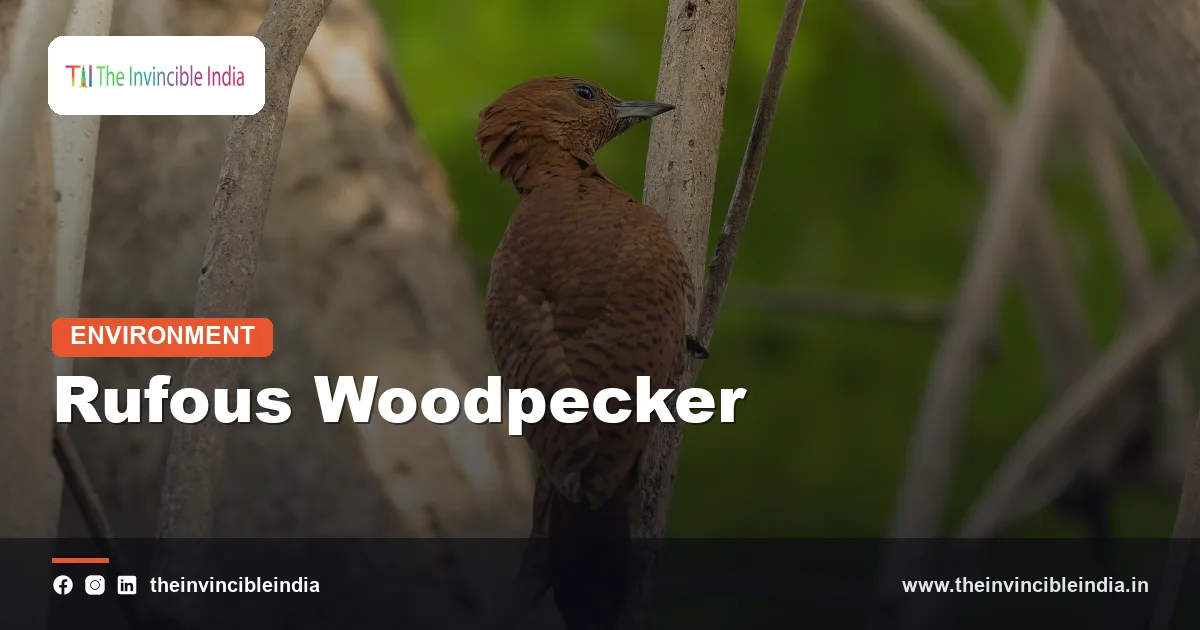
The rufous woodpecker (Micropternus brachyurus) is a small, rusty-brown woodpecker of South and Southeast Asian forests, famous for nesting inside the living nests of tree ants and for feeding almost entirely on ants and their young. In India it is found in the Himalayan foothills, the northeast, the Eastern and Western Ghats and several central forest belts, where it is more often heard than seen.
With its barred russet plumage and short crest, the rufous woodpecker looks unlike the green and black-and-white woodpeckers that most people know. This explainer covers how to identify the bird, where it lives, how its unusual partnership with ants works, and why it deserves attention from anyone interested in Indian forest wildlife.
Quick Facts
| Common name | Rufous woodpecker |
|---|---|
| Scientific name | Micropternus brachyurus (the only species in its genus) |
| Family and order | Picidae (woodpeckers); order Piciformes |
| Size | About 25 cm long |
| Range in India | Himalayan foothills, northeast India, Eastern and Western Ghats and parts of central India |
| Habitat | Moist and dry deciduous forest, bamboo stands, evergreen edges, plantations and wooded farmland |
| Diet | Mainly ants, their eggs, larvae and pupae; some termites and other small insects |
| Breeding | Excavates its nest chamber inside an active arboreal ant nest; usually 2 to 4 white eggs |
| Conservation status | Least Concern on the IUCN Red List; protected under Indian wildlife law |
Key Takeaways
- The rufous woodpecker is a rusty-brown, finely barred woodpecker about 25 cm long, with a short crest and a plain, unstreaked look.
- The rufous woodpecker is the only member of its genus, Micropternus, which sets it apart from all other Indian woodpeckers.
- Ants and their brood make up most of the rufous woodpecker’s diet, and the bird is a specialist at opening arboreal ant nests.
- The rufous woodpecker nests inside living ant nests built in trees, where the ants appear to leave the nesting pair and chicks unharmed.
- Male rufous woodpeckers have a crimson patch on the cheek below and behind the eye, which females lack.
- The rufous woodpecker is assessed as Least Concern, but it depends on mature forest and large trees that carry ant nests.
What is the rufous woodpecker?
The rufous woodpecker is a small woodpecker in the family Picidae whose rich cinnamon-brown plumage gives it its name. Its scientific name is Micropternus brachyurus, and it is the only living species placed in the genus Micropternus. Several regional forms, called subspecies, have been described across its range, and they differ slightly in shade and size.
The word “rufous” means reddish-brown, a good description of the bird’s overall colour. In the field it often looks like a dark reddish blur on a tree trunk rather than the green or pied bird people usually picture when they think of a woodpecker.
The species is widespread but secretive. It lives mostly in the middle and upper levels of the forest, often in or near the clumps of leaves where ants build nests. Because it spends much of its time quietly feeding, many forest visitors overlook it.
The rufous woodpecker is considered a resident bird in India. It does not undertake long migrations, although some birds move locally with changes in season and food supply.
How can you identify a rufous woodpecker?
A rufous woodpecker can be identified by its overall chestnut-brown plumage, fine dark barring on the wings, back and tail, a short bushy crest, and a paler, plainer head. The bird is roughly the size of a large bulbul or small myna, and its bill is relatively short and slightly curved compared with other woodpeckers.
Plumage in detail
- Body: warm chestnut-brown, with the underparts a plain rufous shade.
- Wings, back and tail: neatly barred in dark brown or black.
- Head: paler and more buffy, with a short crest that is often raised.
- Bill: short, pointed and pale to dark, less powerful than that of a flameback.
- Eyes: dark, set in a relatively plain face.
Males and females
The male rufous woodpecker shows a crimson patch on the cheek, just below and behind the eye, while the female has no such patch and appears plainer. This small red mark is the key to separating the sexes, since the body plumage is otherwise the same.
Similar birds
Few other Indian woodpeckers are this reddish all over, so identification is usually straightforward. Birdwatchers sometimes mistake a rufous woodpecker in poor light for a squirrel or a large brown cuckoo, because the bird moves along branches in short, jerky hops and may hang beneath them.
| Feature | Rufous woodpecker | Typical green woodpecker |
|---|---|---|
| Overall colour | Chestnut-brown, barred | Olive-green |
| Size | About 25 cm | About 30 cm or more |
| Main food | Ants and their brood | Ants and termites, plus other insects |
| Nest | Inside a living arboreal ant nest | Hole in a tree trunk |
Where does the rufous woodpecker live in India?
The rufous woodpecker lives in forested parts of India that include the Himalayan foothills, the northeast, the Western Ghats, the Eastern Ghats and some central Indian forests. It is also found in Sri Lanka and ranges east across Southeast Asia to the Greater Sundas.
The bird avoids treeless open land and very dry regions. Its habitat preferences include:
- Moist deciduous and semi-evergreen forests with tall, mature trees.
- Bamboo-rich forests and forest edges.
- Teak, coffee and other plantations that retain a good tree canopy.
- Wooded farmland and orchards with large old trees.
The rufous woodpecker usually keeps to the canopy and middle storey. Trees that hold large nests of tree ants are its key resource, so the bird tends to be found where such trees are plentiful.
In the mountains it generally occupies lower and middle elevations. It is not typically a bird of high Himalayan forests, and it is more likely to be seen in the warm foothills and lowland valleys.
What does the rufous woodpecker eat?
The rufous woodpecker eats mainly ants, along with their eggs, larvae and pupae, and it also takes some termites and other small insects. Ant brood, the soft white stages inside the nest, is rich in protein and fat, and the woodpecker often prefers it to the adult ants.
The bird feeds by tearing or probing the papery or “carton” nests that certain tree ants build from leaves, plant fibre and secretions. It makes a hole in the nest, pushes its bill and tongue inside and extracts the brood. A rufous woodpecker may return to the same nest repeatedly, because the ants rebuild and the colony continues to produce food.
How the bird deals with the ants
Ants that defend their nest can bite and spray irritant chemicals, yet the rufous woodpecker works calmly among them. Researchers suggest that the thick feathers of the head and the bird’s behaviour help protect it, although scientists have not fully explained why the ants tolerate it so well. The bird will also sometimes feed on ants walking on bark or on fallen insects.
Other foods
- Termites found in decaying wood.
- Small beetles and caterpillars picked from bark.
- The occasional fruit or sweet exudate.
Because it depends so heavily on ants, the rufous woodpecker is regarded as an ant specialist. This makes it particularly sensitive to the loss of old trees that support large ant colonies.
How does the rufous woodpecker nest inside an ant nest?
The rufous woodpecker nests by excavating a chamber inside an active ant nest built on a tree, then using that chamber for laying eggs and raising chicks. This is one of the most unusual nesting habits among Indian birds, and it has been recorded in several forest regions.
The pair chooses an arboreal ant nest, commonly one built by acrobat ants or similar tree-living species, that hangs from a branch or sits in a hollow limb. They dig out a cavity in the nest material, working with their bills, and may also use a small hole in the underlying wood. The ants usually remain in the nest and carry on with their activities.
Why would a bird nest among ants?
Biologists propose several advantages. The ants may help discourage snakes, lizards and other predators from approaching, and the nest provides a ready-made, insulated chamber. The woodpecker also has a convenient supply of food next to its chicks. This arrangement is a kind of association in which the bird benefits and the ants seem little affected, though the exact relationship is still being studied.
Eggs and chicks
- The female usually lays 2 to 4 white eggs.
- Both parents take part in incubation and feeding.
- The adults feed the chicks mainly with ants and their brood.
- The young leave the nest after several weeks and remain with the parents for a time.
Breeding generally takes place in the drier months of the year, though the timing varies with region. The nest is often high above the ground and hard to see from below, which is another reason why the bird is rarely observed breeding.
What does the rufous woodpecker sound like?
The rufous woodpecker has a loud, shrill, penetrating voice that can be heard from a long distance in the forest. Its calls are often a series of thin, high-pitched notes and sharp whistles, and they stand out from the quieter background sounds of the canopy.
Unlike many woodpeckers, this species does not drum noisily on dead trees as its main means of communication. It uses its voice more than percussion, and calling is especially frequent in the breeding season and in the early morning. Pairs often call back and forth as they move through the treetops.
Birdwatchers who learn the call can locate the species in forests where it would otherwise be missed. The bird often calls from an exposed branch before dropping to feed, and it may be seen in an undulating flight between trees.
Calls also serve to warn other woodpeckers away from a feeding territory and to alert mates to danger. Sound is therefore the most reliable way to detect the presence of a rufous woodpecker in a patch of forest.
How does the rufous woodpecker climb and feed on trees?
The rufous woodpecker climbs and feeds using the same body plan as other woodpeckers, with toes arranged two forward and two backward, a stiff tail used as a prop, and a long, sticky tongue. These features let the bird hold on to bark and branches while it works on ant nests.
Feet and tail
The zygodactyl foot gives a firm grip on bark and on the rough surface of ant nests. Strong claws help the bird hang beneath branches, a posture that the rufous woodpecker adopts often when it is feeding on hanging nests.
Bill and tongue
The bill is shorter and less heavily built than that of woodpeckers that excavate hard wood, which fits a diet of soft ant nests. The tongue is long and has a sticky tip that picks up ants and brood from deep inside the nest.
Head protection
Dense feathering and a strong skull help the bird work in the middle of an angry colony of ants. This protection is not absolute, and the bird often shakes its head and preens after a feeding session.
Is the rufous woodpecker threatened?
The rufous woodpecker is not currently regarded as threatened, and the International Union for Conservation of Nature (IUCN) classifies it as Least Concern. The bird occupies a broad range across South and Southeast Asia and is reported from many protected areas.
It nevertheless depends on habitat features that are vulnerable to change:
- Large, mature trees that support ant nests.
- Continuous forest cover with a healthy canopy.
- Low levels of pesticide in plantations and farmland.
- Undisturbed breeding sites, since nests are fragile.
Where forests are cleared or heavily logged, the ants and the bird that depends on them can disappear together. Conservation of mature forest and the retention of large trees in plantations are therefore the most helpful measures.
In India all wild woodpeckers are protected by wildlife law, and capturing or harming them is an offence.
Why does the rufous woodpecker matter to forest ecology?
The rufous woodpecker matters because it is a specialist predator of ants and because its unusual nesting habit shows how closely forest species can depend on one another. By feeding on ant brood it may help to regulate ant colonies, although the effect on individual nests is usually small.
The species also serves as a pointer to forest quality. A forest that supports rufous woodpeckers contains tall trees, thriving ant colonies and a healthy insect community. The bird is thus a useful ecological indicator for scientists and birdwatchers who monitor habitat health.
For ordinary readers the species offers a simple lesson: wildlife is full of partnerships and dependencies that are easy to miss. A rusty bird in a canopy nest tells a story about ants, trees, predators and the way a forest functions as a connected system.
How and where can you watch a rufous woodpecker?
You can watch a rufous woodpecker by visiting a mature forest or well-wooded plantation early in the morning and listening for its shrill call. The bird is easiest to find in the canopy, so a pair of binoculars and a patient search of the upper branches are essential.
Practical tips
- Start early, when the bird is active and calling.
- Scan the crowns of tall trees for hanging ant nests, which may attract the bird.
- Watch for an undulating flight across clearings or along forest roads.
- Check bamboo clumps, forest edges and shaded plantations.
- Avoid disturbing any nest, since the chamber is delicate and can be damaged easily.
National parks and sanctuaries in the Western Ghats, the northeast and the Himalayan foothills are good places to look. A local guide who knows the calls can improve the chances of a sighting.
Bottom Line
The rufous woodpecker is a distinctive, rust-coloured woodpecker that lives in association with tree ants, feeding on their brood and nesting inside their nests. Protecting mature forest and large trees is the best way to keep this specialist bird in Indian woodlands.
Frequently Asked Questions
What is a rufous woodpecker?
The rufous woodpecker is a small, rusty-brown woodpecker (Micropternus brachyurus) found in the forests of South and Southeast Asia. It is about 25 cm long and has a finely barred back, wings and tail. It feeds mainly on ants and nests inside ant nests.
Why does the rufous woodpecker nest inside ant nests?
The rufous woodpecker nests inside ant nests because the ants may deter predators and the nest provides a ready-made, insulated chamber. The bird also has food close at hand for its chicks. The exact reasons are still studied, but the habit is well documented.
What does a rufous woodpecker eat?
The rufous woodpecker eats mostly ants, especially their eggs, larvae and pupae. It also takes some termites and other small insects. It opens ant nests with its bill and extracts the contents with a long, sticky tongue.
How can you tell a male rufous woodpecker from a female?
The male rufous woodpecker has a crimson patch on the cheek below and behind the eye, while the female lacks this patch. Otherwise the two sexes look alike, with chestnut-brown plumage and dark barring. The red cheek mark is the simplest identification clue.
Where is the rufous woodpecker found in India?
The rufous woodpecker is found in the Himalayan foothills, the northeast, the Western and Eastern Ghats and parts of central India. It prefers forests with tall, mature trees, bamboo and plantations. It is also found in Sri Lanka and Southeast Asia.
Is the rufous woodpecker endangered?
No, the rufous woodpecker is listed as Least Concern by the IUCN, so it is not currently considered threatened. However, it depends on mature forests and large trees with ant nests. Habitat loss can therefore affect local populations.
{“@context”:”https://schema.org”,”@graph”:[{“@type”:”FAQPage”,”mainEntity”:[{“@type”:”Question”,”name”:”What is a rufous woodpecker?”,”acceptedAnswer”:{“@type”:”Answer”,”text”:”The rufous woodpecker is a small, rusty-brown woodpecker (Micropternus brachyurus) found in the forests of South and Southeast Asia. It is about 25 cm long and has a finely barred back, wings and tail. It feeds mainly on ants and nests inside ant nests.”}},{“@type”:”Question”,”name”:”Why does the rufous woodpecker nest inside ant nests?”,”acceptedAnswer”:{“@type”:”Answer”,”text”:”The rufous woodpecker nests inside ant nests because the ants may deter predators and the nest provides a ready-made, insulated chamber. The bird also has food close at hand for its chicks. The exact reasons are still studied, but the habit is well documented.”}},{“@type”:”Question”,”name”:”What does a rufous woodpecker eat?”,”acceptedAnswer”:{“@type”:”Answer”,”text”:”The rufous woodpecker eats mostly ants, especially their eggs, larvae and pupae. It also takes some termites and other small insects. It opens ant nests with its bill and extracts the contents with a long, sticky tongue.”}},{“@type”:”Question”,”name”:”How can you tell a male rufous woodpecker from a female?”,”acceptedAnswer”:{“@type”:”Answer”,”text”:”The male rufous woodpecker has a crimson patch on the cheek below and behind the eye, while the female lacks this patch. Otherwise the two sexes look alike, with chestnut-brown plumage and dark barring. The red cheek mark is the simplest identification clue.”}},{“@type”:”Question”,”name”:”Where is the rufous woodpecker found in India?”,”acceptedAnswer”:{“@type”:”Answer”,”text”:”The rufous woodpecker is found in the Himalayan foothills, the northeast, the Western and Eastern Ghats and parts of central India. It prefers forests with tall, mature trees, bamboo and plantations. It is also found in Sri Lanka and Southeast Asia.”}},{“@type”:”Question”,”name”:”Is the rufous woodpecker endangered?”,”acceptedAnswer”:{“@type”:”Answer”,”text”:”No, the rufous woodpecker is listed as Least Concern by the IUCN, so it is not currently considered threatened. However, it depends on mature forests and large trees with ant nests. Habitat loss can therefore affect local populations.”}}]}]}


