

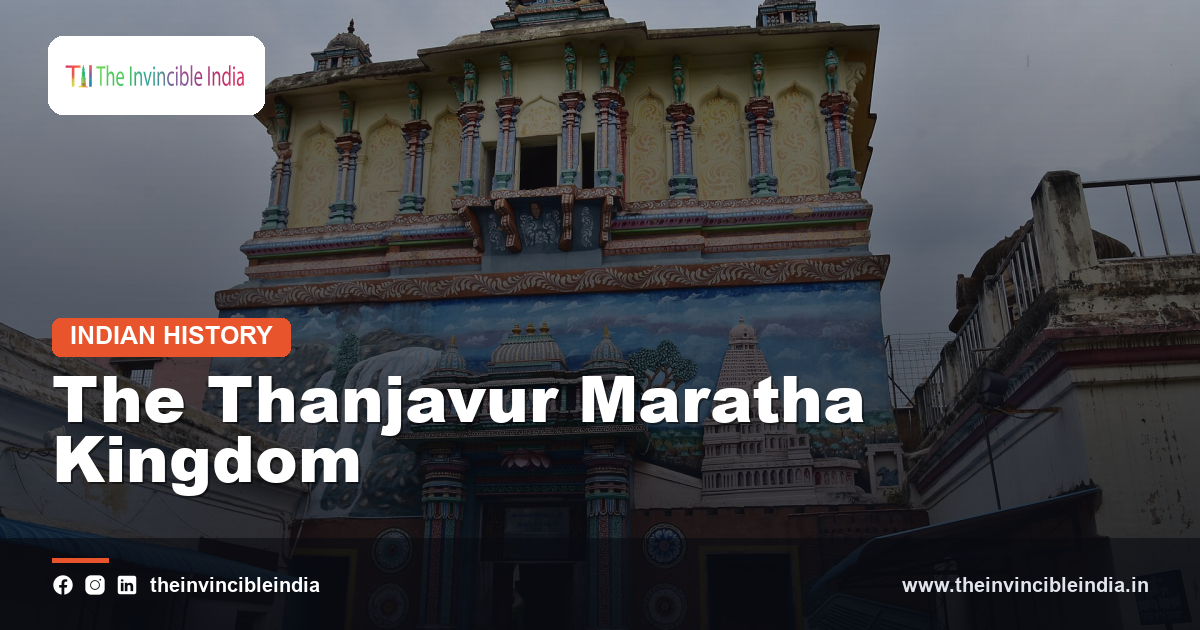
The Thanjavur Maratha kingdom, the realm of the Bhonsle rulers of Thanjavur in the Tamil country, was a state of the later seventeenth to the mid-nineteenth century centred on the fertile Kaveri delta and the historic city of Thanjavur, or Tanjore. Founded by Venkoji, also known as Ekoji I, a half-brother of the great Maratha leader Shivaji, the kingdom became renowned as a centre of art, learning and culture, above all under the scholar-king Serfoji II, who is remembered for his patronage of the Saraswati Mahal Library, music, dance and painting. As an outpost of the wider Maratha world described in the Maratha Empire, Thanjavur blended Maratha rule with the deep Tamil heritage of the delta. Because precise dates and figures should not be overstated, this guide keeps to broad and well-established terms.
Quick answer: The Thanjavur Maratha kingdom was the realm of the Bhonsle rulers of Thanjavur, or Tanjore, in the Tamil country, lasting from the later seventeenth to the mid-nineteenth century and centred on the fertile Kaveri delta. It was founded by Venkoji, also called Ekoji I, a half-brother of Shivaji, and became a renowned centre of art, learning and culture. Its most celebrated ruler, the scholar-king Serfoji II, patronised the Saraswati Mahal Library, music, dance and Tanjore painting. The dynasty blended Maratha rule with the deep Tamil heritage of the delta.
Key Takeaways
- The Thanjavur Maratha kingdom was the realm of the Bhonsle rulers of Thanjavur, or Tanjore, in the Tamil country of south India.
- It lasted from the later seventeenth to the mid-nineteenth century, centred on the fertile Kaveri delta.
- The kingdom was founded by Venkoji, also called Ekoji I, a half-brother of the Maratha leader Shivaji.
- Its most celebrated ruler was the scholar-king Serfoji II, a great patron of learning and the arts.
- Serfoji II is especially remembered for enriching the Saraswati Mahal Library and patronising Tanjore painting.
- The Thanjavur Marathas were custodians of the great Chola-era Brihadisvara temple and blended Maratha and Tamil culture.
Read on for the history, culture, and legacy in detail.
Quick Facts
| Detail | Information |
|---|---|
| Dynasty | Thanjavur Maratha (Bhonsle) kingdom |
| Period | Later seventeenth to mid-nineteenth century |
| Region | Thanjavur, Tamil Nadu (the Kaveri delta) |
| Capital | Thanjavur (Tanjore) |
| Founder | Venkoji (Ekoji I), a half-brother of Shivaji |
| Notable Ruler | Serfoji II (Sarabhoji II), the scholar-king |
| Patronage | Saraswati Mahal Library, music, dance, Tanjore painting |
| Legacy | Cultural flowering and custodianship of the Brihadisvara temple |
Who Were the Thanjavur Marathas?
The Thanjavur Marathas were a branch of the Bhonsle family, the Maratha house to which the great leader Shivaji belonged, who established a kingdom in the Tamil country far to the south of the Maratha homeland. Ruling from the historic city of Thanjavur in the fertile Kaveri delta, they governed a prosperous state from the later seventeenth century until the middle of the nineteenth. Though Maratha in origin, the dynasty governed a land of deep Tamil heritage and came to patronise and blend the cultural traditions of both worlds. They are remembered above all as great patrons of art, learning and religion rather than as conquerors. Their kingdom became one of the notable cultural centres of south India in the early modern period. The Thanjavur Marathas therefore represent a distinctive chapter in which a Maratha dynasty flourished in the Tamil south, leaving a rich legacy of scholarship and the arts.
Where Did the Thanjavur Maratha Kingdom Rule?
The Thanjavur Maratha kingdom ruled over the region around the city of Thanjavur in the Tamil country of south India, in the heart of the fertile delta of the Kaveri river. This delta, watered by one of south India’s great rivers, was among the richest agricultural regions of the peninsula, long celebrated for its prosperity and its dense network of temples and towns. Thanjavur itself was an ancient and illustrious city, famous as a former capital of the great Chola dynasty and home to one of India’s grandest temples. The wealth of the delta sustained the kingdom and supported the lavish patronage for which its rulers became known. The region lay within the wider world of the Tamil south, amid the rivalries of larger powers. The geography of the rich Kaveri delta therefore underpinned the prosperity and the cultural brilliance of the Thanjavur Maratha kingdom.
How Did the Marathas Come to Rule Thanjavur?
The Marathas came to rule Thanjavur in the later seventeenth century, when a Maratha force led by Venkoji, a member of the Bhonsle family, established control over the city and its region. Thanjavur had earlier been governed by the Nayak rulers, who had held the delta after the decline of the Vijayanagara empire, and the Maratha intervention came amid the political turbulence of the age in the Tamil country. Venkoji secured the throne and founded a lasting Maratha dynasty in the south, far from the Maratha heartland in the western Deccan. The establishment of Maratha rule brought a new ruling house to the ancient capital while preserving much of the region’s Tamil character. The circumstances of the conquest are recorded in broad outline. The coming of the Marathas to Thanjavur therefore marked the beginning of a distinctive southern Maratha kingdom in the Kaveri delta.
Who Was Venkoji, the Founder?
Venkoji, also known as Ekoji I, was the founder of the Thanjavur Maratha kingdom and a half-brother of the celebrated Maratha leader Shivaji. A member of the Bhonsle family, he was active in the Maratha ventures in the south and established his own rule at Thanjavur in the later seventeenth century, founding a dynasty that would endure for generations. As the progenitor of the southern Maratha line, he laid the political foundations of the kingdom in the Kaveri delta. His relationship to Shivaji connected the new southern state to the wider story of Maratha expansion in the seventeenth century. The details of his career and his dealings with his famous half-brother are recorded in general terms by historians. Venkoji is nonetheless remembered as the founder from whom the Thanjavur Maratha rulers traced their line. He stands at the origin of a dynasty that became renowned for its patronage of culture.
What Was the Connection to Shivaji and the Bhonsles?
The connection to Shivaji and the Bhonsles was fundamental to the identity of the Thanjavur Marathas, for the dynasty belonged to the same Bhonsle family as the great founder of Maratha power. Venkoji, the founder of the Thanjavur line, was a half-brother of Shivaji, tying the southern kingdom directly to the central figure of Maratha history. The Bhonsles were the leading family of the Maratha resurgence of the seventeenth century, and their branches spread across different regions of India. The Thanjavur branch represented the extension of this family’s fortunes into the Tamil south. This shared Bhonsle heritage gave the Thanjavur rulers prestige and a link to the wider Maratha world, even as they governed a distant and culturally distinct land. The relationship between the branches is recorded in the histories of the period. The Bhonsle connection therefore placed the Thanjavur Marathas within the great family that shaped the history of the Marathas.
Who Was Serfoji II?
Serfoji II, also written Sarabhoji II, is the most celebrated ruler of the Thanjavur Maratha kingdom, remembered as a scholar-king whose patronage of learning and the arts gave the dynasty its lasting fame. Ruling in the later eighteenth and early nineteenth centuries, during the period of growing British influence in India, he devoted himself to scholarship, education, literature, science, music and the fine arts with remarkable energy. He is especially honoured for his enrichment of the great library at Thanjavur and for his support of a wide range of cultural and charitable activities. A man of broad learning and curiosity, he embodied the ideal of the cultivated royal patron. His reign, though politically constrained by the circumstances of the age, became a golden age of culture for Thanjavur. Serfoji II therefore stands as the glory of the dynasty, a ruler remembered above all for his contributions to knowledge, the arts and the heritage of the region.
What Is the Saraswati Mahal Library?
The Saraswati Mahal Library at Thanjavur is one of the most famous and important historic libraries in India, closely associated with the Thanjavur Maratha rulers and especially with the scholar-king Serfoji II. The library grew from a royal collection maintained by the rulers of Thanjavur and was greatly enriched under Serfoji II, who was a passionate collector of manuscripts and books in many languages. It preserves a remarkable collection of palm-leaf and paper manuscripts, printed works and documents covering a vast range of subjects, from literature and religion to science and medicine. The library stands as a monument to the learning and scholarly spirit of the dynasty, and to Serfoji II in particular. It remains a treasured repository studied by scholars to this day. The Saraswati Mahal Library therefore embodies the intellectual legacy of the Thanjavur Marathas and ranks among the great cultural institutions inherited from early modern India.
How Did the Thanjavur Marathas Patronise the Arts?
The Thanjavur Marathas were lavish patrons of the arts, and their court became a renowned centre of music, dance, literature and painting in the Tamil south. The rulers supported the classical music and dance traditions of the region, and Thanjavur is celebrated in the history of Carnatic music and of the classical dance of south India as a major centre of patronage and development. The court attracted musicians, dancers, poets and scholars, and sponsored literary works in several languages, including Marathi, Tamil, Telugu and Sanskrit. Under rulers such as Serfoji II this patronage reached a high point, enriching the cultural life of the kingdom. The distinctive Tanjore style of painting also flourished under their support. Through this generous and wide-ranging patronage the dynasty nurtured a flowering of the arts. The Thanjavur Marathas therefore hold an honoured place in the cultural history of south India as patrons of its classical traditions.
What Is Tanjore Painting?
Tanjore painting, named after the city of Thanjavur, is a classical style of south Indian painting that flourished under the patronage of the region’s rulers, including the Thanjavur Marathas, and remains one of the celebrated art forms of India. The style is known for its rich colours, its devotional subjects drawn largely from Hindu deities and themes, and its distinctive use of gold leaf and ornamentation that gives the paintings a jewelled splendour. Often created as devotional images, Tanjore paintings adorned homes, temples and palaces and became a treasured regional tradition. The patronage of the Thanjavur court helped sustain and develop the art. The style continued as a living tradition and remains practised and admired today. Tanjore painting therefore stands as one of the most distinctive artistic legacies associated with Thanjavur and its rulers, embodying the devotional and decorative richness of south Indian art.
What Is the Brihadisvara Temple?
The Brihadisvara temple at Thanjavur is one of the greatest temples of India, a masterpiece of Chola architecture built many centuries before the Maratha period, of which the Thanjavur Marathas became custodians. Raised by the great Chola dynasty, the temple is renowned for its towering tower, its vast scale and the magnificence of its sculpture, and it is recognised as a monument of outstanding heritage value. Though it belongs to the earlier Chola age, the temple remained a central sacred site through the later rulers of Thanjavur, including the Marathas, who maintained and honoured it. The Thanjavur Maratha rulers thus served as guardians of this ancient and sacred monument in their capital. The temple stands as a symbol of the long and layered history of Thanjavur. The Brihadisvara temple therefore links the Maratha kingdom to the deep Chola past of the city and remains the most celebrated monument of Thanjavur.
How Did the Kingdom Blend Maratha and Tamil Culture?
The Thanjavur Maratha kingdom blended the culture of its Maratha rulers with the deep Tamil heritage of the Kaveri delta, creating a distinctive and cosmopolitan courtly world. Though the ruling house was Marathi-speaking and of Deccan origin, it governed an ancient Tamil land with its own language, temples and traditions, and the court came to embrace and patronise this rich inheritance. Literature and scholarship flourished in several languages, including Marathi, Tamil, Telugu and Sanskrit, reflecting the plural character of the kingdom. The rulers honoured the Hindu religious traditions of the region and maintained its great temples. This meeting of Maratha and Tamil cultures gave Thanjavur a unique cultural identity in early modern south India. The blending extended to the arts, administration and court life alike. The Thanjavur Marathas therefore exemplify the fruitful fusion of different regional cultures, producing a court renowned for its learning and the breadth of its patronage.
How Did the Thanjavur Marathas Govern?
The Thanjavur Marathas governed their compact but prosperous kingdom through a court and administration suited to the rich agricultural society of the Kaveri delta. The ruler stood at the head of the state, supported by ministers, officials and the institutions needed to manage the revenue of the fertile delta and the affairs of the temples and towns. The wealth of the region, drawn from its productive farmland and its many temples, sustained the court and its lavish cultural patronage. The administration worked within the traditions of the Tamil country while reflecting the Maratha origins of the ruling house. In their later period the rulers governed amid the growing power of the British in south India, which increasingly constrained their political independence. Patronage of religion, learning and the arts was central to their conception of kingship. The governance of the Thanjavur Marathas therefore combined the management of a wealthy delta kingdom with a strong devotion to culture and scholarship.
How Did the Kingdom Relate to Larger Powers?
The Thanjavur Maratha kingdom related to the larger powers of its age through the shifting politics of the Tamil south, dealing in turn with neighbouring rulers, other southern states and the rising European powers. In its earlier history the kingdom existed amid the rivalries that followed the decline of the Vijayanagara and Nayaka order in the south, contending with neighbours for position in the region. From the eighteenth century the growing power of the British East India Company increasingly dominated the affairs of south India, and the kingdom, like other southern states, was drawn into this new order. The Thanjavur rulers navigated these pressures through diplomacy and accommodation as their political independence narrowed. The details of these complex relations are recorded in general terms by historians. This changing environment shaped the later history of the kingdom. The Thanjavur Marathas therefore governed within a south India increasingly transformed by the expansion of European power.
How Did the Thanjavur Maratha Kingdom End?
The Thanjavur Maratha kingdom came to an end in the middle of the nineteenth century, when its rule was absorbed into the British-dominated order that by then controlled south India. Over the preceding decades the kingdom, like other Indian states, had seen its independence steadily reduced under the paramount power of the British East India Company. In the mid-nineteenth century the kingdom’s separate political existence came to a close, bringing the rule of the Thanjavur Maratha dynasty to its formal end. The city of Thanjavur and its region passed fully under the prevailing administration of the time. The cultural legacy of the dynasty, however, far outlived its political fall. The circumstances of the kingdom’s end are recorded in broad outline by historians. The close of the Thanjavur Maratha kingdom therefore marked the end of a distinctive southern dynasty, even as its contributions to learning and the arts endured.
Why Is the Thanjavur Maratha Kingdom Significant?
The Thanjavur Maratha kingdom is significant in Indian history as a distinctive southern Maratha state that became one of the great centres of learning and the arts in early modern India. Founded by a branch of the Bhonsle family in the Tamil country, it blended Maratha rule with the deep heritage of the Kaveri delta to create a uniquely cosmopolitan court. Above all it is remembered for the scholar-king Serfoji II and for institutions such as the Saraswati Mahal Library, which preserve a remarkable intellectual legacy. The kingdom nurtured music, dance, literature and the celebrated Tanjore style of painting, and it guarded the great Brihadisvara temple. For students of Indian history, it illustrates the reach of the Maratha world and the richness of south Indian culture. The significance of the Thanjavur Marathas therefore lies in their extraordinary patronage of scholarship and the arts and in the cultural treasures they preserved.
The Thanjavur Maratha Kingdom Today
The Thanjavur Maratha kingdom lives on today through the cultural heritage of Thanjavur, from the Saraswati Mahal Library to the palace, the Brihadisvara temple and the living tradition of Tanjore painting. The great library remains a celebrated repository of manuscripts studied by scholars from around the world, a direct inheritance from Serfoji II. The royal palace of Thanjavur preserves memories of the dynasty and houses collections of art and history. The Brihadisvara temple, guarded by the Marathas and recognised as a monument of outstanding heritage, remains a major sacred and cultural landmark. Tanjore painting continues as a flourishing art form, and the city endures as a centre of south Indian classical music and culture. Historians and conservators preserve the records and monuments of the dynasty. For readers of Indian history, the Thanjavur Marathas endure in the libraries, temples, palaces and arts of their celebrated city.
Sources & Further Reading
- Archaeological Survey of India (asi.nic.in).
- Ministry of Culture, Government of India (indiaculture.gov.in).
- Tamil Nadu Tourism, Government of Tamil Nadu (tamilnadutourism.tn.gov.in).
Frequently Asked Questions
Who were the Thanjavur Marathas?
The Thanjavur Marathas were a branch of the Bhonsle family who ruled a kingdom centred on Thanjavur, or Tanjore, in the Tamil country from the later seventeenth to the mid-nineteenth century. They are remembered above all as great patrons of art, learning and religion.
Who founded the Thanjavur Maratha kingdom?
The Thanjavur Maratha kingdom was founded by Venkoji, also known as Ekoji I, a half-brother of the Maratha leader Shivaji. He established Maratha rule at Thanjavur in the later seventeenth century, founding a dynasty that endured for generations.
Who was Serfoji II?
Serfoji II, also written Sarabhoji II, was the most celebrated ruler of the Thanjavur Marathas, remembered as a scholar-king. Ruling in the later eighteenth and early nineteenth centuries, he was a great patron of learning, science and the arts and enriched the famous Saraswati Mahal Library.
What is the Saraswati Mahal Library?
The Saraswati Mahal Library at Thanjavur is one of India’s most famous historic libraries, associated especially with Serfoji II. It preserves a remarkable collection of manuscripts and works in many languages and remains a treasured repository studied by scholars today.
What is Tanjore painting?
Tanjore painting is a classical south Indian style of painting that flourished under the patronage of Thanjavur’s rulers, including the Marathas. It is known for its rich colours, devotional subjects and distinctive use of gold leaf, and it remains a celebrated living art form.
How did the Thanjavur Maratha kingdom end?
The Thanjavur Maratha kingdom came to an end in the middle of the nineteenth century, when its rule was absorbed into the British-dominated order of south India. Its political independence had steadily declined under British paramountcy, though its cultural legacy far outlived it.


