

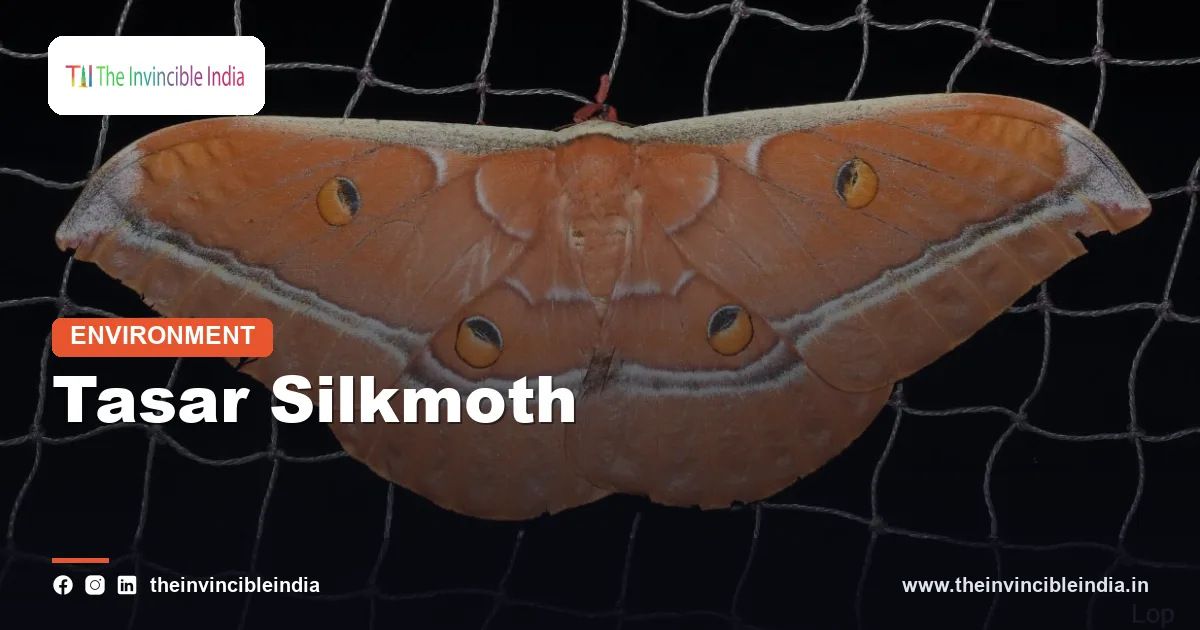
The tasar silkmoth (Antheraea mylitta) is a large wild silk moth of the Indian forests whose cocoons yield tasar silk, a coarse, naturally golden-brown silk that is produced almost entirely by tribal and forest-dwelling communities. Unlike the familiar mulberry silkworm, the tasar silkmoth is not fully domesticated: its caterpillars feed on forest trees such as arjun, asan and sal, and much of its rearing happens outdoors in woodland.
The tasar silkmoth belongs to the giant silk moth family Saturniidae and is the source of what the textile trade calls tropical tasar silk, a fibre for which India is the only producer in the world. This article explains what the moth is, how its life cycle works, which trees it depends on, how tasar silk is obtained, and why this quiet forest insect matters to rural livelihoods.
Quick Facts: Tasar Silkmoth
| Scientific name | Antheraea mylitta (Drury) |
|---|---|
| Order and family | Lepidoptera (moths and butterflies); Saturniidae (giant silk moths) |
| Size | Large moth with a wingspan commonly above 12 cm; females are larger than males |
| Habitat in India | Dry deciduous forests of the central and eastern plateau, especially Jharkhand, Chhattisgarh, Odisha, West Bengal, Maharashtra and Madhya Pradesh |
| Host plants | Arjun (Terminalia arjuna), asan (Terminalia tomentosa) and sal (Shorea robusta), among others |
| Life cycle | Complete metamorphosis: egg, caterpillar (five growth stages), cocoon-enclosed pupa, adult moth |
| Adult feeding | None; the adult moth has no functional mouthparts and lives only a few days |
| Economic role | Produces tasar (tussar) silk, a wild silk with a natural golden-tan colour |
| Official support | Central Silk Board under the Ministry of Textiles; research at the Central Tasar Research and Training Institute, Ranchi |
Key Takeaways
- The tasar silkmoth (Antheraea mylitta) is a large Indian wild silk moth in the family Saturniidae.
- Tasar silk from the tasar silkmoth is naturally golden-brown, coarse and durable, and India is the only country producing tropical tasar.
- The tasar silkmoth caterpillar feeds on forest trees such as arjun, asan and sal, so its silk depends directly on healthy woodland.
- An adult tasar silkmoth does not eat; it emerges from the cocoon, mates and lays eggs within a few days.
- Tasar silk rearing is carried out mostly by tribal families in Jharkhand, Chhattisgarh, Odisha and neighbouring states, making it an important forest-based livelihood.
- Tasar is one of the wild silks of India, alongside muga from Assam and eri, and it differs from mulberry silk in both source and texture.
What is the tasar silkmoth?
The tasar silkmoth is a big, heavy-bodied moth whose scientific name is Antheraea mylitta, found across the forested plateau of peninsular and eastern India. It was described by the English naturalist Dru Drury in the eighteenth century and is placed in the family Saturniidae, the same group that includes the Atlas moth and the Indian moon moth.
The adult is brown to yellowish-brown, with a thick furry body and broad wings. Each wing carries a translucent, eye-like spot, which gives the family its common name of eyespot or giant silk moths. Females are larger and heavier than males, and males can be recognised by their broader, feathery antennae, which detect the scent that females release to attract a mate.
The word tasar is often spelt tussar or tussah in the textile trade. It is believed to derive from an old Sanskrit word for a shuttle, a reference to the weaver’s tool, although the exact origin of the term is not important for identifying the insect. The moth itself is the same animal whatever spelling is used for the fabric.
Where does the tasar silkmoth live in India?
The tasar silkmoth lives mainly in the dry deciduous forests of the central and eastern Indian plateau, where its host trees grow naturally. Jharkhand is the leading tasar-producing state, followed by Chhattisgarh and Odisha, with smaller but significant activity in West Bengal, Maharashtra, Bihar, Madhya Pradesh and parts of Andhra Pradesh.
These regions share a seasonal climate, with a hot dry period, a monsoon and a cool season. The moth’s life cycle is tuned to that rhythm. Caterpillars feed on fresh leaves during and after the rains, while the pupa can rest inside its cocoon through harsh weather, an adaptation known as diapause.
Populations of the tasar silkmoth in different forest tracts have developed small differences in size, cocoon type and the number of generations per year. These regional forms are called ecoraces. Well-known examples include Daba, Sukinda, Raily, Modia and Bhandara. Researchers and rearers value ecoraces because each one is suited to a particular tree species and local climate.
How does the life cycle of the tasar silkmoth work?
The tasar silkmoth goes through complete metamorphosis in four stages: egg, larva or caterpillar, pupa inside a cocoon, and adult moth. Depending on the ecorace and local climate, a year may see one, two or three generations.
Egg
After mating, the female lays a few hundred small, oval eggs, often on leaves and twigs or on the rearing surface. The eggs hatch in about a week to ten days in warm weather. Female moths lay most of their eggs within the first couple of days after mating.
Caterpillar
The tiny newly hatched caterpillar starts feeding on tender leaves. It grows through five stages, called instars, shedding its skin between each one. By the final stage it is a plump green caterpillar several centimetres long, with fine hairs and bright markings. The caterpillar is the only feeding stage, so it must eat enough in a few weeks to build all the reserves the pupa and adult will use.
Cocoon and pupa
When fully grown, the caterpillar stops feeding and spins a hard, oval, greyish-brown cocoon, usually hanging from a twig on a short stalk called a peduncle. The stalk lets the cocoon swing from the branch and keeps it from falling during storms. Inside, the caterpillar changes into a pupa. The cocoon shell is stiff because of a mineral deposit and a protein glue, which is why tasar cocoons are harder to unwind than mulberry cocoons.
Adult
The adult moth softens one end of the cocoon with a fluid and pushes out, usually in the evening. It cannot eat, as its mouthparts are reduced, so it lives only for a few days using stored fat. During that time it finds a mate and the female lays eggs, completing the cycle.
What does the tasar silkmoth caterpillar eat?
The tasar silkmoth caterpillar eats the leaves of a number of forest trees, with arjun (Terminalia arjuna), asan (Terminalia tomentosa) and sal (Shorea robusta) being the three principal host plants in India. The caterpillar is polyphagous, meaning it accepts several host species, but each ecorace has a preferred tree.
Arjun is a large riverside tree widely known in India for its bark in traditional medicine. Asan is a tall tree of dry forests that is also called saj. Sal is the dominant tree of many eastern and central forests and is valued for its timber. A tasar rearer must therefore be familiar with forest management as well as insect care.
Foliage quality affects the size of the cocoon and the amount of silk. Young, well-lit trees that regrow leaves after pruning are preferred for rearing. Over-lopping or fire damage lowers leaf supply, so conservation of host plantations is directly tied to silk output.
What is tasar silk and how is it made?
Tasar silk is a wild silk reeled or spun from the cocoons of the tasar silkmoth, and it is recognised by its natural golden or tan colour, dry feel and slightly uneven texture. The fibre is made of the protein fibroin, held together by the gum sericin, just as in other silks.
Making tasar silk involves a series of steps that are mostly performed by hand.
- Rearing: Eggs, known in the trade as disease-free layings, are placed on host trees or on prepared plantations, and the caterpillars are protected from birds, wasps and other predators.
- Cocoon harvesting: Mature cocoons are collected from the branches once spinning is complete.
- Selection and seed cocoons: Healthy cocoons are kept aside so that moths can emerge and produce the next generation.
- Cooking and softening: Cocoons meant for silk are boiled in a mild alkaline solution to loosen the hard gum.
- Reeling or spinning: The softened cocoons are reeled into a continuous filament or spun into yarn, often on simple hand-operated devices.
- Weaving and finishing: The yarn is woven into cloth, which may be left in its natural shade or dyed.
Because the moth would otherwise cut through the filament while emerging, commercial tasar reeling generally uses cocoons from which the silk has been taken before the moth leaves. A single cocoon contains a very long continuous filament, but the thick gum makes it difficult to unwind cleanly.
How is tasar silk different from mulberry silk and other wild silks?
Tasar silk differs from mulberry silk in its wild origin, coarser fibre, golden colour and more textured feel, and it also differs from India’s other wild silks in the moth species that produces it. Mulberry silk comes from the domesticated Bombyx mori, which is reared indoors on mulberry leaves and produces fine, white or cream, highly lustrous thread.
| Silk type | Producing insect | Main host plants | Main Indian region | Typical character |
|---|---|---|---|---|
| Tasar (tropical) | Antheraea mylitta | Arjun, asan, sal | Jharkhand, Chhattisgarh, Odisha | Coarse, golden-tan, matte, durable |
| Muga | Antheraea assamensis | Som, soalu | Assam | Natural golden sheen, very durable |
| Eri | Samia ricini | Castor, kesseru | North-east India | Soft, woolly, warm; spun from open-ended cocoons |
| Oak tasar | Antheraea proylei and related species | Oak species | Himalayan foothills and north-east | Fine wild silk from temperate oaks |
| Mulberry | Bombyx mori | Mulberry | Karnataka, Andhra Pradesh, Tamil Nadu, West Bengal | Fine, smooth, glossy, domesticated |
Tasar cloth tends to have a dry, slightly rough hand and an earthy shade that ranges from cream to deep honey. Many weavers treat that natural colour as a selling point and leave it undyed. Tasar is also used to make handloom sarees, dress material, stoles and furnishing fabrics, and the weaving clusters of Bhagalpur in Bihar and Champa in Chhattisgarh are widely associated with tussar and kosa silk.
Why does the tasar silkmoth matter to people and forests?
The tasar silkmoth matters because it supports a forest-based livelihood for tens of thousands of rural and tribal families and gives them a reason to protect standing woodland. India produces tropical tasar silk, and the Central Silk Board treats tasar as one of the major wild-silk sectors, with research and training programmes aimed at raising yields and incomes.
Tasar rearing suits communities living near forests for several reasons.
- It needs very little capital, since the host trees are already growing in the forest.
- Rearing is seasonal, which fits around farming and other work.
- Whole families, including women, take part in rearing, reeling and spinning.
- Value is added locally when cocoons are reeled and woven within the same district.
- Healthy host forests also protect soil, water and other wildlife, so the livelihood encourages conservation.
The Central Tasar Research and Training Institute at Piska Nagri near Ranchi, which works under the Central Silk Board, develops improved rearing methods, disease-free seed and training for rearers. State sericulture departments and non-governmental organisations also take part in training and marketing.
What threatens the tasar silkmoth and its caterpillars?
The main threats to the tasar silkmoth in rearing areas are parasites, diseases and predators of the caterpillar, together with the loss and degradation of host forests. Caterpillars are soft and slow-moving, so they are attractive prey for birds, lizards, wasps, ants and bugs.
One serious pest is the uzi fly (Blepharipa zebina), a parasitic tachinid fly. The female fly lays eggs on leaves; when a caterpillar eats them, the maggots develop inside the host and can destroy the pupa. Rearers and researchers control uzi fly in several ways, including using nylon nets to protect caterpillars, timing the crop and using biological controls.
Disease is another problem. Bacterial and viral infections and the protozoan disease called pebrine can reduce yields, which is why the supply of clean seed, hygienic handling and good rearing practice are stressed in training. Fire, illegal felling and conversion of forest to farmland remove host trees and reduce the habitat for wild populations.
How can the tasar silkmoth be protected and supported?
The tasar silkmoth is best supported by protecting its host forests, growing arjun, asan and sal plantations, and strengthening the community systems that produce disease-free seed and fair prices for cocoons. Wild populations of the moth are not currently regarded as globally endangered, but their value depends on continuing healthy woodland.
- Host plantations: Planting and managing host trees on forest and village land gives rearers a reliable leaf supply.
- Quality seed: Regulated grainages, the units that produce eggs, supply clean seed that lowers disease losses.
- Skill training: Training in rearing, reeling and spinning raises quality and income.
- Market access: Cooperatives, self-help groups and handloom clusters help families sell reeled yarn and cloth at better prices.
- Fire and grazing control: Keeping plantations free from fire and uncontrolled grazing protects young trees.
- Cleaner dyeing and design: Marketing undyed or naturally dyed tasar fits growing interest in sustainable textiles.
Seeing a large brown moth on a forest road in the monsoon is usually harmless and sometimes a sign of healthy woodland. People who find cocoons hanging on trees in tasar regions are advised to leave them alone, since they may belong to a rearer or to the wild population.
Bottom Line
The tasar silkmoth is a large, non-feeding forest moth whose caterpillars feed on arjun, asan and sal and whose hard cocoons give India its distinctive golden tasar silk. It links insect biology, forest conservation and rural livelihoods in a way few other creatures do.
Frequently Asked Questions
What is the tasar silkmoth?
The tasar silkmoth is the large wild silk moth Antheraea mylitta, whose cocoons produce tasar silk. It belongs to the family Saturniidae and lives in the dry deciduous forests of central and eastern India. Its caterpillars feed on trees such as arjun, asan and sal.
Is tasar silk made from a wild or a domesticated insect?
Tasar silk comes from a wild or semi-wild insect rather than a fully domesticated one. The tasar silkmoth is reared largely outdoors on forest trees, unlike the mulberry silkworm, which is reared indoors on cultivated mulberry. This is why tasar is classed as a wild silk.
Which trees does the tasar silkmoth caterpillar feed on?
The tasar silkmoth caterpillar feeds mainly on arjun, asan and sal leaves. Each regional ecorace usually prefers one of these trees. The quality of the leaves affects cocoon size and silk yield.
Does the adult tasar moth eat or sting?
No, the adult tasar silkmoth neither eats nor stings. Its mouthparts are reduced, so it lives for only a few days on fat stored while it was a caterpillar. The moth is harmless to people.
Which Indian states produce tasar silk?
Jharkhand is the leading producer of tasar silk, followed by Chhattisgarh and Odisha. West Bengal, Bihar, Maharashtra, Madhya Pradesh and Andhra Pradesh also produce smaller amounts. India is the only country that produces tropical tasar silk.
How is tasar silk different from mulberry silk?
Tasar silk is coarser, matte and golden-tan, while mulberry silk is fine, smooth and glossy. Tasar comes from the wild Antheraea mylitta and mulberry silk from the domesticated Bombyx mori. Tasar fabric is also valued for its natural colour and durability.
{“@context”:”https://schema.org”,”@graph”:[{“@type”:”FAQPage”,”mainEntity”:[{“@type”:”Question”,”name”:”What is the tasar silkmoth?”,”acceptedAnswer”:{“@type”:”Answer”,”text”:”The tasar silkmoth is the large wild silk moth Antheraea mylitta, whose cocoons produce tasar silk. It belongs to the family Saturniidae and lives in the dry deciduous forests of central and eastern India. Its caterpillars feed on trees such as arjun, asan and sal.”}},{“@type”:”Question”,”name”:”Is tasar silk made from a wild or a domesticated insect?”,”acceptedAnswer”:{“@type”:”Answer”,”text”:”Tasar silk comes from a wild or semi-wild insect rather than a fully domesticated one. The tasar silkmoth is reared largely outdoors on forest trees, unlike the mulberry silkworm, which is reared indoors on cultivated mulberry. This is why tasar is classed as a wild silk.”}},{“@type”:”Question”,”name”:”Which trees does the tasar silkmoth caterpillar feed on?”,”acceptedAnswer”:{“@type”:”Answer”,”text”:”The tasar silkmoth caterpillar feeds mainly on arjun, asan and sal leaves. Each regional ecorace usually prefers one of these trees. The quality of the leaves affects cocoon size and silk yield.”}},{“@type”:”Question”,”name”:”Does the adult tasar moth eat or sting?”,”acceptedAnswer”:{“@type”:”Answer”,”text”:”No, the adult tasar silkmoth neither eats nor stings. Its mouthparts are reduced, so it lives for only a few days on fat stored while it was a caterpillar. The moth is harmless to people.”}},{“@type”:”Question”,”name”:”Which Indian states produce tasar silk?”,”acceptedAnswer”:{“@type”:”Answer”,”text”:”Jharkhand is the leading producer of tasar silk, followed by Chhattisgarh and Odisha. West Bengal, Bihar, Maharashtra, Madhya Pradesh and Andhra Pradesh also produce smaller amounts. India is the only country that produces tropical tasar silk.”}},{“@type”:”Question”,”name”:”How is tasar silk different from mulberry silk?”,”acceptedAnswer”:{“@type”:”Answer”,”text”:”Tasar silk is coarser, matte and golden-tan, while mulberry silk is fine, smooth and glossy. Tasar comes from the wild Antheraea mylitta and mulberry silk from the domesticated Bombyx mori. Tasar fabric is also valued for its natural colour and durability.”}}]}]}


