

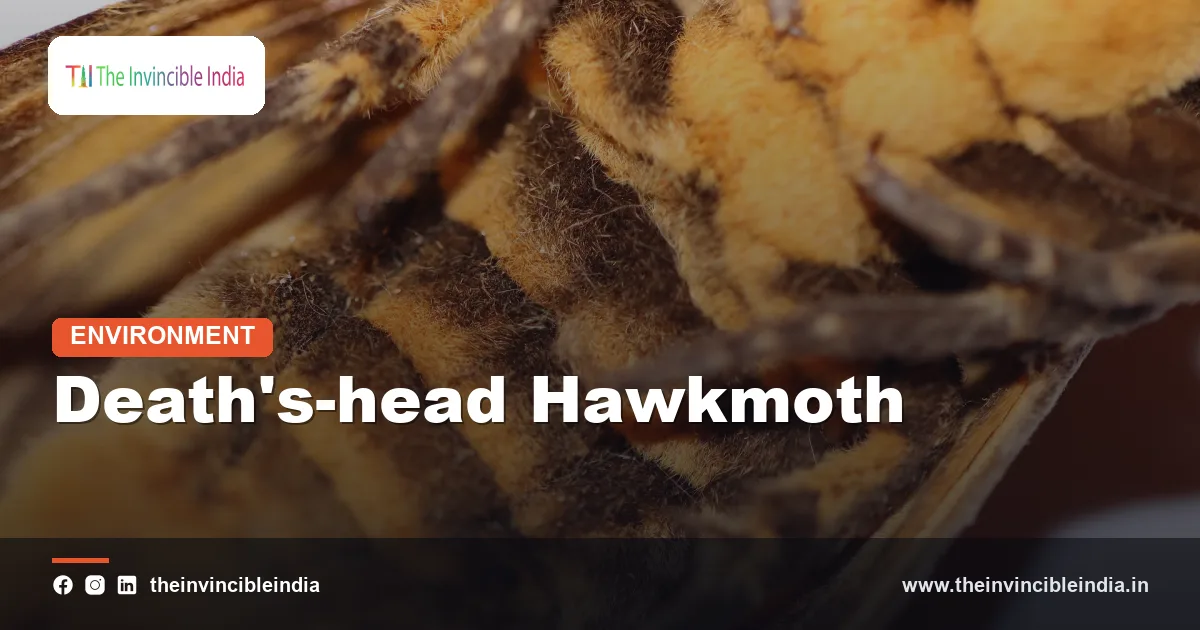
The death’s-head hawkmoth is a large, heavy-bodied moth of the genus Acherontia, named for the pale skull-shaped marking on its thorax, and in India it is represented by two species, the lesser death’s-head hawkmoth (Acherontia styx) and the greater death’s-head hawkmoth (Acherontia lachesis). The moth is famous for three unusual traits: the skull-like mark on its back, a loud squeak that it makes when disturbed, and a habit of entering bee hives to steal honey.
Both Indian species belong to the hawkmoth family Sphingidae, a group of powerful fliers with streamlined bodies and long wings. This article explains what the death’s-head hawkmoth is, how to tell the two Indian species apart, why it squeaks, how it raids bee colonies, what its caterpillars eat, and why folklore has often treated it as an omen.
| Quick Facts: Death’s-head Hawkmoth | |
|---|---|
| Common name | Death’s-head hawkmoth, also called the skull moth or bee robber |
| Scientific names | Acherontia styx (lesser death’s-head hawkmoth) and Acherontia lachesis (greater death’s-head hawkmoth) |
| Family | Sphingidae (hawkmoths or sphinx moths) |
| Wingspan | Roughly 9 to 13 cm, with the greater species being the larger |
| Host plants | Mainly plants of the nightshade family (Solanaceae), sesame and members of the olive and jasmine group, among others |
| Range in India | Widespread across the country, from the plains to hill country; also found across South and South-East Asia |
| Habitat | Farmland, gardens, scrub, forest edges and towns, often near lights at night |
| Flight season | Seen through much of the year in warm regions; adults are nocturnal |
| Notable features | Skull-like thoracic mark, squeaking sound, raids honey from bee hives, huge caterpillars with a curved tail horn |
Key Takeaways
- The death’s-head hawkmoth is a large moth of the genus Acherontia, named for the skull-shaped pattern on its thorax.
- India has two death’s-head hawkmoth species, the lesser (Acherontia styx) and the greater (Acherontia lachesis), both in the hawkmoth family Sphingidae.
- The death’s-head hawkmoth squeaks by forcing air through its mouthparts, a sound that is thought to startle predators.
- The death’s-head hawkmoth can enter bee hives and feed on honey, aided by a thick body covering, a short stout proboscis and a scent that reduces attack by bees.
- Caterpillars of the death’s-head hawkmoth are very large and feed on the leaves of plants such as potato, brinjal, sesame and jasmine.
- The death’s-head hawkmoth is harmless to people, although folklore in many cultures has treated its skull mark as a sign of bad luck.
What is the death’s-head hawkmoth?
The death’s-head hawkmoth is a large nocturnal moth belonging to the genus Acherontia in the hawkmoth family Sphingidae. The genus name comes from Acheron, a river of the underworld in Greek myth, and the species names of the Indian moths, styx and lachesis, also refer to the realm of the dead and to the Fates of Greek tradition.
Hawkmoths are known for strong, fast flight and the ability to hover in front of flowers, and the death’s-head hawkmoth shares the thick body and narrow, swept-back forewings of the family. However, it is less of a flower visitor than most hawkmoths. Its short, stout mouthparts are better suited to taking sweet liquids such as honey, tree sap and fermenting fruit than to reaching deep into flowers.
The genus contains only three widely recognised species. One, Acherontia atropos, lives in Europe, Africa and western Asia, while the other two live in tropical Asia. A European visitor may know the moth by the name of the European species, but the Indian moths are different species.
Which death’s-head hawkmoths live in India?
Two death’s-head hawkmoths live in India, the lesser death’s-head hawkmoth (Acherontia styx) and the greater death’s-head hawkmoth (Acherontia lachesis). Both are found across much of the country, and the two are often confused because they look alike at first glance.
| Feature | Lesser death’s-head hawkmoth | Greater death’s-head hawkmoth |
|---|---|---|
| Scientific name | Acherontia styx | Acherontia lachesis |
| Size | Somewhat smaller, wingspan roughly 9 to 11 cm | Larger, wingspan up to about 13 cm |
| Skull mark | Pale, skull-shaped patch on the thorax | Pale, skull-shaped patch, often broader |
| Abdomen | Yellow and dark bands with a dark central line | Yellow and dark bands, generally with a stouter, heavier look |
| Range | India, Sri Lanka, and westwards into the Middle East | India, Sri Lanka, and eastwards into South-East Asia |
The easiest way to separate the two is by size and overall build, but the difference is subtle, and experts often examine the pattern of the thorax and the abdomen. For a casual observer, the term death’s-head hawkmoth is usually enough.
Why does the death’s-head hawkmoth have a skull mark?
The death’s-head hawkmoth has a skull-like mark because of the pattern of pale scales on a dark thorax, which happens to resemble a human skull with two eye patches and a jaw. There is no proven biological function for the resemblance, and it is most likely a coincidence of the colour pattern.
The marking is formed by a pale, roughly oval area with darker patches that look like eye sockets. The forewings are dark brown and mottled with grey, black and buff, which helps the moth blend into bark and shaded surfaces by day. The hindwings are yellow with dark bands, and they are normally hidden under the forewings when the moth rests.
Some biologists suggest that the bold pattern, combined with the squeak and the swollen abdomen shown in threat, may startle a predator long enough for the moth to escape. This idea is plausible but remains a hypothesis rather than a proven function.
Why does the death’s-head hawkmoth squeak?
The death’s-head hawkmoth squeaks by drawing air into the pharynx and forcing it out across a flap in its mouthparts, producing a high-pitched sound without any wing or leg movement. This makes the moth one of the few insects that can create sound by moving air through the mouth.
The squeak is heard most often when the moth is held or alarmed. It can be produced as the moth breathes in as well as out, and it is audible to people from some distance. Possible functions include:
- Startling predators: A sudden squeak from a large insect may surprise a bird, bat or small mammal and give the moth time to escape.
- Warning display: The squeak is often combined with a raised, flexed abdomen and a flash of yellow, which together look like a threat.
- Communication with bees: Some researchers have proposed that the sound resembles the piping of a queen bee and may calm worker bees inside a hive, though this idea is still debated.
Caterpillars of the species also make sounds. When disturbed, they click their mandibles together, which may serve as a similar warning to attackers.
How does the death’s-head hawkmoth raid bee hives?
The death’s-head hawkmoth raids bee hives by entering the nest at night, avoiding attack through its thick body covering and chemical camouflage, and feeding on honey with its short, strong proboscis. The behaviour has earned the moth the name bee robber in several languages.
Several features help the moth succeed:
- Stout proboscis: The mouthparts are short, stiff and strong enough to pierce the wax caps of honey cells and suck out the contents.
- Thick cuticle: The tough body surface provides physical protection against the stings of worker bees.
- Bee-like scent: Studies have reported that the moth carries chemicals on its body that resemble those of honey bees, which may help it pass as a nestmate.
- Night raids: Entering the hive in darkness reduces the number of bees on guard.
Beekeepers have reported moths in hives of both the Asian honey bee and the European honey bee. A few moths taking honey do limited harm to a strong colony, although repeated raids can disturb the bees and reduce the honey stored. Narrow entrances and reduced hive openings are commonly used by beekeepers to keep large moths out.
What does the death’s-head hawkmoth caterpillar eat?
The death’s-head hawkmoth caterpillar eats the leaves of a range of plants, especially those of the nightshade family (Solanaceae) such as potato, brinjal (eggplant), Datura and tobacco, as well as sesame, jasmine and other garden and crop plants. Host plants vary with locality and season.
The caterpillars are among the largest in India. A full-grown larva can reach around ten centimetres, with a thick, smooth body that is green or yellow, marked by diagonal stripes along the sides and a curved, rough horn at the tail end. Some are brownish, and colour varies between individuals.
Because the caterpillar eats the foliage of crops such as potato and sesame, it is sometimes counted as a minor agricultural pest. Damage is generally limited, as the moth lays eggs singly and caterpillars rarely occur in large numbers. Picking the larvae by hand is usually enough in small gardens.
What is the life cycle of the death’s-head hawkmoth?
The life cycle of the death’s-head hawkmoth has four stages, egg, caterpillar, pupa and adult, with a complete metamorphosis that takes a few months in warm climates. The adult moth lives for several weeks and breeds several times in a year where conditions permit.
| Stage | What it looks like | What happens |
|---|---|---|
| Egg | Small, round and pale green, laid singly | Placed on the leaves of a host plant; hatches in about a week |
| Caterpillar | Large, stout, green or yellow with side stripes and a curved tail horn | Feeds on leaves, grows through several stages and clicks its jaws when disturbed |
| Pupa | Dark brown, glossy and smooth, about the size of a finger | Formed in an underground chamber; the stage may last weeks, and longer in cool or dry weather |
| Adult | Large moth with skull mark, dark forewings and yellow-banded abdomen | Feeds on sap, honey and fruit juices; mates and lays eggs; nocturnal |
When the caterpillar is fully grown, it stops feeding, descends from the plant and burrows into the soil to form a chamber. It then sheds its skin and becomes a pupa. When the adult emerges, it digs its way to the surface and expands its wings before its first flight.
Where is the death’s-head hawkmoth found in India, and when is it seen?
The death’s-head hawkmoth is found across most of India, from the plains to the lower hills, and it is most often seen at night around lights, farmland and gardens. The moths are strong fliers and can cover large distances in search of food and mates.
Typical places and conditions include:
- Farmland and village gardens where potato, brinjal, sesame and jasmine are grown.
- Towns, where adults are drawn to street lamps and lit windows and may be found resting on walls the next morning.
- Forest edges and scrub, where tree sap and fermenting fruit supply food.
- Areas with managed or wild bee colonies, where moths may raid honey.
Adults are active at dusk and through the night, and rest by day on bark, walls or in sheltered spots. Moths may be seen over many months in warm regions, with more records in the post-monsoon period when host plants are in leaf.
Is the death’s-head hawkmoth dangerous or a bad omen?
The death’s-head hawkmoth is not dangerous to humans, since it does not sting, bite or carry venom, and its reputation as a bad omen comes entirely from folklore. A moth that squeaks, has a skull on its back and appears at night at windows has long been linked to death and misfortune in several cultures.
In reality, the moth is a harmless insect. It may flap or squeak when picked up, but it will not harm people, and it should simply be released outdoors. The moth does have ecological importance. As a strong flier it may pollinate some night-blooming flowers, and its caterpillars and adults are food for birds, bats, reptiles and other predators.
The moth has also appeared in literature and cinema in Europe and elsewhere, which contributed to its dramatic image. Education about the species helps replace fear with curiosity.
Anyone who finds a death’s-head hawkmoth indoors can encourage it to leave by switching off the light and opening a window. If the moth is injured, it is best left alone or moved to a safe, shaded place. Protecting hedges, gardens and farm margins with a mix of native plants supports the moths and the wider food web.
Bottom Line
The death’s-head hawkmoth is a large, harmless hawkmoth whose skull mark, squeaking voice and honey-thieving habits have made it one of the most talked-about insects in India. Understanding the two Indian species and their life cycle turns an object of fear into a fascinating part of the country’s night-time wildlife.
Frequently Asked Questions
Which death’s-head hawkmoths are found in India?
Two death’s-head hawkmoths are found in India, the lesser death’s-head hawkmoth (Acherontia styx) and the greater death’s-head hawkmoth (Acherontia lachesis). Both belong to the hawkmoth family Sphingidae. The European species, Acherontia atropos, is not an Indian species.
Why does the death’s-head hawkmoth have a skull on its back?
The death’s-head hawkmoth has a skull-like mark because of a pale pattern of scales on its thorax that looks like a human skull. The pattern has no proven biological purpose and is probably a coincidence of colouring. The resemblance has strongly shaped the moth’s name and folklore.
Why does the death’s-head hawkmoth squeak?
The death’s-head hawkmoth squeaks by forcing air through its pharynx and mouthparts when it is disturbed. The sound probably startles predators and may form part of a threat display. Some researchers believe it may also calm bees inside a hive, but this is not firmly established.
Does the death’s-head hawkmoth really steal honey from bee hives?
Yes, the death’s-head hawkmoth is known to enter bee hives and feed on honey. It has a short, strong proboscis that can pierce wax cells, a thick body covering and a scent that resembles that of bees. Beekeepers sometimes reduce hive entrances to keep the moths out.
Is the death’s-head hawkmoth poisonous or harmful to humans?
No, the death’s-head hawkmoth is not poisonous and cannot sting or bite in a harmful way. It is a harmless insect, and its sinister reputation comes from folklore about the skull-like mark. If it enters a house, it can be gently guided outdoors.
What do death’s-head hawkmoth caterpillars eat?
Death’s-head hawkmoth caterpillars eat the leaves of plants such as potato, brinjal, Datura, tobacco, sesame and jasmine. They are large, green or yellow caterpillars with side stripes and a curved tail horn. They are occasionally minor pests but seldom cause serious damage.
{“@context”:”https://schema.org”,”@graph”:[{“@type”:”FAQPage”,”mainEntity”:[{“@type”:”Question”,”name”:”Which death’s-head hawkmoths are found in India?”,”acceptedAnswer”:{“@type”:”Answer”,”text”:”Two death’s-head hawkmoths are found in India, the lesser death’s-head hawkmoth (Acherontia styx) and the greater death’s-head hawkmoth (Acherontia lachesis). Both belong to the hawkmoth family Sphingidae. The European species, Acherontia atropos, is not an Indian species.”}},{“@type”:”Question”,”name”:”Why does the death’s-head hawkmoth have a skull on its back?”,”acceptedAnswer”:{“@type”:”Answer”,”text”:”The death’s-head hawkmoth has a skull-like mark because of a pale pattern of scales on its thorax that looks like a human skull. The pattern has no proven biological purpose and is probably a coincidence of colouring. The resemblance has strongly shaped the moth’s name and folklore.”}},{“@type”:”Question”,”name”:”Why does the death’s-head hawkmoth squeak?”,”acceptedAnswer”:{“@type”:”Answer”,”text”:”The death’s-head hawkmoth squeaks by forcing air through its pharynx and mouthparts when it is disturbed. The sound probably startles predators and may form part of a threat display. Some researchers believe it may also calm bees inside a hive, but this is not firmly established.”}},{“@type”:”Question”,”name”:”Does the death’s-head hawkmoth really steal honey from bee hives?”,”acceptedAnswer”:{“@type”:”Answer”,”text”:”Yes, the death’s-head hawkmoth is known to enter bee hives and feed on honey. It has a short, strong proboscis that can pierce wax cells, a thick body covering and a scent that resembles that of bees. Beekeepers sometimes reduce hive entrances to keep the moths out.”}},{“@type”:”Question”,”name”:”Is the death’s-head hawkmoth poisonous or harmful to humans?”,”acceptedAnswer”:{“@type”:”Answer”,”text”:”No, the death’s-head hawkmoth is not poisonous and cannot sting or bite in a harmful way. It is a harmless insect, and its sinister reputation comes from folklore about the skull-like mark. If it enters a house, it can be gently guided outdoors.”}},{“@type”:”Question”,”name”:”What do death’s-head hawkmoth caterpillars eat?”,”acceptedAnswer”:{“@type”:”Answer”,”text”:”Death’s-head hawkmoth caterpillars eat the leaves of plants such as potato, brinjal, Datura, tobacco, sesame and jasmine. They are large, green or yellow caterpillars with side stripes and a curved tail horn. They are occasionally minor pests but seldom cause serious damage.”}}]}]}


