

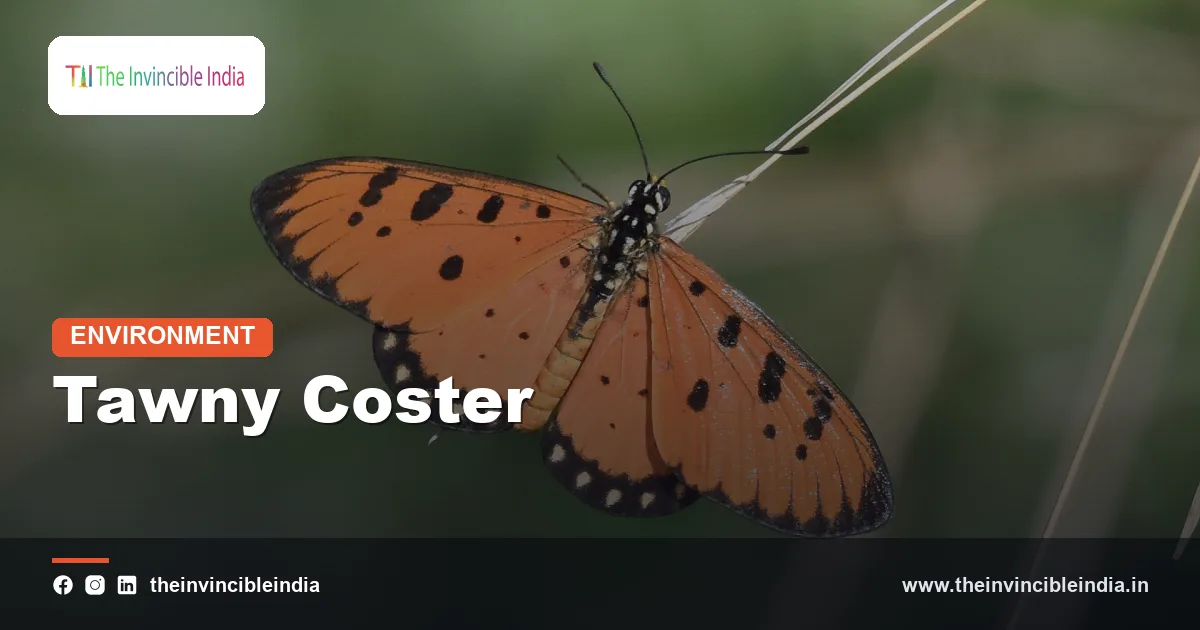
The tawny coster (Acraea terpsicore, also treated as Acraea violae) is a slow-flying, orange-and-black butterfly of the family Nymphalidae that is common across India and has spread quickly through South-East Asia in recent decades. The tawny coster is chemically defended: its caterpillars feed on passionflower and a few related plants, and both the larvae and the adults carry bitter, toxic compounds that predators learn to avoid.
This explainer covers how to identify the tawny coster, where it lives in India, what its caterpillars eat, why it is considered toxic, why it is called a spreading species, and how it differs from look-alike orange butterflies. It was last reviewed on 23 October 2026.
| Common name | Tawny coster |
|---|---|
| Scientific name | Acraea terpsicore (Linnaeus, 1758); also listed as Acraea violae |
| Family and subfamily | Nymphalidae (brush-footed butterflies), Heliconiinae |
| Wingspan | Roughly 5 to 6 cm |
| Appearance | Orange-tawny wings with black spots and a black-edged margin; paler, spotted underside |
| Main caterpillar food plants | Stinking passionflower (Passiflora foetida), Adenia species, and some violet-family herbs such as Hybanthus |
| Defence | Cyanogenic (cyanide-releasing) compounds; warning colours; slow, conspicuous flight |
| Native range | India, Sri Lanka and neighbouring parts of South Asia |
| Recent trend | Rapid range expansion into South-East Asia since the 1990s |
Key Takeaways
- The tawny coster is a medium-sized orange butterfly with black spots, belonging to the family Nymphalidae and the subfamily Heliconiinae.
- Tawny coster caterpillars feed mainly on stinking passionflower (Passiflora foetida), a weedy creeper found along Indian roadsides, fences and wasteland.
- The tawny coster is toxic to many predators because it contains cyanide-releasing compounds, and its slow, fluttering flight advertises that defence.
- The tawny coster is native to South Asia but has spread widely through South-East Asia since the 1990s, which is why it is often called a spreading species.
- The tawny coster is easily seen in Indian gardens, scrub, farmland edges and urban parks, and it is one of the most reliably photographed butterflies in the country.
- Planting or allowing native host creepers in a garden supports tawny coster breeding without harming the butterfly’s wider ecosystem.
What is the tawny coster butterfly?
The tawny coster is a small to medium orange butterfly with black spots, found across the Indian subcontinent and much of Asia. It belongs to the genus Acraea, a group that is far more diverse in Africa than in Asia, and the tawny coster is the best-known Asian member of that genus.
The name “coster” is a historical butterfly name that has no obvious meaning today, and “tawny” refers to the warm orange-brown ground colour of the wings. The species was described by Carl Linnaeus in 1758 in the same work that established modern animal naming. Indian field guides generally place it among the “commons” of the Indian plains because it appears in so many habitats.
Taxonomists have used more than one scientific name for the tawny coster. Many Indian checklists and older books use Acraea violae, while newer references and several online databases list it as Acraea terpsicore. Readers searching for the butterfly will see both names and should treat them as the same familiar species.
How do you identify a tawny coster?
A tawny coster is identified by its orange wings, rows of black spots and a black margin, together with a slow, weak, fluttering flight. The forewing is longer and narrower than the hindwing, and the upper surface usually carries a scatter of black dots against a tawny orange background.
Key field marks
- Upperside: orange to tawny orange, with black spots across both wings and a broad dark border on the forewing tip.
- Underside: paler, often a pinkish or creamy orange, with a pattern of black spots and a dark hindwing margin.
- Body: slender, with a dark thorax and abdomen, and a rather small head.
- Flight: low, slow and weak, often only a metre or two above vegetation, which sets the tawny coster apart from stronger orange fliers.
- Behaviour: frequently settles with wings half-open or closed on grass and shrub tops, and is easily approached.
Males and females look broadly similar, although females tend to be a little paler with heavier black markings. Because so many Indian butterflies are orange, photographers usually confirm a tawny coster by its slow flight, its slender wings and its spotted, rounded outline.
Where does the tawny coster live in India?
The tawny coster lives in almost every lowland and mid-elevation habitat in India where its caterpillar food plants grow. It is recorded across the peninsula, the Gangetic plains, the Western and Eastern Ghats, the north-east, and the lower Himalayan foothills, and it is rarely absent from a warm-climate garden.
Typical habitats include:
- Open scrub and grassland edges
- Village hedgerows and field boundaries
- Gardens, parks and campuses in cities such as Bengaluru, Pune, Delhi and Kolkata
- Disturbed ground, railway embankments and roadsides where weedy creepers climb fences
- Light forest clearings and forest edges
The butterfly is on the wing for most of the year in warm regions of India, with numbers usually highest during and just after the monsoon, when fresh growth of host plants is abundant. In cooler northern areas, adults are most visible from spring through autumn.
What do tawny coster caterpillars eat?
Tawny coster caterpillars eat the leaves of stinking passionflower (Passiflora foetida) and a small number of related host plants. Stinking passionflower is a hairy, sticky, climbing weed with three-lobed leaves and cream-and-purple flowers, and it grows wild across much of India, often draped over fences and wasteland.
Other recorded host plants include species of Adenia, which are also in the passionflower family, and violet-family herbs such as Hybanthus enneaspermus. In some countries where the butterfly has spread, additional weedy passion vines have helped it establish new populations.
Why host plants matter
The host plant gives the caterpillar its chemical defence. Passionflower family plants contain cyanogenic glycosides, compounds that release hydrogen cyanide when tissue is damaged. Tawny coster larvae are able to tolerate these chemicals and retain them, so the insect is protected even though the host plant is toxic to most other animals.
Because the host is a common weed, the tawny coster rarely needs a protected habitat. That ecological flexibility is one reason the species thrives in disturbed, human-modified landscapes.
What is the tawny coster life cycle?
The tawny coster completes a four-stage life cycle of egg, caterpillar, pupa and adult, usually in a few weeks in warm weather. The generation time is short, which allows several generations in a year and helps populations grow quickly when conditions are good.
- Egg: the female lays small, ribbed, yellowish eggs in clusters on the leaves or tendrils of the host creeper.
- Caterpillar: the larvae are dark, often reddish-black, and covered with branching spines. They feed in groups when young and become more solitary as they grow.
- Pupa: the chrysalis is pale with black and orange markings and hangs from a leaf or stem, a pattern that also warns predators.
- Adult: adults feed on nectar from low-growing flowers and may live for a few weeks.
Adults often roost in small groups in vegetation at night. Gardeners who see black spiny caterpillars on a passionflower weed are usually looking at the tawny coster rather than a pest that needs control.
Why is the tawny coster considered toxic?
The tawny coster is considered toxic because its body contains cyanide-releasing chemicals taken up from its food plants and, in part, produced by the insect itself. Predators such as birds, lizards and spiders that taste the butterfly commonly reject it, and often learn to avoid similar-looking orange insects afterwards.
Several features work together as a defence strategy known as aposematism, or warning signalling:
- Bold orange-and-black colouring that is easy for predators to remember.
- A slow, fluttering flight that shows the butterfly does not rely on speed to escape.
- Tough, flexible body parts that survive a trial peck, so a bird that rejects the butterfly leaves it alive.
- Stored chemicals that make the insect distasteful and potentially harmful to small predators.
The tawny coster poses no danger to humans. The toxins are a defence against predators, and handling a butterfly is not known to be harmful, although wild butterflies should not be caught or handled unnecessarily.
Why is the tawny coster called a spreading species?
The tawny coster is called a spreading species because it has expanded its range rapidly across South-East Asia since about the 1990s. The butterfly was historically a South Asian species, but it has since been recorded as a new arrival in places such as Malaysia, Singapore, Thailand and parts of Indonesia, where it now breeds on local passion vines.
What drives the spread?
- Weedy host plants: stinking passionflower is itself a widespread, fast-growing weed that thrives on disturbed ground.
- Chemical protection: few predators attack the butterfly, so established populations face little pressure from natural enemies.
- Short life cycle: several generations a year let numbers build quickly.
- Human landscapes: roadsides, plantations and urban gardens provide the open, disturbed habitat the species prefers.
The tawny coster’s spread is generally considered a natural range expansion rather than a harmful invasion, and in most places it has not been shown to damage native butterflies. Scientists nevertheless track it as an example of how a toxic, weed-feeding insect can colonise new regions.
How does the tawny coster differ from similar butterflies?
The tawny coster differs from similar orange butterflies mainly in its slow flight, narrow forewings and the arrangement of black spots. Several other orange Indian butterflies share its colour, and the table below sets out the main differences.
| Butterfly | Family group | How it differs from the tawny coster |
|---|---|---|
| Common leopard (Phalanta phalantha) | Heliconiinae | Faster, stronger flight; more evenly spotted pattern; often basks with open wings |
| Plain tiger (Danaus chrysippus) | Danainae | Larger; white-spotted black wing tips; more gliding flight; feeds on milkweeds |
| Striped tiger (Danaus genutia) | Danainae | Larger, with bold black veins and stripes on the wings |
| Angled castor (Ariadne ariadne) | Biblidinae | Orange with fine wavy lines and a slightly angled wing shape |
The tawny coster is also grouped with other Heliconiinae, the subfamily that includes the American longwing butterflies. That relationship explains why its caterpillars favour passionflower family plants.
Why does the tawny coster matter ecologically?
The tawny coster matters ecologically because it is a pollinator, a food source and a visible indicator of how butterflies respond to changing landscapes. Adult tawny costers visit small flowers, moving pollen between plants, and their eggs and larvae support spiders, parasitic wasps and other insects.
The species is also a useful teaching example. Citizen-science platforms such as iNaturalist and local butterfly groups in India record the tawny coster in large numbers, giving researchers long-term information about its range, flight season and response to climate and land-use change.
Habitat loss affects rare and specialist butterflies more than it affects the tawny coster. Its adaptability means it is not considered threatened, but it still depends on a mix of nectar flowers and weedy creepers, which are reduced by heavy use of herbicides and by tidy, treeless urban landscaping.
How can you help or watch the tawny coster in a garden?
You can attract and watch the tawny coster by leaving stinking passionflower or other native host creepers in a sunny corner and by planting nectar flowers. Butterfly watching needs little equipment, and the tawny coster is a good first species to practise on because it flies slowly and allows close approach.
- Allow a patch of weedy creepers to grow rather than clearing every wild plant.
- Plant nectar sources such as lantana, tridax, zinnia and marigold in sunny positions.
- Avoid broad-spectrum pesticides, which kill caterpillars along with pests.
- Photograph rather than collect, and record sightings on a citizen-science platform.
- Watch in the morning, when butterflies warm up and become active.
Cultivated ornamental passion vines should be planted with care, because some non-native species grow aggressively. Native or already-naturalised weedy hosts are usually the better choice for butterfly gardens.
Is the tawny coster a pest or a harmless native?
The tawny coster is not a pest, and in India it is a harmless native butterfly. Its caterpillars eat wild passionflower weeds rather than crops, so they cause no known agricultural damage, and the adults do not bite, sting or damage fruit.
In regions where the tawny coster has arrived recently, scientists watch it for possible effects on local butterflies that use similar host plants. So far, it is generally regarded as a benign colonist, although a heavy local population of caterpillars can strip a small passion vine of leaves.
Bottom Line
The tawny coster is an easily recognised orange butterfly that shows how a chemically defended, weed-feeding insect can thrive in human-altered landscapes. It is common in India, spreading across South-East Asia, and harmless to people. Protecting its habitat is simple: keep host creepers, plant nectar flowers and avoid unnecessary pesticide use.
Frequently Asked Questions
What is a tawny coster butterfly?
A tawny coster is a slow-flying, orange butterfly with black spots that is common across India and much of Asia. It belongs to the family Nymphalidae and the subfamily Heliconiinae, and it is scientifically named Acraea terpsicore (also listed as Acraea violae). Its caterpillars feed on passionflower family plants.
Is the tawny coster butterfly poisonous?
Yes, the tawny coster is toxic to many predators, but it is harmless to humans. It carries cyanide-releasing compounds obtained from its passionflower host plants and partly produced by its own body. Its bright orange colouring and slow flight warn birds and lizards to leave it alone.
What do tawny coster caterpillars eat?
Tawny coster caterpillars eat mainly stinking passionflower (Passiflora foetida), a common weedy creeper in India. They are also recorded on Adenia species and on violet-family herbs such as Hybanthus enneaspermus. These plants supply the chemicals that protect the caterpillar and the adult.
Why is the tawny coster called a spreading species?
The tawny coster is called a spreading species because it has expanded rapidly from South Asia into South-East Asia since about the 1990s. It has been recorded as a new arrival in places such as Malaysia, Singapore and Thailand. Weedy host plants, few predators and a short life cycle have helped it spread.
How can you tell a tawny coster from a common leopard?
The tawny coster has a slower, weaker, fluttering flight and narrower forewings, while the common leopard is a faster flier that often basks with wings open. The tawny coster has a black-edged forewing tip and scattered black spots, whereas the common leopard shows a more even leopard-like spotting. Their caterpillar food plants also differ.
Is the tawny coster butterfly found all year in India?
The tawny coster can be seen for most of the year in warm parts of India. Numbers are usually highest during and after the monsoon, when host plants grow fresh leaves. In cooler northern regions it is mainly seen from spring to autumn.
{“@context”:”https://schema.org”,”@graph”:[{“@type”:”FAQPage”,”mainEntity”:[{“@type”:”Question”,”name”:”What is a tawny coster butterfly?”,”acceptedAnswer”:{“@type”:”Answer”,”text”:”A tawny coster is a slow-flying, orange butterfly with black spots that is common across India and much of Asia. It belongs to the family Nymphalidae and the subfamily Heliconiinae, and it is scientifically named Acraea terpsicore (also listed as Acraea violae). Its caterpillars feed on passionflower family plants.”}},{“@type”:”Question”,”name”:”Is the tawny coster butterfly poisonous?”,”acceptedAnswer”:{“@type”:”Answer”,”text”:”Yes, the tawny coster is toxic to many predators, but it is harmless to humans. It carries cyanide-releasing compounds obtained from its passionflower host plants and partly produced by its own body. Its bright orange colouring and slow flight warn birds and lizards to leave it alone.”}},{“@type”:”Question”,”name”:”What do tawny coster caterpillars eat?”,”acceptedAnswer”:{“@type”:”Answer”,”text”:”Tawny coster caterpillars eat mainly stinking passionflower (Passiflora foetida), a common weedy creeper in India. They are also recorded on Adenia species and on violet-family herbs such as Hybanthus enneaspermus. These plants supply the chemicals that protect the caterpillar and the adult.”}},{“@type”:”Question”,”name”:”Why is the tawny coster called a spreading species?”,”acceptedAnswer”:{“@type”:”Answer”,”text”:”The tawny coster is called a spreading species because it has expanded rapidly from South Asia into South-East Asia since about the 1990s. It has been recorded as a new arrival in places such as Malaysia, Singapore and Thailand. Weedy host plants, few predators and a short life cycle have helped it spread.”}},{“@type”:”Question”,”name”:”How can you tell a tawny coster from a common leopard?”,”acceptedAnswer”:{“@type”:”Answer”,”text”:”The tawny coster has a slower, weaker, fluttering flight and narrower forewings, while the common leopard is a faster flier that often basks with wings open. The tawny coster has a black-edged forewing tip and scattered black spots, whereas the common leopard shows a more even leopard-like spotting. Their caterpillar food plants also differ.”}},{“@type”:”Question”,”name”:”Is the tawny coster butterfly found all year in India?”,”acceptedAnswer”:{“@type”:”Answer”,”text”:”The tawny coster can be seen for most of the year in warm parts of India. Numbers are usually highest during and after the monsoon, when host plants grow fresh leaves. In cooler northern regions it is mainly seen from spring to autumn.”}}]}]}


