

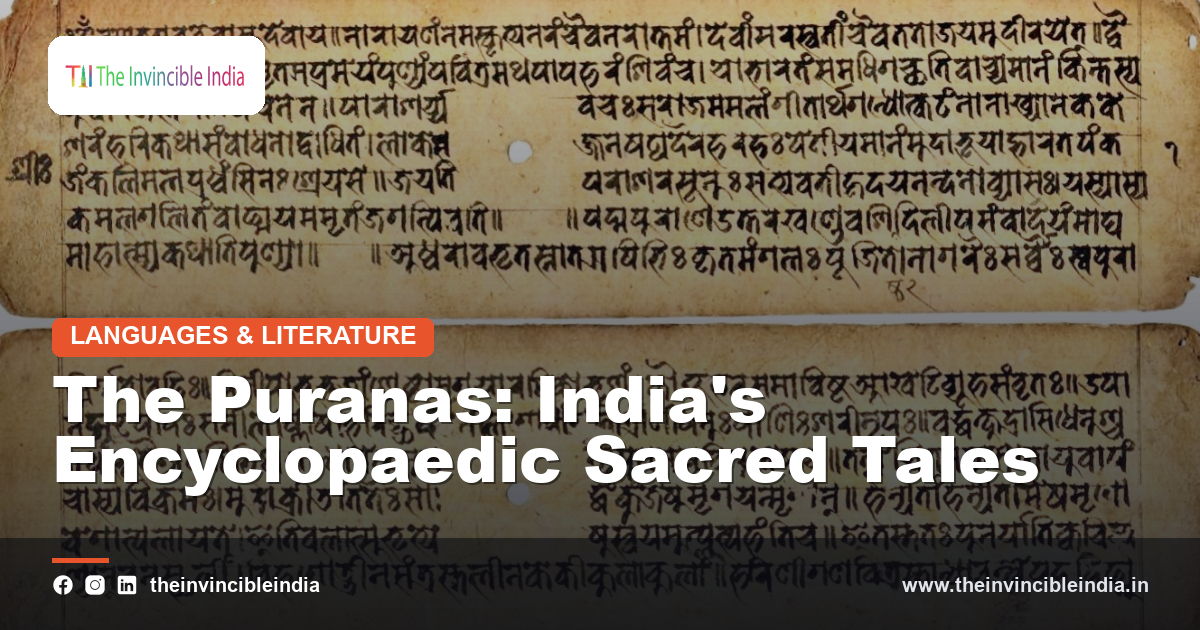
The Puranas are a vast and fascinating body of ancient Hindu texts, encyclopaedic collections of myth, legend, cosmology, genealogy and devotion that have shaped the religion and imagination of India for many centuries. If the Vedas are the ancient foundation of Hinduism, the Puranas are its great treasury of stories, making the deities, myths and teachings of the tradition accessible and beloved to ordinary people. There are eighteen great Puranas, each vast in scope, along with many lesser ones, composed in Sanskrit over the centuries. Rich in the tales of gods and heroes, they are a foundation of popular Hindu religion and culture. This guide explores the Puranas, their contents, the great texts, their famous stories and their enduring role.
Quick Facts
| Detail | Information |
|---|---|
| Type | A genre of ancient Hindu sacred texts |
| Number | Eighteen great Puranas (Mahapuranas), and many lesser ones |
| Language | Composed in Sanskrit over many centuries |
| Contents | Myth, legend, cosmology, genealogy, ritual and devotion |
| Famous example | The Bhagavata Purana, on the life of Krishna |
| Role | A foundation of popular, devotional Hinduism |
The Treasury of Hindu Myth
The Puranas are the great treasury of Hindu myth and legend, the texts in which the vast and colourful world of the gods, goddesses, heroes and cosmic events of Hinduism is set down in story form. Where the ancient Vedas are difficult and remote, the Puranas made the religion accessible and vivid, telling its myths and teaching its truths through engaging narratives that ordinary people could love and understand. They are the source of countless stories known throughout India, of the deeds of the gods, the origins of the world and the great tales of devotion. As the storehouse of popular Hindu mythology, the Puranas hold a central place in the religious and cultural life of India.
What Are the Puranas?
The word Purana means ancient, and the Puranas are ancient texts that form a distinct category of Hindu scripture, later than the Vedas and complementing them. They are encyclopaedic in scope, traditionally said to deal with subjects such as the creation of the universe, its dissolution and recreation, the genealogies of gods and sages, the ages of the world, and the histories of royal dynasties. In practice, they contain a vast range of material: myths and legends, cosmology, ritual, geography, philosophy, devotion and much more. This broad, encyclopaedic character makes the Puranas a rich and varied body of literature, embracing almost every aspect of religion, culture and knowledge.
The Eighteen Great Puranas
The tradition recognises eighteen great Puranas, known as the Mahapuranas, which are the principal texts of the genre, along with a further set of lesser Puranas and many other related works. Each of the great Puranas is a vast text in its own right, and they are traditionally grouped according to which deity they chiefly glorify, so that some are devoted mainly to Vishnu, some to Shiva, and some to the Goddess or to the creator Brahma. Together, the eighteen great Puranas form an immense body of sacred literature. This organised collection of eighteen principal Puranas is at the heart of the Puranic tradition and encompasses its richest and most important texts.
Composed Over Centuries
The Puranas were not composed all at once or by a single author, but took shape gradually over many centuries, growing and being added to over long periods of time. This long process of composition and development means that the Puranas contain material from different ages, and they draw on older oral and textual traditions. Traditionally, their compilation is associated with the sage Vyasa, also linked to the Mahabharata and the arrangement of the Vedas. This gradual growth over the centuries gives the Puranas their layered and encyclopaedic character, and it means they reflect the evolving religion and culture of India across a long span of its history, absorbing and preserving a vast heritage.
Myths of Creation
Among the most important subjects of the Puranas are the great myths of cosmology, the accounts of how the universe came into being, how it is structured, how it passes through vast cycles of creation and dissolution, and how it will end and be created anew. The Puranas describe the ages of the world, the immense cycles of cosmic time, and the structure of the many worlds and realms. These grand cosmological myths express the Hindu vision of a vast, cyclical universe of almost unimaginable scale, endlessly created and dissolved. The Puranic accounts of creation and cosmic time are among the most striking and imaginative parts of the texts and a major part of their teaching.
The Gods and Their Deeds
At the heart of the Puranas are the gods and goddesses of Hinduism and the countless stories of their deeds. The Puranas tell of the great deities, Vishnu, Shiva, the Goddess, Brahma and many others, of their forms, their families, their exploits and their relationships, and of the many incarnations and manifestations through which they act in the world. These stories bring the gods vividly to life, giving them personalities, adventures and dramas that have captivated devotees for centuries. Through the Puranas, the abstract divine of philosophy becomes the personal, story-rich world of popular devotion. This rich mythology of the gods and their deeds is the beating heart of the Puranic literature.
The Avatars of Vishnu
Among the most beloved themes of the Puranas are the avatars, or incarnations, of the god Vishnu, who is believed to descend to earth in various forms to restore righteousness whenever it declines. The Puranas tell the stories of these incarnations, including the well-known series of major avatars, among them Rama and Krishna, whose deeds are celebrated at length. These stories of the divine descending into the world to save it and defeat evil are central to Hindu devotion and are among the most cherished narratives of the tradition. The Puranic accounts of the avatars of Vishnu have profoundly shaped Hindu religion and are among the most popular and influential of all the Puranic tales.
The Bhagavata Purana
The most beloved and influential of all the Puranas is the Bhagavata Purana, above all for its incomparable telling of the life and deeds of Krishna. Its account of Krishna, his enchanting childhood, his playful and miraculous deeds, his love for the cowherd maidens, and his role as the divine teacher, has inspired boundless devotion, art, poetry, music and dance across India. The Bhagavata Purana is a supreme text of devotional Hinduism, cherished for its beauty, its emotional depth and its exaltation of loving devotion to the divine. Its influence on the religious and cultural life of India, especially on the traditions of Krishna devotion, has been immense and enduring.
The Devi Mahatmya
One of the most important Puranic texts for the worship of the Goddess is the Devi Mahatmya, which forms part of one of the Puranas and glorifies the great Goddess in her many forms. It tells the stories of the Goddess as the supreme power who slays terrible demons and protects the world, celebrating her as the ultimate divine force. This text is central to the worship of the Goddess and is recited especially during her great festivals. The Devi Mahatmya is a foundational scripture of the goddess traditions of Hinduism, and its powerful stories of the divine feminine overcoming evil are among the most important and beloved in the whole Puranic literature.
Stories of Devotion
The Puranas are filled with stories of devotion, tales of devotees whose love and faith won them the grace of the gods, and these stories have played a great part in shaping the devotional religion of India. Through the examples of great devotees, the Puranas teach the power of faith, love and surrender to the divine, and they exalt devotion as a path open to all, regardless of birth or learning. These inspiring tales of devotion have brought comfort and guidance to countless people and have nurtured the great devotional movements of Indian religion. The Puranic emphasis on loving devotion, taught through memorable stories, is one of the most important aspects of their religious influence.
Places of Pilgrimage
The Puranas are an important source for the sacred geography of India, describing the holy places, temples, rivers and pilgrimage sites of the land and the merit to be gained by visiting them. They tell the sacred stories associated with particular places, explaining why they are holy and what divine events occurred there, and they praise the benefits of pilgrimage. In this way the Puranas helped to map the sacred landscape of India and to establish and popularise its great pilgrimage centres. This role in defining and glorifying the holy places of India has had a lasting influence on Hindu religious practice, and the Puranic accounts of sacred sites remain important to pilgrims to this day.
Ritual and Practice
Beyond myth and story, the Puranas also deal extensively with religious ritual and practice, describing the worship of the deities, the observance of festivals and vows, the performance of ceremonies, and the duties of religious life. They provided guidance for the practical religion of ordinary people, prescribing how the gods should be worshipped and how the sacred times of the year should be observed. In this way the Puranas served not only to inspire devotion through story but to guide it through practice, shaping the everyday religious life of Hindus. This practical dimension, alongside their myths and teachings, made the Puranas comprehensive guides to popular Hindu religion.
Making Religion Accessible
One of the great historical roles of the Puranas was to make the religion accessible to all people, regardless of their learning or social position. The Vedas and the philosophical texts were the preserve of the learned, but the Puranas, with their engaging stories and their teaching of devotion, brought the religion to everyone. Through their tales of the gods and their exaltation of devotion, they offered a path to the divine open to ordinary people, women and men of all backgrounds. This democratising role, opening the riches of the tradition to all, was of immense importance in the history of Hinduism, and it is a major reason for the enduring popularity and influence of the Puranic literature.
Influence on Culture
The influence of the Puranas on Indian culture is vast and pervasive, for their stories are the very substance of much of Indian art, literature, drama, dance, music and popular religion. The myths and legends of the Puranas are depicted in temple sculpture and painting, enacted in dance and drama, told in folk tales and, in modern times, retold in comics, film and television. The gods and stories known to every Indian child come largely from the Puranas. This immense cultural influence, saturating the arts and the popular imagination of India, makes the Puranas one of the most culturally important bodies of literature in the country and a foundation of its living traditions.
The Puranas Today
Today the Puranas remain a living and beloved part of the religious and cultural life of India, their stories as familiar and cherished as ever. They continue to be read, recited and retold, their myths depicted in art and performance and their teachings guiding devotion. Popular retellings, in books, comics, film and television, keep the Puranic stories alive for new generations, and the great texts continue to be studied and revered. As the treasury of Hindu myth and the foundation of popular devotion, the Puranas endure as one of the most important and beloved bodies of sacred literature in India, a boundless source of story, wisdom and faith for millions.
Sources & Further Reading
- Ministry of Culture, Government of India, on the sacred literature of India (indiaculture.gov.in).
- Sahitya Akademi, national academy of letters, on the Puranic literature (sahitya-akademi.gov.in).
- The Puranas, the classical body of Sanskrit sacred texts.
Frequently Asked Questions
What are the Puranas?
The Puranas are a vast body of ancient Hindu sacred texts, encyclopaedic collections of myth, legend, cosmology, genealogy, ritual and devotion. There are eighteen great Puranas, composed in Sanskrit over many centuries, and they are a foundation of popular, devotional Hinduism.
How many Puranas are there?
The tradition recognises eighteen great Puranas, known as the Mahapuranas, along with a further set of lesser Puranas and many other related works. Each of the great Puranas is a vast text in its own right.
What is the Bhagavata Purana?
The Bhagavata Purana is the most beloved and influential of the Puranas, celebrated above all for its incomparable telling of the life and deeds of Krishna. It is a supreme text of devotional Hinduism and has profoundly shaped the traditions of Krishna devotion.
What do the Puranas contain?
The Puranas contain a vast range of material, including myths and legends of the gods, accounts of the creation and structure of the universe, genealogies, the stories of the avatars, tales of devotion, descriptions of holy places, and guidance on ritual and religious practice.
Why are the Puranas important?
The Puranas are important because they made the religion accessible to ordinary people through engaging stories and the teaching of devotion, and because they are the treasury of Hindu myth that has shaped Indian art, literature, drama and popular religion for centuries.


