

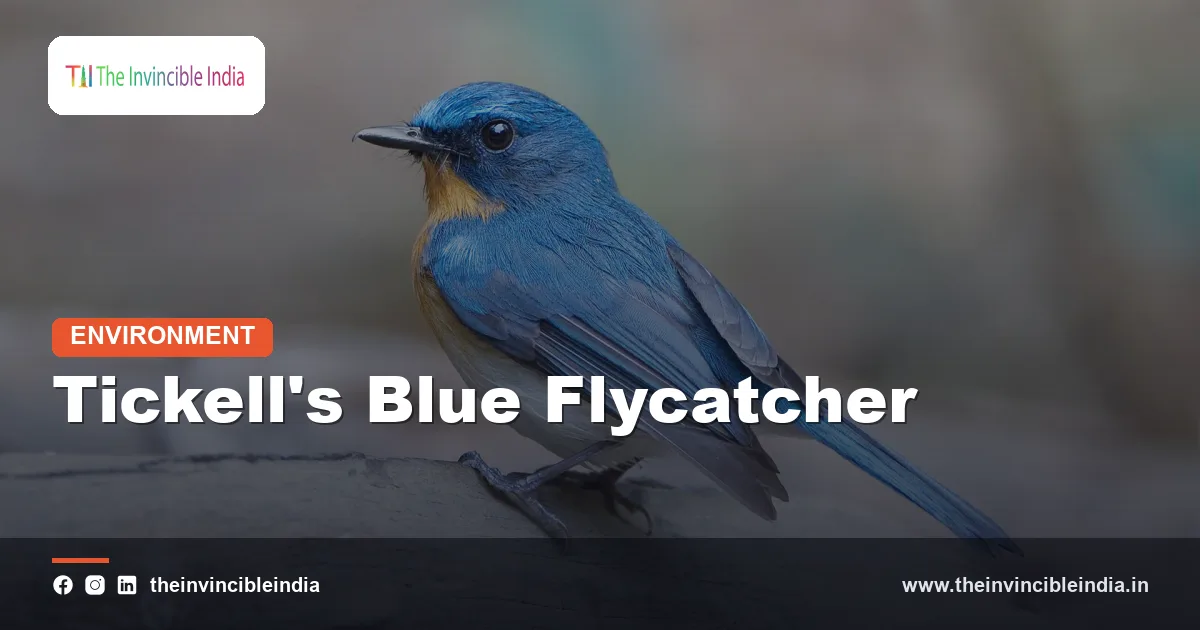
Tickell’s blue flycatcher (Cyornis tickelliae) is a small Old World flycatcher of the family Muscicapidae, found in Indian forests, plantations and gardens, in which the male has bright blue upperparts, an orange throat and breast and a whitish belly. It is a resident insect-eater that hunts from low, shady perches and is admired for its sweet, flute-like song, which often rings out from the undergrowth in the early morning and at dusk.
The bird is named after Samuel Tickell, a nineteenth-century British army officer and naturalist who studied the birds of India and Burma. This explainer covers how to identify Tickell’s blue flycatcher, where it lives in India, what it eats, how it sings and nests, how it differs from similar blue flycatchers and what its conservation status is.
Quick Facts
| Attribute | Details |
|---|---|
| Common name | Tickell’s blue flycatcher (also written Tickell’s flycatcher) |
| Scientific name | Cyornis tickelliae |
| Family and order | Muscicapidae (Old World flycatchers and chats); order Passeriformes |
| Size | About 11 to 12 cm in length; a small, compact bird |
| Range and habitat in India | Resident across much of peninsular and eastern India and the Himalayan foothills; moist and dry deciduous forest, bamboo, shaded plantations and well-wooded gardens |
| Diet | Small flying and foliage insects, caught in short sallies and gleaned from leaves and twigs |
| Breeding season | Roughly April to August over much of India; cup nest in a hole, crevice or hollow with a mossy lining |
| Conservation status | IUCN Least Concern; protected as a native wild bird under the Wild Life (Protection) Act, 1972 |
Key Takeaways
- Tickell’s blue flycatcher (Cyornis tickelliae) is a small Indian songbird in which the adult male is blue above with an orange throat and breast and a white belly.
- Female Tickell’s blue flycatchers are duller than males, with brownish-blue upperparts and a paler orange throat and breast.
- Tickell’s blue flycatcher feeds on insects, which it catches in short flights from low perches or picks from leaves in shady forest undergrowth.
- The song of Tickell’s blue flycatcher is a clear, sweet series of whistles that rises and falls, and it is most often heard at dawn, dusk and in the breeding season.
- Tickell’s blue flycatcher nests in hollows and crevices, such as tree holes, banks, walls and the gaps in buildings, using moss and fibres to make a cup.
- The IUCN lists Tickell’s blue flycatcher as Least Concern because it is widespread in South Asia and tolerates gardens and plantations.
What is Tickell’s blue flycatcher?
Tickell’s blue flycatcher is a small, insectivorous songbird of the Old World flycatcher family, found mainly in the forests and wooded gardens of the Indian subcontinent. Its scientific name, Cyornis tickelliae, places it in the genus Cyornis, a group of blue flycatchers that occurs across South and South-East Asia.
The common name honours Samuel Richard Tickell (1811 to 1875), an army officer who collected and described birds in the Indian subcontinent and Burma during the nineteenth century. Old World flycatchers of this kind are not related to the New World tyrant flycatchers; they are grouped with the chats and robins, and many of them share a love of shady, damp habitats and a habit of flicking the tail.
In India, Tickell’s blue flycatcher is a widespread resident rather than a migrant, so it can be seen in suitable habitat throughout the year. It tends to be a quiet, understated bird that is easy to miss unless the observer knows its call or looks into the lower, shadier layers of woodland.
How can you identify Tickell’s blue flycatcher?
Tickell’s blue flycatcher can be identified by the male’s bright blue upperparts, dark lores (the area between the bill and eye), orange throat and breast and white belly, and by the female’s duller brown-blue upperparts with a pale orange throat. The orange-buff breast against a clean white belly is a key feature that separates it from several other blue flycatchers.
Key field marks in the male
- Deep, rich blue crown, back, wings and tail, with a brighter blue forehead and shoulder patch.
- Blackish face patch around the bill and lores.
- Rufous-orange throat and breast, fading into a white lower belly.
- A neat, thin black bill and dark eyes.
Females and juveniles
The female has olive-brown to dull blue-brown upperparts, with a bluer tinge on the tail and rump. Her throat and breast are a paler orange-buff, and the face lacks the dark mask of the male. Juveniles are brownish, spotted with buff, and acquire adult colours after their first moult. Female blue flycatchers of related species can look quite similar, so the combination of habitat, call and breast colour is often needed to confirm identification.
Where does Tickell’s blue flycatcher live in India?
Tickell’s blue flycatcher lives across much of peninsular and eastern India and the Himalayan foothills, mainly in moist and dry deciduous forest, bamboo thickets, shaded plantations and well-wooded gardens. It prefers habitats with dense understorey and some cover overhead, rather than open fields or bare ground.
Typical habitats
- Moist and dry deciduous forest, especially near streams and ravines.
- Bamboo clumps and thickets.
- Shaded coffee, tea and mixed plantations.
- Large gardens, orchards and wooded parks.
- Forest edges and secondary growth.
The species is generally found at low to middle elevations and is more typical of the plains and foothills than of the high mountains. Some birds make short local movements, especially in the cooler months, but overall the species is regarded as resident in India. Its range also extends to neighbouring countries such as Sri Lanka, Nepal and Bangladesh.
What does Tickell’s blue flycatcher eat?
Tickell’s blue flycatcher eats small insects such as flies, beetles, moths, ants, bugs and caterpillars, which it catches in the air or gleans from foliage. Like other flycatchers, it is almost entirely insectivorous, although it may occasionally take small spiders or other tiny invertebrates.
Typical foods
- Small flying insects such as flies, midges and gnats.
- Beetles and bugs picked from leaves and twigs.
- Moths and their caterpillars.
- Termites during swarming events.
- Spiders and other small arthropods.
Because it eats large numbers of small insects, Tickell’s blue flycatcher helps regulate insect populations in forests and plantations. It can be a quiet ally for plantation owners, though its overall effect on pests is modest.
How does Tickell’s blue flycatcher hunt?
Tickell’s blue flycatcher hunts by “sallying”, which means flying out from a low perch to snatch an insect in mid-air and then returning to the same or a nearby perch. It also hops along branches and picks insects from leaves, behaving more like a small woodland chat than an aerial hunter.
Foraging behaviour
- The bird sits quietly on a low, shaded perch, often one to three metres above the ground.
- When prey passes, it makes a quick, short flight to catch it.
- It frequently flicks its tail and wings while perched.
- It forages in deep shade, sometimes close to streams and damp ground.
Because it likes shade and often stays within the lower storey, the bird is easiest to see where a forest trail or garden path opens a gap in the undergrowth. Patience and a quiet approach are the best methods for good views.
What does Tickell’s blue flycatcher sound like?
Tickell’s blue flycatcher sings a clear, sweet, flute-like song of whistled notes that rise and fall in pitch, and it gives a sharp, short “chik” or “tik” call as an alarm or contact note. The male sings from a hidden perch in the undergrowth, and the song is one of the most pleasant sounds of an Indian forest in the early morning.
The song is usually delivered at dawn and dusk and is especially frequent during the breeding season. It is often compared to the songs of other blue flycatchers and robins, although it has a distinctive musical quality that experienced birdwatchers learn to recognise. The alarm call is more abrupt and may be given along with tail flicks when an intruder, such as a snake or cat, approaches the nest.
Learning the song is the best way to find the species. In dense forest, many sightings begin with the bird being heard first, singing from the shade, before it is traced to a low branch.
How does Tickell’s blue flycatcher breed?
Tickell’s blue flycatcher breeds mainly from about April to August in most of India, building a cup-shaped nest of moss, grass, roots and fibres inside a hole, crevice or hollow. The exact timing varies with region and rainfall, and nests may be started earlier in the south than in the north.
Nest sites and nest structure
- Natural hollows in tree trunks, stumps and rotten branches.
- Crevices in banks, rock faces and stone walls.
- Gaps in buildings, outhouses, culverts and old wells.
- The nest is a neat cup, often lined with finer fibres and hair, and built mostly by the female.
Eggs and chicks
The female typically lays around three to five pale eggs with fine reddish-brown speckles. She does most of the incubation, while the male defends the territory, sings and brings food. After hatching, both parents feed the chicks with small insects. The young leave the nest after a couple of weeks but remain near the parents for some time as they learn to forage in the undergrowth.
How is Tickell’s blue flycatcher different from similar blue flycatchers?
Tickell’s blue flycatcher differs from similar blue flycatchers mainly in its orange breast and white belly, whereas the verditer flycatcher is entirely turquoise-blue and the blue-throated blue flycatcher has a blue throat. India has several blue flycatchers, and the table below compares a few of them.
| Species | Approx. size | Main identification features | Habitat in India |
|---|---|---|---|
| Tickell’s blue flycatcher (Cyornis tickelliae) | About 11 to 12 cm | Blue above, orange throat and breast, white belly | Forest undergrowth, plantations and gardens |
| Blue-throated blue flycatcher (Cyornis rubeculoides) | About 14 cm | Blue upperparts and throat, orange breast | Forests, mainly in the hills and north-east |
| Verditer flycatcher (Eumyias thalassinus) | About 15 cm | All turquoise-blue plumage | Himalayan forests and winter plains |
| Nilgiri flycatcher (Eumyias albicaudatus) | About 15 cm | Dark blue with a pale chin and white tail base | Shola forests of the Western Ghats |
The pale belly and orange-buff breast against the blue back are a simple field mark for Tickell’s blue flycatcher. The call and habitat provide additional help, especially with females, which are harder to separate.
Is Tickell’s blue flycatcher threatened?
Tickell’s blue flycatcher is not globally threatened and is classed as Least Concern by the IUCN, because it has a wide distribution in South Asia and adapts to modified habitats such as plantations and gardens. In India, it is protected as a native wild bird under the Wild Life (Protection) Act, 1972.
The species does best where some forest cover, bamboo and shady understorey remain. Local declines are possible when habitat is cleared or heavily altered.
Possible pressures
- Clearing of understorey and forest patches for development or farmland.
- Heavy pesticide use in plantations, which reduces insect prey.
- Loss of natural nest hollows when old trees are removed.
- Capture for the cage-bird trade, which is illegal under Indian law.
Keeping old trees, bamboo clumps and shaded gardens helps this flycatcher and many other forest birds. Nest boxes and undisturbed corners can encourage breeding in large gardens.
Bottom Line
Tickell’s blue flycatcher is a small, melodious insect-eater of Indian forests and wooded gardens, recognised by the male’s blue back and orange breast. It is widespread and a Least Concern species, and its sweet song and shy habits make it a rewarding bird to look and listen for in shady undergrowth.
Frequently Asked Questions
What is Tickell’s blue flycatcher?
Tickell’s blue flycatcher is a small Old World flycatcher of the family Muscicapidae, found in Indian forests, plantations and gardens. The male is blue above with an orange throat and breast and a white belly. Its scientific name is Cyornis tickelliae.
Why is it called Tickell’s blue flycatcher?
The bird is named after Samuel Richard Tickell, a nineteenth-century British army officer and naturalist who studied birds in India and Burma. The word “blue” refers to the male’s blue upperparts. The name was given in recognition of his contributions to Indian ornithology.
Where can I see Tickell’s blue flycatcher in India?
Tickell’s blue flycatcher can be seen in deciduous forests, bamboo thickets, shaded plantations and large wooded gardens across much of peninsular and eastern India. It is most often found in shady undergrowth near streams. Dawn and dusk, when the male sings, are the best times to look.
What does Tickell’s blue flycatcher eat?
Tickell’s blue flycatcher eats small insects such as flies, beetles, moths, ants and caterpillars. It catches many in short flights from a low perch and picks others from leaves. It may also take spiders and other tiny invertebrates.
How can I tell Tickell’s blue flycatcher from other blue flycatchers?
Tickell’s blue flycatcher has blue upperparts, an orange throat and breast and a clean white belly. The verditer flycatcher is entirely turquoise-blue, and the blue-throated blue flycatcher has a blue throat. Habitat and song also help with identification.
Is Tickell’s blue flycatcher a migratory bird?
Tickell’s blue flycatcher is mainly a resident bird in India, though some individuals make short local movements. It breeds from about April to August in tree holes, banks and building crevices. The IUCN lists the species as Least Concern.
{“@context”:”https://schema.org”,”@graph”:[{“@type”:”FAQPage”,”mainEntity”:[{“@type”:”Question”,”name”:”What is Tickell’s blue flycatcher?”,”acceptedAnswer”:{“@type”:”Answer”,”text”:”Tickell’s blue flycatcher is a small Old World flycatcher of the family Muscicapidae, found in Indian forests, plantations and gardens. The male is blue above with an orange throat and breast and a white belly. Its scientific name is Cyornis tickelliae.”}},{“@type”:”Question”,”name”:”Why is it called Tickell’s blue flycatcher?”,”acceptedAnswer”:{“@type”:”Answer”,”text”:”The bird is named after Samuel Richard Tickell, a nineteenth-century British army officer and naturalist who studied birds in India and Burma. The word “blue” refers to the male’s blue upperparts. The name was given in recognition of his contributions to Indian ornithology.”}},{“@type”:”Question”,”name”:”Where can I see Tickell’s blue flycatcher in India?”,”acceptedAnswer”:{“@type”:”Answer”,”text”:”Tickell’s blue flycatcher can be seen in deciduous forests, bamboo thickets, shaded plantations and large wooded gardens across much of peninsular and eastern India. It is most often found in shady undergrowth near streams. Dawn and dusk, when the male sings, are the best times to look.”}},{“@type”:”Question”,”name”:”What does Tickell’s blue flycatcher eat?”,”acceptedAnswer”:{“@type”:”Answer”,”text”:”Tickell’s blue flycatcher eats small insects such as flies, beetles, moths, ants and caterpillars. It catches many in short flights from a low perch and picks others from leaves. It may also take spiders and other tiny invertebrates.”}},{“@type”:”Question”,”name”:”How can I tell Tickell’s blue flycatcher from other blue flycatchers?”,”acceptedAnswer”:{“@type”:”Answer”,”text”:”Tickell’s blue flycatcher has blue upperparts, an orange throat and breast and a clean white belly. The verditer flycatcher is entirely turquoise-blue, and the blue-throated blue flycatcher has a blue throat. Habitat and song also help with identification.”}},{“@type”:”Question”,”name”:”Is Tickell’s blue flycatcher a migratory bird?”,”acceptedAnswer”:{“@type”:”Answer”,”text”:”Tickell’s blue flycatcher is mainly a resident bird in India, though some individuals make short local movements. It breeds from about April to August in tree holes, banks and building crevices. The IUCN lists the species as Least Concern.”}}]}]}


